All That Glitters Can Do Good: PeaceGold
All That Glitters Can Do Good
Turning Conflict into Craft
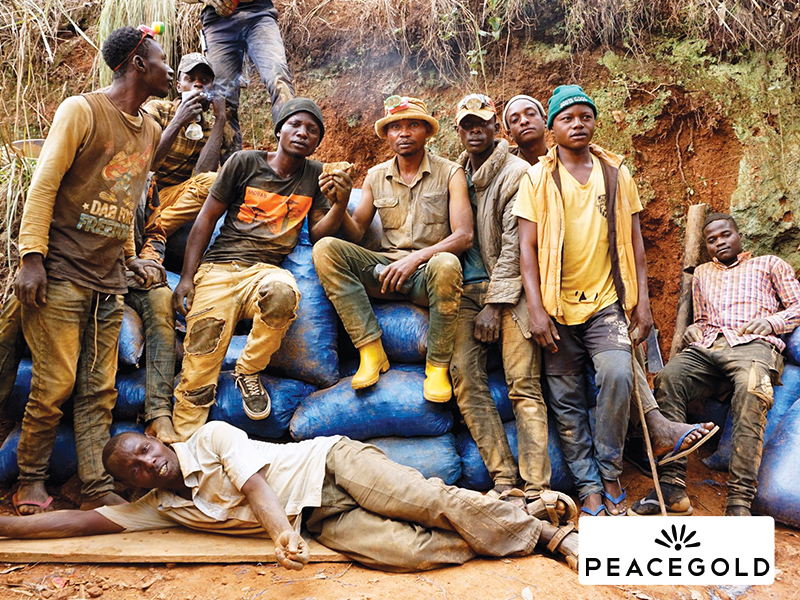
Gold has long been a double-edged sword for the Democratic Republic of Congo (DRC). While its rich deposits could serve as a foundation for economic stability, they have instead fueled illicit trade, conflict, and environmental degradation. PeaceGold aims to turn this dynamic on its head, using gold not as a weapon of war, but as a tool for peace and prosperity.
“We know that gold and other metals are used to fund conflict. They are sources of criminality, smuggling, and informality,” says Greg Valerio, a longtime advocate for responsible artisanal and small-scale mining (ASM) and the founder and CEO of PeaceGold. “But can we find a way to harness the value of that product to build out peace and conflict resolution? That is what PeaceGold is about.”
PeaceGold is an initiative started by Centre Résolution Conflits (CRC), a Congolese civil society organization focused on peacebuilding, and supported by Peace Direct, a nonprofit in the United Kingdom specializing in peace and conflict resolution, and Valerio. CRC’s work spans conflict resolution, demobilization of armed groups, and economic reintegration of former combatants—many of whom are now employed in mining cooperatives under the PeaceGold program.
What makes PeaceGold stand apart from other ethical gold initiatives is its commitment to tying economic development to long-term conflict resolution. By formalizing mining cooperatives, ensuring mercury-free gold processing, and creating an export system that meets international standards, PeaceGold is offering a sustainable solution to a problem that has plagued the region for decades.
Mining as a Pathway to Peace
Historically, many peacebuilding efforts in the region have overlooked a crucial demographic: adult male ex-combatants.
“There were fairly well-trodden rehabilitation frameworks for child soldiers and for women affected by sexual violence, but nothing for adult men,” Valerio explains. “And yet, almost everyone in that part of the world knows how to mine gold. So, the question became: Could we integrate these former militia members into legal gold-mining cooperatives as part of the demobilization process?” The answer was a resounding yes.
By establishing formal cooperatives, PeaceGold provides former combatants with legitimate employment and a financial stake in their communities. “If they’re earning something, even if it’s a small amount, they’re much less likely to return to militia combatant activities,” says Valerio. “Economic security is one of the most effective ways to prevent conflict relapse.” The initiative also works closely with CRC to provide training in conflict resolution, community reconciliation, and cooperative governance, ensuring that miners are not just earning wages but also actively contributing to long-term peace in their communities.
Over the past decade, PeaceGold has developed a multi-faceted approach to transforming ASM in conflict-affected regions.
Formalization & Cooperative Development
One of the primary challenges in ASM is its informality. Many small-scale mining operations operate outside legal frameworks, making them vulnerable to exploitation, smuggling networks, and poor working conditions. PeaceGold’s first priority was to work with mining groups to establish cooperatives, helping them gain legal recognition and adhere to international standards.
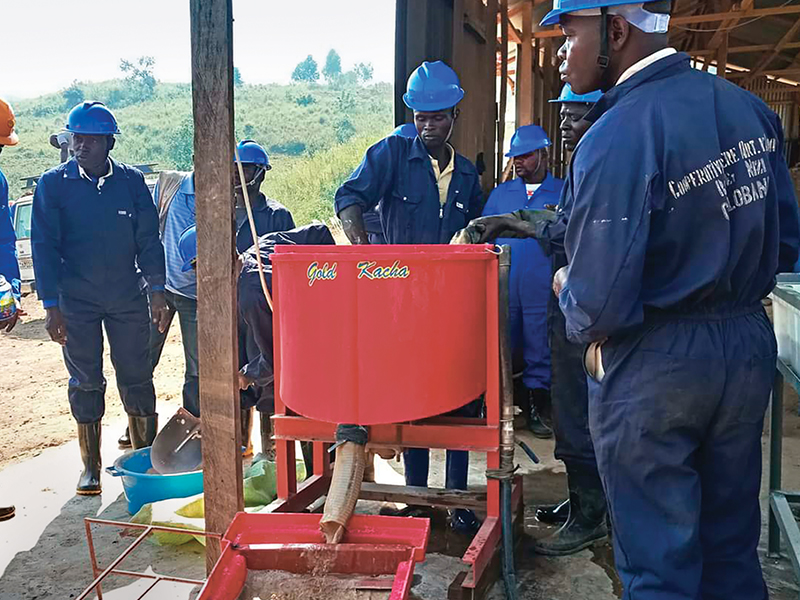
From former combatants to cooperative members, miners in the DRC are finding new purpose and peace through responsible gold sourcing.
By structuring mining groups into formal cooperatives, PeaceGold enables miners to operate legally, access fairer markets, and secure long-term economic stability. These cooperatives follow the Craft Code, a framework developed by Resolve (resolve.ngo) and the Alliance for Responsible Mining (responsiblemines.org), which ensures compliance with ethical sourcing and sustainability standards. To date, 11 cooperatives, representing more than 20,000 direct beneficiaries, have signed the PeaceGold Charter, committing to ethical mining practices and reinvesting in their communities.
A crucial aspect of formalization is ensuring that miners retain control over their production and profit. “Unlike traditional supply chains where wealth is extracted and funneled to foreign corporations, PeaceGold is structured so that the miners themselves have a genuine ownership stake in the platform,” explains Valerio. “We’re a social enterprise in the UK so by law, we’re committed to putting all the funds that we create back into the cooperative.”
Mercury-Free Mining & Environmental Responsibility
Mercury use is widespread in ASM, posing significant health and environmental risks. Many miners are unaware of mercury’s long-term effects, including its toxicity to humans and its persistence in ecosystems. PeaceGold introduced alternative processing technologies that eliminate the need for mercury while improving gold recovery rates.
Working with South African–based Appropriate Precision Technologies, PeaceGold has successfully implemented field-tested gravimetric concentrators and micro sluices that use water and gravity instead of toxic chemicals. These systems have proven to be not only safer, but also more efficient, increasing gold yield by 15 to 20 percent.
“Mercury-free production is absolutely possible,” Valerio emphasizes.
The introduction of a hub-and-spoke mining model is a critical part of this effort. Instead of requiring miners to operate large-scale equipment at their individual sites, a centralized processing hub will handle the crushing, sluicing, and smelting of gold. Smaller mobile units will transport material from mining sites to the hub, eliminating the need for mercury in field operations. “We’re taking the need for mercury in the field out completely,” says Valerio.
Economic Sustainability & Social Impact
Unlike traditional responsible sourcing programs that rely on certification premiums, PeaceGold operates as a social enterprise. This model ensures miners benefit directly from the value of their gold beyond just receiving a slightly higher price per gram. The initiative reinvests profits back into mining communities, supporting education, healthcare, and infrastructure projects.

Economic stability in mining communities means more than fair wages—it funds schools, healthcare, and better opportunities for the next generation.
Every PeaceGold cooperative contributes 1 percent of its revenue to a social fund. “That’s their money and it is ring-fenced for community development and peacebuilding activities,” says Valerio.
PeaceGold is also addressing the issue of child labor by implementing strict monitoring and remediation programs. “Writing an anti-child labor policy to pass an audit is easy,” says Valerio. “How you implement that policy is the issue. That’s the training, that’s the education, that’s the empowerment.” Each cooperative has a designated child labor officer responsible for ensuring compliance with these policies and coordinating remediation efforts.
What Comes Next
PeaceGold represents an ambitious vision for the future of responsible gold sourcing, but it is not yet a finished program. Gold from the program is still being sold through the existing informal system because the infrastructure to fully support PeaceGold’s independent supply chain is not yet in place.
“We’re at a critical moment,” says Valerio. “Right now, our gold is still going through the old channels because we don’t have the financial investment to fully operationalize our system. Until that happens, we can’t trademark the gold as ‘PeaceGold.’”
To fully realize its potential, PeaceGold is seeking to raise $1.6 to $2 million in infrastructure investment and an additional $5 million in trade finance. This funding will allow the initiative to scale up gold processing capabilities, secure legal export channels, and ensure the program’s long-term sustainability.
“Once that’s in place, we will be able to ensure that gold produced under the PeaceGold framework is sold under its own branding and pricing model, rather than flowing into the informal market,” he says.
For jewelers committed to ethical sourcing, PeaceGold will offer an opportunity to support the initiative. The program will be launching a Jewelers Membership, inviting industry professionals to pledge their support and gain first access to PeaceGold when it enters the market. Members will pay a one-time fee of £250 for a lifetime membership and will be listed on the PeaceGold website.
As PeaceGold continues to grow, its mission is clear: to turn gold from a source of conflict into a foundation for peace, prosperity, and ethical craftsmanship. By integrating former combatants into responsible mining, eliminating mercury use, and reinvesting profits into local communities, the initiative is proving that gold can be mined in a way that benefits both people and the planet.