Updates in Responsible Sourcing: Empowering Women & Communities
Empowering Women & Communities
Moyo Gems is on the move.
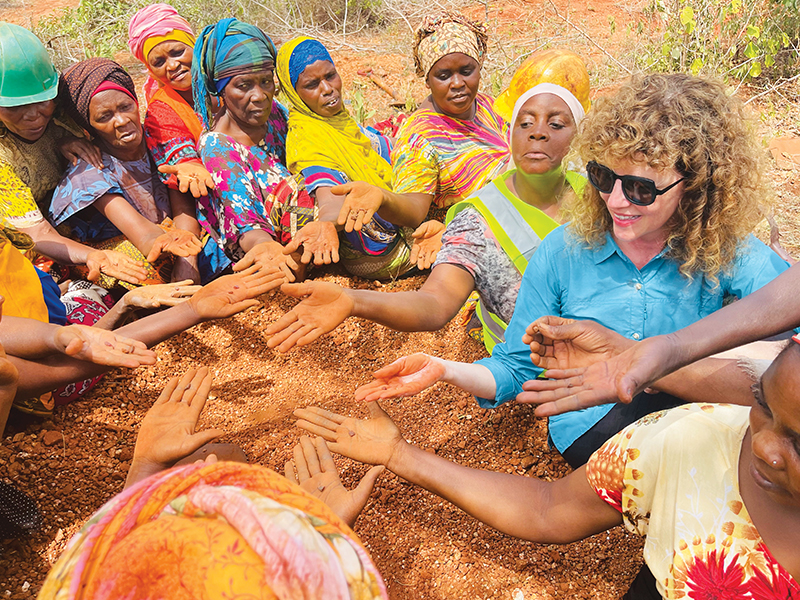
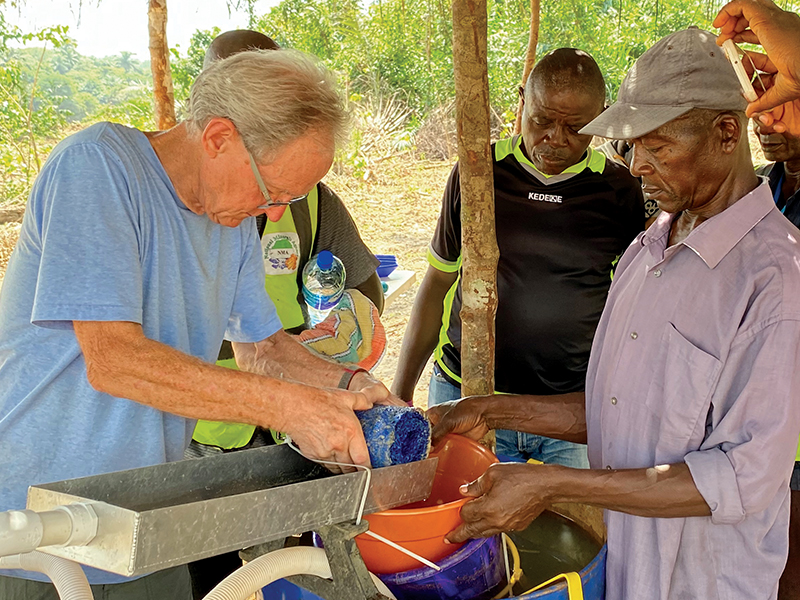
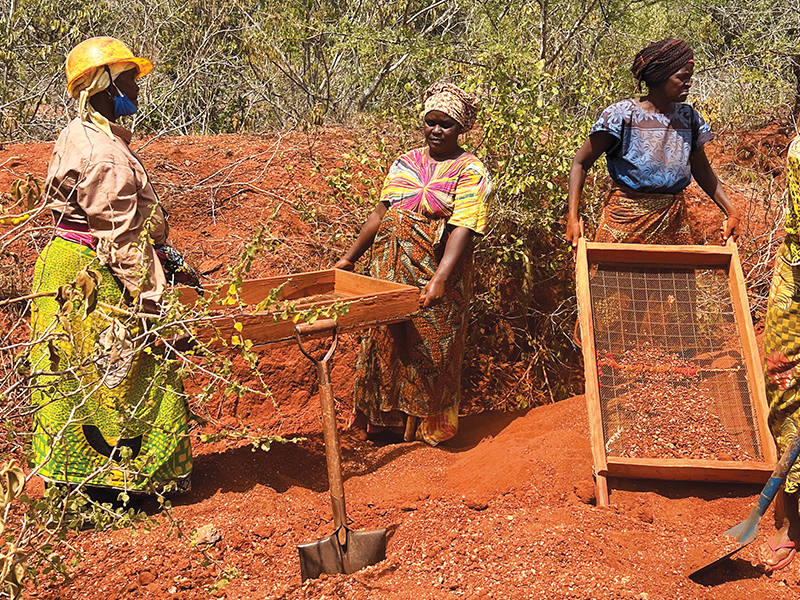
Launched in 2019, Moyo Gems seeks to empower women gemstone miners in Eastern Africa by providing new training opportunities, financial security, and access to fair trade markets. A collaboration of several businesses and organizations—the ethical gem suppliers ANZA Gems, Nineteen48, and Maison Piat; traceability company Everledger; Pact, an international nonprofit dedicated to helping communities develop; and the Tanzanian Women Miners’ Association (TAWOMA)—the initiative began with a pilot program in Tanzania. Pact representatives met and worked with local women miners in the Tanga province, who helped design the program and how it would operate. The miners would receive free gemology, health and safety, and negotiation training; help with securing mining rights to where they were working (making them legal in the eyes of the government); and direct access to the international market through the Moyo Gems brand and its trading partners.
Since launching, the miners have earned 3 to 10 times more for the stones they mine than previously. They are paid based on the number and type of gemstones they sell—a colorful range of sapphires, garnets, citrines, amethyst, and tourmaline—at a price negotiated with the help of a broker (as required by the Tanzanian government). Thanks to the program, the miners now make 95 percent of the export price of their materials instead of the 10 to 30 percent they would have normally made.
But that was only the start, as the Moyo group’s recent initiatives prove.
In 2021, Moyo Gems expanded its work from Tanzania to the Taita Taveta and Kwale counties in Kenya. Cristina Villegas, director, sustainable markets with Pact, estimates that between both countries, there are now about 900 miners participating in the program. The group also hopes to continue to expand its reach to other locations where women miners are active.
Watch: Moyo Gems: Meet Roslyn
In addition, the group now offers traceable colored melee. “Before, we could buy only large stones because we didn’t have a place to cut [melee],” says Villegas. Because of this, Moyo Gems could purchase only about 10 percent of what the women were mining. The other 90 percent of their material was being sold for pennies on the dollar to local brokers. “They weren’t able to sell them to Moyo and get top dollar for them,” says Villegas.
That’s now changed. Thanks to some scouting by ANZA Gems, the group found a location in Thailand where they could have smaller stones cut. “We can now supply a consistent supply of calibrated small gems,” she says. “It’s allowing us to reach a whole new market.”
It also puts more money in the miners’ pockets that they then spend locally, which helps their communities. “It’s win-win,” Villegas says.
Moyo also recently launched a pilot in Tanzania to cut larger sapphires and other gems in-country. Previously, the group couldn’t buy more than 2 grams of each sapphire mined in that country. Any larger sapphires were subject to Tanzania’s value-addition laws, which require larger sapphires to be cut in-country—a capability that Moyo didn’t have.
In 2022 the Moyo group was approached by a large European client interested in purchasing larger stones and who is flexible and willing to pre-finance the order. After visiting the TAWOMA Youth Cutting Studio, which TAWOMA launched earlier in the year for woman aged 18 to 30 who were interested in mineral value chains, he and Villegas saw the program as an opportunity to not only develop these women’s skills but also to address the problem with the larger stones.
“I raised funds and the youth now have a newly outfitted studio,” says Villegas. “We’re still in the pilot phase of the local faceting, but the goal is that later this year the women will be very busy with orders from their European client and the Moyo Gems traders who need their large sapphires cut prior to export.
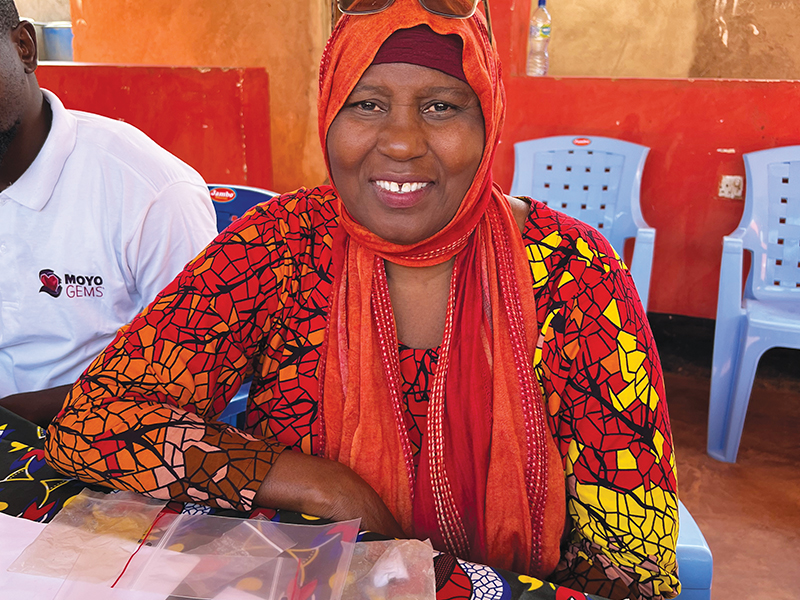
Mariam, a miner participating in the Moyo Gems program, sells her stones at Tanzania Market Day.
“Before, we had to turn away the largest stones,” she continues. “We have solutions now for stones that were previously too large or too small.”
The group has also started looking into supplying nature-positive gemstones, which would be produced with minimal impact to climate change and the ecosystem. Moyo Gems is currently in the process of measuring its carbon footprint in Tanzania, examining what its emissions look like and how they can be brought down to net zero.
“This is a response to troubling sustainability trends,” explains Villegas, noting that many consumers assume natural gemstones are worse for the environment than lab-grown stones, with many companies making green claims for lab alternatives. “It’s being weaponized against poor people around the world.”
The group will spend this year measuring and collecting emissions data from the mines so Moyo Gems can understand its starting point. Then, SCS Global Services has agreed to fund the program’s greening efforts through SCS’s corporate giving program. Moyo will work with local environmental experts to discuss the ways to reduce carbon emissions to net zero, and then discuss the options with the mining communities themselves to see how they would like to move forward.