Updates in Responsible Sourcing: Transforming Gold Mining
Transforming Gold Mining
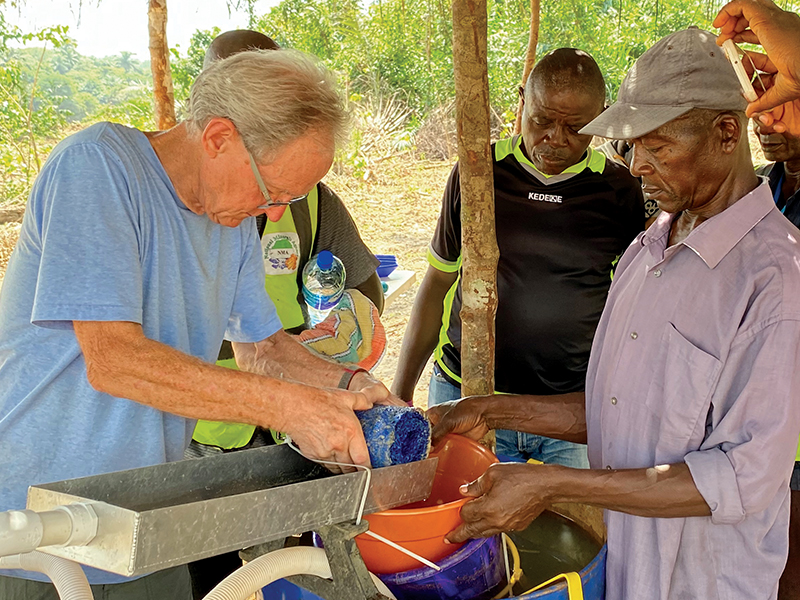
The son of missionaries, jewelry designer Toby Pomeroy knew he always wanted to make a difference. In 2004, he got his chance when he learned about the No Dirty Gold Campaign started by Earthworks, a nonprofit dedicated to environmental health and corporate awareness. The campaign strove to raise awareness about the environmental harm caused by gold mining’s then current practices. It inspired Pomeroy to become actively involved in ensuring that the jewelry industry became more responsible in how it sourced its materials. He started small, working with his metal supplier to offer 100 percent recycled precious metals, but over time he had the desire to do more.
Upon discovering that small-scale and artisanal gold miners still relied on mercury to extract gold from ore—a toxic process that can cause neurological disorders and other health problems—Pomeroy was moved to action. In 2017, he founded the Mercury Free Mining (MFM) initiative, aiming to incentivize scientists and entrepreneurs to develop safer and more effective alternatives to mercury. Originally, they focused on raising $1 million to fund a prize to award the discovery of such a solution. However, the organization switched gears in 2021 when it chose to focus on research to discover the most efficient of several gold ore concentration systems.
Funded by GIA, the study put five concentrators to the test. According to Pomeroy, one device proved significantly more effective than the others: the Goldrop. Developed and produced by John Richmond of Sluice Goose Industries in Albany, Oregon, the Goldrop is a gravity-based elutriation system. Through an assemblage of hoses and valves—all inexpensive items—it uses recirculating water to carry the lighter materials in the ore into a tailings bucket, while the heavier materials, such as gold, fall into a collection jar at the base of the system. Packaged as an all-in-one kit that runs off solar power and a battery, it operates on less than 100 gallons of recirculated water.
Impressed with the device’s efficiency, MFM is focusing its efforts on determining the Goldrop system’s efficiency in all gold ore types and deploying it in as many small-scale mining communities as possible. It coordinated with the Ghana National Association of Small Scale Miners and the University of Mines and Technology in Tarkwa, Ghana, to arrange to field-test the system at three mining communities in Ghana in early 2020. Despite discovering some bugs in the system— “While it lacked the precision we were looking for,” Pomeroy says—the miners immediately saw the potential it held.
Unfortunately, due to the pandemic, the testing was halted early. Since then, Richmond has been modifying and refining the Goldrop to address the issues raised during the initial field tests. And thanks to generous grants from GIA and the JCK Industry Fund, and donations from jewelry manufacturer Lashbrook and many others, MFM has been able to organize additional field tests, including most recently in Sierra Leone.
Last year, Mickey Brookshire, an experienced Sierra Leone gold and diamond miner, saw the concentrator while attending the AGTA Tucson GemFair. “He bought it on the spot,” says Pomeroy. Before bringing it to Sierra Leone, Brookshire first visited Oregon to train with Richmond’s team, devoting several days learning how to set up and run the system.
In October, Pomeroy and Brookshire traveled to Mayata, a small village of 1,000 in Sierra Leone, where they spent six weeks introducing the Goldrop to the miners there. The Mayata villagers have long been dependent on gold mining, and they welcomed the Goldrop system with keen enthusiasm.
Watch: The Goldrop System Update from Sierra Leone
“The miners loved the machine and the process,” says Pomeroy. He notes that agents from the country’s National Minerals Agency (NMA) came to visit the site to witness the device in action. “They were impressed with the technology,” he says, noting that one of the agents called it a “game changer for Sierra Leone.”
The director of the NMA has asked Pomeroy and his team to pull together hard data on the effectiveness of the system. Because the country has also instituted a new licensing program, Pomeroy is waiting for a license to be secured so they can return to Sierra Leone. He hopes to work with the government there to adopt the Goldrop as the standard in artisanal and small-scale mining.
To Pomeroy, working to remove mercury from gold mining is a win-win across the board. More than 90 percent of the mercury getting into waterways and poisoning people is attributable to gold mining. Removing mercury from mining operations will result in cleaner waterways and healthier people worldwide.
Creating a clean gold supply also gives jewelers a story to tell their customers about how each purchase supports artisan miners and their communities. In Mayata, for example, funds from the sale of mercury-free mined gold can help support the building of a health clinic for the village, the development of sanitation facilities to improve water quality, and the purchase of supplies for the local school. “This is an opportunity for our industry to buy their gold and support these initiatives,” he says. “We have at least as much to gain as they do.”
While Pomeroy awaits a return to Sierra Leone, he notes that the Goldrop is already being used in several other mining communities. The CECOMIP Mining Cooperative in Ananea, Peru, invested in a Goldrop in 2022. The miners soon discovered that they got better results than with the traditional shaker tables they had been using. Pleased with the results, the co-op is looking into adding a second machine, allowing it to improve their processing efficiency.
The Goldrop was also used in trials in Colombian mines early last year. During those trials, the system not only effectively extracted mercury from the tailings, but also captured fine gold that traditional methods missed.
According to Pomeroy, the Goldrop can currently process about a ton of mined material during an eight-hour workday. Between its 100-watt solar panels and a motorcycle battery, the system can run all day and halfway through the night before needing to recharge.
“It’s very efficient and has virtually no carbon footprint,” he says. And the Goldrop’s $3,500 price point makes it accessible to many small mining communities.
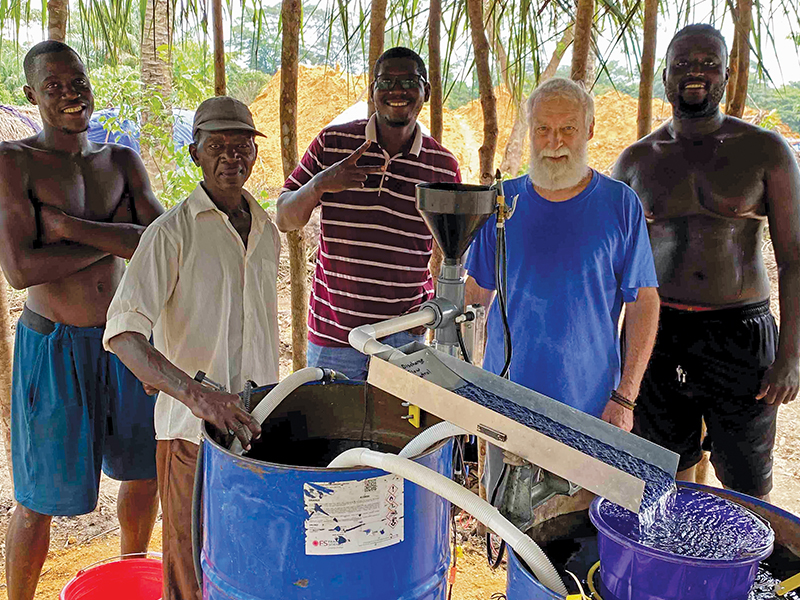
Gold and diamond miner Mickey Brookshire (second from right) introduces miners in Mayata, Sierra Leone, to the Goldrop.
As impressed as Pomeroy has been with the early results of the trials, he recognizes that much more research and work needs to be done. He says that Richmond continues to make modifications to the Goldrop based on feedback from the miners, such as widening the sluice and adding more baffling to slow down the flow of materials. Then there’s also the matter of the machine being scalable, so that mining groups of any size will be able to benefit from the system.
“We want to see this and other highly efficient processors everywhere—as far and wide as we can,” says Pomeroy. “We have a tremendous opportunity to get alternative processors out to people who traditionally have been ignored and [viewed as] an afterthought. I think it’s time for our industry to step up and say we’re taking on mercury pollution in our gold supply chain. There are lots of things we could take on, but I don’t think the jewelry industry is connected to a bigger global one than mercury poisoning from gold mining.”