

Choosing the Best Welding System to Meet Your Needs
The Passing of the Torch
How to choose between pulse-arc welders and laser welders
By Shawna Kulpa
Tired of your torch? While torch soldering remains a great, low-cost and effective way to weld metals at the jeweler’s bench, you may be interested in upgrading to a faster method that requires less cleanup.
As a jeweler, you have two options available: pulse-arc welders and laser welders.
Both are suitable for most of the same types of projects: re-tipping prongs, resizing rings, repairing chains. Both can also achieve similar results. In fact, it’s possible that only experienced welders would be able to differentiate between welds made by a laser and those by a pulse-arc welder.
So, how do you choose which to get for your business? While there are many similarities between the two technologies, they’re not completely interchangeable. Deciding on the best one for your business requires knowing what you want the welder to do and then seeing which type of system is the best fit. To help with that, we’ve talked with several experts about the pros and cons of each technology as well as the questions that you’ll want to ask both yourself and your suppliers once you’re ready to trade in your torch.
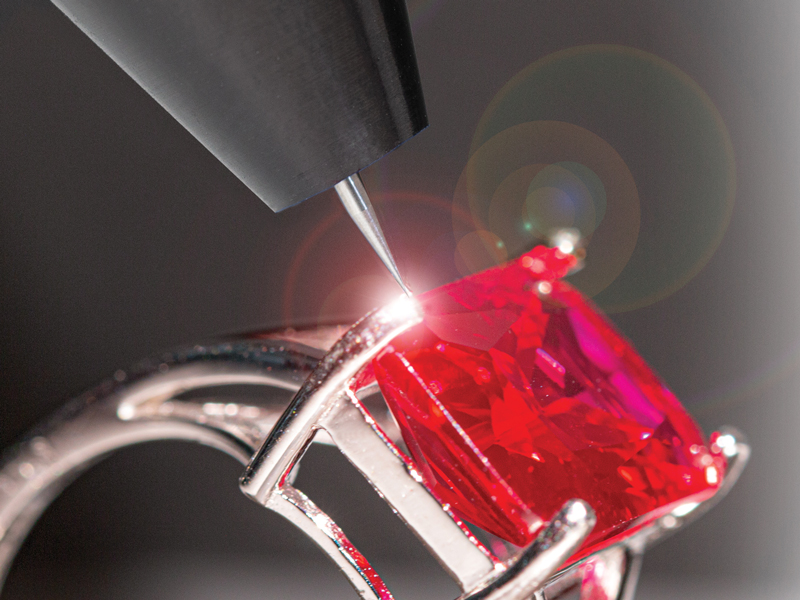
Pulse-Arc Welder:
Advantages & Disadvantages
While both systems can handle all the metals that jewelers are apt to work with, pulse-arc welders have a slight edge when it comes to working on silver. That’s because silver reflects 95 percent of light—and since laser welders use light to weld, that light could reflect off the jewelry piece and produce a weaker weld. Since they use electricity (and silver is a highly conductive metal), pulse-arc welders excel when it comes to working with silver.
“If you work with silver, a pulse-arc is the way to go,” says Scott Peart, marketing manager for Sunstone Engineering in Payson, Utah. “Wherever you touch the electrode, it’ll work just fine. You have the advantage of not having to deal with reflections.”
Another advantage that pulse-arc welders offer is their compact size and portability. They tend to have much smaller footprints than desktop laser welders, so they can be a good fit for a jeweler with very limited workspace. While it depends on the model, most desktop laser welders suitable for all-around jewelry work measure about 20 inches wide by 25 inches deep and can weigh between 75 and 125 pounds. The base of a pulse-arc welder may measure a svelte 8 inches wide by 12 inches deep in comparison.
“They can be mounted on benches,” says Chris Leonard, equipment and machinery product manager at Stuller Inc. in Lafayette, Louisiana. “It’s like setting up a computer with an adjustable arm and monitor.”
Pulse-arc welders also allow jewelers to take advantage of the recent trend of permanent jewelry. Currently popular with today’s consumers, permanent jewelry often consists of bracelets, anklets, and necklaces without a clasp or any other way to remove the item short of cutting it off. If a customer wants a permanent bracelet, she simply places her wrist down on the bench while the jeweler uses a pulse-arc welder to weld the bracelet closed.
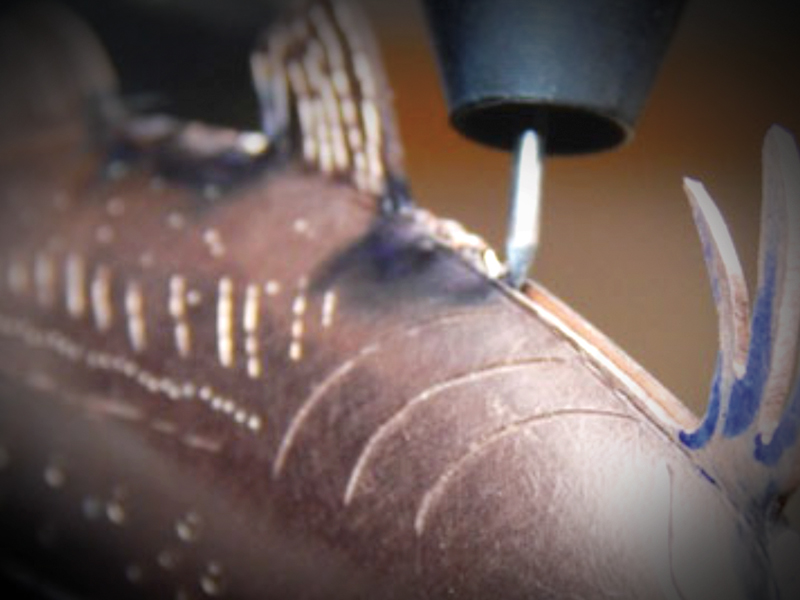
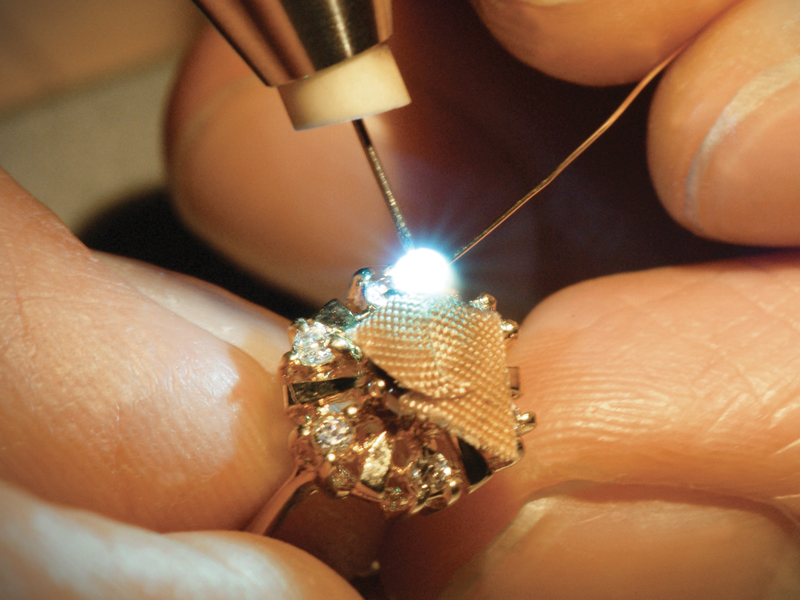
Pulse-arc welders excel when it comes to working with silver, but they rely on an electrode that needs to be able to touch the precise spot being welded.
“You can’t do that with a laser,” says Peart, who notes that many of his current customers are buying pulse-arc welders specifically for permanent jewelry.
While it is possible to do the same thing with laser welders, there’s a larger risk involved, not to mention the challenge of having the customer possibly needing to contort themselves to place an arm in the welding chamber.
“Pulse-arc welders are perfect for that,” says Leonard. “They’re open air, so you can adjust an arm for awkward jobs.”
However, if you’re going to try your hand at permanent jewelry, Phillip Scott, a member of the technical support team at Rio Grande in Albuquerque, New Mexico, cautions that you need to be careful and either have something to block the light or have your customer wear eye protection during the welding.
Fellow Rio Grande tech team member John Sartin notes that at 6,000°C, the light from a pulse-arc welder would be like looking at the sun: “It can damage your retina if [you look at it] too long.” This is particularly important to note if you have a work setup where passersby may be tempted to stop and watch. “Kids are drawn to really cool flashy things,” Sartin adds. “With today’s litigious society, it’s something to keep in mind.”
Despite these advantages, there are some aspects of pulse-arc welders that may not make them a good fit for your needs. First, there is a limit to where you can weld.
“You have to be able to touch the electrode tip, which is mounted in a pen, to be able to commit the weld,” says Adam Kasson, jewelry account manager as well as principle contact for Sisma Laser Technologies at Gesswein in Bridgeport, Connecticut. “If it doesn’t touch, you can’t weld.” That means any tight spots or nooks and crannies in a piece would essentially be off-limits to a pulse-arc welder.
When deciding on the best type of welding system, get to know the technologies so you can understand how they work.
And even if you can get the electrode into a tight spot, you run the risk of welding in the wrong area. For example, if you’re trying to weld inside a V-shaped area, the side of the electrode might touch the metal surrounding it. If that happens, “it’s going to fire the electrical charge through the side of the electrode instead of the tip,” says Sartin. “It’s not great for really tight spots.”
Next, while it depends on the individual model, most pulse-arc welders can fire up to only five shots per second. Sartin ad-mits that some models have a rapid mode that might allow more, “but with those, you have to be really, really talented to use it well.”
You also won’t be able to adjust the spot size and power level on a pulse-arc welder independently. This means that if you need to increase the power for a weld, it will increase the spot size as well.
“The spot size is going to be decided by the power,” says Sartin. “The higher the power, the larger the spot size.”
Two other things to note:
• These systems tend to work a bit messier than laser welders. For example, silver’s low viscosity can cause it to be pushed away by the electric arc. “It tends to almost splatter more, to a certain degree,” says Scott. “The disadvantage is that you have more cleanup.”
• It’s not uncommon for users, especially beginners, to lean into the electrode when welding. Although the electrode retracts when the weld is created, “when the electrode re-extends itself, it can get caught in that metal,” says Sartin. When that happens, you’ll need to resharpen and clean up the electrode with a diamond disc.
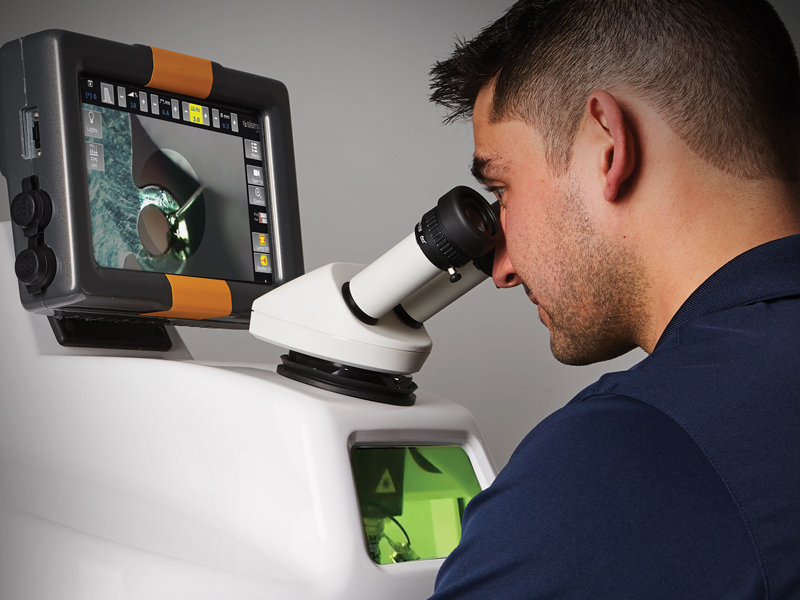
Laser Welder:
Advantages & Disadvantages
One of the greatest advantages of laser welders is their ability to weld just about anywhere.
“They’re really good for getting into hard-to-reach places,” says Peart. “As long as you can see where the weld needs to go, the laser welder can get to that spot.”
Unlike pulse-arc welders, which need to make contact with the area being welded, laser welders require only that the user be able to see the spot through the attached microscope and center it in the crosshairs.
Laser welders also offer users the ability to adjust the spot size and power level independent of one another. If one project needs more power, you don’t have to worry about the spot size of the laser increasing correspondingly. This means that you can concentrate a lot of power in a really small spot, making the welds very precise.
That’s something that’s especially handy when repairing fine or delicate chain. Whereas melting solder with a torch could result in solder floating over other parts of the chain and freezing it, with a laser welder you can localize the heat to the necessary area. The same also applies to repairing clasps without affecting the spring component. “It’s like laser surgery,” says Roy Gessman, director of sales at LaserStar Technologies in Orlan-do, Florida.
In addition, experts estimate that users can get upward of 50 welds per second with a laser. “You can accomplish things faster with a laser,” says Scott. “And time is money.”
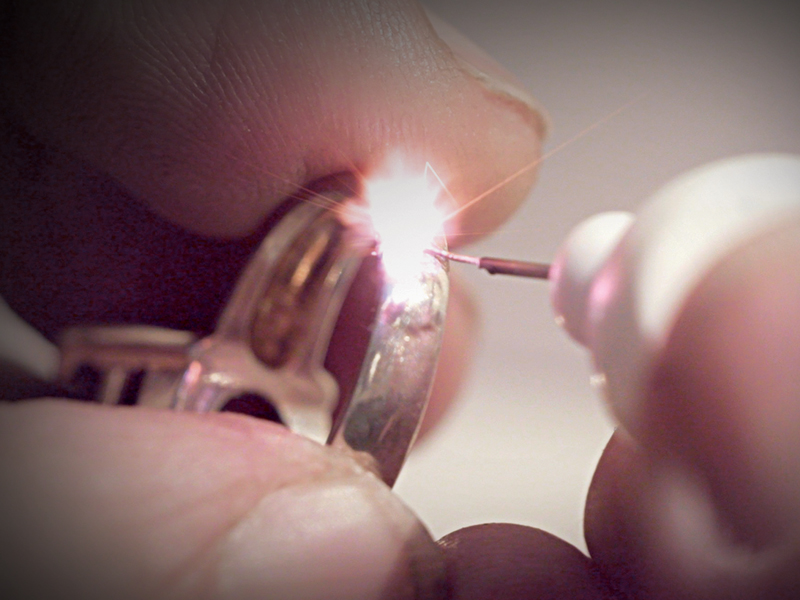
Although they carry a higher price tag, laser welders offer users independently adjustable spot size and power level settings, clean welds, and the ability to get upward of 50 welds per second.
However, he warns that with that speed comes the risk of the piece getting hot very quickly. “With that many welds, the piece starts heating up—which is good for the weld since it keeps the metal warm during welding, but for the user it can get uncomfortable,” he says.
Another benefit that’s often cited is how clean the resulting welds are, helping to save time.
“They’re clean to work with—there’s no firescale or pickling,” says Leonard. “It makes you more efficient. With other instruments, there’s a lot more pre-work and post-work involved.” He notes that, thanks to laser’s preciseness and clean welds, he’s seen jewelers use welders to polish their piece as well as clean up after themselves, another benefit.
Peart concurs. “You can weld something together, turn the power down lower, change the spot size, and weld over that area again to even it out,” he says.
That’s one of the reasons why Gessman likens them to magic wands. “You could be several hours into a piece and find a porosity mark during polishing. With a laser, I can reflow the metal and repair that mark. There are no solder lines, no firescale, no cleanup process. You would never know that porosity was ever there.”
However, there are some disadvantages to laser welders. As mentioned earlier, because it uses light to join metals, a welder will struggle with silver and other highly reflective metals. Many jewelers get around that problem by coloring their silver with a Sharpie marker to cut the metal’s reflectivity. However, Scott notes that it’s only a temporary solution. “As soon as you make that first weld, that marker is no longer there,” he says.
Some users also view laser welders as riskier to use. Since pulse-arc welders require that the electrode be in contact with something before it will weld, there’s very little chance that you’ll zap yourself by accident. With laser welders, zapping yourself is just considered an inevitable part of the learning curve. “If you hit yourself with a laser, it just feels like a hot pin prick,” says Gessman.
And then there’s the issue of price.
Dollars and Sense: Comparing Prices
If money is no object for your business, you don’t need to worry about the price difference between the welding systems. For most jewelers, however, price is going to be a major factor in deciding which technology to invest in.
When it comes down to sheer price, pulse-arc welders win hands down.
“Pulse-arc welders can start as low as $2,300,” says Peart, noting that a top-of-the-line model could run around $8,000. “Our most popular model for the jewelry industry is $5,300.”
Laser welders will cost you a bit more.
“They range anywhere from $10,000 up to $30,000 to $40,000,” says Peart. He notes that with the lower-end models, the power tends to be lower. “They still do really well for the majority of jobs, except with silver, where you would want a higher power welder. The more power you have, the easier it is to weld silver.”
Deciding on the best model for your shop will largely depend on what you’re going to do with it. If you’re a large manufacturer or someone working predominantly in silver, “you definitely need more power,” says Gessman. “But for a small repair shop with light work, a lower power machine will be okay.”
However, don’t let price be the sole deciding factor on which to invest in. If a laser welder ends up being the right choice for your shop, don’t feel as if you must settle for a pulse-arc welder because it better fits your budget.
Most laser welder suppliers offer financing options to help jewelers with the purchase. When crunching numbers, Leonard recommends looking at the work that a laser welder will help you do and its effect on your bottom line.
“The ROI will be tremendous when you figure out how much your time is worth and how much time you’re saving,” says Leonard.
If you determine that a laser welder makes the most sense, but you just can’t swing the money for it right now, you may want to invest in a pulse-arc welder until you are in the position to upgrade to the laser. As Scott points out, instead of having to remove stones from a piece to retip the prongs with a torch, you can do it with a pulse-arc welder and transform that one-hour job into one that takes 15 minutes. “And you still get to charge the same,” he adds.
Keeping Things Up and Running
Of course, the cost of any piece of machinery extends beyond just the purchase price. You’ll also need to consider ongoing maintenance costs.
With fewer moving parts, pulse-arc welders are easy to maintain at minimal cost. Most pulse-arc welders have only two consumables: tungsten electrodes and argon gas (which acts as a shield gas to prevent oxidation).
While the electrode itself should easily last for upward of 10,000 welds, “over time, it dulls out,” Peart says. In fact, you’ll need to plan to resharpen that electrode regularly.
“Every time you fire a weld, it becomes dull, which means the energy is not focused properly,” says Sartin. Welds will be better when the electrode is cleaner and sharper.
How quickly it degrades depends on the number of welds and the power settings used. But once it does dull, the user will need to remove it, sharpen it to a fine point with a diamond disc, and then replace it—all of which will take time. “That slows down production,” says Scott.
Kasson says that most electrodes start out around 2 inches long. Every time you sharpen it, the tip will get shorter. “When it gets too short to stick out of the probe at a specific length, you need to replace it,” he says. You can expect to spend between $45 and $60 for a package of 10 electrodes.
The argon will also need to be replenished, though how quickly will ultimately depend on the use.
Lasers aren’t quite as simple or as cheap to maintain.
According to Gessman, there are five maintenance items that laser welders will require. The first is the flash lamp. Under normal operating conditions, you should expect the lamp to last for several years. However, Gessman notes that over time, the lamp may turn a milky white, starting at the ends and progressing toward the center. While the welder will still operate, “not as much light will be getting through and you’ll see a gradual long-term drop in power,” he says. He adds that new lamps cost around $300, and most users can easily switch them out themselves.
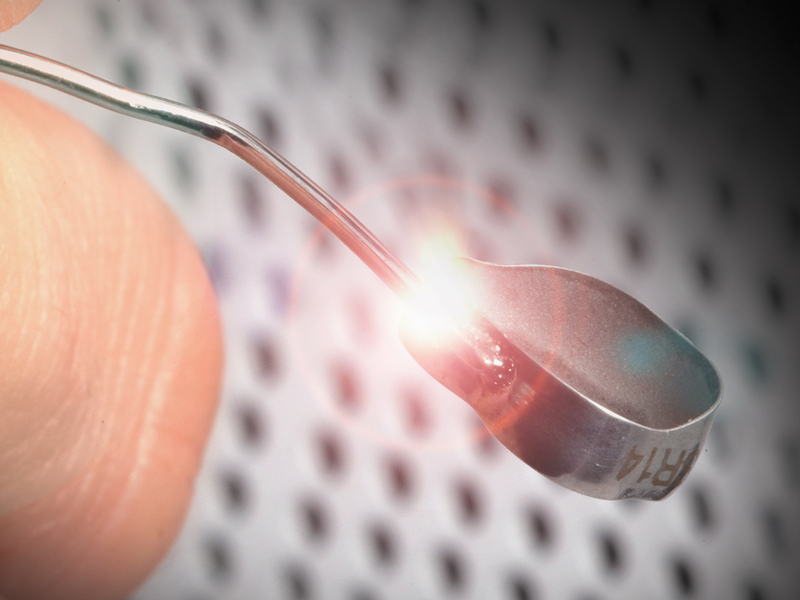
With many moving parts, laser welders require regular maintenance. Users should expect to budget around $500 annually for maintenance costs as well as the time needed to tend to the machine.
The second item on Gessman’s list is a round, protective glass disc that sits inside the welding chamber. “As you weld, black smoke settles on the glass,” he explains. If enough smoke accumulates on the glass, the laser won’t be able to penetrate it, which can crack the glass. He recommends cleaning the disc weekly. But even if you clean the disc regularly, Gessman estimates that the glass will need to be replaced periodically (sooner if it gets cracked or pitted). Users should expect to pay around $50 for a replacement.
Every laser welder uses water to cool down the laser parts. Some machines require distilled water, while others might use deionized water. Regardless of the type, the water should be changed every three to six months. While changing the water, some users may also want to change the water filter. Gessman estimates that the filter should be changed once or twice a year and that jewelers should expect to spend around $175 per filter.
In addition to the water filter, you’ll also need to periodically replace the unit’s air filters. To help prolong the filter’s life cycle, Gessman recommends “that you don’t park [the unit] next to a polishing machine.” While there’s no need to keep your laser welder in a separate clean room, make sure it is in a cleaner part of your shop. There’s no set timetable for replacing air filters, and Gessman recommends users do a periodic visual check of them. “If they’re turning brown or black, put in a fresh one,” he says.
Gessman usually tells his clients to budget about $500 per year for maintenance, though users aren’t likely to spend it all. “You’re not going to replace the flash lamp every year,” he says.
Also, if you’re shopping for a laser welder, make sure you check the maintenance procedures, since “every laser company is different on maintenance,” says Peart. “Some companies require a technician to come out and change the water and filter every year.”
The Learning Curve
Along with maintenance costs, there are also training costs to consider. Luckily, both welding systems are intuitive, and experts say that most users can get up and running after a short time. While training options will differ between suppliers, most offer a lot of free online training resources so that users can learn at their own pace and time. However, for those who would like a little more handholding, most companies also offer in-person training sessions.
While any training can help give you a good understanding of a machine’s capabilities, Sartin likens the learning process for either type of welder as similar to the learning curve for soldering.
“How long did it take for you to learn how to properly solder something?” he says. Ultimately, how quickly someone picks up welding will depend on the amount of time they spend working with the machine.
“With anything, there’s going to be a learning curve,” Sartin says. “It depends on the person and how quick they can pick things up. It takes seat time and practicing on stuff that doesn’t cost you money.”
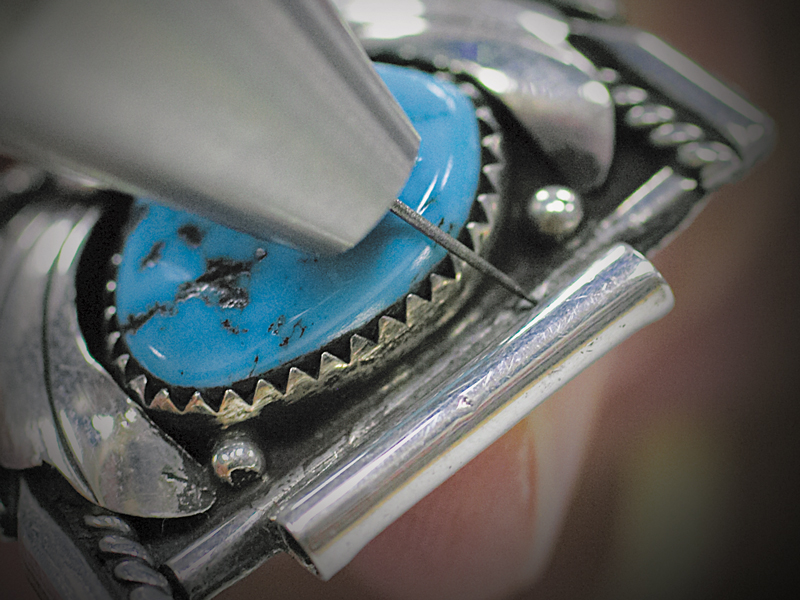
Pulse-arc welders can have a slightly longer learning curve, as users must master the art of holding the piece steady and aligned with the electrode.
To Scott, the hardest part of learning how to weld with either a pulse-arc or a laser welder is learning how to focus when you’re looking through the microscope. “Learn where your hands are,” he says.
That said, the experts seem to agree that pulse-arc welders have a slightly longer learning curve.
“Holding the piece steady during the weld is a lot harder than people think,” says Sartin, noting that fine motor movements in the jeweler’s hands can shift the alignment of the piece with the electrode without the jeweler even knowing it. “Learning how to [bring the piece to the electrode] to make the weld where you want takes more time than looking through a microscope, focusing the crosshairs, and firing the laser.”
To help with the process, Scott recommends that anyone buying a pulse-arc welder also invest in a bag of inexpensive jump rings. “Make a Byzantine bracelet,” he says, noting that the first inch or so of the bracelet likely won’t be that great. “By the time you get to the end, it’s looking pretty good. You can start doing incredible stuff in a couple of hours.”
Kasson estimates that it takes most users 10 to 13 hours to get the gist of using a laser welder, but notes that certain skills, such as retipping prongs, will take significant practice and diligence. He estimates that it takes the average pulse-arc welder user the same amount of time, but some applications may take longer.
Questions to Ask of Yourself and Your Supplier
When it comes to shopping for a welding system, there are questions that you’ll need to ask the suppliers. But before you can do that, you first need to take a good, hard look at your business and decide what you want the welder to do for it.
“What metals are you welding? What kind of stuff are you doing? How many pieces are you going to do?” asks Scott, who says that once he has that information, he can help a customer find the best fit.
For example, “with repairs, time is money,” he says. “The speed and accuracy of a laser is going to pay for itself in three to six months.” On the other hand, if you’re making chains where every link is the same, “the pulse-arc welder would be perfect.”
“How many jobs do you have coming in?” adds Leonard. “What types of jobs are they? Is this something you want to help build your business? Do you want to increase the volume? That might help dictate what you need.” If your goal is for large-scale growth, you’d likely want a laser welder.
On the other hand, “if you’re only closing jump rings and nothing else, save some money and get a pulse-arc welder,” says Peart.
For a printable checklist of important items to consider when shopping for a welding system, click here.
Also consider who is going to be using the system. Will you be the sole operator, or will other employees work with it? If your employees will be the primary users, involve them in the decision-making process because success with the system “comes down to the comfort level of the user,” says Leonard.
Once you’ve identified the who, what, where, and why of your investment, it’s time to share that information with the suppliers and ask some questions.
“Try to educate yourself,” says Leonard. “Do as much research as you can. Speak with many companies. Go to a training course before buying. Test drive it. Go to trade shows to see live demos. Do your due diligence and research to see what’s the best fit for you.”
Aside from the capabilities and limitations of any systems you’re considering, you’re also going to want to ask about all the things that go along with investing in a piece of machinery—supplies, training, and service, and how much all of that will cost.
For example, what happens when something goes wrong with the system? Will you be on your own to troubleshoot and fix the problem, or will the company offer support? Is there a charge for that support? What’s the availability of spare parts?
“Service is paramount,” says Kasson. “What costs are involved? If your machine goes down, do you have to wait for imported parts? It is inevitable that at some point, your machine will have a problem, and you need a reliable partner to be able to support you to get you back up and running as fast as possible.”
Along those lines, ask about the running cost of the machine. “Just as a car needs routine maintenance, in the way of an oil change, a laser welder follows the same principle,” says Kasson. “What kind of water is needed? How much are filters, and how often do they have to be replaced? How much is a flash lamp?”
And don’t forget to ask about any warranty that’s included with the purchase. What does it cover and, perhaps more important, what doesn’t it cover?
Regardless of the type of system you decide to purchase, ask about financing options, as the supplier may be able to offer you a better deal than you might find elsewhere.
Finally, investing in a new piece of equipment, especially one with a large price tag, can be daunting. It’s easy to get overwhelmed by details and to push a decision down the road. But every day that you put off making the purchase is another day that you could potentially be sending clients to your competitors. “The worst time to buy is tomorrow,” Kasson says. “The best time is today.”
And once you finally pull the trigger on the purchase, prepare to be amazed at the possibilities the welder will offer.
“They’re going to change your life,” says Scott. “If you’ve only used a torch up to this point, it’s going to rock your world. The technologies are that good.”