

Together Forever
Joining two metals to produce a match made in heaven
By Shannon Cournoyer
(Originally published June 2009)
Jewelry with more than one metal is growing in popularity. Yellow gold and silver, white gold and steel, platinum and cobalt—no matter what two metals you are trying to unite, wedding them blissfully in a piece of jewelry takes attention to design aesthetics and technical detail. And, just like any marriage, it takes a little finessing for the two to coexist in harmony.
Design Approaches
Some designers envision their mixed metal jewelry clearly with the metals in place, while others begin with a design and decide later which metals best suit it. Todd Reed of Boulder, Colorado, who specializes in raw diamond jewelry (right), uses the former approach: He knows where he wants yellow, white, or blackened metal when he’s designing a piece, taking into consideration the relationship between the number of stones and the metal. “When using mixed metals, you can be painterly,” he says. “It’s the canvas for me. I use colors to define space. Dark contrasts with light.”

Edward Rosenberg, designer and CEO of Edward Mirell in Deerfield, Florida, uses the opposite approach. He starts by sketching hundreds of designs, from which the company’s designers and its research and development team select and fine-tune a few to put into production. With the goal of being on the cutting edge of fashion, they interpret the designs in terms of what will strike a chord with the public, taking into account trends in metals and colors.
In addition to enhancing the overall design of a piece, different colors of metal can be used to make a normally utilitarian element beautiful. For example, Reed will sometimes opt to use a gold bezel setting in a silver piece to make the setting stand out and draw more attention to the stone. And when you turn over the piece, you see the gold bezel beneath, adding another element of interest to the back. Rosenberg and his team might use a band of silver on the inside of a titanium ring or a piece of silver on the back of a pendant. This is not only an aesthetic accent, but also adds weight to lightweight titanium, simultaneously adding perceived value. “Customers often perceive a weightier piece as having more value,” he says.
Metal Pairs That Work
When marrying metals with different characteristics, designers and manufacturers need to consider the alloys’ strengths and weaknesses to arrive at a successful union. Each metal has its own character and personality, so making the relationship work can take some effort. In Edward Mirell’s designs, sometimes harder metals protect softer metals. A cobalt ring might have accents of colored titanium, which may be susceptible to abrasion. The treated areas are placed in recesses at the top of the ring, so the main body structure protects them from wear.
Designer Genevieve Yang of Santa Rosa, California, likewise relies on harder metals to protect her more delicate fine silver and 24k keum-boo pieces. Keeping in mind the softness of the fine silver, Yang often adds a rim of sterling silver to a piece such as a ring to protect the softer interior metal. “Rigid sterling rims on my fine silver ring help it stay beautiful longer,” she says. Yang is careful to use the sterling only where it will experience natural wear, so any tarnish will rub off.
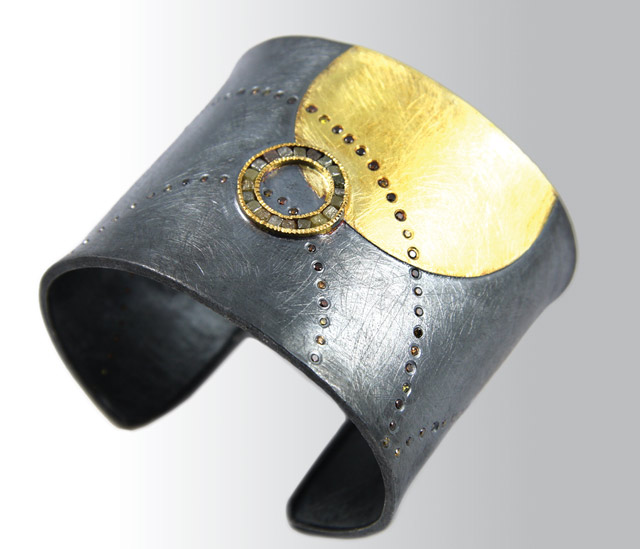
Cuff by Todd Reed
“This cuff features 28 gauge 18k yellow gold fused to 18 gauge silver. The inside rim of the cuff that touches the wrist is 16 gauge round wire rolled into flat stock and soldered to the edge. When the cuff is forged into shape, the thin stock [combined] with a thickened edge makes a wonderful curved surface.”
“From a design standpoint the composition is a series of radiuses in 18k, raw diamond cubes, and brilliant-cut natural color diamonds.”
“I love the strong contrast between the painted silver and the brush-finished gold. I also love the tension created between the raw diamonds in the central circle component and the brilliant-cut diamonds.”
While some mixed metal pairings fill a utilitarian purpose, others are purely aesthetic. “I just love steel,” says Reed, who commonly solders steel to yellow gold. “I love this black, raw metal, how it combines with raw diamonds and other metals, especially yellow gold.”
Rosenberg often pairs gold and silver, a common combination, but he also uses many more unusual combinations, such as cobalt with platinum, gold, silver, or palladium. “Cobalt shows great with silver and with platinum blends,” says Rosenberg. “It has such high brilliance that it complements other white metals when combined with them.” Sarah Graham of San Francisco prefers blackened steel with 18k yellow, white, and rose golds. “I like combining an unfamiliar metal that doesn’t have a high perceived value, such as blackened steel, with high karat gold and diamonds,” she says.
Techniques for Combining Metals
You can use a variety of techniques to combine metals in jewelry designs, and each method offers benefits and limitations. The following are the most common techniques, and some tips for using them effectively.
Cold joining. Softer metals, such as yellow gold, are easier to connect with cold joining than harder metals, such as nickel white gold, because they are easier to manipulate with hand tools. This method is also a prime choice when joining metals that might be damaged by heat, such as blackened metals. Graham (whose Caged Coral locket is shown at right) uses cold joining to combine the 18k gold and blackened steel elements in her Flowering Coral collection because soldering them might alter the finish of the blackened steel. (For more on this, see “Soldering.”) She inserts a center gold bezel through a steel flower and rivets it in place using a rotary hammer tool. She also uses prongs that can be bent over and “set” to secure the bezel, as though it were a setting for a stone.
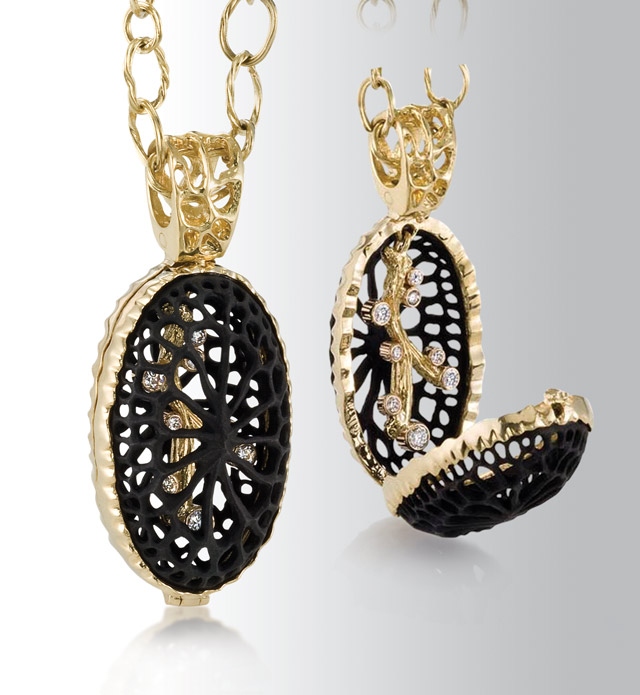
Caged Coral Locket by Sarah Graham
“The 18k chain is handmade using wire pulled through a custom shaped draw plate and twisted randomly to create our signature look.”
“The steel cages are bezel-set into the gold locket frames. We use a burnisher to push the scalloped gold edges over the steel.”
“The gold and diamond branch inside the locket is customizable—no two lockets have the same piece inside. Usually the customer is involved in deciding what goes inside. The possibilites are limited only by the size of the cage.”
To combine a softer metal such as gold with a harder metal such as titanium, jewelers at Edward Mirell cut a dovetail channel and press in the softer metal so that it spreads into the channel, then burnish it over to hide the seam. The company will also commonly use riveting to add aesthetic interest, such as adding a small rivet of gold to a titanium bracelet for accent.
Soldering. When joining mixed metal jewelry by soldering, Stewart Grice of Hoover & Strong Inc. in Richmond, Virginia, advises jewelers to choose solder based on the metal with the lowest melting point, and “use the hardest solder you can get away with.” He recommends silver solder for economic reasons when working on gold and silver combinations, and gold solder when working on platinum and gold combinations. “You don’t want to risk melting the gold component with even the lowest-melting-point platinum solder,” he says.
For a yellow and pink/red gold combination, Grice suggests using yellow gold rather than red gold solder because “it has superior flow and wetting properties,” he says. “Red solders can have the potential to create dry joints where some oxide from the high copper content may prevent a good bond between the two metals you are trying to join.” This can be an important attribute when taking a bi-metal piece through subsequent fabrication applications, such as rolling.
When soldering yellow gold and blackened steel, Graham uses yellow gold solder for the delicate process. “Soldering 18k gold to blackened steel is something we do all the time, but it is more challenging and messier than soldering gold to gold,” says Graham. “The matte black finish on our steel is a heat process, so soldering onto it or even around it can mess up the finish. Locating the solder joints at points that will require the least amount of heat is preferable.” On many pieces of jewelry, that means soldering at the end rather than the middle, so less heat is required and the entire piece doesn’t have to be brought to a high temperature.
Laser welding. This method is used extensively in mixed metal jewelry manufacturing but can muddle the edge between the two when the metals mix. As with other methods, it can take a little trial and error to get the results you want. One solution, according to Giles Pope, director of education and training with LaserStar Technologies in Riverside, Rhode Island, is to “make an undercut in the metal with the lower melting point, keyhole weld at the undercut seam, then add the [lower-melting-point] metal to the undercut area with the laser.” This provides a clean line of demarcation between the two metals, as well as a strong bond.
Reed’s team uses laser welding for two main purposes: positioning metals in preparation for soldering and combining metals such as platinum and gold, gold and steel, and gold and silver. When laser welding a white metal to another metal, Reed’s fabrication team marks the white metal at the point of welding with a Sharpie so the surface isn’t reflective and it’s easier to work with, they say.
Designer Paul Klecka of Carlsbad, California, believes that CAD’s accuracy in design has made laser welding the way to go for joining disparate metal components in jewelry. “With CAD, you can cast pieces with very precise dimensions and they can be connected seamlessly with a laser,” he says.
Casting. Casting is probably the most complicated method of combining two metals in a jewelry design. “Some metals are co-castable and some aren’t,” says Teresa Fryé of Techform Advanced Casting in Portland, Oregon. Metal casting compatibility is specific down to the alloy; for example, some platinum alloys won’t bond metallurgically with gold and some will.
According to J. Tyler Teague of JETT Research in Johnson City, Tennessee, “most metals other than certain platinum alloys will oxidize too much to actually metallurgically bond with the second metal.” He adds that platinum alloys containing cobalt don’t bond well, but 90/10 platinum/iridium bonds well with most yellow gold alloys.
That said, it is still possible to co-cast metals that don’t metallurgically bond if a mechanical bond is sufficient. To achieve a mechanical bond, a bi-metal piece must be designed with interlocking parts that, once cast, hold the piece together as one unit. (Click here for a step-by-step on co-casting.)
Klecka, who has worked extensively with co-casting in the past, uses an undercut to add security to the bond. To be sure there’s no chance of failure, Klecka suggests dropping a bit of solder between the two metals after casting.
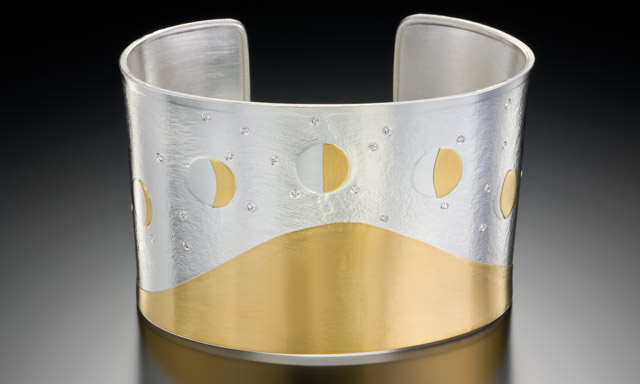
Lunar Cycle Cuff by Genevieve Yang
“The design for this cuff was inspired by the month I spent in the Wyoming wilderness in winter. I was captivated by the moon each night. This cuff captures my memory of it.”
“The body of the cuff comprises pure fine silver. Using the keum-boo technique, I added a 24k moon, which rises and falls above a pure gold hill. I added a sterling silver edge for additional structural support and finishing.”
“Conflict-free white diamonds, which range in size from 0.5 pointers to 2 pointers, are flush-set to represent stars.”
As a general rule, for the co-casting process to create either a metallurgical or a mechanical bond, the two metals must have distinctly different melting points. The higher-melting-point metal is cast first as a separate piece. The cast piece is then assembled to a wax model that makes up the remaining portion of the design, and the two pieces are invested together. The burnout and casting processes then proceed accordingly for the metal with the lower melting point.
For example, the casting temperature of purple gold (around 2,050°F to 2,175°F) and platinum/iridium (around 3,560°F) have a wide enough difference that they can be co-cast, but the same gold against 18k palladium white gold (around 2,170°F) creates what Linus Drogs of Au Enterprises in Berkley, Michigan, calls “an uncontrolled mess.”
No matter which metals or method you choose, planning the union with care will lead to a lasting relationship. Achieving a delicate balance between aesthetics and technique is the key to making quality mixed metal jewelry. “The marriage of technology to the age-old skill of jewelry making really does make a difference,” says Rosenberg. “But you also need the artistry to create something beautiful.”