

Bi-metal Casting
Casting an 18k white and 18k yellow band
By J. Tyler Teague
It is possible to co-cast metals that don’t metallurgically bond if a mechanical bond is sufficient. To achieve a mechanical bond, a bi-metal piece must be designed with interlocking parts that, once cast, hold the piece together as one unit. Here is an example of a band that was co-cast:
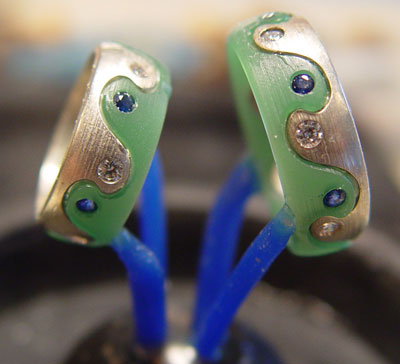
The higher-melting-point metal is cast first as a separate piece. In the case of the wave band shown above, the diamond-set 14k white gold component (melting point: 1,025°C) of the wave band is cast first. The cast piece is then assembled to a wax model that makes up the remaining portion of the design—in this case a blue-sapphire-set wax. If you look closely at the photo, you see how the wave pattern overlaps and hooks into the opposite metal piece to keep the ring mechanically locked.
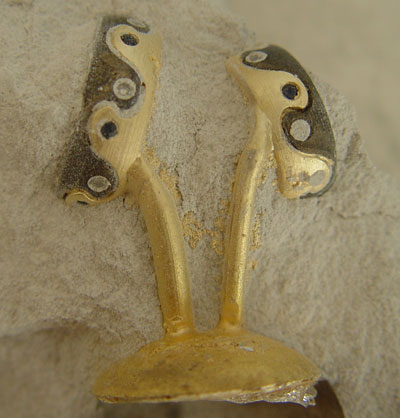
Another way to achieve a good mechanical bond is to have locks from the cast metal part extend into the wax. When you cast the second metal on the first, it essentially envelopes the locks to hold the two parts together.
The two pieces are invested together (above). The burnout and casting processes then proceed accordingly for the metal with the lower melting point. In this case, the second metal cast is 14k yellow gold (melting point: 930°C).
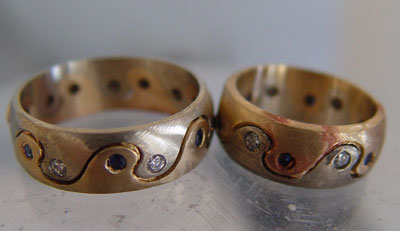
The cast rings. If you wish, you can run some solder or laser between the parts, but it isn’t necessary.
J. Tyler Teague is the owner of JETT Research in Fairview, Tennessee. Visit his website at jettresearch.com.