

Come Together (Part 2)
Tips for making tube rivets
By Arthur Anton Skuratowicz
In the second installment of this two-part series on riveting tips, I demonstrate making a rivet with a tube. Riveting a platinum tube into a gold ring or bangle and later flush setting a diamond into it looks great, as the platinum shows off the white sparkle of a diamond in contrast to the yellow gold background.
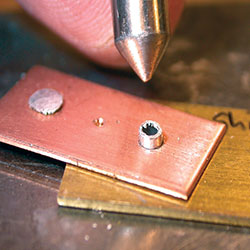
1. When making a tube rivet, use a center punch or grind a shallow taper on a steel rod.
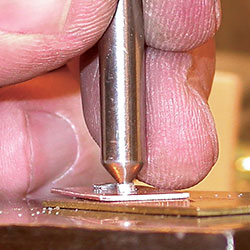
2. The tapered rod will flare out the tube end. You can then spread it further with a ball-ended dapping punch or carefully flare out the edge with a domed hammer.
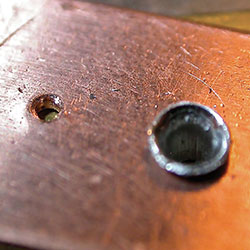
3. The flared tube edge can be filed or sliced to look like flower petals or a propeller. Here the tube end is ready for flattening.
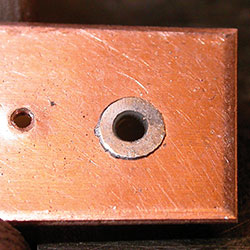
4. Finish up the tube with a flat-ended hammer to crisp up the edge of the opening.
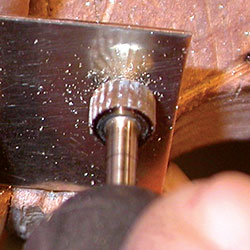
5. To make a flush rivet, use a setting bur to countersink the hole.
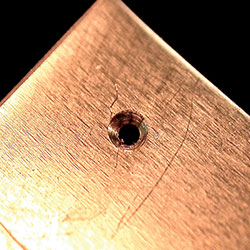
6. The countersunk hole has an angle to it, which allows for the metal of the rivet to fill into it, thus making the rivet flush.
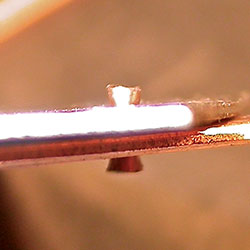
7. Here the two metal plates are riveted together. One side will be hammered flush, while the other will have a domed top.
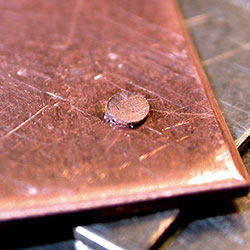
8. To prepare for using the doming tool, hammer the rivet flat. It will still protrude above the surface of the metal.
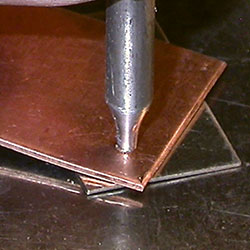
9. Position the doming tool on the rivet top and hammer. Some trial and error is needed to match the end of the tool to the rivet.
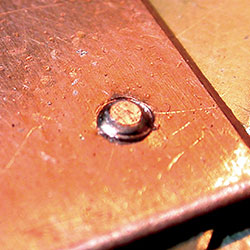
10. To clean up the domed top, detail and polish the metal frays around the dome.
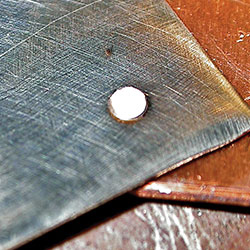
11. The other side of the domed rivet is flush. Experienced riveters can hammer and burnish the rivet flush. Otherwise, some sanding and smoothing is needed.