

Gemstone Buying Guide
Selecting quality & unique gemstones
Beauty, rarity, durability: Discover the attributes that attract us to colored gemstones and what makes gemstones valuable and precious. Colored gemstones provide the opportunity for unique personal expression and can fit all budget ranges.
FIND YOUR FAVORITE
Learn about individual gemstones in our alphabetized guide.
How Gemstones Are Graded
While gemstones have similar quality factors as diamonds’ 4C’s – Cut, Clarity, Color and Carat – they are valued differently. Color is by far the most important factor for colored gemstones, whereas cut is usually considered the most important C for diamonds.
Gemstone Color
Most colored gemstones derive their beauty from their color, like purples, blues, greens, yellows, oranges, reds. Three factors relate to a gemstone’s color:
Hue: the pure color on the spectrum, describes the dominant color and any additional colors visible in a gem.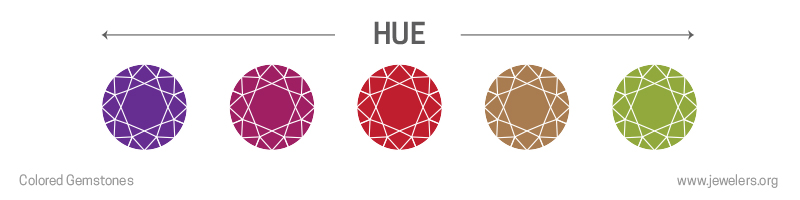
Tone: the lightness or darkness of a color. In the GIA color-grading system, tones range from very light to very dark.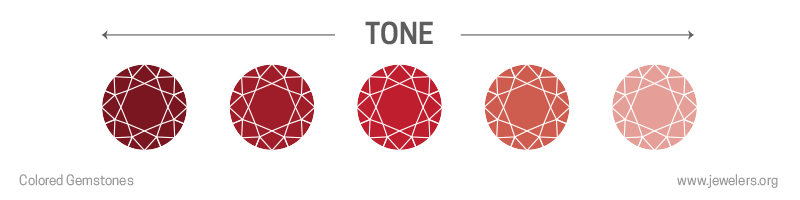
Saturation or Intensity: is the purity of the hue.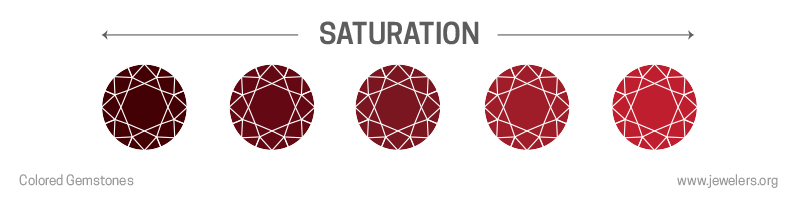
When buying colored gemstone jewelry, select what you consider beautiful. Because of the subtle differences in the tone and hue of gemstones, look at several options to find the one you prefer.
Each gem variety has an optimal hue, tone and saturation; ask your jeweler to show and explain how gemstones each exhibit their optimal color.
Cut
Gem cutters, also called lapidaries, work to achieve a desirable mix of color, weight and a safe shape for mounting. During creation, a gemstone’s size is constrained by nature. For example, while large-sized amethysts are readily available, a large alexandrite is extremely rare.
The cut describes the shape and how it’s fashioned. Some gemstones, such as opal, are suited to a smooth, rounded surface. Others, such as sapphire, are more frequently shaped with a precise series of flat, symmetrical planes called facets, which create an illumination of the gem’s color. Some cutters today may also use convex or concave facets, shaping colored gemstone like small sculptures. A well-cut colored gemstone will have its own individual and beautiful sparkle.
Clarity
A colored gemstone’s clarity contributes to their beauty. Unless a gemstone is opaque and blocks all light, how light moves through the gemstone affects its beauty. Some gemstones have few internal inclusions to interrupt the passage of light, as is the case with most pieces of tanzanite. Gemstones can also have characteristic inclusions; for example, some emeralds have a “jardine” (garden), which makes each gem truly unique. Typically, the fewer inclusions a stone has, the more valuable it is but these “imperfections” also make a gemstone unique.
Size
Gemstones are measured by carat weight, as well as dimensions in millimeters. Millimeter size is taken into consideration when matching colored gemstones for a ring, earrings or other types of jewelry.
Durability
A gemstone’s ability to be fashioned, mounted and worn is a function of how durable it is – a matter of both hardness and toughness. Some gemstones, such as sapphire, ruby and garnet, are well-suited to an active daily life and work well in rings, bracelets or cufflinks. Others, such as emeralds, pearls and opals, call for earring or necklace mountings to keep them beautifully displayed but out of harm’s way. Moh’s hardness scale lists the standards of a gemstone’s hardness levels: the closer a gemstone is to 10, the harder and more durable for everyday wear it is.
Enhancements
In certain gemstones, color occurs naturally while others need some assistance to get to the final color. Many gemstones are treated or enhanced in some way, such as with heat or safe irradiation, to achieve beautiful colors or clarity. Treated gems are not considered rare, but they can still be very valuable.
While treated gemstones are still natural, jewelers are legally obligated to disclose any treatments a gem has received prior to making a sale. Full disclosure of gemstone treatments isn’t just a matter of obeying the law; it’s about the ethics and obligations of a jewelry professional.
Some jewelers also treat lab-created gemstones. These gems have all the optical, physical and chemical properties of naturally occurring gemstones, but they are created in a laboratory rather than occurring in nature, then treated to achieve the final appearance. Jewelers are also required to disclose if a gem is lab-created and treated.
When looking at gemstones, ask your jeweler about the stability of the treatment – if it is permanent, long-lasting or short-lived – and if any special care is required. The gemstone’s report should also contain the treatment details.
Some common gemstone treatments include:
- Bleach: Chemically treated (hydrogen peroxide) to alter or remove color, and is practically undetectable, even to the trained eye. Used for pearls and jadeite jade.
- Diffusion: Heat treating a stone and adding other elements, like beryllium, to permanently enhance its color. Most often seen with corundum, which are rubies and sapphires. This treatment is not always the most stable, and can fade with time and exposure to certain elements.
- Dye: A process that dates back to the first century A.D. and is most often used on lower quality pearls as well as turquoise, black onyx, lapis lazuli, chalcedony, emerald, quartz and ruby. Dyes can fade over time or alter, so do not expose to acetone, rubbing alcohol and prolonged direct sunlight (like a day at the beach).
- Filling: The process of filling small fractures or cavities in the gemstone with glass, resin, oil or wax to smooth the surface and enhance clarity. Seen in diamonds, rubies, emeralds and sapphires. This enhancement is not permanent. Avoid high heat, hot water, changes in air pressure and household cleaners, which can potentially alter the filler.
- Heat: Gems are exposed to high temperatures to permanently alter their color. This is one of the most common gemstone treatments; over 95% of all rubies on the market today are heat-treated. In most cases, the treatment improves the gem’s apparent color and/or clarity. Traditional heat treatment results in a very durable gem requiring no special care or handling issues. Common heat-treated gems include amber, amethyst, aquamarine, citrine, ruby, sapphire, tanzanite, topaz and tourmaline.
- High Heat High Temperature (HPHT): HPHT is used for diamonds, permanently changing brown diamonds to colorless or yellow, orange or blue. Colored diamonds treated this way are not considered natural colored diamonds.
- Irradiation: Uses small doses of radiation to physically alter the gemstone’s color permanently. Blue topaz is achieved through irradiation combined with heat treatment. Irradiation may also treat sapphires, quartz and colored diamonds (like black, green, blue, yellow and red).
- Oil: A treatment for gemstones with surface inclusions, like emeralds. The oil smooths the surface and improves clarity. This treatment is not permanent and care must be taken to avoid ultrasonic cleaning techniques. Take this gemstone jewelry to your jeweler for professional cleaning.
Determining Gem or Diamond Treatments
Qualified laboratories test gemstones and diamonds for known treatments and issue reports of authenticity. A gem labeled as “natural” means no treatments have been made; “treated” or “undetermined” is used if the lab cannot determine the original color.
Jewelry Reports
To give you the information you need, many jewelers provide written notice. This information is written or stamped on the invoice or on an information card enclosed with your purchase. Be sure that you are clear on the meanings of any codes included in the report. It is important to obtain this information prior to leaving the store because it affects your purchase price, future cleaning and repair and replacements of an insured loss.
Buying Colored Gemstone Jewelry
When selecting colored gemstones, consider the following: Do you love the color? Does the gemstone have brilliance and fire? Does the gem have light throughout the stone, or are their flat areas?
Some jewelers offer loose colored gemstones and can create a personalized mounting. Discuss how you see yourself wearing the piece so your jeweler can select mountings consistent with your lifestyle.
Gemstones can be personal and meaningful, especially when it comes to birthstone and anniversary milestones!
You have the right to know what you are buying, whether it is a natural gemstone, an enhanced or treated gemstone or a lab-created gemstone. The Federal Trade Commission (FTC) has established guidelines for the jewelry industry stating that jewelers must disclose any treatment that is not permanent, that creates special care requirements or that affects the gemstone’s value. Likewise, if a material is created in a laboratory, it must be disclosed. Jewelers of America Members uphold a high Code of Professional Practices and commit to disclosing this information in the belief that a well-informed jewelry purchaser is a satisfied purchaser.