

Is 3-D Scanning Right for Your Business?
Planning for Scanning
A look at the benefits and cost of investing in 3-D scanning capabilities
By John Shanahan
(Originally Published by MJSA May 2022)
“A typical jewelry piece is everything 3-D scanning does not like,” says Srdjan Urosev, found-er and CEO of eLUXE3D in Rochester Hills, Michigan. “It’s small, detail-rich, and reflective.” Despite this, the technology, which first made its mark in the aerospace and automotive industries, is growing in popularity among jewelry manufacturers and their customers for its combination of accuracy, time savings, affordable pricing, and enhanced peace of mind for customers.
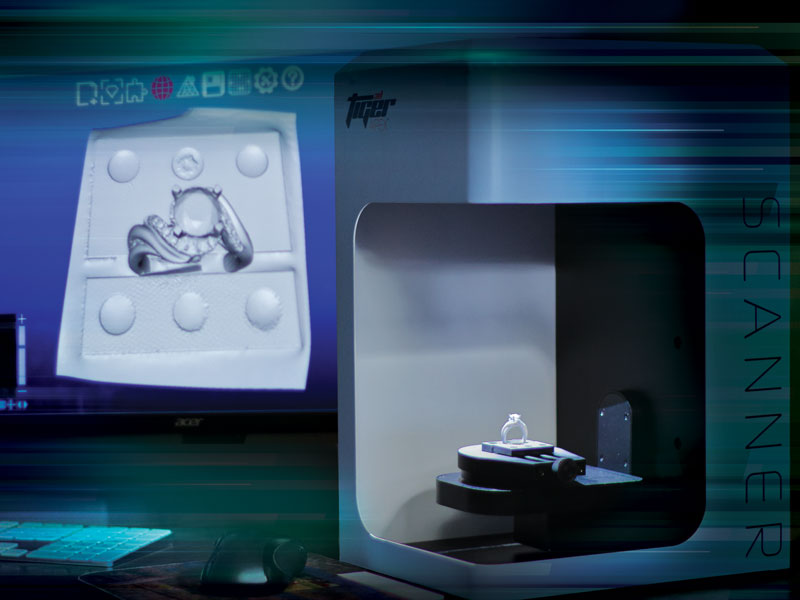
Digital 3-D scanning has been around since the 1980s, but those first iterations were incredibly expensive and, because they used touch-probe sensors to collect data, were better suited to large, flat surfaces. When the technology reached the dental industry, showing that it could be used for considerably smaller applications, it also caught the attention of the jewelry world and uses for it—along with its availability—began to flourish.
Today, jewelry manufacturers both large and small can attest to scanning’s usefulness. But what place it has in your shop, and whether it’s right for you depends largely on what you’re doing in your day-to-day business.
Shedding Light on Scanning
In 3-D scanning, a jewelry piece is placed into a provided holding device, basically a small clamp or ring jig, on a platform or arm that can rotate and move through two or more axes. A light pattern, typically a series of lines, is projected onto the piece and picked up as data by one or more high-resolution digital cameras. To keep the light from reflecting off the metal and either distorting the scan or rendering it useless, each piece must be coated with a spray that turns the surface a flat white. (Pieces such as raw castings that are not reflective do not need to be sprayed.) This coating can later be removed in an ultrasonic cleaner. The scan data can be sent to a CAD system for refinement and for later output to a digital printer for production.
Camera resolution plays a vital role in scanning, and potential buyers have options. When looking at a scanner, there are two terms to pay attention to: megapixels and field of view (FOV). Megapixels is the resolution of the camera and the projector; the higher the number of megapixels, the better the resolution, which means greater detail. FOV is the observable area that the scanner can capture in an individual image, which in turn defines how small an object you can scan. Ideally, you want a scanner with an FOV measurement appropriate for smaller items.
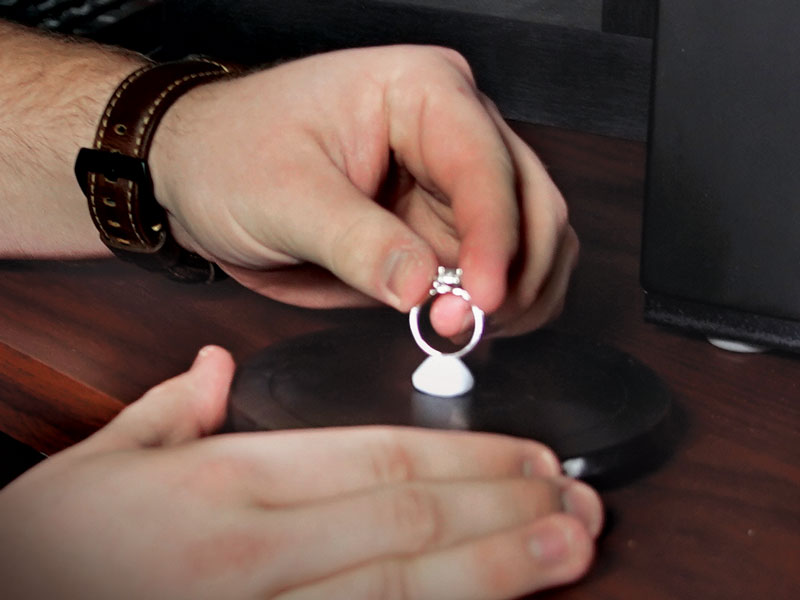
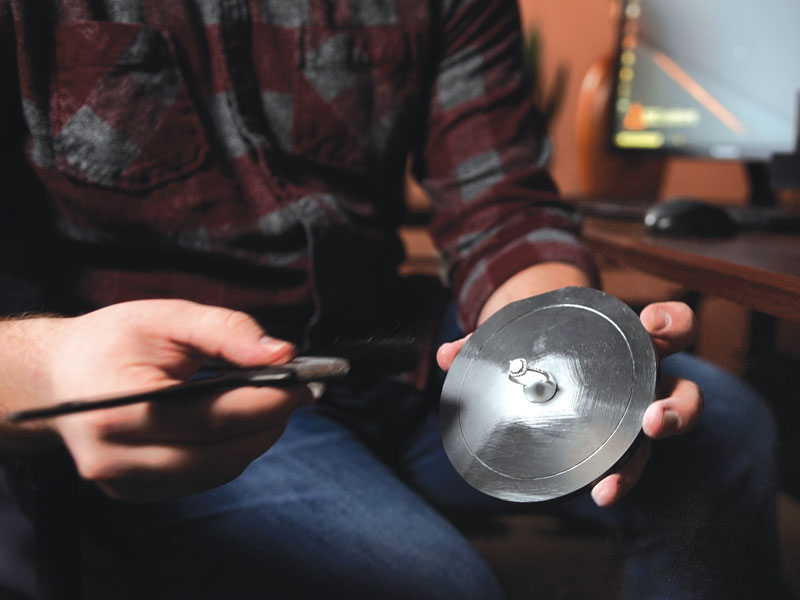
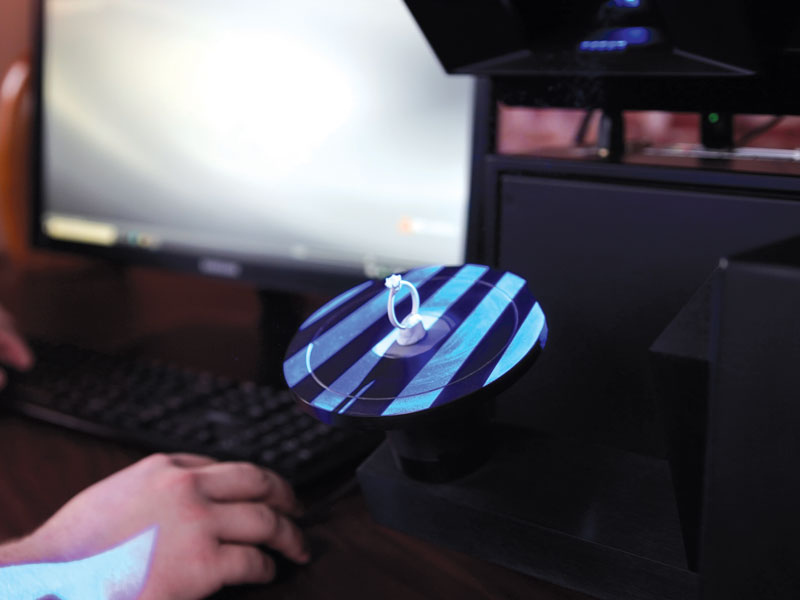
Due to possible reflectivity issues, most jewelry items must be coated with a spray that turns the surface a flat white before they can be scanned.
Many scanners on the market now have cameras with resolution ranging from 1.3 to 6.4 megapixels, with accuracy to as small as 5 microns (0.015 mm). This matters when attempting to pick up very fine detail without having to do too much additional work in the CAD file. Your choice of resolution may depend on how much detail you need or intend to add or refine yourself.
For Fernando Cortes, owner/operator of Red Door Distributions, a supplier and jewelry manufacturer in San Diego, resolution was one definite selling point when he bought a system from B9Creations in Rapid City, South Dakota. “Before B9 came out with theirs, I was looking at a scanner and the accuracy was 30 to 40 microns (0.03 – 0.04 mm). A lot of prongs in jewelry are about [that size]. It would scan but the level of detail wouldn’t be there. When B9 came out with the Scan 350 model, that accuracy was 15 microns (0.015 mm), which is plenty for jewelry. Their newest model is down to 5 microns (0.005 mm)—now you can really get into every nook and cranny.”
Travis Johnson, owner of Johnson’s Custom Jewelry in Spokane, Washington, considered several models of scanner before choosing the Tiger 3D Apex Pro from Romanoff International Supply Corp. in Amityville, New York, which comes with dual 6.4 megapixel cameras. He knew he’d made the right choice when the high resolution proved essential to one particular job.
“A customer brought in two medallions, one Saint Michael and one Saint Christopher,” he says. “He wanted to put them on either side of a class-style ring. I’m sure I could have modeled those images in CAD, but due to the amount of time to get that detail, it would have been considerably more than the customer would want to pay.”
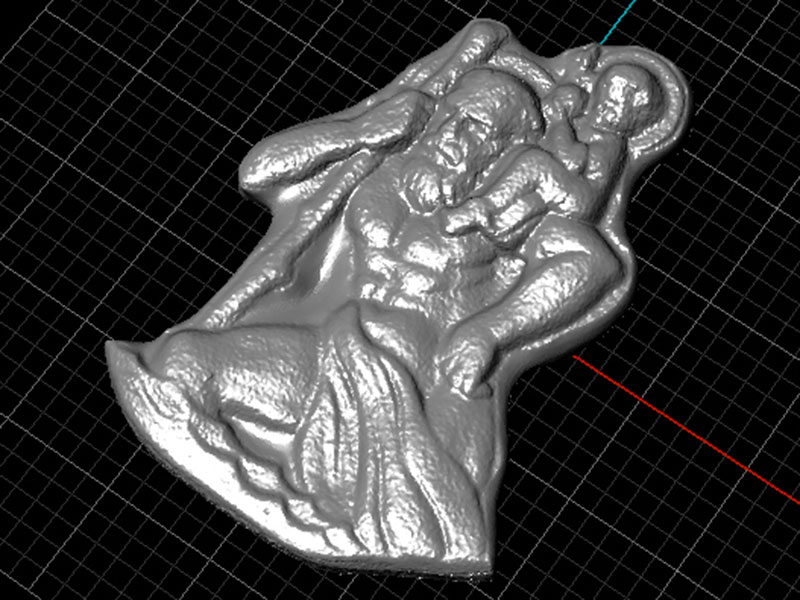
“I’m sure I could have modeled those images in CAD, but due to the amount of time to get that detail, it would have been considerably more than the customer would want to pay.” —Travis Johnson
Instead, after just 10 minutes with the high-res scanner, Johnson had perfectly captured the saints. “The detail in the faces, the chest, and stomach, were pretty amazing,” he says. From there, it was an easy task to attach the images to the ring in CAD and proceed with the job.
That kind of story makes it seem like the immediate go-to for scanning would be whatever model offers the highest resolution. But as with most things when thinking about getting into a technology, what you intend to do with it matters. Molly Hollingsworth, a bench jeweler and CAD designer with Jewelsmith in Durham, North Carolina, says her shop landed on the B9 Scan 500 based more on its acquisition volume—the size of its scanning chamber—than its 1.3 megapixel resolution.
“The volume is 90 mm wide by 80 mm high by 55 mm deep (3.5 inches x 3.1 inches x 2.1 inches), which is big enough for bracelets, objects from nature, and other large pieces,” she says, also noting that her shop handles a lot of organic-based custom work. “At the resolution that we have, we can capture very fine details, including tiny facets, engraved lines, and milgrain. In our experience, by the time a piece is grown, cast, and finished by hand, there is generally some loss of extremely fine detail anyway.”
A Question of Cost
When you’ve got an idea of the kind of resolution you want, it’s about time to head for checkout. The cost of most high-quality 3-D scanners still represents a considerable investment, but that cost is coming down. For many jewelers, watching that price point become more affordable has been a prominent factor in their purchase decision.
“We’ve been drooling over them for years and dreaming of the possibilities,” says Hollingsworth. Jewelsmith is very new to scanning, having only purchased its machine in February 2022. “We were waiting for the price to come down and for the resolution to be where we needed it to be.”
Dempsey’s Jewelers in Johnson City, Tennessee, only picked up a scanner in December 2021 once the price point was satisfactory. “I’d been looking at them for several years, but they were just too expensive,” says Clayton Stewart, the shop’s CAD designer and IT person. “I also wanted to let the technology get a little older and prove itself. We didn’t want to spend money on something where you could kind of get the form of a scan, but it wasn’t that great. Now it’s come down to where it was more feasible.”
Urosev, who sells the systems, is not surprised at this wait-and-see strategy. “Over the past several years, the price of 3-D printers has come down. Jewelers saw that and they’re saying, ‘I want to have one of these, but I’ll wait until you bring the price down.’”
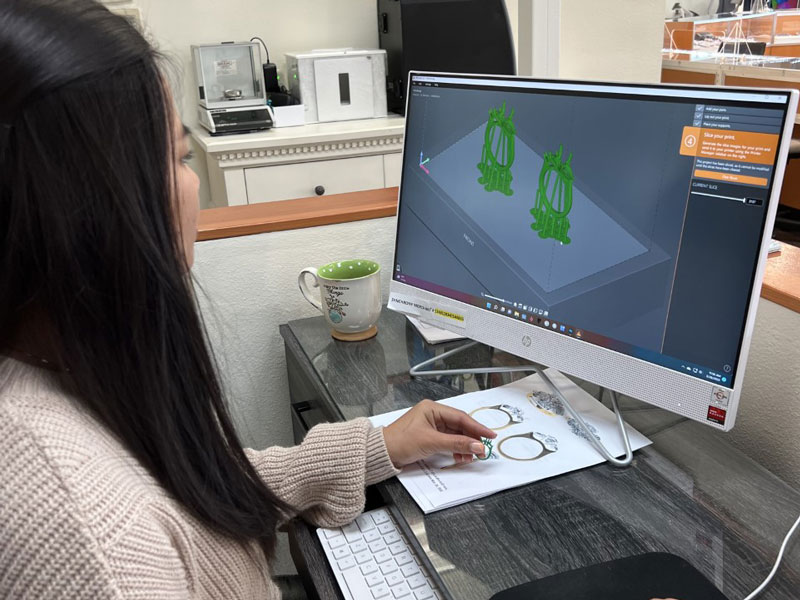
“Once we tell someone we can 3-D scan [their jewelry] and fulfill their need for whatever they want, it pretty much sells itself.” —Kathleen Kimball
He feels that what potential buyers need to look at is the cost of getting into this technology versus the cost of not getting into it. Much of that boils down to knowing how much you can actually do with it. “Many of our customers come in with one specific application in mind for scanning, but once we start working with them, they’re like, oh, I can use it for this and this, and now they’re running the scanner every day.”
Available space can also be a factor in purchasing a scanner. Every inch of floor space represents money, so maximizing its use matters. A driving consideration for Cortes in buying the Scan 350 was the unit’s small footprint and all-in-one construction. “When you’re talking about a studio, you only have so much room and there are only so many computers you can have. I wanted to get the maximum value out of the smallest footprint.”
Another important but sometimes overlooked cost of adopting the technology is the time it takes to get yourself and your staff trained on the equipment. Good news: that’s come down, too.
Getting Up to Speed
As 3-D scanning systems have evolved, their ease of use has increased to the point where performing the actual scanning has a very gentle learning curve. Many dealers and distributors provide training, which doesn’t necessarily eat up a lot of time. And if you’re already using CAD in-house, that part of the learning curve flattens even more.
Kathleen Kimball, CEO and president of George Thompson Diamond Co. in Camarillo, California, with a manufacturing facility in Thailand, says they bought a scanner after seeing it at a jewelry show in August 2021. “Until that show I didn’t even know it was a technology we could use,” she says. Kimball chose a B9Creations system in part because the shop had already been using that company’s 3-D printer, and in part due to another B9 customer’s recommendation. “I asked a friend who’s big in manufacturing which one he used, and said he really liked this one. We took delivery in September 2021. There was a little bit of a learning curve with it, so we really started using it as a sales and manufacturing tool in December.”
Johnson, with a 15-year background in CAD design, says he got his system up and running easily. “I watched a demonstration at JCK and I spent half an hour with someone via computer when I got it, and that’s all the training I’ve had on it,” he says. “It’s easy to use. The software that comes with the scanner is pretty basic. There are only a couple of options. You put the part in there for the initial scan and you set up where your platform is and hit ‘go.’ There’s not much more to it, though you will sometimes need to change the angle and scan again to capture everything.”
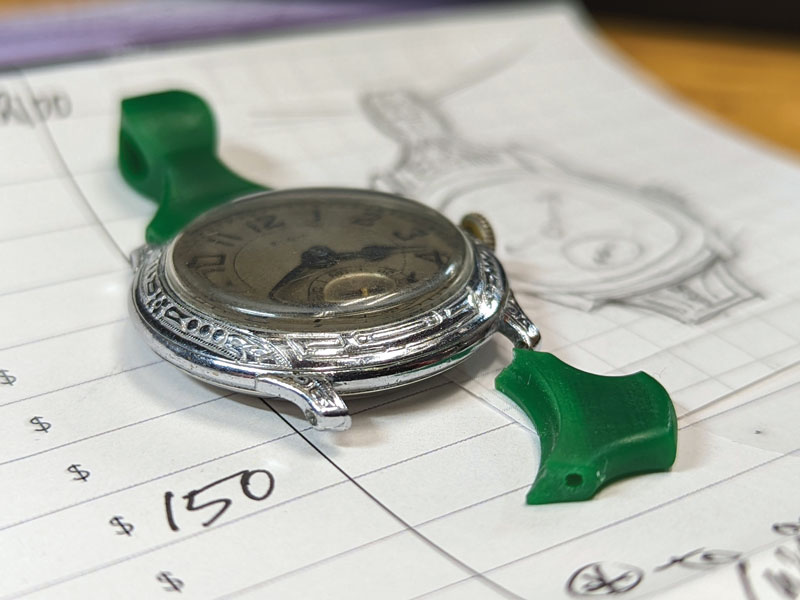

One of the key considerations when purchasing a 3-D scanner for Molly Hollingsworth of Jewelsmith was the size of the scanning chamber. Her shop settled on a scanner with a chamber that is large enough to scan bracelets, objects from nature, and other large pieces.
On the output side, having some background in CAD helps but it’s not a deal-breaker. “It can help you navigate through the system faster, but we have a lot of customers who buy a standalone unit and train someone just to scan,” says Cortes. “Then once they have the scan, they send the file off to the CAD designer and they have everything they need to work with. I like that you don’t need a slew of complementary skill sets to use it, but if you do then that learning curve reduces.”
Where the CAD background helps is in cleaning up the digitally output file. While a scanner can pull in images of a piece and pull together the disparate scans by adding some reference points with a few clicks of the mouse, it still doesn’t know what it’s looking at. “The scanner doesn’t know what’s up and down, left or right,” Johnson says. “When the STL file comes into CAD, it’s tilted on all axes to some degree, so I have to get it straightened up in the viewpoint so I’m looking at it correctly.”
Khadee Monroe, CTO of Carrera Casting in New York City, notes that scanning is a step in a process—not the entire process itself. “It’s not like it’s one scan and you have a digital copy,” she says. “You have a scan that does about 85 percent of the work for your CAD designer, and then they can do their additional touch-ups and it’s good to go.”
Time Is Money
Everything that gets done in a jewelry operation, no matter how simple, represents a cost. Reducing time means reducing costs. Reducing costs means a more profitable operation. So, a technology that saves time and enhances productivity puts dollars in pockets.
Cortes says he’s always been on the lookout for the next technology that can offset some of the inefficiencies of making jewelry. He got into CAD to enhance his design processes, and 3-D printing to pick up time lost to hand carving. For him, 3-D scanning falls into that time-saving category.
“You’re buying time,” he says. “The traditional way to create something digitally is difficult. You can only take so many pictures of an object and import them into a CAD software and try to place them where you think they line up. That drove me crazy because we spent a lot of time on it and it’s not like you can charge the customer a whole lot more for your setup time to make a model.”
For Kimball, the efficiency of scanning became a lifeline for her company when the pandemic and its impact on shipping schedules complicated being able to get orders to its facility in Thailand. “When we would have a special or custom order, we used to send it over to Thailand and do everything there,” she says. “But without having the ability to go back and forth, we had to come up with a solution to continue to offer custom work to our clients. We got the 3-D scanner, and we could scan rings, make replicas, whatever we needed to do to fulfill our clients’ needs.” The technology now allows them to keep some jobs in-house when needed, while some still go to their jewelers in Thailand.
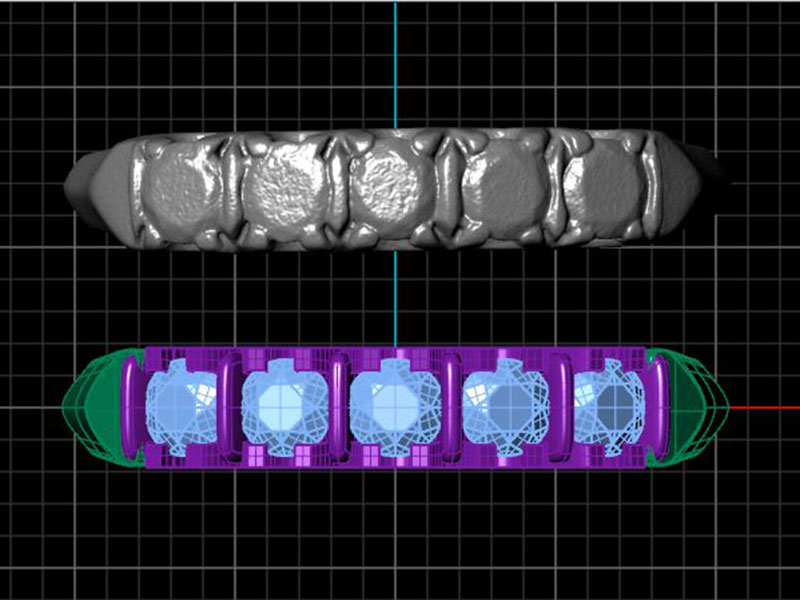
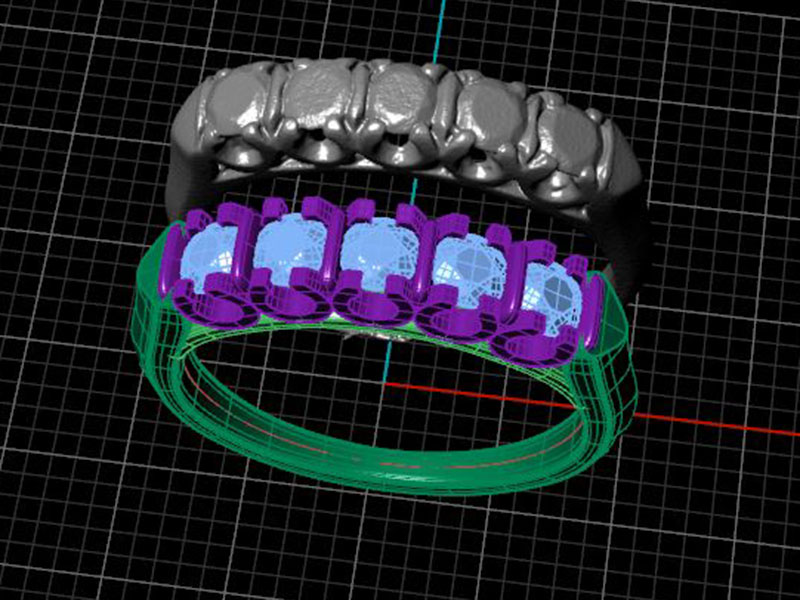
“It’s best suited for scanning a part that you either need to work against, like a matching band, or if someone has an antique ring that’s worn and they want to remake.” —Clayton Stewart
Johnson experienced the time savings first-hand when a bout of COVID-19 put him briefly out of action. When he recovered, he was close to the deadline on creating a bezel-set shadow band for a client’s very organic, freeform engagement ring. “I had less than two days from when I got back to produce a wax for it,” he recalls. “That first day I scanned it, imported it, designed the band against it, put it on the printer that night, and the next day she got to come in and look at a wax. And it fits perfectly without having to make any adjustments.”
In terms of saving customer time, it’s more about reducing the time they need to spend apart from their jewelry. If a customer wants a shadow band, like Johnson’s client, the normal route would be to take in the piece, set aside time to get photos, take measurements, and input data into CAD, all of which can add up to a day or more where the client has to trust that their jewelry will be safe. Well, not anymore.
“Before, if someone wanted matching bands, we’d make an appointment for them to leave their ring with me for two or three days,” Stewart says. “Now we tell them, we can scan that if you’ve got five minutes. We give them the ring back and I can start working on the band.”
In that regard, it’s not just saving the customer time, it’s bringing a level of trust and service that has the added benefit of peace of mind. Which, of course, is priceless.
Putting It to Work
The remaining question if you’re still on the fence about 3-D scanning is probably “What is it good for?” Frank-ly, with the advancements in technology over the last few years, the short answer is: just about anything. But one of the most popular things to do with the technology is to create shadow bands.
“It makes them so easy,” Johnson says. “I have a customer whose fiancée and her sister got their grandmother’s wedding set. The sister got the engagement ring, and the fiancée got the wedding band, but she wanted to match the grandmother’s engagement ring. They were identical other than the engagement ring having a center stone that sat on top of the ring, so I was able to scan the band, then add a top and set. It was backwards from what we usually do.”
“It’s good for shadow bands and for recreating items,” Kimball says. “If someone has an earring and they lost one and they want an exact replica, it’s great for that.” As you might do in CAD, it’s just a matter of getting the image of the item and flipping it. But whereas in CAD you might need several hours to take measurements and input them, you can instead spend a few minutes to get the same result.
Hollingsworth likes the way the scanner simplifies capturing the shape of unusual, freeform gemstones. “It makes it more efficient,” she says. “Where before you might have to spend hours fitting a stone with an eccentric culet, now you can get your seat pretty close to where it needs to be and just touch it up a little in the metal. It saves a lot of time.”
“It’s best suited for scanning a part that you either need to work against, like a matching band, or if someone has an antique ring that’s worn and they want to remake it as closely to the original as possible,” Stewart says.
The small footprint of some scanners makes for an interesting benefit that may not be immediately obvious: portability. “We have customers who’ve taken their scanners to bridal shows,” Urosev says. “If you can take someone’s engagement ring and scan it to get all the data, now you have everything you need for design, an advantage over anyone else there. You can quickly design multiple iterations of what that ring or band is going to be.”
Monroe says one of the most vital jobs for which Carrera is using scanning lately is digitizing its expansive collection of aging rubber molds, which is both preserving item records and simplifying storage. Digital models don’t decay and don’t require special environmental conditions to preserve them. “We’re discarding a lot of the molds now because our customers are going digital,” she says. “Some customers want to see what the difference is because they’ve just always used molds. Now we have their styles on the computer and we can print in any quantity anytime with no issues. It’s a faster turnaround. For us it saves a lot of space and time sifting through molds, going back and forth trying to locate something.” She adds that this initiative now has 10 to 15 dedicated people working on it around the clock.
And let’s not forget the “wow” factor this technology packs—and its power as a conversation starter. Johnson keeps his scanner out in plain view in the store. “Our customers love the technology we have,” he says. “I have my CAD desk out on the sales floor, our 3-D printer is there, and the scanner is right there, too.”
“I think it’s a relatively new technology to the consumer even though the industry has been using it for a while,” Kimball says. “It doesn’t take much to sell it. Once we tell someone we can 3-D scan [their jewelry] and fulfill their need for whatever they want, it pretty much sells itself. There’s no one else in our area doing it.”