

Exploring Alternative Metals for Jewelry
Against the Grain
A look at three lesser-known jewelry metals and how to put them to work in your shop
By Shawna Kulpa
Quick Links: Tantalum • Zirconium • Iron
Maybe you’re looking to hit a new price point. Maybe you want to offer your customers more options. Or maybe you’re simply tired of working with just precious metals. Whatever the reason, you’re ready to expand your skill set and try your hand at working with something beyond gold, silver, platinum, and palladium. But what metals should you try?
Although there’s a seemingly endless array of metals and metal alloys in the world, not all of them are suitable for jewelry work. Of those that are, you may already be familiar with some of the more common ones, such as titanium and cobalt. But there are some lesser-known metals that are beginning to catch the eye of jewelry consumers. This month, we highlight three of them—tantalum, zirconium, and iron—and give you an overview of why they may appeal to your customers and what you can expect should you decide to put them to work in your shop.
Tantalum
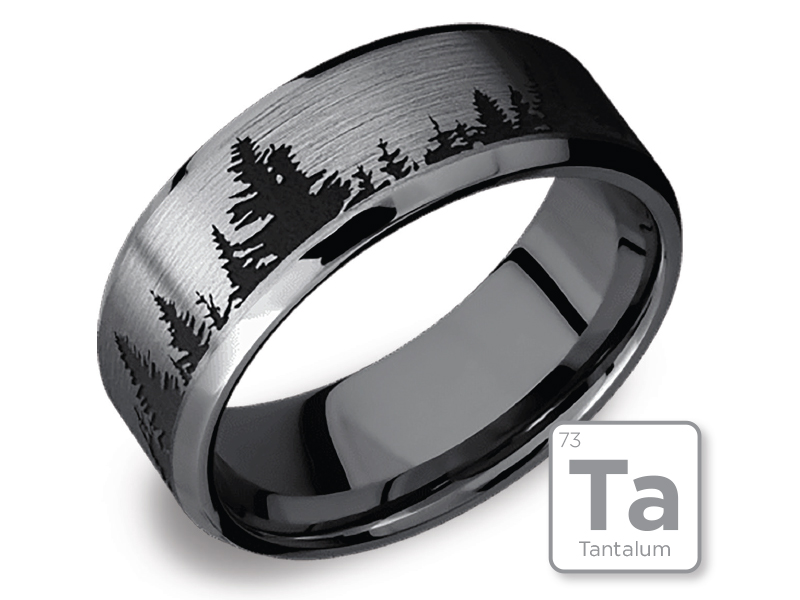
A rare metal, tantalum is part of the class of metals known as refractory metals, which are defined by their strong resistance to heat and wear. Primarily used to make components for electronics, the metal is renowned for its resistance to corrosion. It’s also hypoallergenic and is often used to make surgical instruments.
But this dark blue-gray metal may also have a place at the jeweler’s bench. Thanks in part to its high ductility, tantalum is suitable for many of the processes involved in making jewelry, including bending, stamping, and pressing.
Eric Laker, founder and CEO of Lashbrook in Draper, Utah, says his company has worked with the material for a number of years. The work started slow and involved only the occasional one-off custom request. He credits Benchmark Rings for being the first company to offer the metal as part of its regular bridal band lineup. Once more consumers started being exposed to the metal, Laker says his company saw a dramatic uptick in requests for it. In early 2019, he realized that they too needed to add the metal to its standard band lineup.
Why Tantalum?
Because it’s extremely durable and resistant to chipping, shattering, and breaking, tantalum lends itself particularly well to bands. The metal can easily withstand daily wear, which makes it especially appealing to men who work with their hands (and who like the metal’s more industrial look). It’s also corrosion resistant so it will not react after exposure to everyday chemicals, such as household cleaners.
Tantalum rings often feature sleek and modern designs, but they also offer consumers a feeling of substance and heft (since tantalum is a heavy metal). The metal’s darker hue lends itself to further customization, whether through colorful inlay or decorative engravings and finishings.
However, since it’s a relatively rare metal, tantalum tends to be slightly more expensive than other alternative metals. Depending on the options chosen, Laker says that a tantalum band could run anywhere from $600 to $5,000, but notes that the metal is still less expensive than gold and platinum.
Manufacturing
Tantalum has a Vickers hardness of 60 to 120 HV. Laker says that while the metal is more malleable than some other alternative metals and perhaps even white gold, it can be difficult. First, it’s what some jewelers might consider to be a “sticky” metal. It has a tendency to move rather than cut, Laker says, which means it can ball up if you’re not doing things just right.
“It is a pain in the neck to machine,” he adds. “It’s gummy. If you don’t use the right tools and techniques, it can actually tear.”
In additon, the metal has a melting point of 5,463°F (3,017°C), the fourth highest of all metals. That high temperature rules out casting, which is one of the reasons why most tantalum used in jewelry takes the form of wedding bands.
Repairs
Because the metal is somewhat malleable, Laker says tantalum bands can usually be sized (although, as noted earlier, it can pose challenges). However, he notes that since many of his company’s bands feature inlay or laser-engraved patterns, it’s often just easier to offer the customer a new band, especially if the ring needs to go up or down more than a full size. “It’s not even part of our business model to size rings,” he admits.
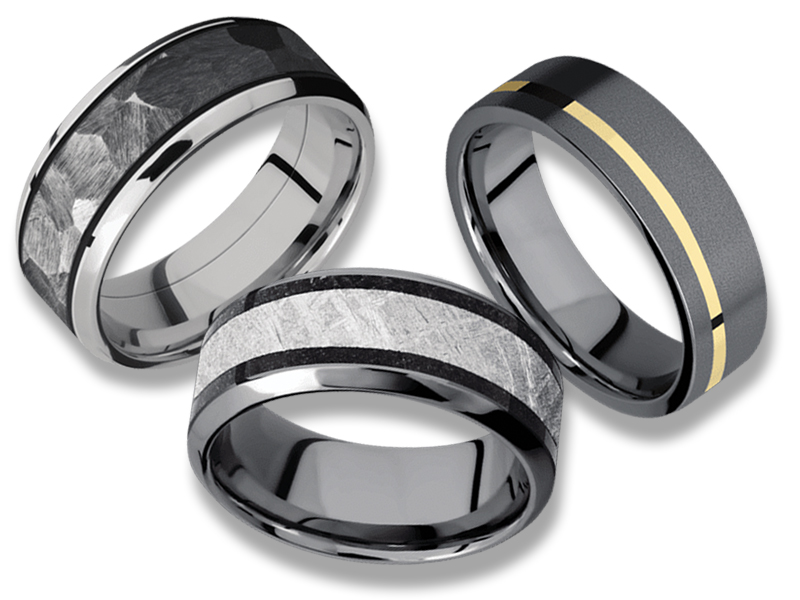
The high melting point of tantalum rules out casting, which is one reason why the metal, when used in jewelry, mostly takes the form of wedding bands.
Aside from an occasional size exchange, Laker says, Lashbrook rarely if ever has a tantalum ring come back with a problem. “It’s exceptionally durable,” he says, noting that that durability is one of the metal’s main selling features as a wedding band. “It’s not scratch proof, but with most finishes, you’ll probably never notice a mark on it.” If scratches do occur, the metal can often be polished back to its original luster.
Treatments
Tantalum jewelry is usually offered in one of two shades: natural and darkened. While the metal can be darkened using a simple heat treatment to create an oxide layer, Laker hasn’t found that method to be particularly durable in the long term. However, he notes that “the color difference is subtle enough that as it wears off, you don’t hear about people being concerned about it.” If customers are bothered by the color change, the band can be heat treated again to recover the darker hue, provided that the band doesn’t have an inlay material that can’t handle the heat treatment.
Sourcing
One concern often raised about tantalum is that the origin of the metal cannot often be accurately traced, which can be an issue for customers concerned about responsible sourcing. The metal is found in just a handful of areas: Australia, Canada, Brazil, and a few African countries, including Ethiopia, Democratic Republic of Congo, Mozambique, Nigeria, Rwanda, and Uganda.
Not only are deposits of the metal relatively scarce, but the metal is also usually found in combination with niobium, which is why they’re sometimes referred to as “twin” metals. Because the process of separating tantalum from niobium is complicated, there are not many metal processors set up to handle the work, and those that do usually mix batches of the metals together for processing since the quantities being mined are generally small. This makes it next to impossible to know where the metal originated.
“It’s all being processed in Asia,” says Laker. “You might find someone saying that everything is coming from Australia, but I don’t believe that it can be certified. It’s all mixed together at the mill.” Because the metal is rare, he believes processors are happy to process whatever they can, with little regard to where it’s coming from or interest in processing small amounts separately. At the end of the day, “it’s a commodity,” says Laker.
Given the limited amount of metal available, it can be difficult to find providers if you’re new to working with tantalum. Laker cautions that you’ll likely have to look beyond your usual metal sources.
“Tantalum is not regularly sourced,” says Laker. “It’s not something most providers of metal are carrying.” This is why he says it was a bit of a struggle for his company when it first began including the metal in its regular lineup. “The suppliers that have it will be those that specialize in the very uncommon.”
Zirconium
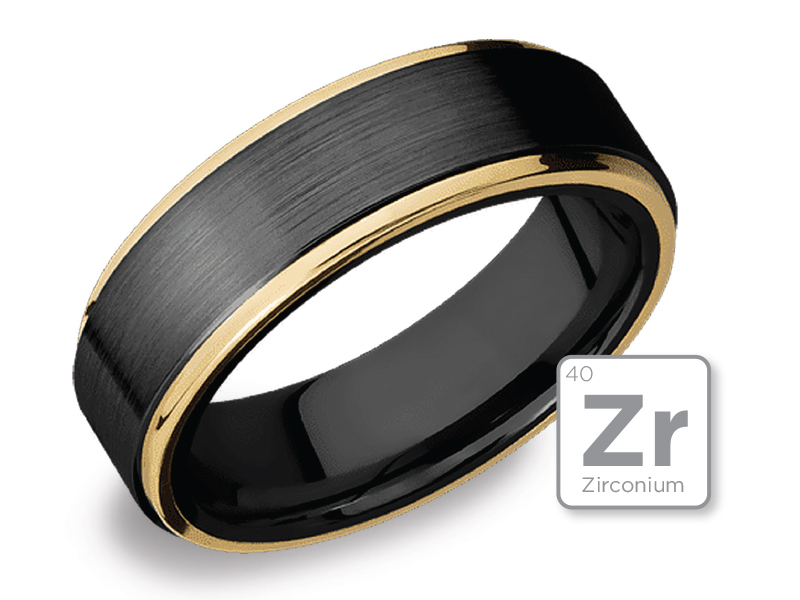
Agrayish-white metal, zirconium might initially be mistaken for other similarly colored metals, such as titanium. However, it’s unique in that when it is heat treated, it develops an oxidized layer that turns the surface nearly black.
Thanks to its high heat and corrosion resistance, zirconium has been used in many applications, including aeronautics, submarines, and even nuclear reactors.
Why Zirconium?
What makes the metal appealing to many consumers (especially younger ones seeking something different) is that hard, dark oxide layer that forms after heat treating. “It’s a great black,” says Laker. “The only solid black out there is ceramic, and you’re very limited in what you can do with it and it’s brittle.”
Actually, the black layer that forms is a ceramic, but a really tough one—it has the hardness of sapphire (around a 9 on the Mohs scale).
The metal is also lightweight, which can appeal to consumers who would prefer a piece that doesn’t weigh down one’s finger. In addition, zirconium is hypoallergenic, so it can be a good option for customers with skin allergies.
“As a metal, it’s very similar to titanium,” says Laker. “It’s lightweight and machines similarly in many ways. Compared to tantalum, zirconium and titanium are a dream to machine.” Its durability is also similar to that of titanium’s as well as tantalum’s, which makes it a good choice for wedding bands.
Depending on the options chosen, Laker says that a zirconium band might run anywhere from $400 to more than $10,000.
Manufacturing
Highly reactive with oxygen, zirconium has a high melting point of 3,362°F (1,850°C). It can be cast with special equipment, but it’s mostly limited to use in wedding bands.
In addition, when it is in powder form (such as bench or machine shavings) the metal becomes unstable and can spontaneously ignite in air—something Laker has experienced for himself. “It can combust,” he warns. His facility had a five-alarm fire earlier this year that was started when a barrel of zirconium chips ignited. While his team is accustomed to fires occurring regularly in the machines, he says, “this time we were shortsighted and didn’t anticipate it would last as long.” The heat set off the building’s sprinklers, which wound up causing the bulk of the damage. “Some of our electronics were fried,” Laker says.
Despite the metal’s ability to spontaneously combust, Laker doesn’t think many jewelers will have a problem when it comes to working with the metal. “You’re not likely to have an issue at the bench since it’s unlikely you’ll create enough heat,” he says. “But don’t have a nest or ball of chips on your bench,” just in case, he warns.
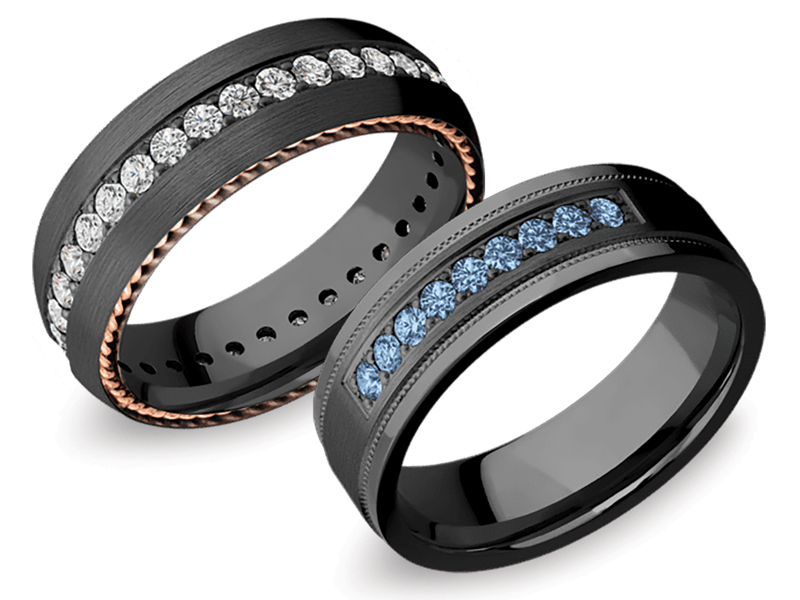
Jewelers should expect zirconium to require a little extra work at the bench. If you try to bend it, the metal wants to spring back.
Zirconium is a malleable metal, but jewelers should expect it to require a little extra work at the bench. For one thing, it has a very high modulus, which means if you try to bend it, the metal wants to spring back and return to its original shape.
“It requires more of everything,” says Laker. “More force with the hammer. More drill bits. More burs. It’s going to be relatively difficult to work with.” He notes that while the material itself is not “super hard, it is hard on tools” because it can be harder than the metals some jewelers’ tools are made from, such as steel. And if you blacken the metal, the resulting ceramic layer will be even harder.
Repairs
Laker notes that the metal is very durable. “I’ve seen rings worn for years that show no signs of real wear,” he says. “We ship probably more than 2,000 zirconium rings a month and we rarely see them come back for wear and tear.”
However, the metal can be scratched, which can remove the black ceramic layer. For that reason, customers would want to avoid wearing it during rough activities, such as rock climbing or weightlifting.
While not impossible, zirconium bands can be resized but it will be difficult, which Laker partially attributes to the metal’s strong memory. “It has such memory that you can stretch it on the sizer, and it’ll pop back,” he explains.
Treatments
While it is possible to achieve that rich, black color by heating with a torch, Laker recommends using an oven to produce a deep and even oxide layer.
The black oxide layer that forms on zirconium can be chipped, revealing the lighter color material below. While you can heat treat the piece again, Laker recommends first removing the rest of the oxide layer and then reheating the piece. Otherwise, the remaining layer of oxide can grow and darken, potentially causing a color mismatch.
“You can’t spot-check chips with heat treatment; you just wind up calling more attention to [them],” he says. If you want to refinish it, he advises, take the black off and start over.
Laker also recommends applying the heat treatment after any gemstones have been set in the band, limiting the stone options. “We allow for diamonds and sapphires,” he says. If a customer requests a softer stone, the Lashbrook team will often set the stone in a bezel that can be added later.
Many customers are drawn to zirconium bands because of the dark color palette it offers jewelers for engraving designs. The metal can be laser engraved both before and after heat treatment, depending on the type of contrast wanted. “If you want the whole thing dark, put the pattern on it first,” says Laker. “If you want a lot of contrast, heat treat it and then do the pattern. There’s an opportunity for tremendous contrast.”
Sourcing
Zirconium isn’t found in its native form but instead must be extracted from other minerals. Most zirconium is extracted from either zircon, which is predominantly mined in Australia and South Africa, or baddeleyite, which is mined in Brazil. It is estimated that zirconium is more than twice as abundant as copper and zinc, and 10 times more abundant than lead.
Iron
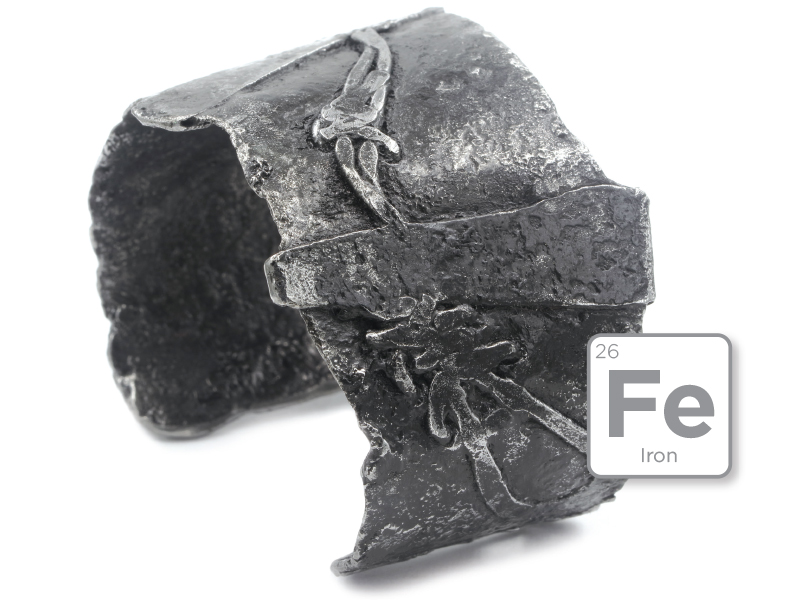
Iron is one of the most abundant elements on Earth. On its own, the material isn’t as strong as many other metals (it has a Vickers hardness of 25 to 80 HV). However, when combined with small amounts of carbon, the resulting alloy becomes much stronger. Most jewelers working with the metal are using an alloy with somewhere between 0.18 percent and 0.06 percent carbon; known as a low-carbon or mild steel, it’s very ductile and malleable. (With these alloys, the more carbon that is added, the stronger but less ductile the alloy.)
Why Iron?
Michael Edelman of M. Edelman Art in Grantsville, Maryland, notes that his customers like that the metal is unique, at least in the jewelry realm. “It offers a unique color and feel for most people,” he says. He describes the color as a “velvety black” and says that iron pieces feel like they have more heft to them than comparable pieces in silver and gold.
“Maybe it’s the function that iron doesn’t have the same price attached to it,” he says. “You don’t have to use a little to keep the cost down. An extra 3 ounces of steel in a piece [doesn’t add much to the price]; that’s not the case with an extra 3 ounces of gold.”
One of the things that Edelman likes most about working with iron is that he finds that the metal has more structural integrity than the brass, bronze, and silver with which he also works. “I can make things smaller and thinner,” he says.
Manufacturing
As with tantalum and zirconium, casting is off the table when it comes to iron. It has a melting point of 2,795°F (1,535°C) and you need to prevent the metal from oxidizing during casting.
Both forging and fabricating are options, however. Edelman finds iron to be a bit harder than silver. “It takes more force to move it,” he says. That said, “you can get quite a few hits in before it needs to be annealed.”
Edelman believes that most standard jewelry tools will work with iron, although he admits that he started making his own pliers from hardened steel because he kept breaking commercially available ones. “You do need heavy duty pliers for bending the metal,” he says.
Iron’s high tensile strength can make setting stones a challenge, as it can be hard to push the metal over the stones. “They don’t sell iron bezels for stones,” says Edelman. He’s tried making his own thin bezels from iron and even then, the metal is difficult to move around the stone.
One of the things Edelman likes most about working with iron is the fusing process, and how much simpler he finds it than soldering silver.
“With silver, if you solder it, the piece has to fit together very well” in order to get a successful join, he explains. “You don’t have to do that with iron. The pieces don’t even really have to touch” in order for you to get a perfect seam when welding.

As with tantalum and zirconium, casting iron is off the table—but it is highly durable, and can withstand a lot of wear and tear.
Because the metal can easily oxidize, Edelman recommends using a reducing flame when welding it. “If your flame isn’t exactly right, it will either not weld or blow up in your face,” he says.
Also, he recommends investing in welding goggles rather than the glasses jewelers may typically wear when soldering gold or silver. “The metal’s too bright,” he says, noting that while you can technically wear the jewelry goggles, “you’ll regret it.” He notes that jewelers will also want to weld using acetylene.
“Propane won’t work because the cone is too wide and you can’t pinpoint the spot,” he says. An acetylene/oxygen flame can be adjusted to create a reducing zone in the flame, which allows the metal to melt without severe oxidation. Propane needs four times more oxygen to burn, and the resulting flame structure doesn’t create that reducing zone. Edelman notes that he primarily uses a 00 tip when welding iron.
Repairs
Highly durable, the metal can withstand a lot of wear and tear from customers. Edelman has found iron to be incredibly durable. He also notes that iron rings can be resized without issue.
To help prevent rust from forming, Edelman applies an automotive clear coat to his pieces once they’re done. It appears to work well; in the 15 years that he’s been working with the metal, he’s never gotten a customer complaint about a piece developing rust.
Treatments
Iron can be heat treated to give the metal a colorful rainbow effect. Edelman notes that the effect is pretty durable, but it is not a “forever” treatment. “If you wore the piece every day and beat on it, you might get a couple of years out of the treatment,” he says.
There are also commercially available chemicals that can be applied to iron jewelry to give the metal a darkened patina. When using any of these chemical treatments you’ll want to follow their specific safety instructions.
Sourcing
Edelman notes that iron is readily available from many suppliers. Usually sold in sheet, plate, bar, and coil stock, the metal is available in a range of grades, though Edelman prefers to work with low-carbon grades 1008/1009. “They have a pinch of carbon, but it’s as close as you can get to iron,” he says.
Steel is the most recycled industrial material, which can be a selling point for those consumers concerned about the materials used in their jewelry. In addition, many steelmakers now use technologies that significantly reduce emissions from the steelmaking process.