

A Guide to Sales Prospecting in the Digital Age
Stop Waiting for the Phone to Ring
Tools and techniques to kick your prospecting game into high gear
By Andrea Hill
Prospecting is the act of searching for new qualified customers. The definition alone tells you how important it is, yet in most businesses, prospecting is neglected. Part of the problem is that people tend to confuse promotion with prospecting. And while you can achieve some prospecting with promotion, they are not the same thing. The challenge has become greater as businesses shift more and more of their sales and marketing budgets to online channels. In most cases, the things we have the least skill at (or pay the least attention to) suffer most during times of major change. This is definitely true of prospecting.

How can you keep your sales pipeline filled with qualified leads, so you can turn some of them into customers, and then loyal customers? How much time and attention will it require, and do you have the marketing and sales staff to manage it? And what are the tools and channels for prospecting today, particularly if your prospecting experience was limited to trade shows in the past?
Let’s start by looking at how things have changed, and then examine some of the tools and techniques you can use to kick your prospecting game into high gear.
Buyers Are in Control
Everything about prospecting started to change in 2007. Why? Because prior to 2007, nearly all online activity was conducted on a desktop or laptop computer. But after the first iPhone was released, the shift from desktop devices to mobile devices was swift. Suddenly, we had a whole new habit. If we needed an answer to where to find something, how much something cost, or how something worked, we just whipped out our phones and started typing (or talking). It’s not possible to overestimate how much this changed everything about selling for both B2C and B2B.
The chain of events looked like this:
- People started doing research on and asking questions of their smartphones.
- Sellers of goods and services recognized what people were searching and asking for and started to offer information about, and then delivery of, those things on their websites.
- Customers started favoring the websites that had the most comprehensive information.
- More sellers jumped on board, trying to compete for customer attention.
- Customers took control of the shopping cycle.
Today’s prospects no longer wait for a visit, a phone call, or a trade event to learn about the things that interest them. They do their own research. Prospecting has shifted from being a seller-driven activity to a customer-driven activity.
This is a good thing. Or at least, it can be, if you’re prepared with the right tools.
On-page SEO
The first, most important tool in your prospecting toolbox is your website. Or more accurately, how well your website performs in on-page SEO. On-page SEO, also referred to as organic SEO, is everything you can do directly within your website to improve your website’s position with the search engines. It includes:
• Technical optimization, which includes website speed, optimization of source code, the trustworthiness of your IP address, and overall security.

• Content, including all the text, images, motion graphics and video, and interactive elements you share on your site. How frequently you post new content and how recently you posted your last new content is critical, and content that is meaningful and unique is of the highest SEO value.
• Content structure, organization, and meta-tags.
• Internal links and structure. This is about your website hierarchy, how logically your website is organized, how many levels of navigation the search engine bots must crawl to find your content (hint: less is better), how well you avoid duplicate content, how you handle internal links, and how “friendly” your URLs are (human readable).
• Site design. Does it work on mobile? Do you minimize file sizes? Is it clear what each page is about and what you want visitors to do on each page?
When you optimize your website for all these variables, and keep improving your performance from that point forward, your website will be recognized as a trustworthy, recommendation-worthy site by the search engines. When that happens, you can use inbound marketing as your primary prospecting technique.
Inbound Marketing
At its most basic, inbound marketing means attracting new prospects by creating the content and experiences that are most valuable and interesting to them. It requires understanding your customer profile, what content matters to customers, and what search terms they use. If you understand your target customer well, you can create content that draws them to you through search.
Of course, getting them to your site is not enough. Search engines also make note when searchers click a link to your site, then bounce back to the search results. The search engines interpret that to mean that what was promised (the link) wasn’t what was delivered (on the website), and your search rating is penalized for that.
When a person searching the internet sees a well-formatted and enticing link, clicks it to land on a page offering information and ideas that satisfy their curiosity, and sees supplemental elements that establish you as a trusted advisor, you are primed to turn that visitor into a prospect. The last ingredient is information capture. You need to collect an e-mail address so you can reach out to those visitors again.

No matter what other prospecting tools you use, the most versatile, effective, value-generating tools in your prospecting toolbox are on-page SEO and inbound marketing.
When a person searching the internet sees a well-formatted and enticing link, clicks it to land on a page offering information and ideas that satisfy their curiosity, and sees supplemental elements that establish you as a trusted advisor, you are primed to turn that visitor into a prospect. The last ingredient is information capture. You need to collect an e-mail address so you can reach out to those visitors again.
No matter what other prospecting tools you use, the most versatile, effective, value-generating tools in your prospecting toolbox are on-page SEO and inbound marketing.
Customer Relationship Management
Once you capture those leads, you need a good customer relationship management (CRM) system to nurture them. Today’s CRM systems do more than manage your customer database. You should expect your CRM system to help you score the value of your leads, connect with all your social media platforms, track lead engagement with your social media and website, manage e-mail and SMS communications, and automate your marketing.
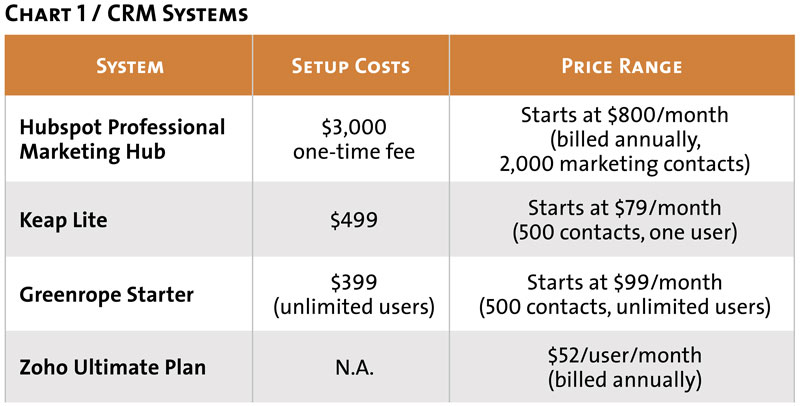
CRM systems are ubiquitous, with at least 50 non-industry-specific cloud-based systems, and at least one industry-specific option for nearly every industry. To date, there are no strong jewelry-industry-specific CRM systems, and that’s OK because you don’t need that. A general CRM system will meet the needs of any jewelry business and can even be configured to manage specific activities such as customer return and repair tracking processes.
Some fully featured CRM systems to consider are in Chart 1 (above).
Chatbots and Live Chat
When customers come to your website, they will have questions, and they like being able to get answers quickly and without picking up a phone. This is where live chat and chatbots come in.
Even the most rudimentary websites (though that begs the question, why would you have a rudimentary website?) can offer a chat feature today. Chat systems are almost always third-party, cloud-based systems that connect to your website using a code snippet. You manage the chat system through a dashboard, where you can set your availability (by schedule or on-the-fly), assign who is monitoring the chat at what times, respond to all incoming chats (both live and with automations when the system is unattended), and analyze your chat activity.
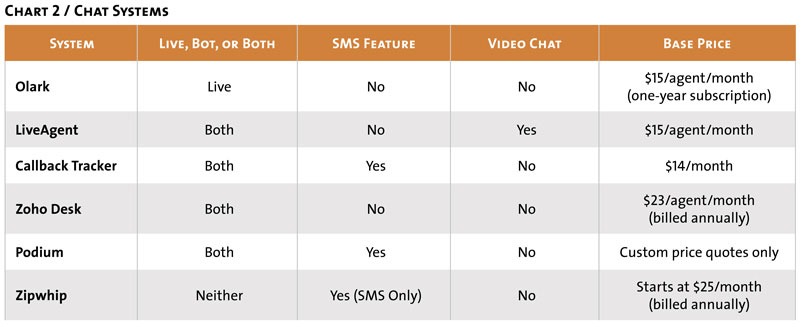
Like CRM, there are dozens of chat systems to choose from. Look for a chat system that incorporates some automation to facilitate self-service (web visitors generally appreciate that), SMS features for texting (yes, even for B2B), and ideally a ticketing or task system to turn inquiries into actions. The best chat systems integrate directly with CRM systems, so every chat gets stored in the client record. Some CRM systems either have their own chat functionality or offer a native integration. For instance:
• Hubspot offers its own chat feature.
• Keap offers simple integrations to many different chat systems.
• Greenrope natively integrates with Olark and with many other systems via Zapier.
• Zoho has a separate (from its CRM) software called Zoho Desk with a native chat app.
Chat systems to consider are listed in Chart 2 (above).
Instant Video Meetings and Booking
One of the reasons traditional trade shows worked so well for prospecting is that potential buyers attended them with buying in mind. There is no easier sale than the one in which the prospect is ready to buy.
Digital prospecting follows the same rule. When someone searches for something and lands on your web page filled with useful, relevant information, they enter that ready-to-buy state. Your online chat feature may be sufficient for helping to close the sale, but what if you need a little bit more? This is where instant video meeting and self-booking features come in.
Only one of the top chat systems, LiveAgent, offers integrated video chat. That’s a best-case scenario. But you may find that Podium, with its SMS and customer engagement features, meets your needs better than LiveAgent’s extensive Help Desk features. If that’s the case, you need a different video meeting and booking system.
This is not about whether or not you can do a Zoom call. This is about making it easy for a website visitor to launch a calendar by clicking a link or a button, selecting a time on that calendar that works for them, and knowing that they have a video meeting scheduled without having to send an e-mail, wait for a response, and endure the tedium of finding a mutually acceptable time.

You could get a Calendly account, which allows people to click a link and pick a time on your calendar. If you select the Premium-level plan for $8/user/month, you can program it to trigger a video call link (using a variety of video systems) and send it to the customer. All you have to do is show up at your desk on time, click the link, and you’re in a video meeting.
Zoom also has a booking feature called Zoom AI. If you’re already committed to Zoom as your video calling system, Zoom AI makes self-booking easy. You’ll need one of the paid Zoom plans (starting at $14.99/month) to use all the features.
Marketing Automation
Everything described so far should be coupled with collecting contact information. When someone lands on your web page, try to collect an e-mail address. When your CRM is integrated to your social media channels, try to scrape an e-mail address. When someone enters a live or bot chat, collect an e-mail address. Do everything you can to collect contact information, because less than 5 percent of all website visitors remember to return to a website they visited—even when they visited a website they liked!
But what do you do with those e-mail addresses? Let’s start with this: You don’t just send them a mass e-mail once a month. That’s like asking three people on a group date and calling them Date 1, Date 2, and Date 3. You won’t get any of them to stick around long enough for dessert.
Marketing automation is the term that’s used to describe e-mail that is triggered by a specific action, sent on a predetermined schedule, and targeted according to the type of trigger.

For example, if someone gives up their e-mail address while studying your page about custom manufacturing services, the first thing you do is send them a personalized e-mail (Dear FirstName) thanking them for their interest in your custom manufacturing services. Then, two days later, send another e-mail that asks them if they have any questions about your custom manufacturing services. On Day 8 you might send them an e-mail (still saying Dear FirstName) with testimonials from happy buyers of your custom manufacturing services. On Day 15 you send another e-mail with an FAQ about your custom manufacturing services.
Each of those e-mails will go out because they were pre-written and pre-scheduled. This fact alone makes marketing automation more effective at prospecting than most of us will ever be. Software never has a day when it doesn’t have time to send out the scheduled e-mails.
Over time, different activities on your website will trigger different e-mail automation campaigns (called drip campaigns), all of which keep your prospects connected to your brand.
Reference and Testimonial Systems
Rating, voting, and testimonial systems are all important social proof (trust) tools, but they are also important for prospecting.
Your prospects may not know you, but they likely know (or know of) some of the people and companies that buy from you. That sort of endorsement goes a long way to building confidence. Consider implementing a tool such as Testimonial Engine Pro (mytestimonialengine.com, $297/month) or Endorsal (endorsal.io, $29/month billed annually), which let you create endorsement and rating widgets for your site, request reviews from customers, make it easy for customers to post reviews to your Google and Facebook pages, and display your customer referrals on your website along with the reviews it imports from your Google, Facebook, and other review site pages.
LinkedIn is extremely useful as both a referral and a reference system. As you build your network, you can see how people you want to connect with are connected to people you already know. You can ask one of your contacts to make an introduction for you through LinkedIn, which will be interpreted much like a referral by the person to whom you are introduced.
Expert Marketing
Expertise is important for running your business, but you can also use it as a prospecting tool. Cultivate industry awareness by marketing yourself and your team as experts. The tools of expert marketing include blogs, LinkedIn Publishing (where LinkedIn members can write, edit, and share articles), informational videos, white papers, case studies, magazine articles, and conference presentations and panel discussions. Just make sure all that content lives on digitally.

For example, if you offer a presentation at a conference or on a webinar, make sure you also publish your presentation deck on your website and on social sharing network Slideshare. That way, all the preparation you put into that presentation will help you reach a lot of qualified, interested prospects over time. Plus, presentation content on your website will help build your on-page SEO.
What about Paid & Pay-Per-Click Advertising?
Pay-per-click (PPC) and paid advertising can be highly effective as sales tools—if the product you are selling is something that is easy to buy online: inexpensive, from a recognizable brand, or so wildly innovative that it’s hard to pass up. The only way to get a return on investment from most paid advertising is to get 2 percent of the people who click on it straight to a shopping cart. If you sell a product or service that is more expensive or requires a more involved sales process, then PPC and paid advertising are not effective prospecting tools.
What About Retargeting/Remarketing?
There are two types of retargeting: pixel-based and list-based. The terms “retargeting” and “remarketing” are often used interchangeably, so it’s best to be specific. Pixel-based—most accurately referred to as retargeting—involves tagging a site visitor with a pixel, which sets a cookie in the user’s browser that allows you to use paid ads to try to re-engage the user by popping up in their social and news feeds and search activity. List-based retargeting—most accurately referred to as remarketing—is only possible when you have a list of e-mail addresses or cell-phone numbers.
Pixel-based retargeting is quite difficult to personalize, which makes it an expensive option for most B2B companies (unless you sell something with really broad application, such as office supplies). List-based remarketing is much more effective for B2B budgets and purposes. Pixel-based retargeting is also undergoing a major disruption right now due to Google taking a more proactive stance on privacy. While the online advertising world reshuffles itself, you can expect advertising to get more expensive and for some retargeting programs to disappear entirely.
This takes us right back to marketing automation! Once you collect those leads (e-mail addresses and cell-phone numbers), you need to nurture those prospects with relevance and consistency.
Of course, your last option is the most tried and true prospecting approach of all—waiting for the phone to ring. But if you don’t want to put your business fate in the hands of, well, fate, you would be wise to apply these prospecting methods, one-by-one, to your business. Start at the top of the list with on-page SEO, implement it, then move on to inbound marketing. As you master each of these disciplines, your prospecting game will get stronger and stronger, your sales pipeline will fill up, and you’ll have more opportunities to complete sales.