

A Closer Look at the Orion 200x Welder
Smarter by Design
Testing the Orion 200x pulse-arc welder
By Melissa Muir
(Originally Published by MJSA February, 2026)
Pulse-arc welding technologies are becoming increasingly common in jewelry studios, workshops, and at retail repair counters as jewelers look for ways to improve efficiency while reducing costs. As these machines gain wider adoption, manufacturers continue refining their designs, making them easier to use, more reliable, and more powerful. Sunstone Engineering, whose primary focus is micro-welding technology, has long been at the forefront of these developments.
About a year ago, I wrote about the Orion mPulse, a machine that represented a complete redesign from Sunstone’s earlier models. It introduced improved energy delivery and a refined, modern interface. This time, Sunstone has turned its attention to the upper end of its lineup. The Orion 150s and 200i have been fully re-engineered and reintroduced as the Orion 150x and 200x. These are not incremental updates. They are machines rebuilt from the inside out.
About the Orion 200x
The new Orion x-series combines Smart Energy Release, True-Fire Technology, and WeldIQ to deliver greater accuracy, consistency, and efficiency. To fully appreciate what these technologies bring to the bench, it helps to first understand how pulse-arc welding works.
Pulse-arc welding falls under the TIG, or Tungsten Inert Gas, welding category. The tungsten electrode delivers the energy, while the inert gas, typically argon, shields the weld area from unwanted chemical reactions. The metal being welded is grounded using tweezers or pliers connected to the machine. When the grounded metal touches the tungsten electrode, argon begins to flow. The electrode then retracts slightly, creating a plasma arc that transfers energy from the electrode to the metal. This arc is hot enough to melt the metal and fuse it at the joint. Almost instantly, the electrode returns to its resting position and the argon flow stops. The entire process takes place in fractions of a second.
Inside every pulse-arc welder is a capacitor that stores energy. In earlier machines, that capacitor charged to full capacity for every weld and then discharged all of that energy at once, regardless of how much was actually needed. Any unused energy was converted into excess heat and internal strain on the machine, contributing to component wear and less precise welds over time.
Smart Energy Release changes that approach. Instead of charging to full capacity every time, the machine builds and delivers only the amount of energy required. If a weld calls for 10 joules, the capacitor charges to 10 joules and delivers exactly that. The result is less heat, reduced stress on internal components, longer equipment life, and noticeably cleaner welds. During testing, the difference in weld quality was immediately apparent.
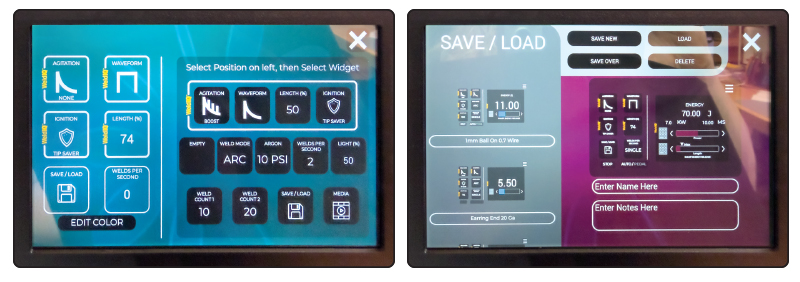
A redesigned touchscreen gives jewelers direct access to ignition modes, waveforms, and agitation settings, making it easier to dial in consistent welds.
Sunstone first introduced True-Fire Technology with the mPulse in 2024. This system addresses one of the frustrations of earlier pulse-arc welders, especially at lower wattage, where misfires could occur. True-Fire ensures that every time a weld is triggered, it fires reliably. The consistency is tangible. When holding a piece being welded, the energy feels more decisive, with a noticeable increase in punch despite using efficient energy levels.
WeldIQ brings all of this together through a digital dashboard that gives the user direct control over three key aspects of the weld: ignition mode, waveform, and agitation. Rather than relying on presets, the machine encourages a more hands-on approach to dialing in welds.
Ignition mode controls how the weld begins. What were once called Standard and Standard+ are now Precision Mode and Tip Saver Mode. Precision Mode allows the electrode to contact the workpiece directly for maximum accuracy. Tip Saver Mode lifts the electrode slightly, reducing wear on the tungsten and extending its life.
Waveforms control how energy is delivered over time. The three options are Classic, Square, and Triangle. These determine how quickly energy ramps up, how long it is sustained, and how it ends. For thicker materials, such as welding two pieces of 1 mm sheet together, I often use Triangle mode. It delivers a high peak with a sustained taper over a set duration, producing a deeper and stronger weld. Afterward, I may switch to Square mode and make another pass to smooth the surface.
Agitation adds high-frequency bursts of energy that influence penetration and spot size. The profiles, now called Soft, Standard, Boost, and Max, replace the older terminology. Adjusting agitation allows you to balance heat, penetration, and precision based on the demands of the project.
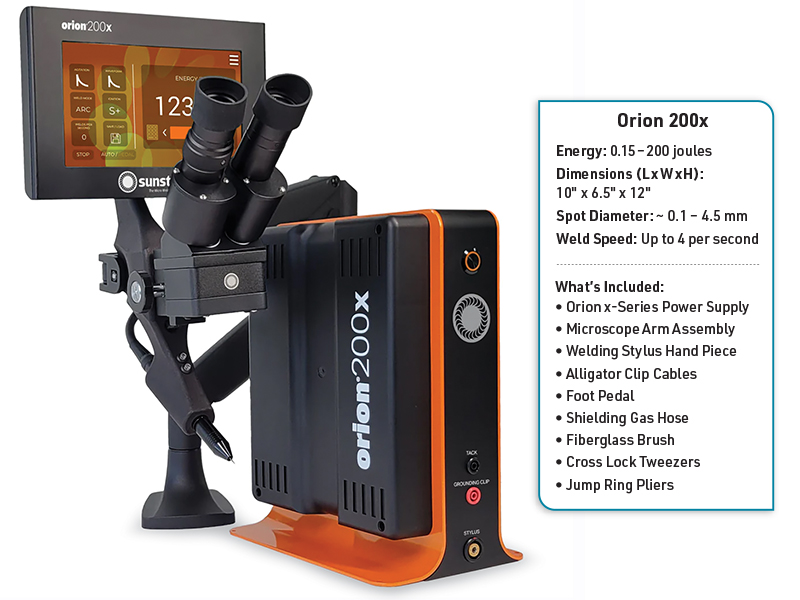
The internal redesign of the Orion x-series also results in a smaller, lighter control box with a much-reduced footprint, measuring roughly 10 inches by 6.5 inches by 12 inches. The swing-arm microscope houses an 8 inch digital touchscreen, and the welder can be triggered either by contact or with the included foot pedal. One of my favorite additions is the PowerTap buttons positioned just above the stylus that holds the electrode. These allow power adjustments without taking your eyes off the work or navigating the screen.
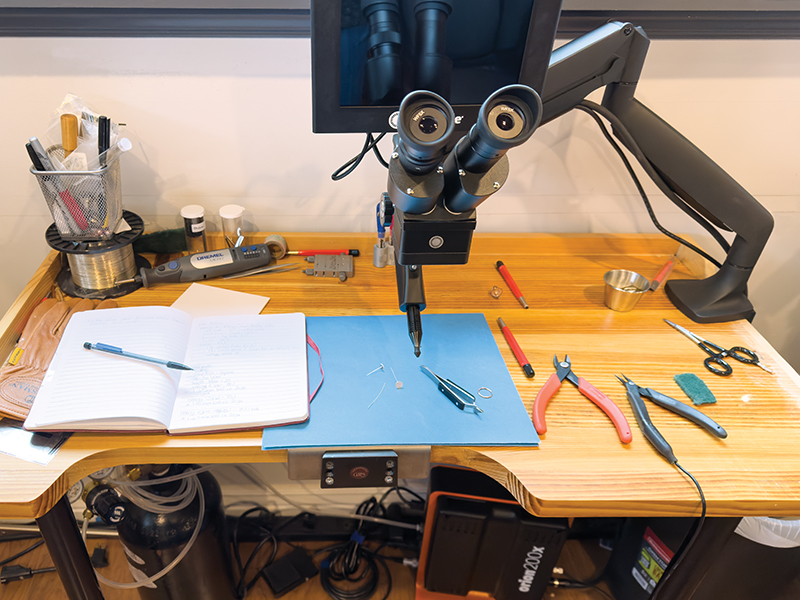
With its reduced footprint and integrated microscope arm, the Orion 200x fits comfortably on a jeweler’s bench without sacrificing power or functionality.
The user interface is clean and intuitive, making it easy to dial in settings quickly. The Orion 200x delivers energy from 0.15 to 200 joules, with a spot size range from 0.15 to 4.5 mm. The microscope provides 5x magnification and automatically darkens during a weld to protect the user’s eyes. Eye protection is critical, as looking directly at a weld can cause serious eye damage.
How Well Does It Work?
When the machine arrived at my studio, I immediately noticed that everything came in a single box rather than the two boxes required for the Orion 200i. The touchscreen is smaller than its predecessor, but the overall footprint and weight of the control box are dramatically reduced, taking up about half the space and weighing roughly half as much. Setup was straightforward, aided by a clear, visual manual that explains each component and connection. From pressing the power button to being ready to weld took less than a minute.
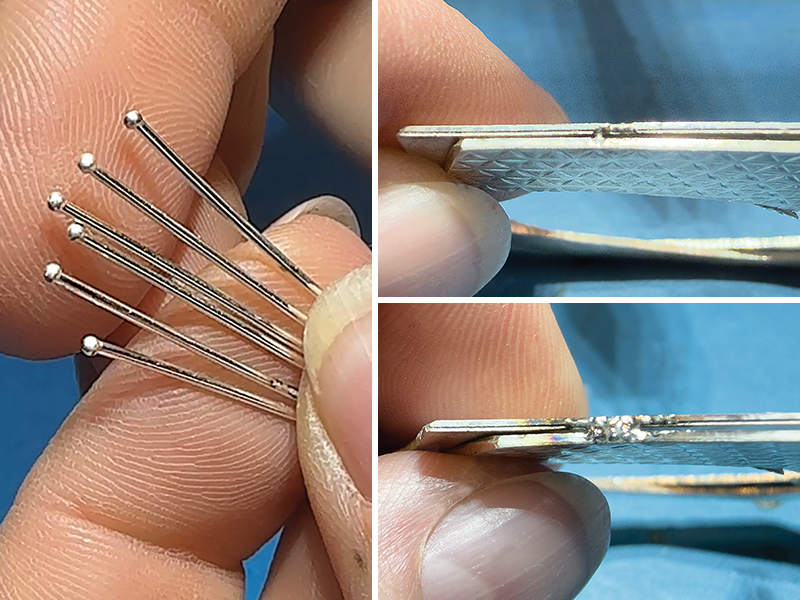
Because there are no presets, I started by working on scrap metal, changing only one variable at a time. I might select a waveform and keep the power and agitation constant, then adjust one setting to see how the weld responded. Once I found settings that worked well, I saved them to the machine. For example, I tested forming balls on the end of 0.8 mm sterling wire, adjusting settings until I achieved repeatable, consistent results. Building a library of saved profiles allows me to return to proven settings quickly and work with confidence.
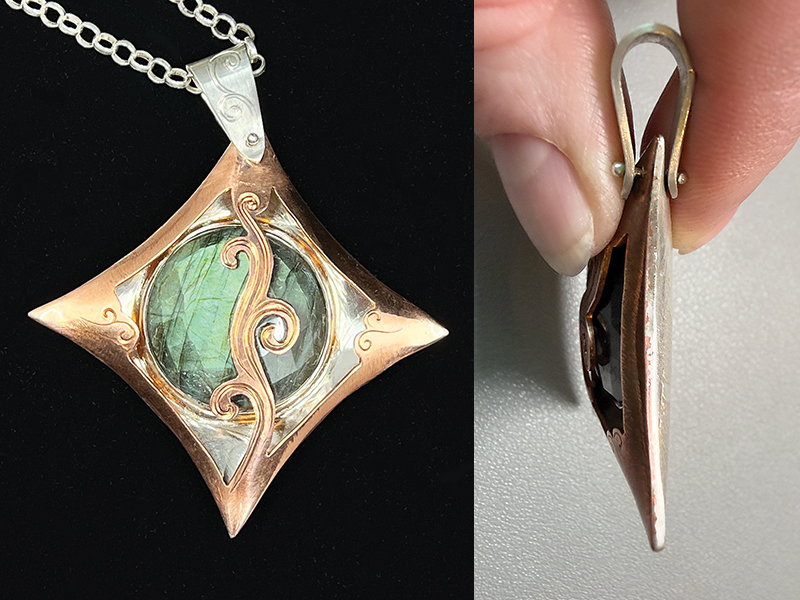
After dial-in testing, I moved on to real pieces, such as welding earring posts onto finished elements. Positioning the electrode correctly takes practice, and there is a learning curve. The only way to overcome it is time at the bench, learning how to hold and position both the tool and the workpiece for clean energy transfer.
From there, I welded two pieces of 0.8 mm sheet together. Silver and copper are among the most challenging metals due to their high thermal conductivity. Wearing leather gloves or holding pieces with pliers or tweezers helps manage this. While pulse-arc welding is generally safer for stones than laser welding, heat-sensitive stones still require attention. If a piece is too hot to hold, it may also be too hot for the stone. I keep a steel bench block nearby so I can set work down and allow the steel to dissipate heat efficiently.
Argon plays an important role in weld quality. It helps create smoother, cleaner welds and reduces oxidation. Any light discoloration that appears with argon is usually superficial and can be removed with the included fiberglass brush. Without argon, oxidation occurs within the weld itself, leading to porosity and brittleness that can cause failure. I noticed significantly less oxidation with the 200x compared to the 200i.
Having used the Orion 200i for nine years, transitioning to the 200x took some adjustment. Energy delivery is more efficient, which meant rethinking familiar settings. The updated terminology also took some getting used to, but it ultimately made more sense, as it clearly describes what is happening during the weld. The interface makes it easier to see how changes in one setting affect another. For example, adjusting energy automatically updates the maximum allowable duration based on the capacitor’s limits. This encourages efficient energy use and cleaner results. I also appreciated the ability to customize the screen layout and colors, keeping frequently used controls front and center.
Some of my favorite tasks for a pulse-arc welder include closing jump rings, repairing chains, making headpins, resizing and repairing rings, and chain making. I no longer file the ends of ear wires. By selecting a lower power setting and touching the wire end to the electrode, the tip rounds smoothly and cleanly.
Pulse-arc welders work with a wide range of metals, cost significantly less than laser welders, and require far less space. In my experience, the welders perform beautifully with gold and platinum and far outperform lasers when working with silver and copper.
When deciding between a laser and a pulse-arc welder, I always ask what metal will be used most often. Although I work with gold and other high-precious metals, silver dominates my bench work, making a pulse-arc welder the best choice for my studio. The machine also works well with stainless steel, aluminum, tungsten, and titanium, adding to its versatility for modern jewelry work.
MJSA would like to thank Sunstone Engineering for providing the pulse-arc welder for testing.