

Diamond Buying Guide
All about the world’s most popular gemstone
Rare, fascinating and dazzling, the diamond has ignited romantic passion throughout history. The word alone conjures up images of rare, precious, desirable, beautiful, sparkling tokens of love. There is a lot to learn and love about diamonds and diamond jewelry.
One of the most important aspects of buying quality diamond jewelry is where you shop. A trustworthy jeweler or jewelry store, like Jewelers of America members, will walk you through the jewelry shopping experience, answer specific questions about buying diamonds and help find your perfect diamond.
Whether your looking for a simple every-day diamond piece or a diamond engagement ring, understanding some of the basic diamond quality factors and terminology in advance of your purchase can help you feel more comfortable talking to a salesperson or shopping online.
Our Diamond Buying Guide lays out everything you need to know about diamonds.
4Cs of Diamonds
There are four factors that determine the value of a diamond, collectively known as the 4Cs of Diamonds: Carat, Clarity, Color and Cut. Understanding of the 4Cs can help you determine what qualities of a diamond are important to you and how to shop for them. A diamond jewelry purchase – whether it’s a classic pair of diamond studs or a diamond engagement ring – should never be based on the specifications alone.
While the 4Cs generally refers to diamonds, it’s important to note that natural diamonds, lab-grown diamonds and other gemstones use this grading system.
Carat
Carat measures a diamond’s weight and size. The term “carat” is derived from the carob seeds that were used to balance scales in ancient times.
Today’s metric carat is equal to 200 milligrams, or one-fifth of a gram, and there are approximately 142 carats to an ounce. Carats are further divided into points, with 100 points per carat. A half-carat diamond may be referred to as a 50-point stone.
Because large diamonds are rare, they generally have a greater value per carat. When considering the value of a diamond or gemstone, two diamonds or gems of equal carat weight can have differing price points based on the other Cs (clarity, cut, color).
Diamond Carat Chart
Carat weight compared to millimeters 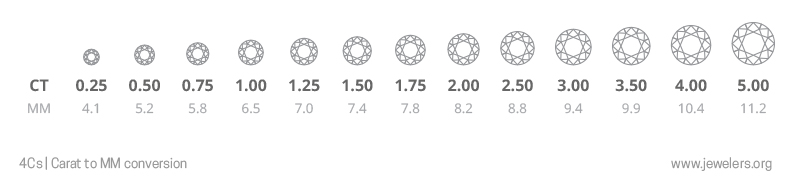
Clarity
A diamond’s clarity is affected by any external and internal characteristics created by nature when the diamond was formed or as a result of the cutting process.
Characteristics such as internal spots or lines are called inclusions. Although these marks make each stone unique, the fewer the inclusions, the more valuable the stone. Inclusions can sometimes interfere with the passage of light through the stone, diminishing the sparkle and value of the diamond. Inclusions are not generally visible to the naked eye without magnification. Blemishes, which are external imperfections that occur on the surface of the diamond, also affect the diamond clarity grade.
According to the quality analysis system of the Gemological Institute of America (GIA), clarity is graded on a scale ranging from Flawless (Fl) to Imperfect (I). Only a tiny percentage of diamonds ever achieve a clarity grade of Flawless. The closer a diamond is to Flawless, the higher the value of the diamond.
It’s important to remember that clarity is based on a grading scale and could fall between two specifications – for example, if a diamond is graded as an SI1, it could be incredibly close to a VS2.
Diamond Clarity Scale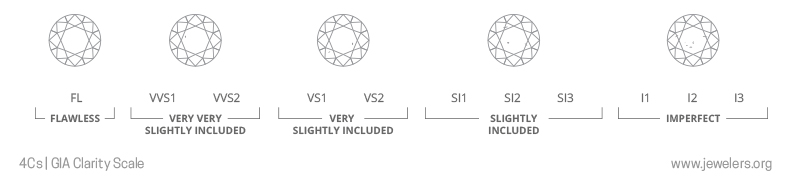
Color
Diamonds come in every color of the spectrum, but the most popular are colorless. Truly colorless, pure white diamonds are extremely rare and, therefore, the most costly. Laboratories, like the Gemological Institute of America (GIA), grade a diamond’s color using a color scale based on how far they deviate from the purest white.
The best way to see the true color of a diamond is by looking at it against a white surface. Colorless diamonds are graded D, E or F. All three grades are considered colorless but with slightly decreasing transparency. Color grading continues down through the alphabet, with each letter designating a slight darker or warmer tint.
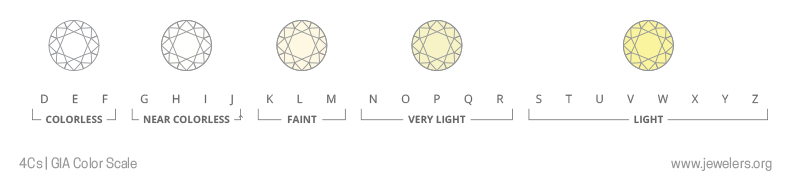
Colored Diamonds
Diamonds also come in a spectrum of majestic colors, from red and canary yellow to blue, green and pink. These colorful diamonds, known as fancies, are valued for their depth of color, just as white diamonds are valued for their lack of color. Fancy diamonds are graded in order of increasing intensity from Faint, Very Light, Light, Fancy Light, Fancy, Fancy Intense, Fancy Vivid, Fancy Dark and Fancy Deep. These colored diamonds are rarer than colorless and tend to have higher costs
Diamond color grades are determined by professionals under ideal circumstances, a situation seldom duplicated outside of a laboratory.
Similar to clarity, color is graded on a range – a diamond with a G color grade could be very close to an F or to an H.
Cut
The cut is one of the most important quality factors of a diamond, as it affects the diamond’s optical and physical properties like brilliance – how a diamond reflects light and “sparkles.”
Diamond shape is different than cut – shape only refers to the diamond’s form as a whole – such as heart, round, princess, oval – whereas the cut refers to how the jeweler physically cuts the diamond stone into its shape and to the proportions and symmetry that achieve optimal light dispersion, which affects a diamond’s quality and price.
A diamond’s light reflection, known as brilliance, is an extremely important factor in evaluating the quality of a diamond’s cut. A poorly cut diamond will actually lose light and appear dull.
The most common cut, the round brilliant, has 58 facets, or small, flat, polished planes designed to yield the maximum amount of light reflected back to the viewer.
The widest circumference of a diamond is known as the girdle. Above the girdle of a brilliant cut diamond are 32 facets plus the table, which is the largest and topmost facet. Below the girdle are 24 facets plus the culet, or point.
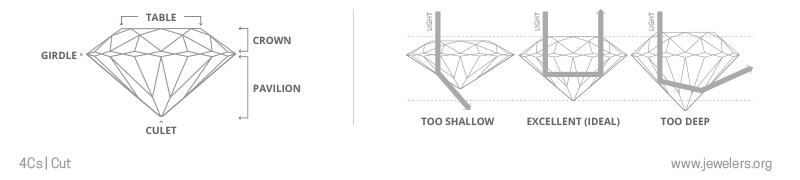
Proportion diagrams will typically include the following information:
- Depth: The height of a gemstone measured from the culet to the table
- Table: Located at the top of the diamond, the table is the largest facet of a diamond
- Girdle: Range of girdle thickness
- Culet: Appearance, or lack thereof, of the culet facet
A diamond’s cut grade impacts four aspects of the stone’s optical and physical properties:
- Luster: The quality and amount of light that is reflected off just the surface of the diamond. Luster is directly related to the hardness of the stone and the quality of its polish.
- Brilliance: The amount of white light that is returned to the eye from both internal and external surfaces. Brilliance is determined by the quality of the diamond’s polish and the number and size of inclusions inside the gem.
- Dispersion: The display of spectral or rainbow colors seen coming from the inside of a diamond. Often referred to as “fire,” dispersion is directly related to how well the stone is proportioned.
- Scintillation: A diamond will show scintillation, or “sparkle,” when movement is involved. The viewer, the light source or the diamond itself must be in motion for scintillation to occur.
Despite all of these specifications, the most important part of choosing a diamond is to finding one that appeals to you personally. While it is beneficial to understand the technical aspects of diamonds, it is most essential to fall in love with your diamond.
A Diamond’s Unique Characteristics
Diamonds may not be the rarest gemstone, but they do have a set of unique characteristics that sets them apart from other gemstones and gives them a value beyond price. When considering a diamond jewelry purchase, these are some of the stone’s top qualities:
Unique Beauty
The beauty and inner fire of the diamond has made this precious gem prized for centuries. Each stone, like its owner, is endowed with a personality and character uniquely its own.
Durability
A diamond is the hardest substance known to man, ranking 10.0 on the Mohs Hardness Scale, and are resistant to deterioration. When cared for properly, diamond jewelry can be worn every day and passed on as an heirloom to future generations.
Enduring Value
Gem-quality diamonds have consistently retained their value, sometimes even increasing in value, after years of being worn and enjoyed.
Diamond Shapes
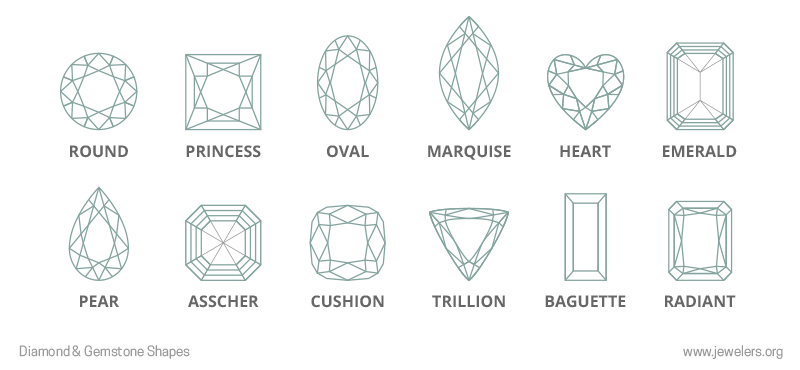
Diamonds and gemstones are cut into many different shapes, each with their own aesthetic and cutting requirements. While shapes are sometimes referred to as the cut – like emerald-cut diamonds– the cut refers to how a jeweler cuts the gemstone to achieve its symmetry and proportion.
Most people are familiar with the round solitaire diamond and common “fancy” shapes, which refer to a gemstone cut in any shape other than round. Fancy cuts include baguette, emerald, triangle, pear, princess, oval and marquise. If you are uncertain about a term used to describe your diamond, ask your professional jeweler to clarify it for you.
Use our chart of diamond and gemstone shapes to find your favorite!
Caring for Your Diamond
Diamonds may be the hardest substance known to man, but they still can be damaged, abraded or scratched. Follow these quick tips to best care for your diamond jewelry:
- Don’t wear diamonds during rough work; they are still prone to chips and scratches.
- Don’t jumble your diamond jewelry with other pieces; diamonds can scratch your other fine jewelry.
- Diamonds look best when they are clean, revealing the diamond’s fire and brilliance. Clean your diamonds regularly using commercial jewelry cleaner, a mix of ammonia and water, or a mild detergent. Dip the jewelry into the solution, and use a soft brush to dislodge dust or dirt from under the setting.
- Keep diamond jewelry away from chlorine, bleach or other chemicals that can pit or discolor the mounting.
- See your professional jeweler at least once a year to have your diamond jewelry professionally cleaned and checked for loose prongs and wear.
For more information on how to clean and care for your fine jewelry, use our guide on Jewelry Repair & Care.
Diamond Alternatives
While diamonds are a naturally beautiful gemstone, some buyers prefer alternates, or stones that mimic a diamond’s quality. Many times, alternates can provide the look of a diamond but tend to have more affordable options. It’s important to discuss with your professional jeweler if a diamond alternative is something that would suit your needs.
Lab-Grown Diamonds
Lab-grown diamonds (sometimes abbreviated as LGD) are grown in a laboratory under controlled conditions. These stones have all the same properties of a natural diamond, making them difficult to separate from natural diamonds without special training and equipment. Your jeweler is legally required to inform you if a diamond is lab-grown and the diamond must be identified with a term such as “synthetic,” “laboratory grown” or “[brand name] created.” Lab-grown options have become more widely available over the last decade; however, despite their identical look and quality compared to natural diamonds, lab-grown diamonds do not hold value over time like their natural counterpart.
Moissanite
Moissanite is a diamond simulant made of silicon carbide that closely resembles a diamond. Moissanites have grown in popularity in engagement rings, as buyers can get a larger-size center moissanite for less than a diamond and their hardness level is still suitable for daily wear at a 9.25 (compared to diamonds at a 10). Natural moissanites are extremely rare – the first moissanite ever discovered was found in a crater from a fallen meteor in the late 1800s – so moissanites used in jewelry are all laboratory-created. Once cut and polished, it is near impossible to distinguish moissanites from natural diamonds by the untrained or naked eye.
Enhanced Diamonds
If you’re looking for a colored diamond or Diamonds can be colored, tinted, coated, irradiated or heated to improve their color and clarity. Inclusions are sometimes removed with lasers and fractures filled with a glasslike compound. Some of these procedures are not permanent. While it is not always possible to determine if a diamond has been enhanced just by looking at it, it is required that your jeweler disclose this information to you and a professional jeweler will let you know if a diamond’s natural appearance has been altered.
Diamond Grading Reports
Grading reports are meant to provide clarity about the specifications of diamonds and gemstones. A grading report can help explain the quality factors like color, clarity, cut and carat weight.
While grading reports provide detailed insight into the gem, it should not be the primary factor when deciding on the stone you purchase. Visiting professional jewelry stores with gemology experts on staff to compare diamonds in person and understand their unique characteristics will help you determine the best diamond or gemstone for your budget..
Grading Report or Certificate or Appraisal?
Let’s start with what a diamond or gemstone grading report is not: it is not a jewelry appraisal or a certificate of the stone’s value. Key differences:
- A jewelry appraisal is typically used for insurance purposes and any after-purchase care or design follow up. It should not be used as a substitute for a grading report.
- A certificate guarantees the exact grade or value of the stone, while a grading report is a subjective report and offers a grade within a range of values.
Consider a grading report a blueprint of a diamond or gem’s properties that verifies its authenticity and quality. As you search for your perfect diamond or gemstone, a grading report can help explain the quality factors of the stone based on scientific properties; however, it is still subjective in that it is the opinion of the individuals who graded the diamond or gemstone and is based on the specific lab’s grading standards. This is why there are sometimes discrepancies between grading reports from different labs..
What is Included with a Grading Report?
A grading report describes in detail the characteristics of an unmounted diamond or gemstone. How that information is referenced varies depending on the lab but most grading reports contain :
- Grading results, also referred to as the 4Cs of diamond quality: color grade, clarity grade, cut grade and carat weight. The grading scales will differ slightly for colored gemstone grading reports, where color is the most valued quality factor
- The stone’s characteristics: shape, proportions, finish, polish
- Any known treatments
- Light performance: measuring the brilliance, fire, scintillation, or fluorescence (a diamond’s intensity under long-wave UV light) of the stone
- Many grading reports also include a plotted diagram of inclusions and blemishes that can affect how light is displayed. This is another area where colored gemstone grades differ because almost all gemstones have some inclusions. When considering diamond inclusions, keep in mind that truly flawless diamonds are extremely rare, representing less than 1% of all finished diamonds.
Industry standards recommend updating reports every five years. A diamond grading report can be a document of identification in the event of loss or theft.
Jewelry stores you can trust, like members of Jewelers of America, have gemological experts or gemologists on staff who understand the possible variances and subjectivity inherent in diamond and gemstone grading. They value transparency and can clearly explain the grading report.
Typically, grading reports are not commonly issued for smaller stones or antique and vintage pieces. Larger or custom jewelry pieces, such as engagement rings, will usually come with a grading report.
Who Publishes the Grading Report?
Diamond and gemstone grading reports are provided by laboratories within the jewelry industry. The following organizations are respected labs within the industry that offer diamond and gemstone grading reports or certificates:
Gem Certification & Assurance Lab
Gem Certification & Assurance Lab, Inc. (GCAL) offers a unique suite of certification, identification, valuation and forensic services for natural and lab grown diamonds, gemstones and jewelry. GCAL’s mission is to provide the most accurate and consistent gemological services with uncompromising integrity and unparalleled customer care. Every diamond is precisely measured, analyzed, photographed and Gemprinted, thoroughly grading it to the highest standards.
Gemological Institute of America
The Gemological Institute of America (GIA) offers Diamond Grading Reports and the GIA Diamond Dossier, (a more compact report for diamonds less than 2 carats). As the global authority on diamonds and gemstones, GIA established the Diamond 4Cs and the International Diamond Grading System™ in the mid-1950s. To avoid fraudulent reports, all GIA reports contain security features such as a hologram, security screen, microprint lines and a unique GIA report number.
Gemological Science International (GSI)
Gemological Science International (GSI) is the only major gemological organization established in the 21st century, founded in 2005 in New York City. Today, it is one of the largest gemological entities in the world. Utilizing cutting-edge processes, proprietary technologies and a commitment to the highest ethical practices, GSI is a global leader in natural diamond and lab grown diamond jewelry certification. They also provide manufacturers and retailers a wide range of gemstone identification and grading services.
EGL USA
EGL USA offers comprehensive reports for diamonds, colored diamonds, colored gemstones, pearls and mounted jewelry. The lab identifies treatments and enhancements and issues distinct reports for lab grown and enhanced diamonds, as well as those reviewed for light performance and cut grade. EGL USA reports are protected by extensive security features. Diamond Report numbers can be checked on their official website..
International Gemological Institute (IGI)
International Gemological Institute (IGI), founded in 1975, offers reports on diamonds and colored stones, as well as appraisals, diamond authentication and information on gemstone origins. IGI reports include all the same categories as GIA reports, as well as a Clarity Scale and Color Scale so you can see how your diamond measures against diamonds of varying clarity and color.
Is the Grading Report Legitimate?
Jewelers with a training in gemology are uniquely qualified to obtain a grading report from an established industry lab and explain its contents. Here are some things to consider when concerned about the legitimacy of a grading report.
Is the price too good to be true?
If the price is much lower than other diamonds or gemstones for the same grade on the market, you should proceed with caution. Just as with a quality car or fine leather handbag, you are not going to get a good- to high-quality ring for a significant price break.
Is the lab independent?
It’s important that the diamond or gemstone grading report is produced by an independent lab that doesn’t have a stake in the stone’s price or profit. Make sure the grading lab is independent of diamond and gem suppliers, mines or retailers.
Did more than one grader work on the report?
A legitimate grading report will use a process wherein multiple graders evaluate an individual diamond or gemstone separately. This way, because no two diamonds are exactly alike and determining the value of their qualities is somewhat subjective, the grade is established by a consensus and not one individual’s opinion.
WHERE TO BUY
Find diamond pieces at a trustworthy, Jewelers of America member store.