

What It Takes to Create Jewelry that Meets Your Standards Every Time
Quality by Design
How to create jewelry that meets your standards every time
By Sharon Elaine Thompson
(Originally Published by MJSA August, 2025)
In the jewelry industry, a company’s reputation rests on the quality and consistency of its work. Whether you’re a solo designer or part of a larger manufacturing team, the stakes are high. One subpar piece can damage a customer relationship, prompt costly rework, or erode trust in your brand. That’s why establishing a quality control (QC) system is essential.
A good QC system doesn’t just catch problems at the end of the line. It builds quality into every stage of the process, ensuring that what leaves your shop meets the expectations of your clients and reflects the standards you’ve set for your business.
Define What Quality Means to You
The definition of acceptable quality can vary widely among jewelers. One way to establish your standards is to decide “What do I want to achieve in the end?” says Karen Rice, senior consultant for manufacturing at StrategyWerx, a subsidiary of Hill Management Group in Chicago, an international consulting firm serving the jewelry and luxury goods industries. “You begin by defining your desired outcome: the stones must be a specific size, the finish should meet certain standards, and the metal must be of a particular quality, etc.”
Chris Ploof, principal of Chris Ploof Designs in Leominster, Massachusetts, looks to leading examples in the industry when setting his benchmarks. One of his product quality priorities is durability, especially for wedding bands. If someone buys a piece of jewelry that they will own forever, “they have the right to know that it will last forever,” he says. To that end, he insists that the wedding bands they make are 1.9 mm to 2 mm thick, and that they are not cast. “Our Precision Cut Precious rings are made out of drawn tubing because it’s more durable.”
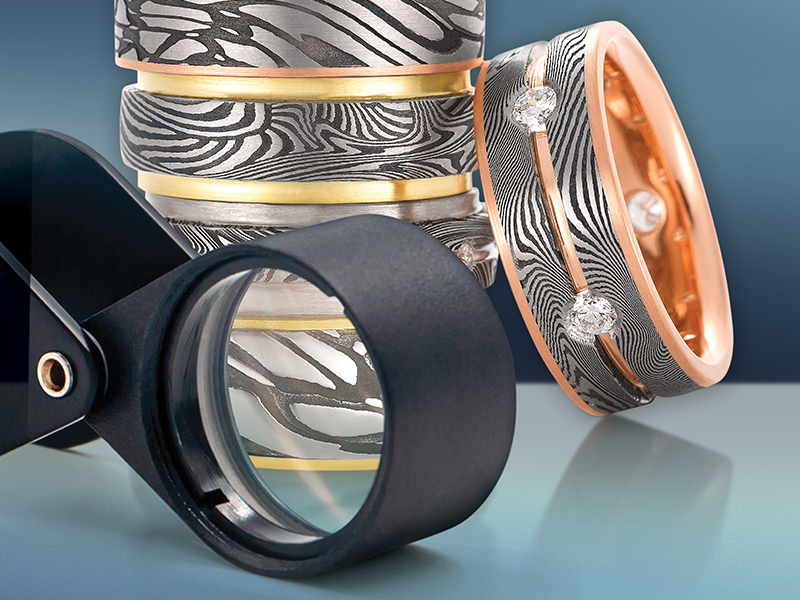
He also makes his own Damascus steel, controlling the quality of the material from the start of the process all the way to the finished rings. Even the trays that display his product at retailers are made in-house to maintain quality control. “Every bench in our shop has a microscope,” he says. “Even some of our machines have microscopes on them. We want to be able to see things really well.”

Every ring from Chris Ploof Designs reflects rigorous quality control—from raw material selection to final polish and display.
Tailor Standards to the Clients
At Au Enterprises in Troy, Michigan, which produces products for a number of customers, the quality level for each project is negotiated between the company and the client, says CEO Linus Drogs. One client may want everything inspected at 20x, under a microscope, and will reject anything that reveals a defect at that magnification. Other clients may set their quality expectations at 10x loupe clean or even just eye clean.
Regardless of how strict the standards are, consistency is critical—and that starts with documentation. Expectations should be recorded in writing and supported with photos or control samples.
For example, Rice worked for a company that did a lot of plating. “Because plating can be finicky,” she says, the company insisted that every plating batch be matched to control samples to be sure the color was consistent with what was expected. Similarly, companies can use a control sample—similar to a color grading set—to help spot gemstones that do not meet standards, she adds.
Build Quality into Every Stage
Of course, quality control isn’t just about the final check. “Ideally, quality control should be done at every operational stage,” says Rice. While most small manufacturers may not have dedicated QC staff, they can train team members “to recognize when quality has been compromised and either correct the issue and/or elevate the issue to a supervisor or manager for further investigation.”
Sharon Zimmerman, principal of Sharon Z Consulting in the San Francisco Bay area, encourages clients to map out their QC steps. “What steps have to happen before you hit that last quality control check? Do the jewelers internally need to be checking for things like loose stones or unsoldered links or whether a chain has integrity? Do jewelers have to be responsible for, say, the weight of an earring, if it’s too heavy? Or is that for the initial designer to consider first?” Knowing who’s responsible for each part of the process helps keep standards consistent.
However, manufacturing is never static, so QC standards, says Rice, should “always be evolving based on the needs of the business.”
At Au Enterprises, every project has a job bag where technicians are trained to note any changes in procedure on that bag. For example, if a jeweler uses a 600-grit wheel rather than the 400-grit on the spec sheet because the shop is out of the coarser grit, the substitution gets documented. That way, if the customer is unhappy with the finished texture the 600-grit wheel creates, you can find where in the process the alteration occurred and can ensure it doesn’t happen again.
Technicians should also record small observations, such as if a polishing compound feels greasier or grittier than usual.
On the other hand, if the customer likes the change in texture, you will be able to make the change permanent, improving the customer’s satisfaction with the product. Without a QC documentation system, says Drogs, you won’t know how to reproduce those “pleasant surprises because you don’t know what was altered or tweaked or modified” in the process that caused that improvement in quality.
Technicians should also record small observations, such as if a polishing compound feels greasier or grittier than usual. In one case, an Au Enterprises tech noted that the smell of their investment had changed, so he documented it on the job bag. “Now, it didn’t affect anything on our end,” says Drogs, “but I contacted the manufacturer, and they acknowledged that they were forced to change a raw material supplier. It resulted in a different aroma from the investment that we were using.”
However, says Drogs, if there had been a catastrophic failure in the casting, because the process of investing and casting hadn’t changed, technicians might have believed that nothing had changed. “Except somebody wrote down on the white board that the smell had changed,” says Drogs. If there had been a failure, that observation would have given the team a place to start their investigation.
When quality changes, says Drogs, “the majority of the time, it turns out to be something really small, really something subtle, but that’s the trigger that started some cascade, which then changed the whole end result.”
Experienced team members don’t just catch problems, they can suggest better ways to work. That’s why Zimmerman believes it’s necessary to “encourage honest and open communication” with your staff. After all, your end game is to deliver “the best possible experience for your consumers,” she says.
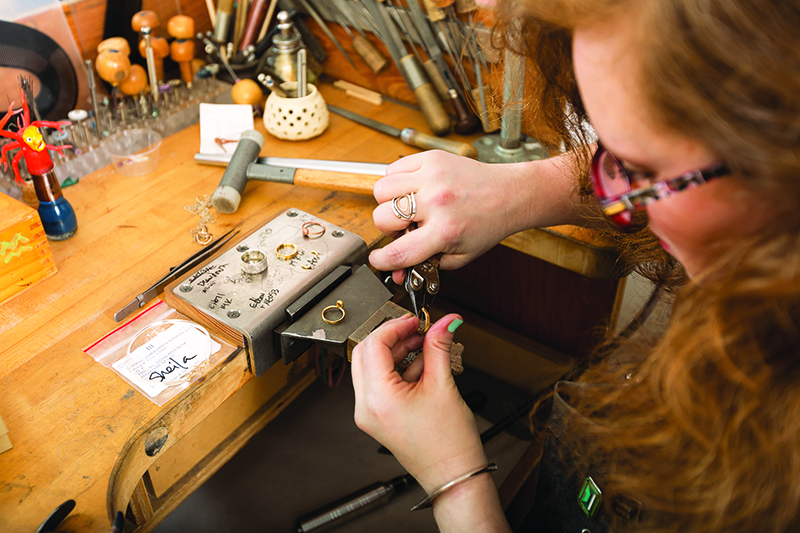
Skilled hands and sharp eyes at the bench are often the first (and best) line of defense when it comes to catching quality issues early.
Start with Trusted Suppliers
Quality control begins well before the final polish. “You have to build it in,” says Drogs. “If you inspect your end product and find that the heads are all failing (and you didn’t make the heads) [at the beginning of the project], somebody should have rejected all of those cast or sourced parts that are now in the final product that you can’t sell.”
But quality control may start even before parts get to your door. It begins with finding a supplier who will deliver dependable materials to you.
“If you want to be at the pinnacle of quality assurance, I think it’s got to start from the second you bring anything into the building,” says Ploof. One way he does that is by using an X-ray fluorescence (XRF) analyzer to verify the metal’s karatage and alloy content before anything is put into production.
“We actually did documents for our vendors,” says Rice, recalling a company for which she used to work. They set thousands of stones a year, and to fit the settings precisely, the stones had to be cut within strict parameters. “We didn’t want a setter to get a stone, then have to spend time adjusting the setting to get that stone to set,” she explains.
Zimmerman recommends including expectations in vendor agreements and supplying control samples when necessary. In some cases, even providing tools may be required to achieve the desired result. “Maybe that’s just part of the cost of doing business,” she says. “But at the end of the day, this is all about ensuring that you’re shipping a product that you can stand behind. If it costs a little more upfront, it will cost you a lot less later.”
Create a Foundation for Training and Growth
Having QC standards and a procedures manual makes training easier and more consistent when you hire someone new, or even if you are just bringing in temporary workers to help you prepare for a show. “You can at least say, this is how we mix investment. This is how our burnout schedule works. This is how we size a ring,” says Drogs. Established rules and standards ensure that “a team is working together, as a team, and not a group of people all working independently.”
No matter the size of your operation, the lack of a QC system puts your business at risk, both financially and reputationally. Some makers avoid QC because they fear they’ll discover too many flaws. “That should be a sign that maybe you need quality control more than you think,” says Ploof.
Others might put quality control on the back burner because it’s expensive, in terms of time, effort, and energy, to establish and maintain such a system, and it can take time before the benefits become clear, says Drogs.
But most often, says Zimmerman, it’s because quality control is “just not a priority in the beginning, until something happens that makes it a priority.” Perhaps you ship an order that the retailer rejects. “I’ve absolutely seen entire orders get rejected because chains were not up to snuff, or the sizing was off, or stones were loose. Then suddenly you’re out thousands of dollars.”
That’s why Zimmerman encourages multiple checkpoints, including one final review before shipping. “I’ve worked with some designers who have felt that some of those checks and balances were a little too oppressive,” she says, “but it’s actually so vital, because it’s still about building relationships and it’s about not costing you money.”
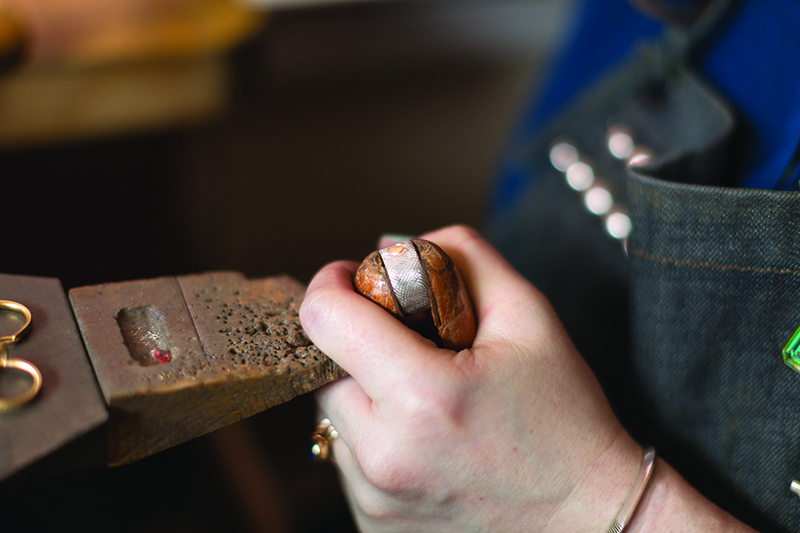
Every jeweler plays a role in quality control, spotting potential issues early and taking pride in delivering work that meets the highest standards.
Quality Is an Investment
Without quality control, the consequences are clear: lost customers, increased rework, and higher scrap rates. “There are many negative issues that occur when you don’t have a fully functioning quality control system,” says Rice. But with a system in place and proper training, expectations are clearer, repair rates go down, and customer satisfaction improves.
“Establishing a quality control system actually saves you money long term,” says Drogs. “You’ll eventually make better products and have fewer rejects.”
Implementing quality control takes discipline, says Rice—a willingness to start, an understanding of its value, and the commitment to see it through.
“Quality control needs to be happening 100 percent of the time, in 100 percent of the areas in a facility or a business,” says Ploof. “To be really successful at it, everybody plays a part.”