

Powerful Plastic
Creating plastic dies for small production runs
By Roland Auer
When producing large earrings like the ones shown here, finding a way to make them smooth and lightweight (without putting endless hours into the project) can be a challenge for a goldsmith. Unlike large manufacturers that have the budget to invest in developing the tooling needed for efficient production, a goldsmith needs to be creative to keep the production costs affordable for small runs.
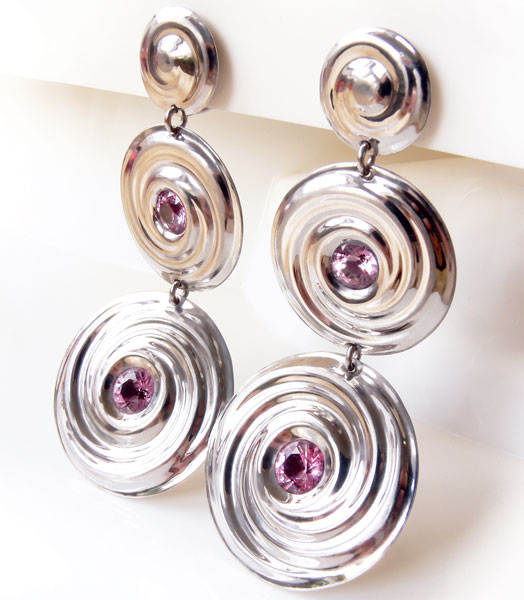
In this project, I’ll demonstrate a simple way to form these earrings from sheets of gold, using inexpensive homemade tools. Made of plastic, the tools are suitable for stamping single pieces or a small series. Although the plastic is not strong enough for producing larger quantities, it does provide an alternative that reduces investment costs while increasing efficiency.
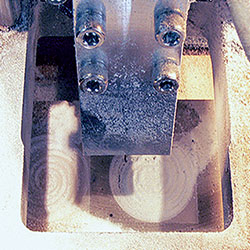
1. To begin, create the dies in a CAD program and cut the plastic with a three-axis milling machine. (You can also make similar dies by hand, using standard goldsmithing tools.) It’s important to use a robust plastic that is elastic enough not to break under pressure.

2. I used two types of plastic to see which one gets the best results. I opted for the gray one; it includes aluminum and is a little more flexible than the white, which includes quartz powder. As there are many synthetic materials available, consult a specialist on the best product for you.
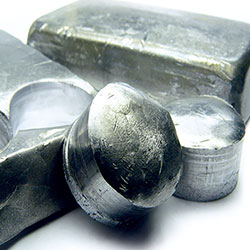
3. Punch a small cylinder out of a lead block. Although it can be hazardous to your health, lead has very good deformation characteristics that make it ideal for this project. Use care when handling the material and don’t heat the lead, as the fumes are toxic. [Editor’s Note: Alternative materials can be substituted for lead, including Cerrotru (a tin-bismuth alloy) and Kirksite (a zinc-aluminum alloy).]
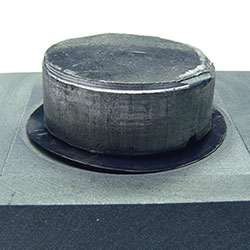
4. To get the best pressure for the desired shape, the lead cylinder should be smaller in diameter than both the gold sheet and die, as well as taller than the depth of the die. When squeezed by a spindle press, the cylinder will spread in diameter, becoming wide enough to reach the outer parts of the gold sheet and the die. If the cylinder were the same size as the gold and the die, too much lead would get pressed outward. This would divert too much of the press’s energy to this unneeded outward part, leaving the press applying too little pressure to the middle of the stamp.
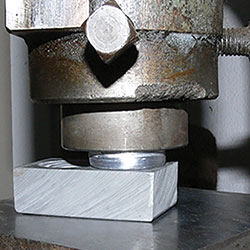
5. Anneal the gold sheets before stamping. Align the die, gold sheet, and cylinder in the press. The force from the press will push the gold into the plastic.

6. Since both the gold and the lead cylinder will conform to the shape of the plastic die, you will need to punch out additional cylinders to stamp the remaining sheets—two for each disc (front and back).
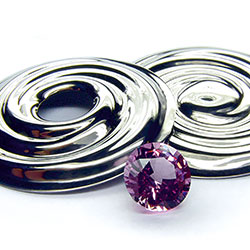
7. Cut a hole for a gemstone on the front sheet of each disc. (The back sheet will help to press the stone into position.) Make sure the hole is slightly smaller than the gem. Use a ball dapping punch to adjust the hole as needed for a good fit.
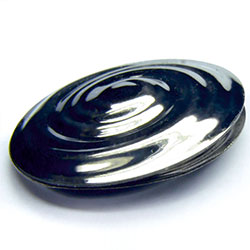
8. The positioned gemstone shouldn’t allow the outward edges of the two sheets to touch without pressure. Because the gold sheets are thin, you can easily correct the shape with your hands. Use a laser to weld together the sheets at one point. Make sure the gem is positioned well, then carefully press the sheets together and weld a second point on the side opposite the first. Check the gem’s position.
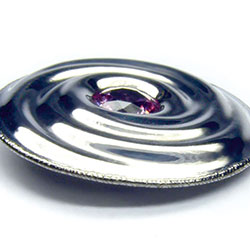
9. Weld the entire outward edge.
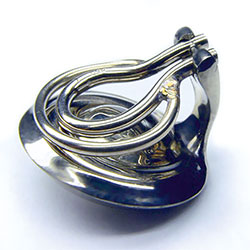
10. After creating all of the discs, weld an earring clip on to the back of the smallest one. Even if the gemstone can withstand heat, do not solder the clip: The heat could weaken the gold sheets, which would loosen the stone.
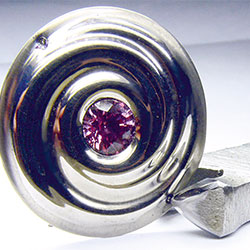
11. To create holes for the jump rings that will connect the discs, file away material from a pair of pliers so the ends touch only at one point. Use the pliers to press small holes into the gold, then drill to complete. This technique will yield a smoother result than only drilling the holes.
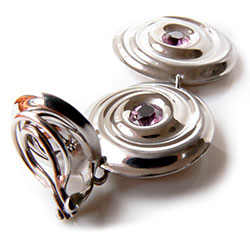
12. To complete, join the discs together with jump rings, weld the rings closed, and polish the finished earrings.