

Perfect Vintage
Kelly Liddicoat turns heads with Swirling Spirits ring
By Shannon L. Brown
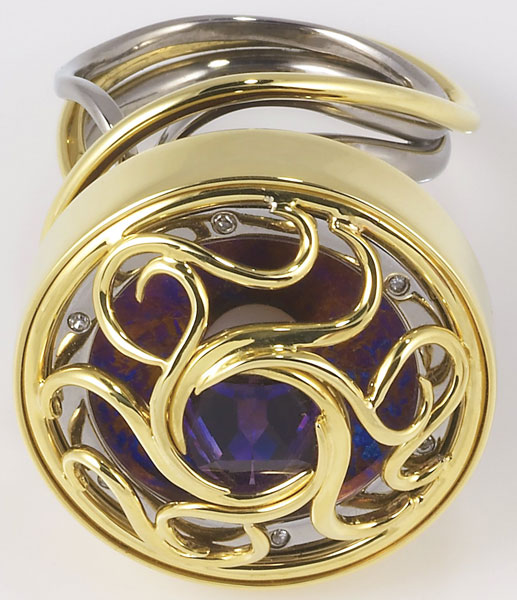
When a car with spinning rims pulled up next to hers, Kelly Liddicoat of Kelly Liddicoat Designs in Kerrville, Texas, was instantly inspired to create a spinning ring. Destined to sit at its center, a wine-colored 1.68 carat “triopp” amethyst—a trillion with the corners cut off at 45 degree angles—provided the starting point for Swirling Spirits. The spinning ring executed in 18k royal yellow gold and titanium took second place in the Gold/Platinum category of the 2011 Saul Bell Design Award Competition.
Liddicoat fabricated the top and bottom of the ring separately, starting with the three vines that make up the shank—one of round 16 gauge 18k yellow wire, and one each of round 12 gauge and 16 gauge titanium wire. She bent the wires around a steel mandrel with pliers, hammered them, and filed them into a swirling shank that has a hole in the center. (The top of the ring is eventually placed into a purchased bearing that is set into this hole.) After sanding and a quick polish, she laser welded the shank together.
To fabricate the top of the ring, Liddicoat began by cutting two circular pieces of 20 gauge titanium sheet, which she dapped and nestled together—think of it as putting one cereal bowl inside another. She drilled a hole in the center of the dishes, inserted a piece of 3 mm titanium tubing, and tacked it in place with a laser. Inserting the titanium tubing into the bearing, she tested the spin. Discovering it would only spin manually, she crafted a counterweight by nestling a 1 mm thick piece of tantalum about 1/3 size of the dishes between them, leveling off the dish sandwich with a piece of titanium wire placed directly opposite the tantalum. The now off-balance circle would spin freely when the wearer moved her hand.
To hide the outside edge of the titanium dishes, Liddicoat fashioned a ring made from a bar of titanium turned on a mini lathe and flush-set six 0.01 carat diamonds into it. She laser welded the ring on top of the dishes and anodized the titanium.
Cutting nine pieces of 18 gauge gold wire, she worked with three at a time, forging them into vines that would form the cap for the dishes. With the vines tacked to an outside ring of the same wire, she dapped the section to give it the desired height and shape, then permanently laser welded it together. She then set the amethyst in a cage constructed of three bars of 24 gauge round gold wire and welded it into place in the center of the vines.
The amethyst-set 18k vine component meets the titanium dishes in a unique way: A full-drilled 6 mm white Akoya pearl is sandwiched between the top of the titanium tubing and the amethyst’s culet. Liddicoat drilled out one end of the pearl to fit into the culet, gluing it lightly and testing the tension several times, drilling it out more until it had the right tension. She then enclosed the entire top structure of the ring in an 18k bezel, laser welding it to the vine component and attaching it to the shank with a hexhead screw.
The end result, says Liddicoat, is a whimsical accomplishment. “This ring is a true doodle with no set plan or sketch,” she says. “I simply started with a concept in my head to make something with movement—with some aspect of kinetics in the materials—and a color palette that I love.”
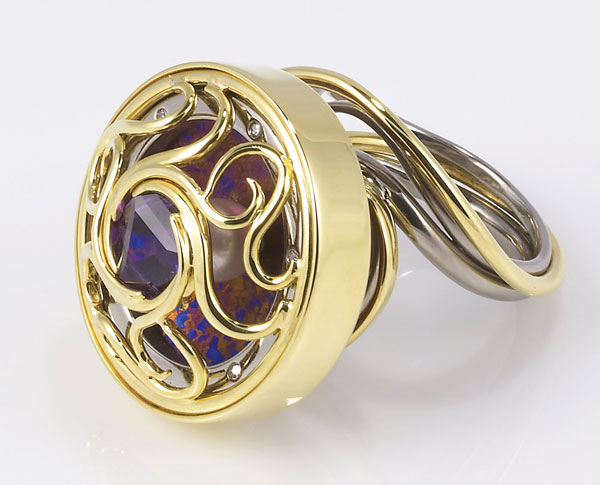
The top of Kelly Liddicoat’s Swirling Spirits ring spins freely when the wearer moves her hand. Crafted in 18k royal yellow gold and titanium, it features a wine-colored 1.68 carat “triopp” amethyst—a trillion with the corners cut off at 45 degree angles—at its center.
To achieve a crystallized finish, Liddicoat placed the titanium sheet that would become the dishes in a vacuum furnace to starve it of oxygen. “As it heats up, the metal gets a crystal-like grain structure,” she says. Anodizing the titanium for five seconds in a bath of Dr. Pepper soda gave the dishes their gold, blue, and purple hues.