

What Does Custom Really Mean
Custom, Defined
Bespoke, made to measure, or simply one-of-a-kind—the answer depends on whom you ask.
By Sharon Elaine Thompson
(Originally Published by MJSA May, 2026)
Custom design. From retailers to designers, customers to bench jewelers, and even trade publications, the term is widely used and generally understood. Or at least, it seems to be. But what does custom design actually mean?
That is not as clear as you might think, and if you think you’ll find the definitive answer here, you’ll be disappointed. What you will find is somewhat differing opinions from three respected jewelers who make their living from providing “custom” design for customers. Their insights offer plenty to consider—and to debate—at the next trade show, industry event, or online forum.
Design in Dialogue
Melissa Tuttle
Green Lake Jewelry Works
Seattle
At Green Lake Jewelry Works in Seattle, Senior Designer Melissa Tuttle defines custom simply: “To us, custom means bringing your vision to life, meeting you wherever you are in the process.”
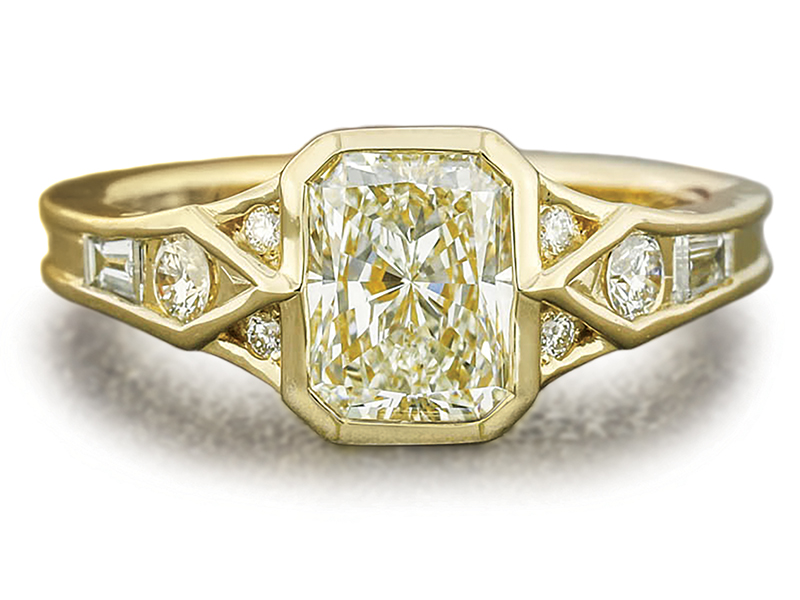
For some customers, she explains, custom can be as straightforward as modifying an existing design. It might be “‘I like that ring. I want to put my stone in it, which is a different shape,’ or ‘I want to add something to the side of it,’” Tuttle says. Others may come in with a completely original idea, while some don’t even know where to begin—they just know that nothing they are seeing in the cases quite “hits the mark.” Those clients are often open to starting from scratch.
“We can start from you saying, ‘I love Art Nouveau, I love these waves, and I love these types of gems,’” says Tuttle. “That’s what custom is—piecing and putting elements together. ‘What do you like? What proportions work on your hand? What’s always inspired you?’ We end up speaking to clients a lot more about how they live, their lifestyle, aspects of their job, what they’ve always thought were beautiful metal colors that they enjoy, and if they’re coming in with stones. We just siphon that information down into a shorter list, and we say, ‘Okay, here’s where you are,’” she explains. From there, the design team begins to guide the process.
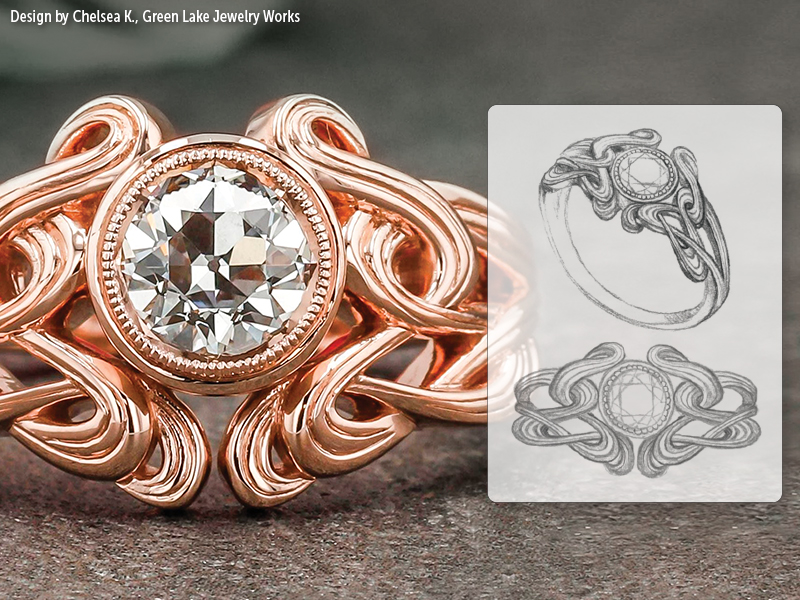
“We’re also mindful of budget. If a client’s ideas would require full custom work that doesn’t align with their range, we’ll talk through it together and offer other creative options.” But it always starts with talking to the customer and listening to what they say.
In addition to hand sketches and drawings, Green Lake Jewelry Works employs a team of CAD modelers. These modelers translate the designer’s sketches, along with the measurements and the notes on the design intake form, into digital renderings. Those renderings serve as a starting point for ongoing collaboration, with revisions made as the client provides feedback.
The role of artificial intelligence (AI) in this process is still evolving. “We have a lot of conversations going on about that, because it’s coming up,” says Tuttle. “It’s not that we won’t touch it or won’t work with AI, but we are still of the mindset that we want to do much of [the process] by hand. That is something that keeps that personal touch.”
That said, clients are increasingly arriving with AI-generated designs. “We’re not opposed to that,” Tuttle says, describing it as another way to begin the conversation. However, customers aren’t aware that AI designs often don’t work structurally. “It might look really pretty and flowy,” she says, “but then you turn it, and the side view doesn’t match the top view.” In those cases, designers must explain what modifications are needed to make the piece both manufacturable and wearable.
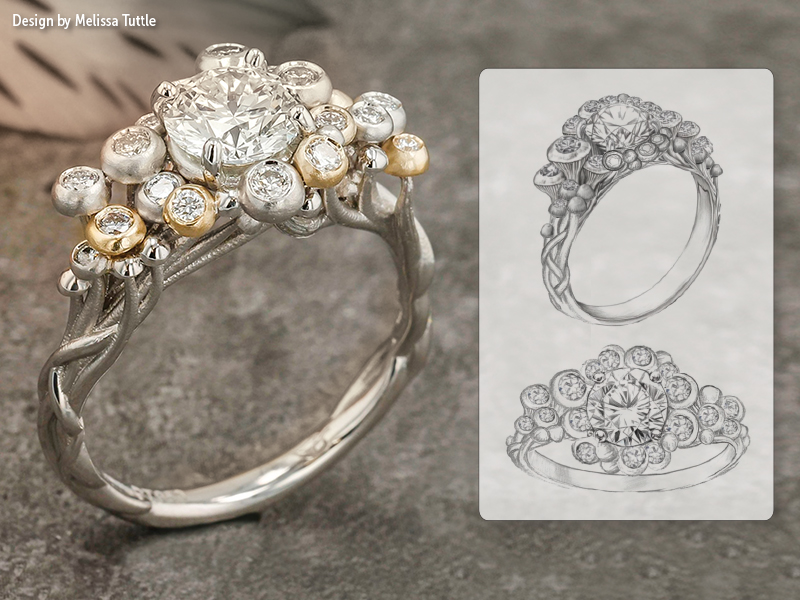
Tuttle expects clients’ attitudes toward AI to diverge. “Some of them are going to say, ‘I don’t want AI, I want handmade.’ Those are the kinds of clients who come to a place like us. Then there will be clients who love AI and want someone to make their image into a real ring. And we’re not opposed to doing that to some degree.”
In either case, the goal remains the same: to improve upon the starting point. “We can make it better than even the AI version,” she says. “AI is not going to necessarily understand the elements of surprise that would bring you that extra bit of joy. We want to make sure that the joy is not lost.”
For Tuttle, that human connection is essential. There’s no joy in telling AI what you want and having it generate something. “There’s a joy in interacting with someone and building something and creating something that’s really unique to the customer.”
Degrees of Custom
Cynthia Renée Marcusson
Cynthia Renée Inc.
Cary, North Carolina
Cynthia Renée Marcusson, principal at Cynthia Renée Inc. in Cary, North Carolina, has thought long and hard about what she means when she says “custom.” The way we communicate is that we agree words have certain meanings, she says. But someone else might understand those words to mean something different. As a result, says Marcusson, the terms used to describe custom design “were always nebulous to me.”
As she struggled to define the terms to her own satisfaction—so she could, in turn, define the nuances inherent in “custom design” for her customers—she turned to clothiers, such as English and Italian tailors, to see how they defined their work.
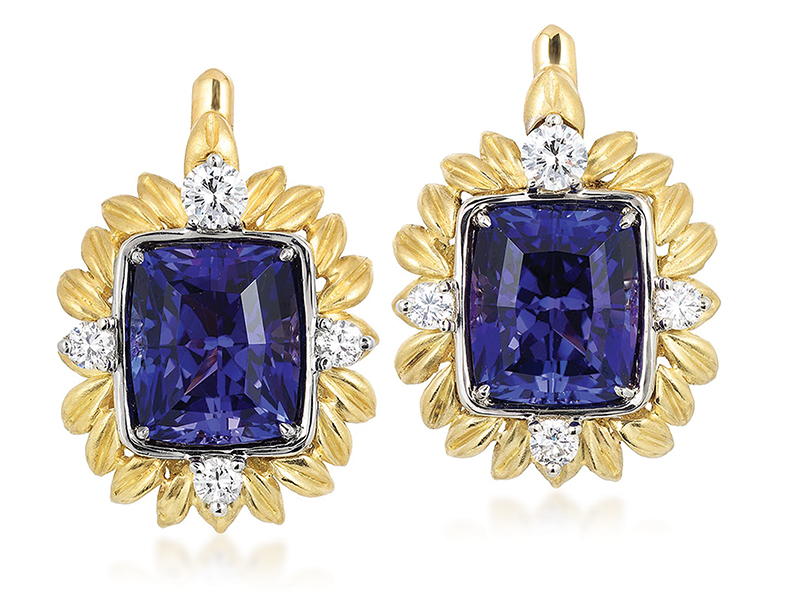
She calls her top-of-the-line creations “bespoke/full custom,” because, as she notes, “it’s hard to get rid of that term.” Bespoke jewelry, for Marcusson, is that which is “handmade, starting from scratch, developing a new design concept and using construction techniques, which are paramount, that I haven’t used before, or engineering something in a way I haven’t before.” A piece like this, she explains, could take six months to a few years to work out.
These pieces, she says, are “complicated. It’s why most people don’t do bespoke, because it takes a lot of time, and you have to then charge for that. So, you have to be up in a rarefied clientele, and even then I may have to explain the costs to them”
Her second tier of custom she calls “made to measure,” a term borrowed from the tailors. These pieces are “still handmade and one-of-a-kind, and usually include unique colored gemstones, but I’m adapting a concept or a motif that I previously made.”
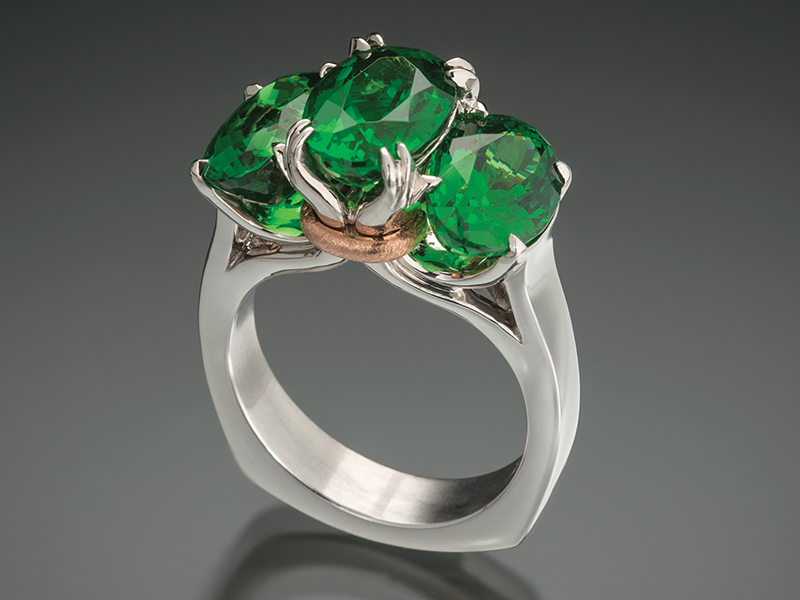
For example, she won a Spectrum Award for a piece that contained “an incredible suite of one-of-a-kind gemstones, and engineering how to do it took a long time.” Afterward, someone wanted another necklace, with different gems and different shapes. “That would be made to measure,” says Marcusson. “It’s still handmade, still one-of-a-kind, but I’ve already worked out the concept, the hinges, the mechanisms, and so forth.”
Lastly, she has “customized,” or “ready-to-wear.” She starts with a pre-existing jewelry model that can be customized with different gemstones, finishes, diamonds, or metals. This is much like choosing a jacket design, then adapting it with a choice of wool colors, buttons, and measurements. “It is still a high-quality piece,” she says.
When it comes to the use of AI in designing, Marcusson is open to it—as long as it’s used as a tool. “I don’t think that’s any different than sketching with my pencils. It has to do with how far afield you go from the original concept.” Marcusson may occasionally use AI as a communication tool, she says. “I can take my sketches and concepts and adapt them visually in AI so the customer can see something more lifelike, if they need to.”
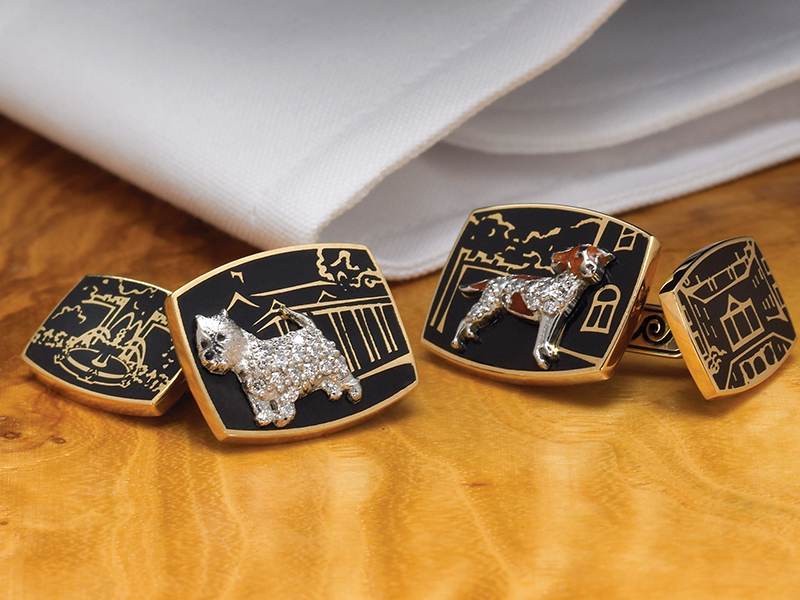
But AI is not useful if you are designing a piece that is highly engineered, she says. “The pieces have to fall right and have the warmth of human touch,” says Marcusson. They have to look good from all directions and fit the customer’s body. AI can’t work that out.
None of these tiers are of lesser quality than the others, she explains. They are all reflective of time, labor, and skill. A customized ring should be just as beautiful as a bespoke ring. It all comes down to the time and innovation required to make the pieces. For the client, they are all unique.
Made by Hand
Andrew Costen
Costen Catbalue
Vancouver, British Columbia, Canada
Andrew Costen, co-owner of Costen Catbalue, in Vancouver, British Columbia, Canada, began his training at just 15 in London. As an apprentice, every piece he created was formed entirely by hand, working directly with the metal. At the time, goldsmithing was firmly regarded as a trade; everything, even wedding bands, was handcrafted.
“There wasn’t even much casting going on,” he recalls.
Today, those same techniques are often viewed through a different lens: handmade pieces are showcased as artwork, and goldsmiths themselves are increasingly seen as artists.
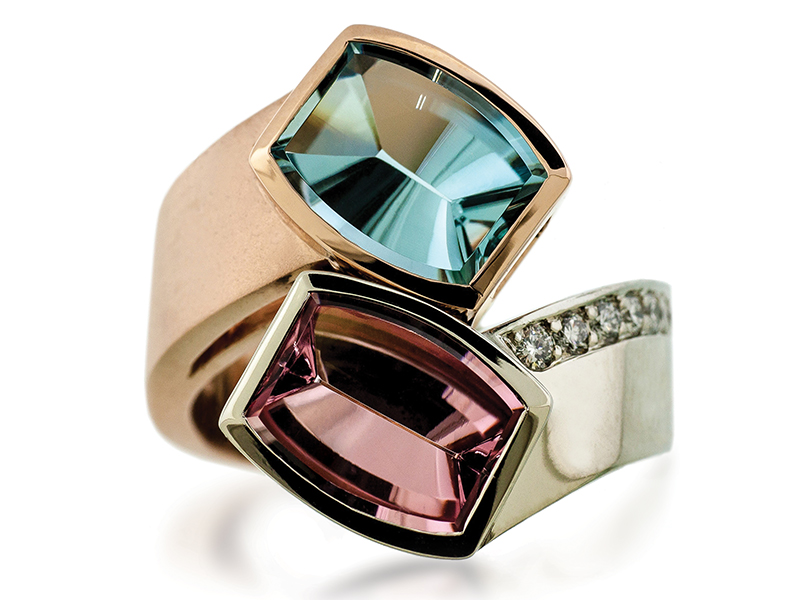
For Costen, the definition of custom is straightforward: “A custom design is a one-off piece, created specifically for an individual.” The process is inherently collaborative and requires both time and care. Clients meet with the jeweler to explore materials, gemstones, styles, and design elements. Some arrive with a clear vision, while others bring only a general idea. “In both cases, it’s about working together to create something meaningful and personal,” he says.
Costen begins each project with pencil sketches, using both original drawings and photographs of past work to guide the conversation. These references help clients visualize gemstone combinations, metal colors, and design possibilities. Once a direction is established, he produces a more detailed colored-pencil rendering, recorded in a dedicated sketchbook to give the client a vivid impression of the final piece.

In discussing custom work, Costen also uses the term “handmade,” raising an important question: Does carving a design in wax, then casting and finishing it, qualify as handmade?
He notes that during his training, wax carving was not considered handmade, as the maker lost physical contact with the piece during the casting process. Today, his perspective is more nuanced. “If you’re carving it by hand, then to me, that’s handmade. And if it’s a one-off, it’s unquestionably custom,” he says.
Costen distinguishes this approach from mass-produced designs created through CAD/CAM processes. “With CAD, you can press a button and produce multiples,” he explains. “Anyone can do that with little training. When you’re working by hand, every step depends on your craftsmanship, and if something goes wrong, you start again, by hand.”
For those without formal drawing training, CAD tools can help bring ideas to life. However, he emphasizes the importance of authorship. “You have to ask: Who is the designer? If these tools are simply helping translate someone’s vision, they can be part of the process. But for me, there needs to be a human designer at the heart of a custom piece.”

That isn’t to say that Costen Catbalue does not use CAD/CAM—they do. For clients less concerned with a fully handcrafted process, CAD can offer a more cost-effective option. A digital image is created from an original design, the wax is produced using CAM, and the cast piece is then meticulously hand finished.
The studio also uses CAD/CAM in more complex ways. Intricate designs, such as multi-component pendants, can be digitally divided into separate parts, cast individually, then assembled and finished by hand. Even with technological assistance, the final piece relies heavily on skilled craftsmanship.
Ultimately, Costen believes that maintaining traditional hand skills benefits not only the finished work, but also the maker. “Working with your hands is good for your soul,” he says. “It’s also good therapy for the brain.”