

Thank You, Come Again
Thank You, Come Again
How jewelry businesses can turn first-time buyers into repeat customers.
By Sharon Elaine Thompson
(Originally Published by MJSA May, 2026)
You’re in business for a reason. You have a product you believe has value. You want to serve your community. You want to exercise your skills. Or you simply want to make a living. But whether you’re a retailer, a supplier, or a manufacturer, without customers you don’t have a business. Getting new customers’ attention—and keeping existing customers happy—is the name of the game.
Where Customers Find You First
or most businesses today, the primary place people will find you is online. While it doesn’t hurt to have a presence on social media, your website is where customers, whether wholesale or retail, first seek information about your company, form their initial impressions, and begin to establish trust. It’s the one place people can interact with your business 24/7, and for many, it’s the preferred way to do business.
“We’ve been working a lot, over the last 10 to 15 years, to improve our SEO so that we show up on search engines,” says David Baird, head of growth for Master Casting and Cad in Chicago. As a result, the company ranks highly when people search for terms such as “casting” or “manufacturing.”
With so much noise online, it can feel impossible to attract attention. But spreading your marketing budget across too many platforms—traditional, digital, or both—can dilute its impact. “When I see retailers trying to do too much and say too much,” says Peter Smith, consultant, executive coach, and sales expert with The Retail Smiths in Boston, “what they end up saying is nothing.”
Instead, Smith advises businesses to focus on what makes them attractive, unique, relevant, and resonant—and then lean into that message consistently. That focus might be custom work, a specific brand mix, ethically sourced materials, or a particular approach to diamonds. “Just make sure that every time customers are seeing you, they’re not seeing a different message,” he says.
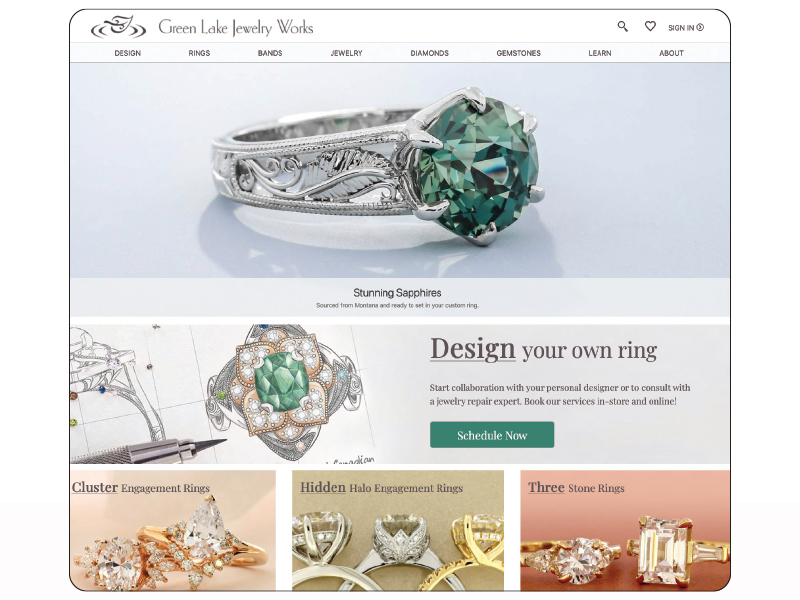
A strong website acts as both a first impression and an ongoing touchpoint, especially when it’s kept current. At Green Lake Jewelry Works, frequent updates with new custom pieces signal creativity and encourage repeat visits.
Defining What Makes You Different
At Green Lake Jewelry Works in Seattle the focus is on unique custom design, explains Senior Designer Melissa Tuttle. Every member of the sales team is also a designer, with an interest in art and design, and all complete an in-house design program.
The store itself reinforces that identity. Specially designed cases, a hand-painted floor, and a gallery-like layout emphasize creativity and craftmanship. Online, the website acts as a “visual calling card,” says Tuttle. “People can see we don’t just make your standard, classic, run-of-the-mill pieces over and over again. We make unique pieces.” The website is refreshed constantly with new and distinctive designs.
Suppliers and manufacturers, meanwhile, often differentiate themselves through quality, service, and problem-solving.
For Rick Winslow, founder and CEO of Downeast Trading Co. Inc. in Middlebury, Vermont, the focus has always been on quality. “My feeling was always that the product should speak for itself,” he says. “Our chains use the finest components regardless of cost. I say, we don’t have the cheapest chains, but we have the best, and we stand behind them.” Over time, that approach led to steady growth. “We just acquired customers,” he says.
Your website not only advertises what sets you apart, it may also be how customers do business with you. At Down-east, most orders now come through the company’s website. “We get about 12 to 20 orders a day,” says Winslow. “People used to call us, but the website makes it convenient for them to order.”
Making It Easy to Do Business
One reason websites have become so central is their ability to support business anytime, anywhere. To enhance accessibility, Au Enterprises in Troy, Michigan, is developing an interactive website feature that allows customers to track their own projects, review estimates, and access critical information needed to complete a sale, “regardless of location or time of day,” says President and CEO Linus Drogs.
That said, traditional marketing methods still play a role. “We’ve run campaigns on the back of buses, we’ve done radio and TV spots. We also have a newsletter that clients can sign up for,” says Tuttle. Trunk shows and special events help draw customers back into the store, particularly when special gemstones or designer collections are involved.
For manufacturers and suppliers, trade shows remain a key channel for meeting new buyers. While both Downeast and Au Enterprises now attend as few as two to five shows per year, Master Casting and Cad participates in many more. “Shows are a major way we find new clients,” explains Baird. It’s where he can meet and interact with the people he might be working with.
Still, nothing beats word of mouth for attracting new customers. “I depend on word of mouth,” says Winslow. “I prefer to treat customers the way I would like to be treated. If you treat people right, you earn their trust and loyalty.”
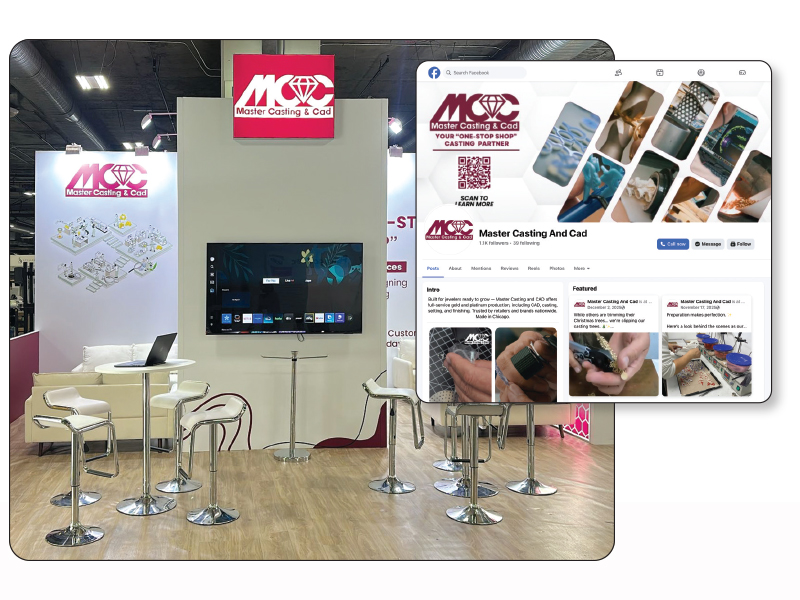
New business often comes from visibility—whether on a trade show floor or in online communities. Master Casting and Cad builds connections through trade shows and active participation in social media groups, where referrals frequently originate.
Baird agrees. Word-of-mouth referrals are also a primary way customers discover Master Casting and Cad. Many of those referrals come through Facebook groups the company participates in. Users can post their needs, such as “I’m looking for someone who can cast or someone who can do A to Z production,” he says. And others may reply, “Check out Master Casting and Cad. They do a great job.”
Creating a Memorable Experience
Attracting a new customer is only the first step. Once someone contacts your company, the experience you provide determines whether they’ll return.
For retailers, says Smith, this starts with the physical space itself. A comfortable, welcoming, “cozy” environment, one that uses lighting not only to create atmosphere, but also to focus customers’ attention on small collections in islands of light, can shape how customers feel. “These little sorts of shadows, this little play of lighting, dilates the pupil and makes us more open,” says Smith. These focused areas help you tell curated stories, too, he says, by putting negative space between clusters of product. “Tell a little story here, have a little negative space. Tell a little story here, have a little negative space.”
People, of course, are central to the experience. A genuine smile, open body language, and thoughtful engagement matter, but it’s not just about being pleasant, and making a customer think, “Boy, he or she was very, very nice,” says Smith.
Instead, a sales associate needs to remember that their role is to influence buying behavior. To do that, they need to learn something about the client by asking high-quality questions, such as, “Tell me about the person you’re buying for.”
At Green Lake Jewelry Works, every custom project begins with an interactive design page created specifically for the client. The page captures details such as size, metal preference, and initial thoughts on stone size, shape, number, and so on. During the design process, clients can upload images they like, while designers share suggestions, sketches, or links, allowing for an ongoing conversation.
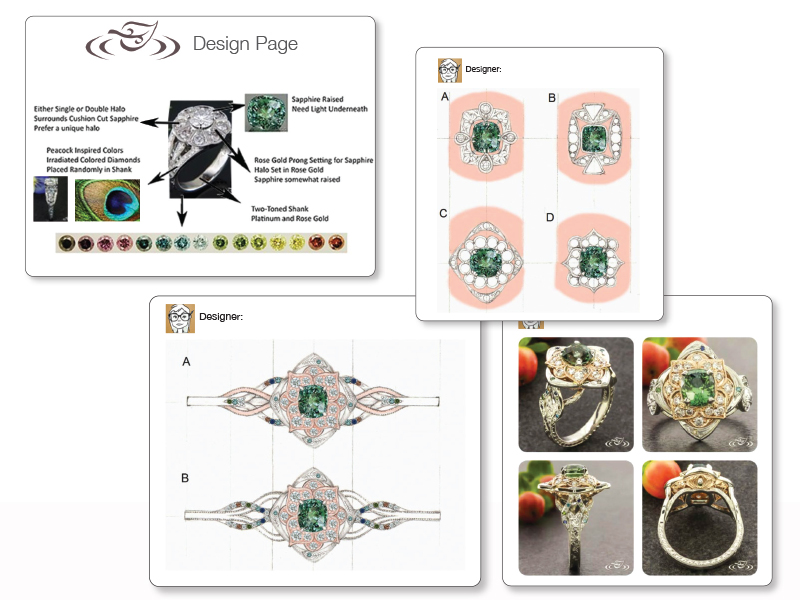
Custom design works best when it’s collaborative and transparent. Green Lake Jewelry Works uses individualized design pages to allow clients and designers to exchange ideas, review updates, and refine details in real time.
But the designer has to listen as well as ask questions. At Green Lake, says Tuttle, clients usually know a piece is going to cost them a bit more than elsewhere. However, they do have clients who want what the store has to offer, but who have a firm budget limit. “We try to guide them toward things that, visually, may not be noticeable but could save them a little bit.” That might mean using 14k gold instead of 18k or using lab-grown diamonds for side stones instead of natural diamonds. “There are times even when we’ve had to use a CZ or a stand-in stone for the center, knowing that the actual design is the most important thing to the customer, and that they can upgrade that later.”
A big part of the company’s culture, she explains, is investing not just in the piece, but also in the client’s emotional connection to it. “We invest in finding their joy,” says Tuttle. “I could push somebody into a bigger diamond, more glitz, more glam. We don’t care about that. We care about making interesting pieces that make them say, ‘This is so me.’”
That level of care often leads to the most valuable form of marketing: word of mouth. After helping one couple with their engagement and wedding rings, “they started sending in couple after couple after couple,” Tuttle recalls. “By the time all was said and done, I think I had at least 8 or 10 couples who came to me from that one client. That was the truest form of loyalty.”
Turning First-Time Buyers into Repeat Customers
Many retailers devote a lot of time and money to attracting new customers, but far less to encouraging existing customers to return, says Smith. Yet focusing on the customers who have already bought something from you at least once, he says, is actually more profitable.
For example, a retailer with 1,000 customers might see only 10 more than once a year, leaving 990 customers who never return. Yet if those customers are re-engaged through follow-up or special events, “they are 70 percent more likely to convert and at a 30 percent higher average ticket,” he says, noting that “it doesn’t cost anything like traditional advertising. So, if your business spends more on the 99 percent of people who don’t come in more than once…it would have a huge impact on the business, far beyond what you’re spending on traditional advertising.”
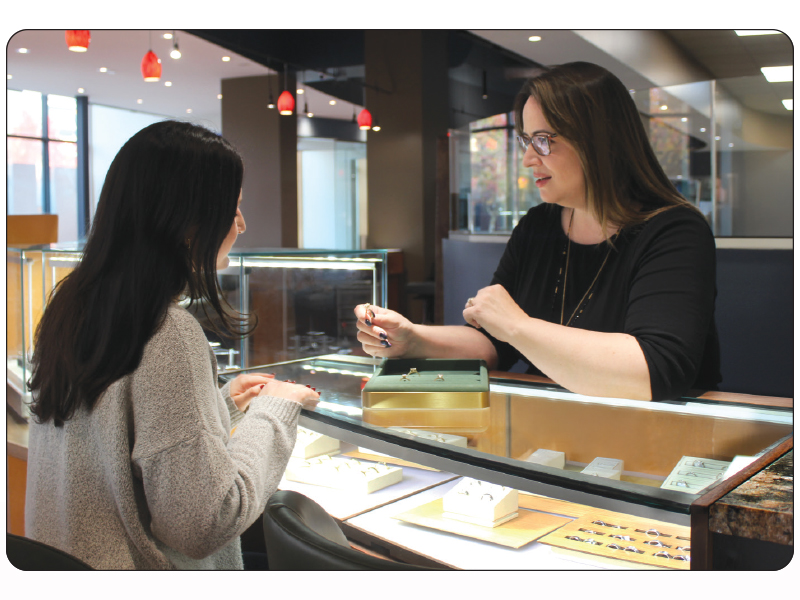
Delivering thoughtful, personalized service is central to Green Lake Jewelry Works’ approach, often resulting in strong word-of-mouth referrals from satisfied clients.
But whether you are a supplier working with a retailer client, or a retailer working with a consumer, a customer’s return depends on them having a good experience with your business and your product in the first place. And it means giving them what they want.
“If you get a top-rated customer, do everything you can to keep them,” says Winslow. “Our philosophy is that we are only in business to help you make money. As our client, your customers are our end users. Whatever we can do to make a retail jeweler profitable benefits us.” If that means offering stock balancing or exchanging jewelry that has been damaged after purchase, so be it.
Retailers need suppliers and manufacturers on a regular basis: to provide metal, gemstones, jewelry, and services. “Business is a symbiotic relationship. We’re here to help you and you help us. We both win,” says Winslow.
Mistakes, too, can become opportunities. “We can try to be 100 percent perfect at producing a piece, but we’re human. We make mistakes,” says Baird. “The important part is: How do we handle the problems, if they come up? That determines whether someone continues to work with you.”
Staying Connected
For retailers, getting customers back often comes down to thoughtful follow-up. “How often should you reach out to a customer, and for what purpose?” asks Smith. “My own sense is that a handful of times a year is probably appropriate.”
“What’s not okay,” he adds, is reaching out “no times a year.” Yet that is the default for far too many retailers. “The vast majority of customers who leave the store having purchased don’t hear from that salesperson again.”
However, follow-ups can’t always be about sales and discounts, says Smith. At least a few of the invitations to return should be about appreciation for their business. Bring in live music and food just as a thank you, he recommends. Make a point that the invitation is limited—maybe only about 30 people.
Don’t worry about customers feeling like you’re trying to sell them at these events. “If you get them back in, and they feel more comfortable about coming back in, the selling is going to happen,” says Smith. “And of course, when they’re in, they’ll try on things, and you have a photographer, perhaps, who’s taking pictures, and those pictures are being popped up on a screen. Make it more of an experience.”
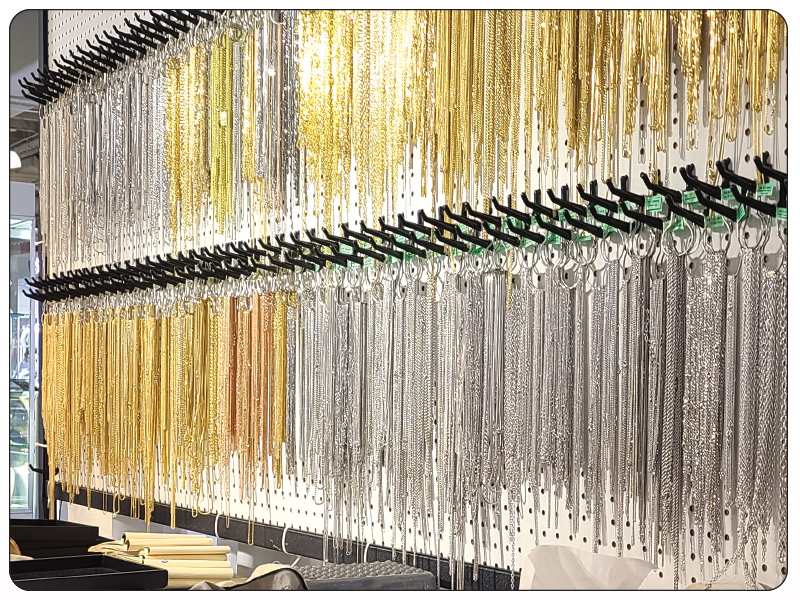
Initial connections may be made on the trade show floor, but Downeast Trading builds lasting relationships through delivering customer service and support.
For suppliers, staying connected may mean thinking like a partner and anticipating what customers will need next.
“As our client, your customers are our end users. Whatever we can do to make a retail jeweler profitable, benefits us,” says Winslow. Downeast will do what it can to keep a client’s customers happy. “If your customer returns a broken piece complaining that it just ‘fell apart,’ that you know was not defective, you can, within reason, return it to us for a replacement. It protects the retailer’s reputation, and we can recycle the metal. Our cost for doing this is minimal in comparison to the benefit of keeping our retailers happy.”
A manufacturer may also have to work with more permeable walls to help their customers close a sale. “More of my clients now have my personal cell phone number, so I’m taking phone calls at dinner time or on a Saturday or during a vacation,” says Drogs. That availability can make a difference when a retailer is trying to close a sale quickly.
Suppliers also need to stay ahead of market changes. With the rapid rise in gold and silver prices, Drogs has already begun exploring new 3k and 6k gold alloys to meet demand for gold-like materials at lower price points.
“Part of customer service, is that I have to be on the leading edge of the material that people may be looking for in the very near future because of these metal prices,” he explains.
Winning attention and loyalty is becoming harder as the jewelry industry shrinks and competition increases. Rising metals prices only add to the challenge. But in the end, success is less about the specific channel you use and more about the connection you make.
Businesses that keep customers coming back focus on quality, protect their reputation, respond thoughtfully when things go wrong, and stay passionate about helping their customers succeed. When customers feel heard, supported, and appreciated, they don’t just return—they bring others with them.
Five Ways to Bring Customers Back
Attracting a new customer is only the beginning. These practical tips used by retailers, manufacturers, and suppliers alike, can help turn first-time buyers into repeat clients.
Make it Easy to do Business
A clear website, straightforward ordering, and fast responses reduce friction and build trust.
Be Consistent
Customers should recognize your message, values, and quality every time they interact with your business.
Ask—and Listen
Good questions reveal what customers actually want, not what you assume they want.
Follow up Thoughtfully
A few well-timed touchpoints each year matter more than constant promotions.
Handle Problems Well
Mistakes happen. How you resolve them often determines whether a customer returns.