

Testing the Diprofil Dipromini Filer
Get Into the Grooves
By swapping rotation for a rapid reciprocating stroke, the Diprofil Dipromini Filer allows jewelers to refine tight, hard-to-reach areas.
By Melissa Muir
(Originally Published by MJSA May, 2026)
When it comes to final finishing—especially in tight or hard-to-reach areas—jewelers have become quite creative with their flex-shafts and micromotors. However, those tools can sometimes create more work than they solve. Burs and accessories can grab, spin, and damage prongs, under galleries, and other fragile elements. Getting files or sanding accessories into these areas can also be challenging. Ceramic stones can be shaped into fine points, but in a rotary tool there is still a risk of cutting grooves.
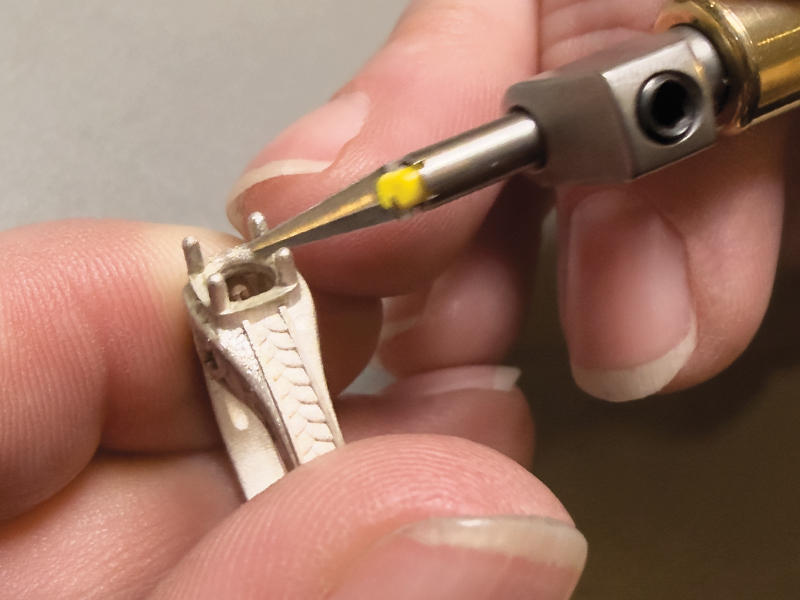
One of the tools I’ve been working with in my studio changes that dynamic. The Diprofil Dipromini Filer is a reciprocating system that eliminates many of the challenges associated with rotary tools. It bridges the gap between hand filing and rotary abrasion, offering greater control, repeatability, and access to tight spaces. The Dipromini is especially effective in narrow areas where precision is critical.
About the Diprofil Dipromini Filer
Instead of spinning like a traditional bur or abrasive point, the tool operates with a rapid back-and-forth stroke—up to 11,000 strokes per minute—creating a controlled filing motion similar to a hand file. This reciprocating action helps maintain crisp edges, which is particularly useful when working on prongs or sharp corners. Flat surfaces can be refined without rounding, and tight areas—such as under galleries, around prongs, and within pierced designs—become much more accessible. Removing growth lines and other imperfections in confined spaces is straightforward with the range of available files and ceramic stones.
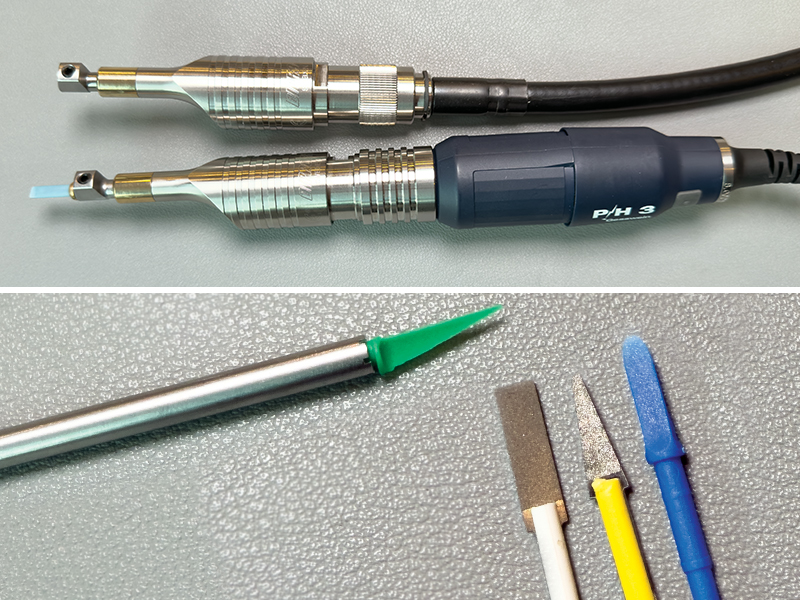
Available for both flex-shaft and micromotor setups (top). Interchangeable files and stones (bottom).
The system is available in multiple configurations, including models designed for flex-shaft systems as well as micromotor platforms such as NSK and Marathon PowerHand. While several stroke lengths are offered, the most practical options for jewelers are 0.5 mm and 1.0 mm. Stroke length refers to how far the file travels back and forth, and each has its strengths.
The 0.5 mm stroke handpiece excels in precision and surface refinement. Its tight, subtle motion is ideal for fine finishing and pre-polish work, delicate surfaces, thin materials, and stone-adjacent cleanup where minimizing tool marks is essential.
In contrast, the 1.0 mm stroke is more efficient for material removal. The longer stroke increases cutting action, making it well-suited for shaping and profiling, removing excess solder, cleaning castings and growth lines, and general bench work. Despite the increased stroke length, the tool maintains excellent control thanks to its ergonomic, lightweight design and low vibration.
One of the most compelling aspects of the Dipromini is the versatility of its interchangeable tooling. Fixtures are available to hold both round and flat accessories, allowing the use of flat ceramic stones as well as round ones. Diamond files designed specifically for the system are small, thin, and durable. They are quite aggressive and ideal when significant material removal is needed. My personal preference, however, is the ceramic stones. Available in grits ranging from 36 to 3,000 or finer, they are suitable for everything from aggressive shaping to very fine pre-polish work. An added benefit is that they refine the surface without embedding abrasive particles into the metal.
The stones and files are secured with specialized tool holders and extenders, which improve access to deep gallery work, undercuts, and interior elements. The slim profile and forward motion make the tool particularly effective for working inside rings, around gallery wires, under settings, and within complex fabricated forms. I especially like using it tight piercing designs.
Compared to hand files, there is significantly less fatigue, and the thinner profile of the Dipromini files allows access to areas that even my smallest traditional files cannot reach. This also leads to a noticeable increase in productivity.
Depending on the handpiece and motor used, the system can be quite lightweight. Some micromotor handpieces can feel slightly heavy during extended use, but when paired with a flex-shaft, it feels balanced and comfortable.
This is not a replacement for traditional tools, but rather a valuable addition to the bench. It works alongside existing tools to access ultra-tight areas that would otherwise be difficult to finish cleanly.
How Well Does It Work?
In testing, I first wanted to see how it would perform on some of my pierced designs. Many of my more complex pieces terminate in extremely tight points, which I typically refine using a saw blade as a file or even cotton thrumming string loaded with a cutting compound. The Dipromini left a much smoother, more even finish with far less effort.

Ring shank with grow lines (top). Removing grow lines (bottom). Ring shank after grow lines removed (right).
Next, I tested how well it would clean up prongs on a cast piece. These prongs featured flat sides and an interior profile, making them a good challenge. Using a flat diamond file accessory with the 0.5 mm handpiece on a Marathon Power-Hand micromotor, I was able to create a clean, flat, pre-polished surface on each of the three faces. I then switched to a tapered, rounded file and refined the interior curves of the setting with similarly consistent results.
Using the brass accessory holder, I mounted a 1 mm thick ceramic stone. Mine measured just under 5 mm wide, while the tool opening is slightly over 3 mm. Initially, I tried positioning the stone in the exposed portion of the holder without modifying it, but it quickly became clear that this approach wouldn’t work—the stone was not held securely and fell out once I began working.

Cleaning pierced areas (left). Cleaning around prongs (right).
After removing the holder, I realized I had slightly bent it and needed to reshape it. To correct the fit, I used a diamond disc to reduce the width of the ceramic stone so it could seat fully inside the brass holder and properly within the handpiece. Once secured with the tension screw, the setup worked well, allowing for effective material removal and pre-polishing. While narrower stones are available for purchase, modifying standard stones proved to be a simple and effective solution.
In addition to ceramic stones and diamond files, Diprofil offers plastic accessories. On their own, they have limited use, but when paired with a small amount of diamond paste, they become highly effective polishing tools. They can even be used on stones to remove minor scratches and blemishes. I found the triangular plastic accessories particularly useful for accessing tight areas between settings, bezels, and decorative elements. Some processes took a bit longer to achieve the desired result, but with continued use of the Dipromini, I’ve found my speed improving significantly.
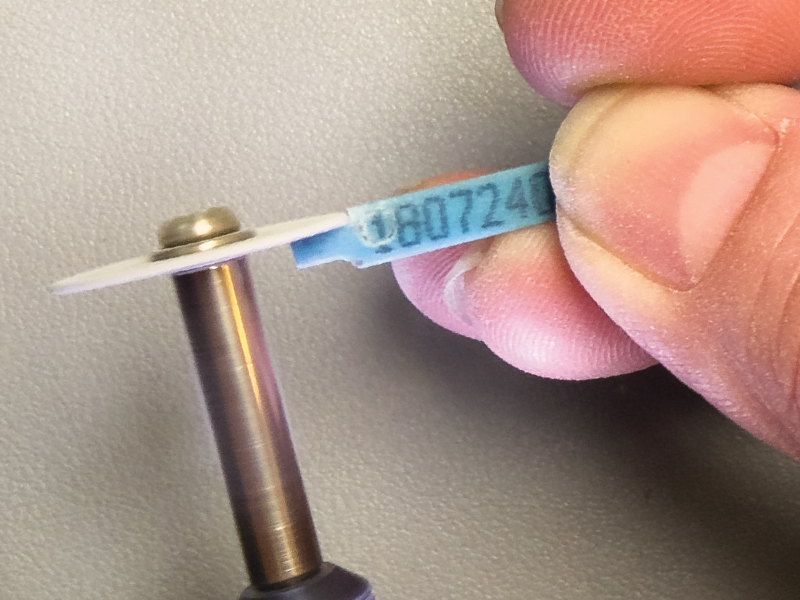
Standard ceramic stones can be modified for a secure fit.
After working with both the 1.0 mm and 0.5 mm handpieces, I found myself favoring the precision and control of the 0.5 mm—especially in hard-to-reach areas. While the 1.0 mm excels at more aggressive material removal, for the fine, detailed work I do in my studio, the 0.5 mm is the clear choice.