

The Cost of a Beautiful Box
Wrapping It Up
Sustainable jewelry packaging poses complex trade-offs between sourcing, recyclability, luxury presentation, and customer expectations
By Sharon Elaine Thompson
(Originally Published by MJSA April, 2026)
As environmental news becomes more frequent, more jewelry buyers are asking about artisanal or ethically mined gold, gemstones, and lab-grown stones—and more retailers are providing them and advertising them. Unfortunately, too often everyone’s interest in sustainability ends with the packaging—the boxes, wraps, tissue, bags, and hangtags used to present a purchase.
Yet the dyes in paper and print are often toxic, contaminating water sources, while non-biodegradable elements, made from plastic or plastic-based materials, too often end up in landfills and even in the bodies and bloodstreams of wildlife and human beings.
Alisa Thorp, co-owner of Mercurius Jewelry in Oakland, California, says that as far as she can remember, sustainable packaging is not something customers have ever asked for. But Mercurius has made a commitment to ethical sourcing.
“I think it’s important, in terms of consistency, that it be part of the vision of the brand,” she says. “It would be incongruous to put a lot of thought into where your gold is coming from, how the piece is made, that there’s equity in terms of pay across the sourcing, and then to deliver the ring in a plastic box.”
Two Sides of Sustainable Packaging
Even for businesses committed to sustainability, packaging presents a conundrum. There are two key aspects to consider: sourcing and recyclability.
As Thorp points out, packaging sourcing matters just as it does with artisanal gold and gemstones. Is the paper recycled or sourced from sustainable forests? Is the fabric from off-cuts that might otherwise be discarded? Has the plastic been recycled from other sources? Is the dye soy- or plant-based? All of these reduce environmental impact, even if the package ultimately ends up in a landfill. Supplier labor practices are another important consideration.
The second question is recyclability: whether the finished box, bag, or papers can be recycled—either at the curb or in a home compost pile—or whether it can be separated easily into its components so that at least some parts can be recycled.
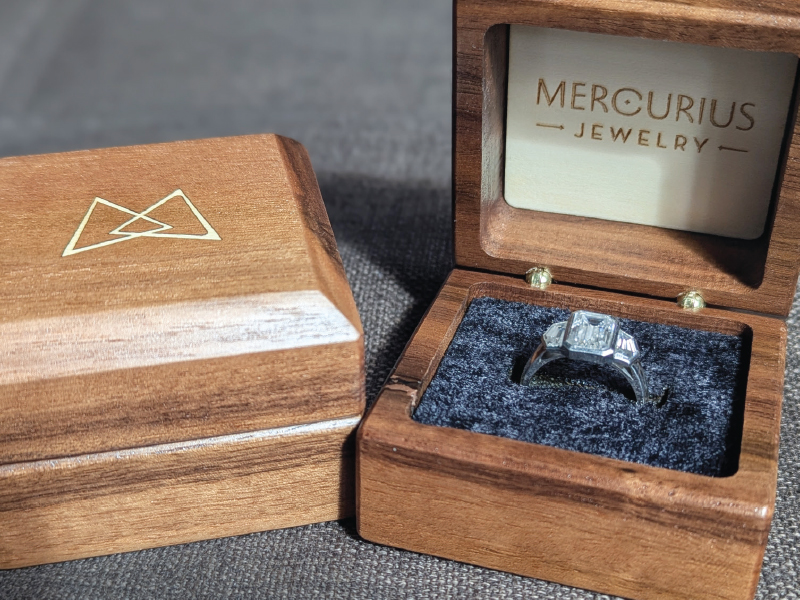
Wood presentation boxes used by Mercurius Jewelry are sourced from U.S. makers through Etsy as part of the company’s effort to use packaging with more transparent sourcing.
Thorp says that jewelers often spend significant time learning about sustainability in jewelry materials, but packaging involves an entirely different industry. “You’re hopping over to this whole other industry that has a whole other set of parameters,” she says. Ideally, she adds, one could simply search for responsibly sourced packaging online and find clear answers, but it is rarely that simple. Many packaging companies lack detailed websites or sourcing information. “It feels like a research project just to get started.”
Because packaging combines many elements—paper, wood, plastic, adhesives, dyes, fibers—these questions may be difficult to answer. Some materials may be responsibly sourced while others aren’t. Some elements might be recyclable individually but not once assembled.
The Recycling Reality
Some packaging materials are becoming more sustainable as manufacturers adopt recycled and responsibly sourced inputs. Paper, for example, says Thorp, can be certified by the Forest Stewardship Council (FSC), indicating that the forest from which the paper comes is responsibly managed.
Recycled cardboard and paper shipping envelopes and boxes are available, as are packing “peanuts” made from cornstarch that dissolve in water. In an attempt to eliminate the foam inside its wood jewelry boxes, Mercurius looked into foam grown from mushrooms and hemp hurd—the woody inner core of the hemp stalk—but Thorp says she didn’t like the look of it for a fine jewelry box.
“You always come up against the balance between sourcing something that you feel good about and how it looks in the luxury space,” she says.
Even packaging labeled “made from 100 percent recyclable materials” doesn’t necessarily mean the package itself can be recycled. This is because recycled paper and card stock may be coated with plastic or imprinted with toxic dyes. Components may be bonded with toxic adhesives or attached to non-biodegradable materials.
The attractive, branded packaging used to deliver jewelry purchases to the customer is rarely recyclable—and often doesn’t include sustainable materials. Boxes and bags are made of plastics and synthetic fibers, toxic dyes, and bleached papers, permanently bonded together with adhesives. Boxes can have metal hinges, which have to be recycled separately. Even if the end user—your customer—wants to take the packaging apart to recycle what can be recycled, it’s virtually impossible.
If packaging is produced overseas, transportation adds another environmental cost. “What is challenging,” says Thorp, is where the packaging elements are coming from. “How far are they being shipped? Carbon footprint is one of the biggest considerations, and it can be hard to find the information.”
The Perceived Value Problem
What happens if a retailer removes the shiny plastic coatings, plush fabrics, elaborately shaped plastic boxes, tissue paper, gilding, and brilliantly printed business logos imprinted on everything? What remains may be a brown cardboard box with shredded kraft paper or mushroom foam inside—hardly something that signals a valuable piece of jewelry.
Perceived value is one of the biggest issues standing in the way of creating sustainable packaging. When customers purchase fine jewelry, they expect the presentation to reflect its significance—financially, emotionally, and visually.
Packaging is especially important when it comes to wedding and engagement rings, says Anna Bario, co-owner of Bario Neal, with showrooms in Philadelphia and New York City. There is a momentousness to the presentation, so “how the box opens, how it feels, how heavy, how luxurious it is,” all matter, she says.
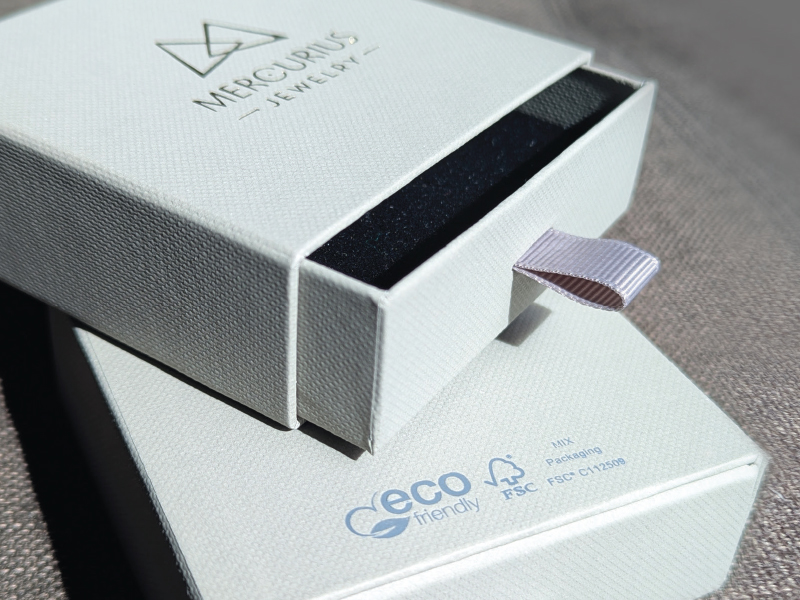
Paper presentation boxes used by Mercurius Jewelry illustrate how even simple packaging choices can reflect a company’s sustainability values.
Like magicians building up to the finale of an illusion, gift recipients want to zoom in on the shiny, glittery paper sack, rummage through layers of colorful tissue, reveal and build the tension by opening an enclosing box (also shiny and richly printed) to display the suede, satin, or velvet box inside, before finally pulling out the rabbit in the form of jewelry. Most of this showy exterior packaging, if not all of it, will end up in a landfill, where little of it will degrade naturally.
“It can be kind of paralyzing just deciding on the aesthetics of your package,” Thorp says. “If you add your values into it as another filter you could drive yourself crazy.”
Practical Steps for Sustainability
So, what can you do?
Start with the three pillars of sustainability: reduce, reuse, recycle. Many jewelers already practice reuse—for example, reusing Ziplock bags, job envelopes, or shipping boxes from suppliers. To reduce the amount of waste generated, some retailers ask customers if they would like a carrying sack when they leave the store.
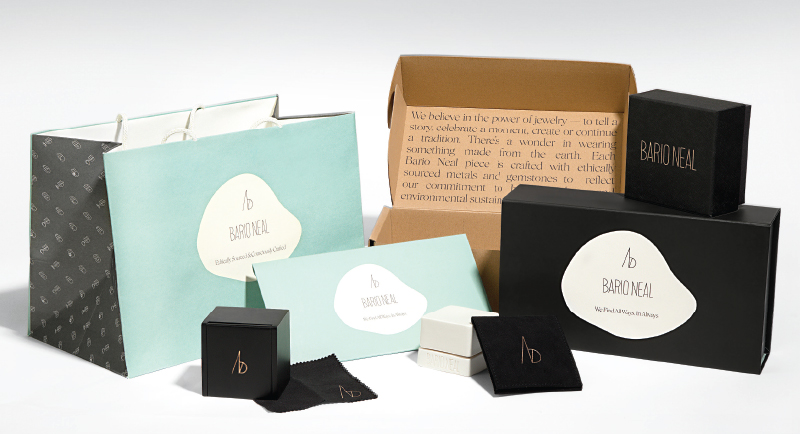
Bario Neal designs its packaging—from outer gift bags and boxes to presentation cases—to be reused, helping extend the life of materials beyond the initial purchase.
To lessen environmental impact, you can substitute cellulose-based cellophane in place of plastic Ziplock bags in your shop and to deliver repair jobs. You can choose fully recycled and recyclable paper products for your shipping boxes and envelopes—and you can re-use those that are not recyclable to keep them out of the landfill for as long as possible. You can choose seaweed-based bags or recyclable paper sacks with biodegradable ribbon or hemp handles and have them and your business cards printed with non-toxic soy- and plant-based inks. Including information cards that explain packaging materials and how to recycle or compost them can help customers participate in the effort.
Thorp makes the best decisions she can. She sources wood boxes made in the United States through Etsy, paper boxes from Westpack in Denmark, which provides transparent information on sourcing, and tissue from EcoEnclose in Colorado. She also buys in small quantities so that “if a better solution comes along, I can update next time,” she says.
Even with these efforts, consumers and recyclers may not recognize sustainable materials, and items may still end up in landfills. However, they are more likely to break down safely without harming wildlife or contaminating water.
Designing Packaging to Last
Because mass-produced sustainable jewelry packaging for high-end jewelry is limited, some companies extend packaging life by designing pieces intended to be kept and reused.
One example is the redesigned jewelry packaging of Bulgari, which “marries sustainability and luxury.” According to the company’s website, its boxes are made from “100 percent paper…sourced from responsibly managed forests. The wood fibre, the 100 percent pure silk, and the natural latex from rubber trees are all entirely chemical free. This new packaging reduces plastic by 96 percent compared to the previous packaging.” If customers choose to dispose of the box, Bulgari provides them with the “correct destination of the packaging to facilitate its recycling.”
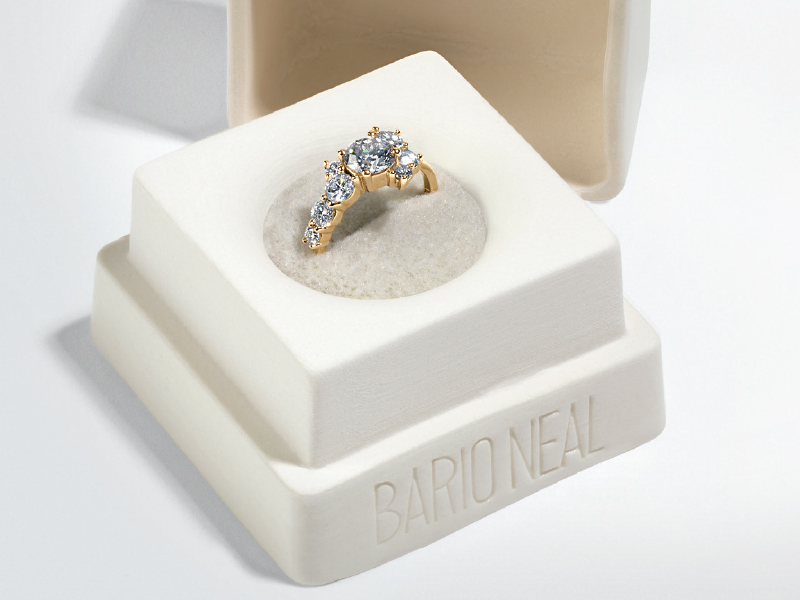
From recycled paper to reusable boxes, packaging is becoming another place where jewelers can put their values on display.
An even bigger commitment to sustainable design comes from the design house Boucheron, which has created “a jewelry case designed to be cherished, reused, and easily disassembled for efficient recycling, without the use of glue or stitching.” Featuring just two materials, the company’s new packaging replaces the 11 non-recyclable components of its original packaging. Sleek and lightweight aluminum boxes complement the house’s design aesthetic. Inside, the boxes are lined with wool felt certified with the Responsible Wool Standard in Boucheron’s signature green palette.
Smaller companies are also innovating. Bario Neal collaborated with a package design firm and ceramicists in the United States to create an ivory-colored porcelain jewelry box meant to be kept indefinitely. The company also offers a sustainably sourced wood box finished with a natural stain. Both are designed for second lives as keepsake containers.
Instead of disposable outer packaging, Bario Neal uses sturdy gift boxes designed for reuse. Overly large and featuring a magnetic closure, these boxes feature a folder containing care and sourcing information. And once the insert holding the smaller presentation box is removed, the gift box can be used to hold jewelry or other keepsakes.
Though there is a cost to designing and producing packaging like this, says Bario, “a lot of the extra time and expense is on the front end in solving the problem. Once you get to just the per piece price difference, it’s not super significant.” Besides, those who design and make jewelry are producing a luxury product that deserves a luxury presentation.
Fully sustainable packaging—combining responsible sourcing and recyclability—may not yet be widely available. However, retailers can reduce environmental impact by choosing lower-impact materials, asking suppliers for transparency, educating customers, and rethinking presentation. With creativity and commitment, packaging can become an extension of the jewelry itself—something distinctive, meaningful, and far less likely to end up in a landfill.
Sustainability Packaging Checklist
Evaluating jewelry packaging can feel overwhelming. This checklist can help guide the process.
Materials & Sourcing
• Paper or cardboard comes from recycled content or responsibly managed forests
• Suppliers provide clear information about material sourcing and manufacturing
• Dyes, coatings, and inks are non-toxic or plant-based
Recyclability
• Packaging can be recycled curbside or composted
• Materials are not permanently bonded together with plastics or heavy adhesives
• Components such as metal hinges or inserts can be easily separated
Design & Presentation
• The packaging still reflects the value and significance of the jewelry
• Materials balance luxury presentation with environmental impact
Reuse & Reduction
• Packaging is designed so customers can keep and reuse it
• Shipping boxes and packing materials are reused when possible
• Packaging elements are kept to a minimum to reduce waste