

A Market in Motion: Demand Holds, Stability Wavers
Demand Without Stability
Color demand stays strong amid rising costs and tariffs
By Deborah A. Yonick
(Originally Published by MJSA April, 2026)
Demand for color remains strong, but tariffs, rising costs, and supply uncertainty are forcing the trade to rethink how gemstones are sourced, priced, and sold.
The 2026 colored gemstone market is not short on demand. It is short on stability.
That was the message delivered by Stuart Robertson, president of Gemworld International, as he opened the GemGuide market outlook at AGTA GemFair Tucson in early February.
The concern wasn’t gemstone-specific—it was economic. With consumer confidence at a 14-year low (even below COVID shutdown levels), Robertson reminded the room that “our industry doesn’t sell a single necessity.” As essential costs rise, discretionary spending tightens, particularly for independent jewelers—the backbone of U.S. jewelry retail.
That pressure is reshaping demand. What’s moving, Robertson said, is either “really high-end, scarce product” or the low end. The middle—historically the industry’s most dependable tier—has stalled. Retailers are buying cautiously, focused on immediate needs. Tariffs have added another layer of complexity, making costs harder to model, quote, and defend at the counter.
On the Gem Floor
That caution was visible in Tucson. Eric Braunwart, president of Columbia Gem House (CGH) in Vancouver, Washington, described buyers who select goods, total the order, and then quietly remove items before committing, unsure what pricing will look like months ahead.
Others are not saying “no,” as New York gem merchant and designer Jeff Bilgore observed, but “not now”—a delay driven less by weak demand than by uncertainty about replacement costs.
Not all signals were restrained. Carl Larson of Pala International in Fallbrook, California, described an unusually active opening day, with buyers purchasing over the counter rather than simply comparing and returning later. The activity suggested that while caution defines the tone, appetite for well-priced goods remains intact.
Even so, Robertson cautioned that Tucson may “prove to be an anomaly,” as goods already inside the U.S. are trading more smoothly. Dealers with domestic inventory are faring better than those bringing goods in on carnet. Tucson has long rewarded immediate delivery; now, if goods must ship later and duties apply upon re-entry, “the price is not really the price.” In many cases, that uncertainty simply “kills the deal.”
Tariffs and the Cost Equation
The tariff burden is landing largely where expected. Robertson cited reporting indicating that 96 percent of tariffs collected to date have been paid by U.S. consumers.
Raja Shah of Tampa-based Color First described the adjustment curve. Imports paused briefly after the tariff shock as companies assessed the impact. As demand held, businesses began blending tariff costs into pricing rather than passing them through outright, allowing trade to resume without the full sticker shock many had feared.
Even with recent headline reductions—notably affecting India, a major processing and export center for colored stones—Robertson underscored how dramatically the framework has changed: “Last year at this time, there was zero tariff on loose colored gemstones.”
If the U.S. becomes the higher-cost market, supply will gravitate elsewhere—a shift Braunwart is already seeing, with some suppliers prioritizing markets where duty structures are stable and predictable. In the current climate, consistency may matter as much as cost.
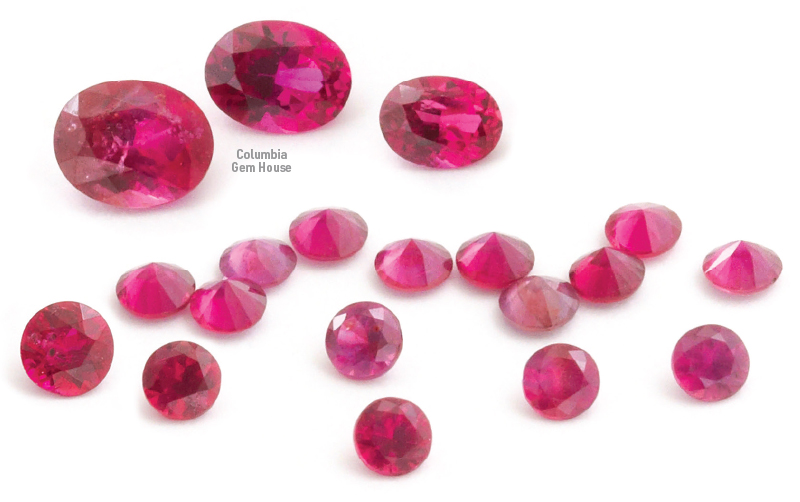
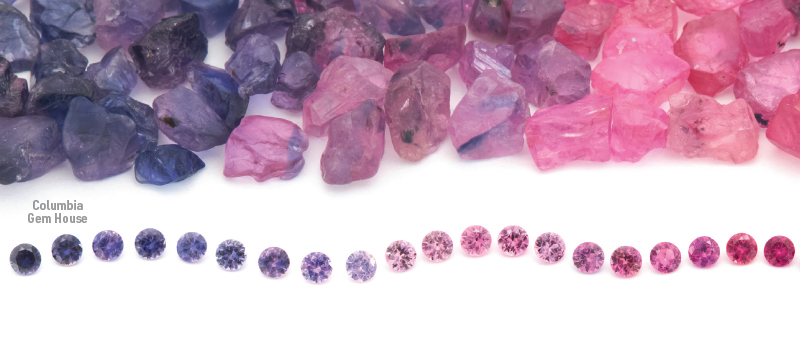
That reality underscores the value of controlled sourcing. CGH recently unveiled a collection of untreated, traceable rubies and sapphires from central Tanzania, spanning vivid pinks, saturated purples, padparadscha hues, and true rubies—many displaying distinctive two-tone zoning. By emphasizing documented origin and untreated goods, CGH is reinforcing transparency and supply certainty at a time when replacement cost is being carefully weighed.
The longer-term issue is inventory depletion. As U.S. stock is consumed, replenishment will reveal the full cost structure. Robertson predicted a scenario in which “the same stones” trade at “two different price points,” depending on whether they are sold domestically or overseas—a divergence that matters even at the luxury level, where globally mobile consumers can choose the market offering stronger value.
Metals Volatility
Metals are compounding the shift. Gold and silver have surged beyond traditional jewelry supply-demand drivers, pushing designers toward alternatives and lighter construction.
Robertson described curb-link pieces hollowed out “like a Jell-O mold,” noting that extreme weight reduction may ease short-term cost pressures but raises longer-term questions about durability, repairability, and consumer confidence in what constitutes value.
Design trends reflect adaptation rather than retreat. As GemGuide Editor-in-Chief Brecken Branstetter noted, experimentation is accelerating. Designers are incorporating porcelain, ceramic, wood, and steel—sometimes setting fine stones into these materials—not merely as cost strategies but as aesthetic decisions that preserve color while reducing metal weight.
Saturated bead strands are gaining traction for similar reasons, Branstetter noted: strong visual impact with less gold. Estate and antique sourcing are also expanding as retailers seek distinctive finished goods with workable margins.
Color Remains the Bright Spot
Many gem varieties continue to demonstrate disciplined long-term price appreciation, even after adjusting for inflation. Robertson contrasted that stability with diamonds, where volatility has been sharper—particularly in lab-grown goods, where rapid price erosion has reshaped the category. Given that trajectory, he noted, it is not something he would have “necessarily anchored [his] ship to.”
Montana sapphire is gaining traction—particularly in bridal—alongside zircon, spinel, garnet, and tourmaline. These selections reflect a shift toward color, provenance, and differentiation, with Montana sapphire strong enough to warrant renewed pricing attention in the GemGuide.
That momentum, however, is unfolding against tightening supply. Branstetter pointed to export pauses in Malawi, Zambia’s brief export duty, and rising labor and mining costs narrowing availability across several categories. At the upper end, increased reliance on invitation-only auctions and concentrated production is funneling the finest ruby into fewer hands, pushing pricing beyond many independent retailers’ reach.
Even in a volatile market, demand for colored gemstones remains strong, with buyers continuing to seek stones that offer rarity, beauty, and lasting value.
As Larson emphasized, fine gemstones do not trade like commodities; dealers price with replacement in mind, not historical cost. With limited availability at the top end, uncertainty around future supply is reinforcing firm pricing rather than weakening it.
Demand for color remains resilient. What has shifted is the sense of stability. As Bilgore put it, the market feels less like firm ground and more like “quicksand”—still moving, still selling, but without the stability buyers prefer.
In 2026, the defining trend may not be any single gemstone, category, or country, but the discipline with which the trade recalibrates sourcing, pricing, materials, and inventory in a climate where stability is no longer guaranteed.