

Hosting Events can Build Loyalty, Community, and Long-Term Value
Experiences That Stick
How hosting events can build loyalty, community, and long-term value for jewelry businesses
By Sharon Elaine Thompson
(Originally Published by MJSA February, 2026)
Surveys have shown that a growing number of people—led by more than 60 percent of Gen Z and Millennials—prefer receiving gifts of experiences over physical gifts. Experiences can be shared with the giver, anticipated in advance, and remembered afterward. If there are photos taken or something created during the experience, the recipient can revisit not just the gift, but also the connection with the giver, long after the moment has passed.
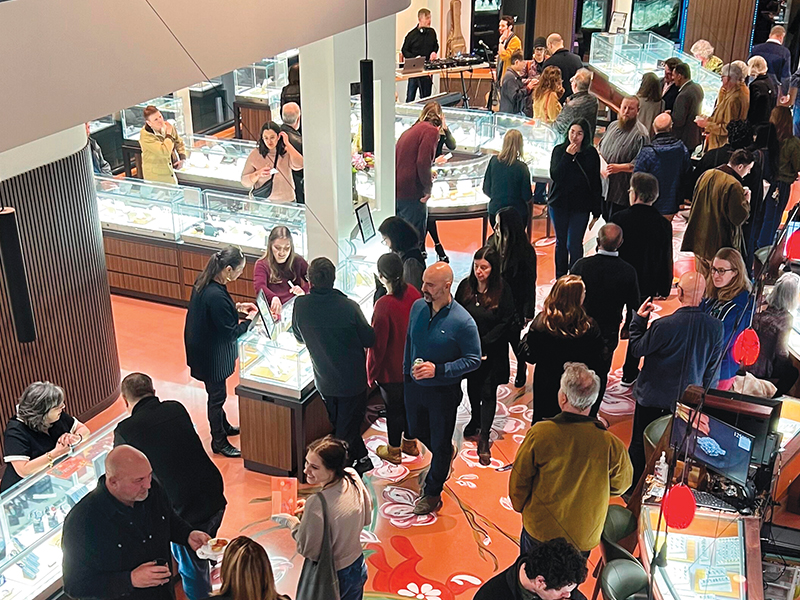
Special store events, particularly those that involve a hands-on component, can have a similar effect on your business. They create excitement, enthusiasm, and a sense of fun while engaging your existing customer community and introducing your business to new customers. In a relaxed, party-like atmosphere that feels more like a social gathering than a sales environment, people’s resistance tends to drop because they don’t feel as though they’re being “sold to.” Even longtime customers who are already familiar with your offerings may begin to think of your business less as a retailer and more as a trusted friend.
While an event or experience may not generate significant sales at the time, it can leave a lasting impression. Customers are more likely to remember you and keep your business top of mind when they later need the products or services you offer.
The Power of Experience
There are countless reasons to host a special event or experience: the opening of a new space, the exhibition of work featuring a particular designer or group of jewelers, a fundraiser for a cause, a way to highlight what makes your business unique, or a celebration of an anniversary, holiday, or community milestone. Sometimes, the reason is simply the excitement and goodwill an event can generate.
At Danaca Design Gallery, a distinctive space in Seattle’s University District, owner Dana Cassara offers classes taught by a variety of artists, covering everything from introductory jewelry making to specialized techniques for more experienced makers. She also hosts non-jewelry art classes to encourage creativity, provides bench space for maker-members who can’t work at home, sells gemstones and jewelry tools, and offers gallery space where artists can exhibit finished work.
Cassara is especially enthusiastic about events that encourage participation from her jewelry artist community, and she has built events and experiences into the DNA of Danaca. Over the years, those events have included a tiara challenge and a bolo challenge, both followed by runway shows. Once a year, she hosts a “swap meet” where makers from across the region come to sell or trade tools, books, stones, metal—anything used in the production of jewelry. Recently, Cassara expanded into a second 1,600-square-foot space dedicated solely to the gallery and to hosting events.
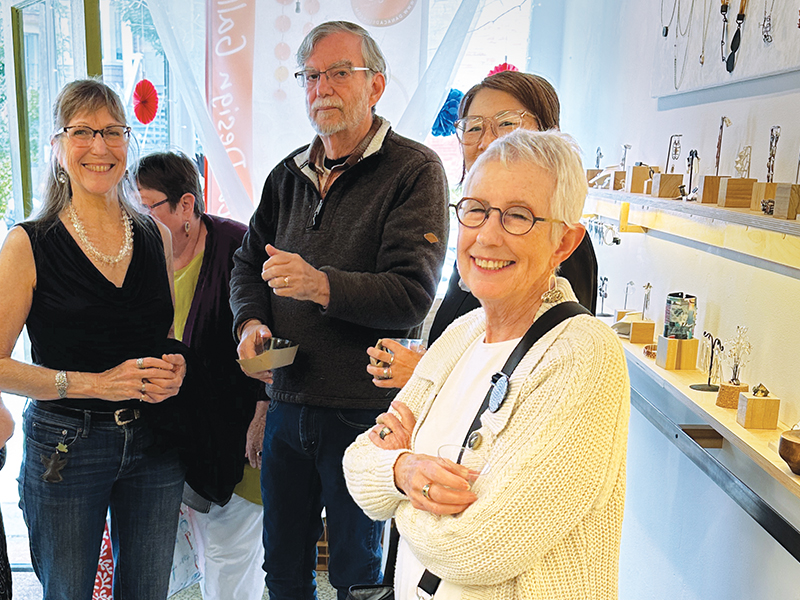
Attendees mingle during a reception at Danaca Design Gallery, where social, event-driven experiences create a welcoming atmosphere and help foster community and connection around jewelry.
Party-like special events create a kind of excitement that’s impossible to replicate on a day-to-day basis, she says. In addition to meeting jewelry artists, guests “get energy off of each other” as they admire and try on jewelry during the event.
“Jewelry is tactile,” says Cassara. “It comes to life on people. The opportunity to see things in person, try them on, feel them—that’s definitely going to generate more sales than just seeing them online.”
That energy flows between staff and customers. “It’s really fun because you’ll run across people you’ve never met but you actually kind of know because they have a piece of jewelry that you’ve worked with,” says Kristen Bales, marketing and creative content manager at Green Lake Jewelry Works in Seattle. “You get to see the person wearing it. You’ll go ‘Oh, my gosh! I love that ring.’ And you’ll see how wearing jewelry does spark that story and connection with other people.”
Recently, Green Lake Jewelry Works moved its flagship store to a larger space. To kick off the holiday season, the team introduced both longtime and new customers to the location with an interactive special event that included a scavenger hunt and a photo booth.
One of the most striking features of the new store is its hand-painted floor. Upon entering, guests received a postcard directing them to find specific elements of the floor design as part of the scavenger hunt. Each clue led participants to a different area of the store, where they were introduced to Green Lake’s work with designers such as Susan Misani, who traveled from Milan, Italy, for the event, and Seattle micro-mosaic designer Cynthia Toops, who demonstrated her craft.
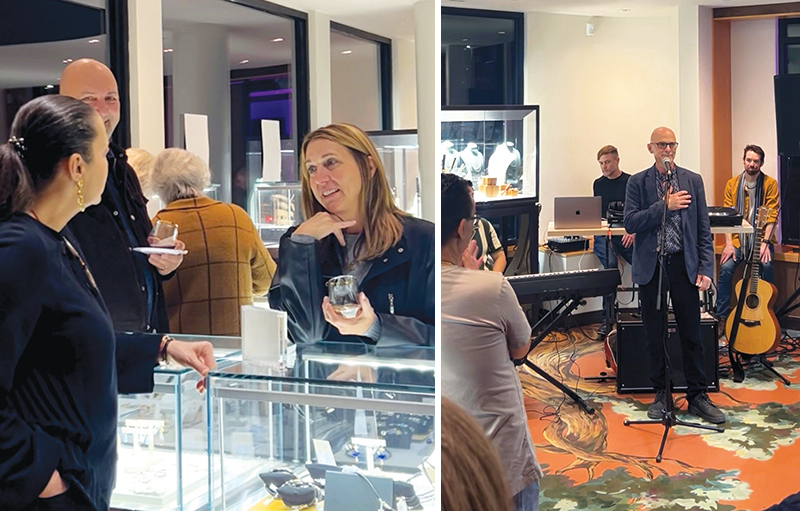
Guests attend the flagship store grand opening at Green Lake Jewelry Works, where interactive elements and shared experiences helped introduce the new space while strengthening connections with both longtime and new customers.
The hunt, says Bales, “was a great conduit to encourage interaction with our designers and to share different elements of the store we’re really excited about, like our gemstone bar, where you can see a wide variety of sapphires and diamonds.” She admits, however, “it did get more challenging as the night got busier and busier, because then you couldn’t see the floor really at all.”
The event also reconnected staff with past customers, particularly bridal clients who were able to see how Green Lake’s non-bridal offerings had expanded, says Elaine Stevens, the company’s gemstone buyer. Customers could see that, “for any special occasion—anniversaries, babies being born—we have special gifts. It was lovely to reconnect with them so they could see how we can continue to be their jeweler.”
A popular corner of the store was the photo booth, which subtly reminded attendees of Green Lake’s extensive experience in bridal design.
“We thought about the kinds of fun offerings in the wedding industry that are available to us. Everyone has gone to a wedding, and there’s been a photo booth,” says Bales. Just as wedding guests give their souvenir photos pride of place on the fridge door, Green Lake hoped attendees would keep their framed photo booth images—decorated with the same artwork used on the floors—on display. “It’s such a joyful memento.”
Building Community
For many jewelers the goal of these events is less about immediate sales and more about building and maintaining community.
The COVID-19 pandemic was destructive to many businesses as people moved their shopping online. It curtailed Cassara’s event-heavy schedule, and, she felt, weakened the sense of connection among her jewelry artist community. In response, she devised what became her most successful event: the month-long “Battle of the Rings.”
It was devised, says Cassara, as “an opportunity to have a connection with our community, to give people something to do, and to keep our presence online.”
The event was such a huge success that it has continued both online and in person. A curated selection of 64 rings, chosen from about 150 submissions, is posted online, where Danaca’s international community of 3,000 to 4,000 followers vote for their favorite. All rings must be available for sale and priced below $1,600. Artists supply the physical pieces to the gallery, and “we go all out for it in terms of photographing and videotaping,” says Cassara.
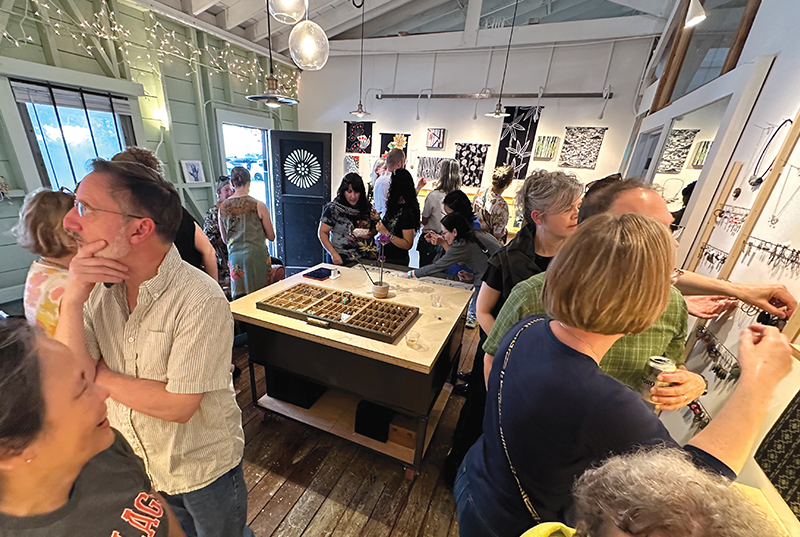
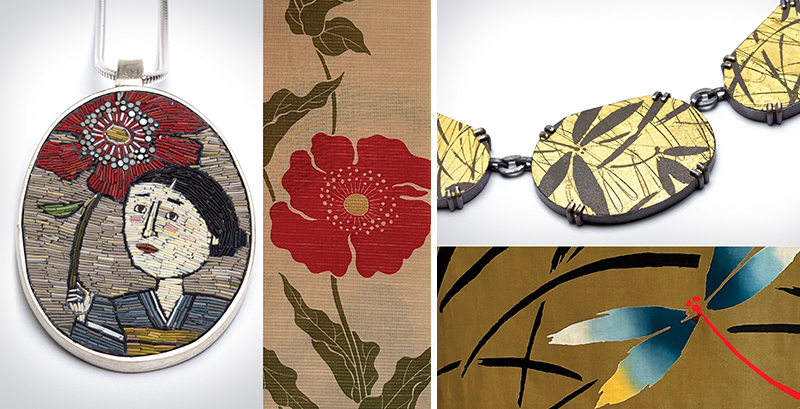
Danaca Design Gallery’s Yukata Inspired exhibition brings artists and visitors together around a shared theme, challenging jewelers to reinterpret Japanese textile patterns through contemporary design.
The creativity and craftsmanship are extraordinary. Many of the rings are kinetic. “They spin, they flip, they shoot, they light up, they do all kinds of things,” says Cassara. About one-third of the rings sell, and people now travel from across the country to attend the physical exhibition. “It’s excellent exposure for the artists,” says Cassara, noting that she often produces a catalog of the entries.
Your business can often amplify the impact of an event by partnering with a complementary business. Customers are introduced to your offerings in a fresh context and gain insight into your values. By combining mailing lists, both partners can reach new audiences, and collaborative events are more likely to attract attention from niche media outlets.
At Danaca, Cassara hosts several exhibitions a year. One of the most popular exhibitions is a collaboration with Okan Arts, a family business that sells Japanese textiles online and organizes quilting experiences and tours to Japan. The exhibition, Yukata Inspired, challenges artists to design jewelry based on the patterns found in lightweight cotton kimonos traditionally worn during Japan’s hot, humid summers.
Cassara selects and invites participating artists, though some reach out on their own. “I do often seek people I think would enjoy a fabric motif,” she explains. “I invited Jeanie Pratt to work with the fish fabric as she is known for that and likes fish.” Each year, the group includes both established and first-time participants.
Some artists incorporate the fabric directly into their work. Others translate shapes or motifs into metal, while still others abstract colors and lines until the connection is barely recognizable.
The event is promoted through both businesses’ mailing lists and online platforms. Patricia Belyea, co-owner of Okan Arts, blogs regularly, and Yukata Inspired has also been covered in International Examiner, a digital publication serving Seattle’s Asian community.
Another memorable Green Lake event was a “mine your own sapphire” experience held on a summer day as a fundraiser for the Boys & Girls Club. The store purchased gravel from a Montana mine, divided it into individual burlap sacks, and promoted the event online and in-store. Participants—including a number of children—paid a flat fee for a bag of gravel, with proceeds donated to the charity.
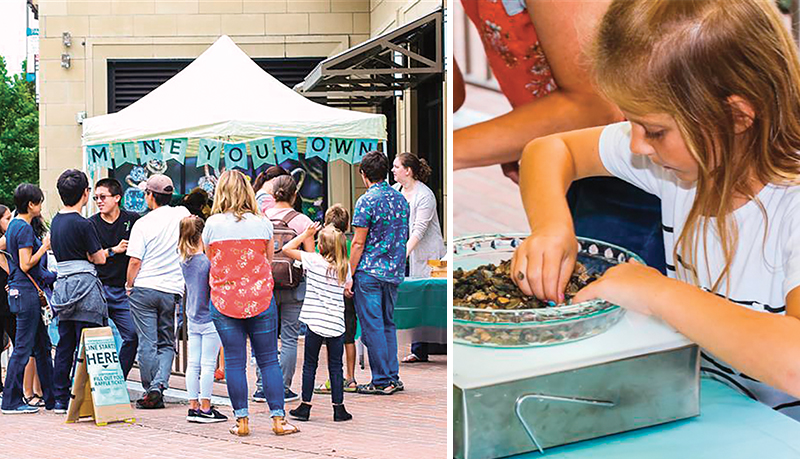
At Green Lake Jewelry Works’ “Mine Your Own Sapphire” event, participants of all ages got a hands-on experience, sorting through Montana mine gravel during a fundraiser benefiting the Boys & Girls Club.
“We had tables set up with about 10 light tables so participants could sort through material,” explains Bales. A rinsing station at the beginning of the line helped reveal the rough more clearly, and those who didn’t want to wait could take a bag home to sort later. The event took place outdoors at Green Lake’s Bellevue studio and in the parking lot of its former Seattle location. Participants who found sapphires could consult with Green Lake’s gemologist on the spot.
Though Bales says they don’t have concrete figures on how many participants were first-time or repeat customers, the event clearly made an impression. “Our clients still mention the experience they had doing mine your own!” she says.
Event Planning for Community Building
Hosting a successful event requires more than a good idea. Attention to promotion, logistics, and staff support can help ensure the experience runs smoothly and leaves a positive, lasting impression.
• Promote through multiple channels. Use emails, press releases, social media, and in-store handouts.
• Plan logistics early. If serving food or alcohol, secure required permits and review insurance, staffing, and security needs.
• Set the tone. Music, whether live or curated, helps shape the atmosphere of an event.
• Support your staff. Provide food, drinks, and a designated break area to keep teams energized.
Planning for Impact
The return on investment for special events and experiences can be difficult to measure in strictly financial terms, particularly when the goal is community building rather than immediate sales. But the goodwill they generate—through word of mouth, shared memories, and repeat engagement—often proves invaluable over time.
That goodwill doesn’t happen by accident. Successful events require careful planning, starting with promotion. For events at Danaca, Cassara relies primarily on her website and a combined email list of about 6,000 subscribers, along with press releases that occasionally result in local media coverage.
For its grand opening, Green Lake used its digital mailing list and an Eventbrite invitation. “We promoted it heavily on our Instagram page, we had physical postcards in the store for people to pick up and for designers to give to their clients,” says Bales. In the months leading up to the event, their design team also reminded clients that the store would be moving to the new location in time for the holidays. “I think that made a huge impact in the awareness of our new location.”
Even for someone who enjoys hosting, says Cassara, events can be a “whole ordeal.” There’s promotion, food, music, and potentially permits for serving alcohol. Depending on the event, you may need additional insurance, staff, or security.
For most events, it’s probably easiest for businesses to cater food and hire a band for music. However, for Green Lake’s new studio opening, the team chose to showcase the talents of their staff rather than outsource everything.
While a local bakery provided all the food, “we did all of the plating and serving. We got to put some of our artists to work in a different medium. They made the most beautiful charcuterie boards you’ve ever seen,” says Stevens.
Music followed a similar path. Although Green Lake originally planned to hire a trio, they ultimately relied on in-house talent. “The guitarist was one of our jewelers, the singer was our design manager, and the DJ in between was one of our production assistants,” explains Stevens, adding that the result “was stunning and personal and intimate. If you have that talent in your crew, use them. It just really makes such a huge difference.”
Security is another important consideration. While neither Danaca nor Green Lake experienced issues, both ensured there were plenty of staff present throughout their events. For Green Lake’s Seattle opening, staff from the Bellevue studio were brought in to help. “The store was littered with employees,” says Stevens. “You couldn’t lift your hand and not accidentally hit an employee.”
Staffing, in general, is critical as excitement builds and sales opportunities emerge. Events can mean long days—some Green Lake employees worked 14-hour shifts—but responsibilities rotated, and staff supported one another throughout. “Everybody here just takes such pride in this company and their store, that there wasn’t a moment that someone wasn’t stepping up to fill it,” says Stevens. “It just sort of was seamless.”
Keeping staff fed and energized is just as important. Green Lake brought in pizzas and salads and made sure everyone had time for a break. Owner Jim Tuttle ensured staff could rest and recharge before returning to the floor.
Considering the amount of time and effort needed to pull together these types of events, one can’t help but wonder: Do they directly increase sales or foot traffic? But Cassara doesn’t think of it in that way.
“I really like the energy around it,” she says. While she believes events do help sell work, “for me, it’s all about fun. I want to sell things, but I really have to have fun. Otherwise, I don’t want to do it.”