

Using AI to Boost Jewelry Sales
Smarter Selling
Jewelers can now use AI to streamline marketing, sharpen sales conversations, and gain clearer insights into their business
By Sharon Elaine Thompson
(Originally Published by MJSA January, 2026)
Artificial intelligence (AI), depending on who you listen to, will either bring about the end of the world or free humans from drudgery. But used thoughtfully, AI can be a helpful marketing tool.
It can help draft text for emails, social media, blog posts, websites, and video or presentation scripts; create a marketing plan or social media calendar; train sales staff; and even help close custom design sales. When prompted correctly, it can be a whiz at analyzing your business data as well as assessing how your business fits into the competitive landscape.
But like any technological tool, artificial intelligence needs human intelligence (yours) and business savvy (also yours) to work most effectively. That’s why we used the words “draft” and “help” and “prompt” in the paragraph above. Only by customizing and personalizing your AI instructions, will you get feedback that is pertinent for your specific business. Then you must use your human and business intelligence to evaluate the quality and accuracy of what AI provides.
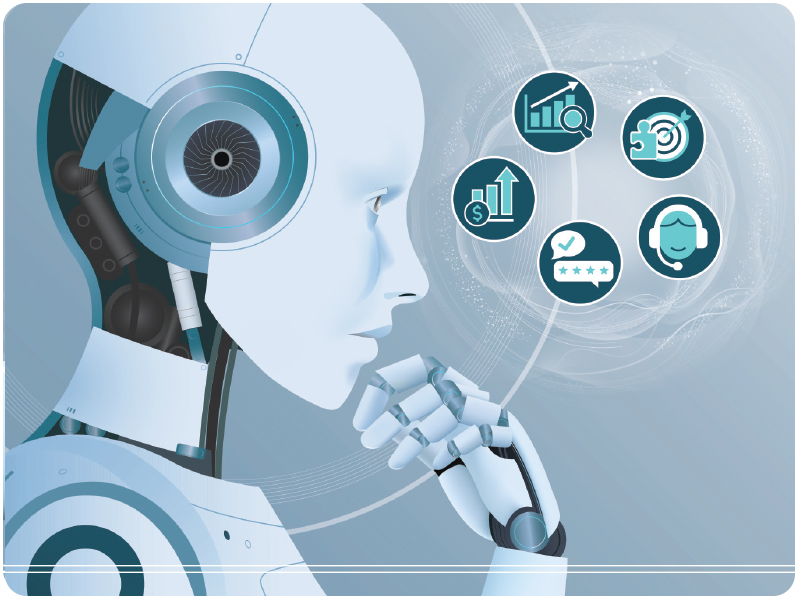
From headlines to campaign planning, AI can streamline marketing work, but strong results still depend on human insight and brand clarity.
“A lot of people think they can go to an AI and say, ‘Write this marketing email for my jewelry business, or start an email campaign for my jewelry company,’” says Rider Harris, founder of the AI consulting firm GoBananas.ai in Las Vegas. AI will do that if you ask, he says. But without the right context onboard, the results will probably be disappointing, because “the input that we give the AI has a direct correlation to the output that we get in return.”
AI should be treated more like a junior team member or an intern than a senior executive, says Laryssa Wirstiuk, founder and creative director of Joy Joya, a marketing company in Glendale, California, that focuses on helping clients improve email and SMS marketing campaigns. “To set that person up for success, you have to invest time, effort, and mental bandwidth for it,” she says. “But the more you invest in it, and the more you know about your own business, that person becomes better and more skilled and more experienced.”
Laying the Foundation
If you hire a new employee or outside consultant, before they can help your business, you teach them about your business. What industry are you in? What is your company’s name, and how long have you been in business? Where are your stores, and how many do you have? What products and services do you offer? What’s your best seller? What marketing campaigns are you running, and who is your target market? You have to do the same for any AI you work with.
Giving an AI platform a solid grounding in your business depends on you having a strong brand foundation, says Wirstiuk. What’s your business’s story? What makes you unique? What is your value proposition?
“That’s always been an issue and a challenge for businesses,” she says. “AI complicates everything now, because businesses think, ‘Oh, I can skip all those things. AI will figure it out for me.’ But you really need to have that foundation in place first.”
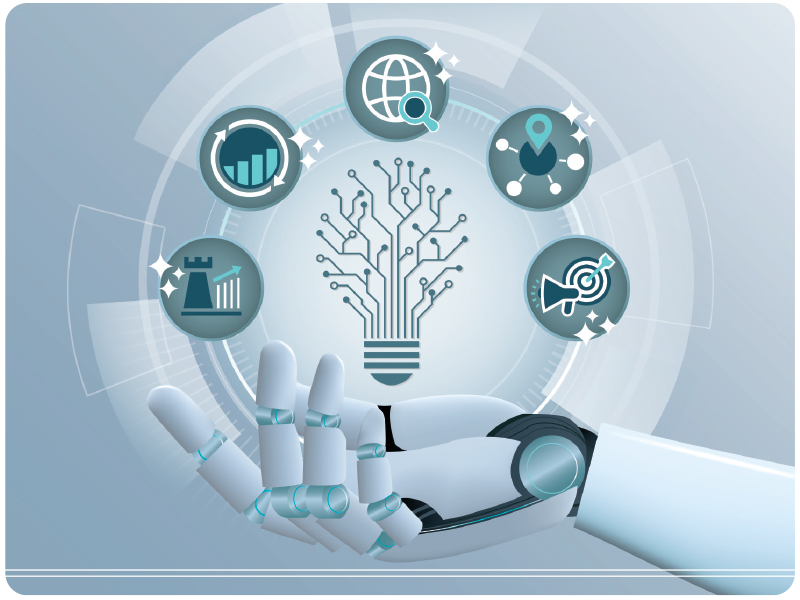
From headlines to campaign planning, AI can streamline marketing work, but strong results still depend on human insight and brand clarity.
If you have a strong brand foundation, a consistent marketing strategy, and clear goals, AI can be a great brainstorming tool, says Wirstiuk. You can ask it how to improve what you’re doing, analyze where you might put your marketing money for the most effect, or suggest new areas of opportunity. “AI can give you insights to help you continue refining it over time,” she says, “or give you ideas that maybe you didn’t consider before, based on the performance you’ve already established.”
Be critical of the feedback AI gives you. If it recommends leaning heavily into social media but your business intelligence tells you your target audience doesn’t spend time there, it may be time to rethink the context you’ve given the platform or the prompts you have used.
Improving Content Creation
AI is often used to create content. With the internet’s insatiable hunger for content, “it’s very difficult to keep up with the demand and amount of content a business really needs to be putting out today to stay visible,” says Wirstiuk. AI can help develop fresh marketing ideas that are relevant to your product line and goals.
“I use it to come up with quippy headlines or short covers for YouTube videos,” says Jennifer Shaheen, founder and president of Technology Therapy in Providence, Rhode Island. “If you take your top ideas and ask it to make 20 more, it goes faster and gives you more to work with.”
In addition, AI can help you personalize a message, as contradictory as that might seem, by crafting your copy according to your audience. You can ask it to be casual, professional, funny, or to style it for Gen Z or Baby Boomers.
Even for experienced copywriters, notes Shaheen, this can be difficult. “It’s not easy to switch your tone and your intonations from one audience to another.” But AI can do it in seconds.
Here, too, users should be wary. AIs can “hallucinate”—create stories that aren’t real or present information written with authority but that is inaccurate.
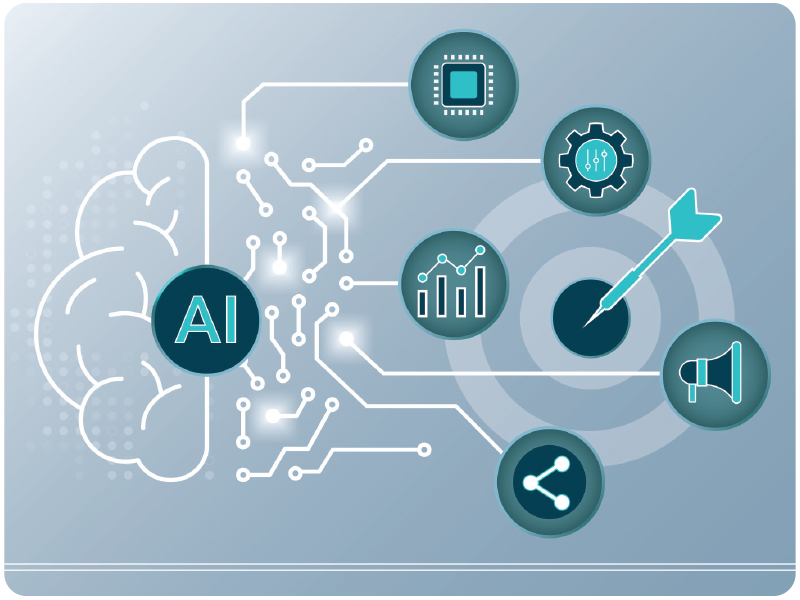
AI can generate captions, hashtags, and video scripts quickly, freeing jewelers to focus on strategy rather than starting from scratch.
“Artificial intelligence can sometimes spit out things that aren’t quality,” says Shaheen. “You are going to need a human to level up the quality and check it for taste and style.”
Make sure the content AI produces adheres to your policies and matches the tone and the personality you want to project, she adds. Double check it for accuracy, evaluate the quality of the result, edit the message, and proofread it before sending it out to represent your business.
“You need to educate yourself, even on a basic level, about what these tools do and how they work, because they can lead you astray, if you’re just blindly following whatever they’re producing for you,” says Wirstiuk.
Learning the Tools
AI’s potential is so vast that, if you’ve never worked with it before, it can be overwhelming to know how and where to start.
One way to get comfortable, suggests Harris, is to begin with one task and learn how to do that. He recommends starting with email—maybe have it write an email or a response—and see what it comes up with before asking it to design your entire campaign. Or create a few social media posts. Starting slowly allows you to get familiar with prompting and to understand what those prompts return.
Ask it to create text in different voices. For example, suggests Harris, if you want to use it to write your social media content, compare the social media post it creates in a “professional” voice versus a “casual” voice.
“It’s smart that you take some classes,” says Shaheen. “It’s important that you get a baseline.” Having taught classes in the use of AI, she says people often tell her later, “I wish I had known that,” or “That made my life easier,” or “I didn’t realize that’s why I wasn’t getting the outcomes I was looking for.”
Once you get confidence, you can use AI to expand your organic reach online.
“AI can help search the web to find relevant topics that boost the ability for [the post] to go viral,” says Harris, who uses it for much of his social media. “It can generate captions for me. It can generate hashtags for me. If I want it to, it can generate a full-blown script for me to follow for my social media videos.” Instead of spending hours researching with a search engine and then creating the script yourself, AI can prepare it in a fraction of the time.
Protecting Your Visuals
One thing marketing experts recommend you not do with AI, or do extremely cautiously, is generate images.
“With a category like jewelry,” says Wirstiuk, “it’s so important to show the actual product in a realistic setting. Consumers are getting very savvy about AI and questioning every image and every video that comes across their path.”
Some jewelers put images of their own top-selling designs into AI and ask for iterations, hoping to recreate their earlier success. But use caution if you do this, says Shaheen.
“Remember that customers want to be attracted to new things. If you’re just going to iterate everything that you already have, you might not necessarily gain the attraction that you’re looking for.” Repetitive “sameness” she adds, is a common complaint about AI.
You must also protect your creations. “If you put an original design work into AI,” says Shaheen, “you’re giving, oftentimes, rights over to those platforms that they can reuse them. [Your design] becomes part of their what they call ‘training data.’”
Making Sense of Your Data
One thing AI excels at is handling large amounts of data, analyzing it, and presenting it clearly. You can use it to analyze your marketing to find what has worked and what hasn’t, then focus on using the successful tactics moving forward.
For example, AI can research competitor pricing much more efficiently than you can. Searching competitors’ websites and comparing prices with yours can take hours, if not days. AI can search the web for maybe 20 minutes, says Harris, present a summary of what it’s found, and even log its sources.
AI can help you forecast, too, says Shaheen, who used one client’s previous three years of fourth-quarter sales to look at what the store should do in the future. “I used the AI to help me analyze what’s gone up, what’s gone down, where there were holes and opportunities.
“You can also ask AI to compare the data that’s out in the market,” she continues, “like reports put out by other organizations, and ask it ‘Should we consider showing more colored stones this year in our catalog, rather than just diamonds?’ or ‘What are the trends that we’re seeing?’”
These kinds of normally time-consuming analyses can help you manage inventory more effectively and prevent over- or understocking issues.
“When it comes down to it,” says Shaheen, “we forget that AI is a tool. It’s like Excel or QuickBooks. It’s a matter of finding out the ways you can use it.”
Strengthening Sales Conversations
Strange as it may seem AI can help with a business’s human interactions, too.
Overcoming a customer’s objections is one of the biggest challenges a sales associate has, says Harris. When an associate cannot completely or satisfactorily address an objection, they may fail to close, which means lost revenue. AI can research and develop a long list of potential objections, generate ways to overcome them—perhaps even ones you haven’t considered—and help an associate learn to close more sales.
Used thoughtfully, AI can also help you close a custom sale and strengthen your human-to-human relationship with the customer.
One store owner had a client who wanted a custom design, but after going through the usual questions—What do you like? What don’t you like?—she was no closer to knowing what the client wanted. Rather than sit down and sketch, says Shaheen, a process that could take hours, the store owner used AI to create a couple of design iterations. The customer quickly saw what she liked and didn’t like, and they were able to move on from there. “[The store owner] got to make the customer happier, faster,” says Shaheen, and in the process saved hours of design work.
Shaheen recommends other jewelers use AI actively like this. Using images from your own website or from your case (bearing in mind copyright protection issues), you could say, “‘Let’s pull out three things that you like, and then let’s iterate that together.’ Make them part of the process,” says Shaheen.
AI may present something that can’t be made. However, says Shaheen, by explaining why it can’t be made as shown—perhaps the metal, stones, or setting style aren’t compatible with the design—you can reassure the customer that she is in safe hands with your skills, knowledge, and experience.
“It also brings the customer in a bit more,” she says, “and makes them feel like they helped create it. You’ve built a relationship and a bond because you worked on something together.”
Will AI Improve Your Bottom Line?
Will the time invested in adding AI to your arsenal of tools improve your bottom line?
You may not see a direct correlation. More accurately forecasting sales trends and managing your inventory can certainly save money. Creating more effective email, social media, and video scripts can boost visibility, direct visitors to your website, and perhaps turn browsers into buyers. Training associates to more effectively close sales will certainly affect your income, as will using AI to build stronger connections with custom clients.
However, says Harris, the biggest change you’ll see will be in time saved.
Before learning AI, Harris often has clients list their most time-consuming tasks, along with how much time they take and how often they do those tasks. After the client starts using AI, he surveys them again. “They’ll save 15 minutes there, 20 minutes there, 25 minutes there,” says Harris. And time, as they say, is money.
That said, before diving into AI, remember that it comes with caveats. AI platforms are notorious for taking copyrighted material from the unwary and using it without permission.
Before you commit, recommends Shaheen, ask yourself how you plan to use AI. “What information are you going to be putting into it? Are these things that you would want the whole world to see? Understand what you want to protect, because each tool has different terms.” Those terms can vary depending on the level of subscription you purchase. A higher subscription fee may come with higher copyright protections that guard against granting the platform free rein to use your material.
What you can’t do, says Wirstiuk, is ignore AI. “Business owners need to have some working knowledge of marketing and technology. If it’s not them, they need a business partner, a trusted member on their team who is keeping up with how quickly everything’s changing. You cannot be completely ignorant and use these tools and just trust that they’re going to solve your problems or make things happen for you.”
You can’t be afraid of it, she says. “Businesses that are avoiding AI are going to be left behind in the next year or two.”
AI Do’s & Don’ts
Whether you’re using AI to draft emails, brainstorm campaigns, or support sales, a few smart guidelines can help you get better results and protect your business.
Do:
• Treat AI like a new hire—give it training, clarity, and guardrails.
• Feed it examples of your best emails, posts, or product descriptions.
• Edit for taste, accuracy, and brand consistency.
• Start with small tasks to build confidence.
• Re-prompt when the output misses the mark.
Don’t:
• Upload anything you wouldn’t want out in the world.
• Rely on AI to replace your brand story or marketing strategy.
• Skip the proofreading step.
• Incorporate AI images into marketing without clear disclosure and a review for realism.
• Expect perfect results on the first try.