

AI is Reshaping How Jewelers Create
Design, Disrupted
AI is becoming an essential tool in the jeweler’s toolkit.
By Shawna Kulpa
(Originally Published by MJSA January, 2026)
Jewelry makers have been adapting to new tools for generations, from wax carving to CAD and from rubber molds to 3-D printing. Artificial intelligence (AI) is simply the latest addition to that toolkit—albeit one that can work faster than any human.
Right now, much of the impact is felt at the front end of the process. AI helps jewelers visualize concepts with clients, test variations of a design, and generate photorealistic renders for sales and social media. Behind the scenes, manufacturers and software developers are pushing toward tools that can analyze files, suggest sprue placement, estimate costs, and eventually convert images into production-ready models.
AI is also raising questions about the future of manufacturing, its impact on the workforce, and how to protect intellectual property. Underlying them all is one essential question: How much are humans still needed?
Faster First Drafts
If there is one place where AI has already found a foothold, it is visual content.
“It’s a great way to create content quickly, and social media requires so much content,” says Michael Magee, senior subject specialist at the Gemological Institute of America in Carlsbad, California. “The other place I’m seeing it is design ideation—creating variations on a theme or finding ways to engage with the client quickly for custom work. Because you’re trying to come up with new and interesting designs, it gets to the visualization stage really quickly.” For jewelers trying to turn a vague description into something a customer can react to, being able to spin up a handful of designs in minutes can be a game changer.
On the manufacturing side, those same images are starting to drive downstream work. At Master Casting & Cad in Chicago, Head of Growth David Baird sees AI primarily as a new form of counter sketching.
“Where I think it’s already having an impact is on customer interaction, where a jeweler is showing a customer images of pieces,” he says. “That translates to manufacturing, as jewelers give the image to us, and we use that to create the CAD design.” Not long ago, that image might have been a hand drawing. Today, it may be a highly polished AI render.
Jewelry designer Greg Stopka of JewelSmiths in Pleasant Hill, California, has built his entire design workflow around that capability. Instead of starting with text prompts where he might describe in words his ideas, he begins with his own sketches that he uploads into the program.
“You render it in AI and tell AI to make 20 or 30 iterations of this design, keeping the reference the same as much as possible. It will give you iterations in rings, pendants, earrings—whatever you want—in just a few minutes.”
Across the industry, developers are experimenting with similar sketch-plus-AI models. Valérie Leblond, co-founder of the BLNG design app (blng.ai), frames her platform as an early-stage exploration tool rather than a full production solution.
“You can draw, generate, and talk with the AI,” she says, stressing that jewelers remain responsible for structure and manufacturability. “They rebuild the design in their CAD software. The value is accelerating exploration.”
That shift—from doing everything by hand to curating from a flood of options—is something designers outside the jewelry world are seeing as well. Munich-based experiential designer and Studio Tish co-founder Yves Peitzner says that for now, the most meaningful use of AI is “mostly being used as design inspiration. You can create hundreds of thousands of designs at a time,” he says, “but you still need to choose something. It’s a co-creator.” For jewelers who don’t know how to build a CAD file from scratch, he sees real potential. “If you don’t know how to make a 3-D model, this would be very helpful,” he notes. “AI is just a tool—like Photoshop or an editing tool—and the role of the human is still very important.”
Which is a key point: None of these tools removes the need for a designer’s eye. Stopka relies on AI for speed and realism, but he still has to decide which direction will work. “That is where I think a lot of jewelers think it’s going to take our jobs,” he says. “You need to have some design skills. If you have stones to work with, you have to be able to design around them. That’s a basic skill of a jeweler. You’re never going to be obsolete.”
Magee also points out that AI is not a magic wand. “There are people who aren’t using AI yet and are still living in that ‘AI makes weird hands’ mindset, that AI just makes crazy, unproducible fluff,” he says. “But on the other side are people who think AI is a magic wand that will fix and do everything for them. In my experience, most AI tools are great at producing images that are about 80 to 90 percent accurate. If you want a perfect image or model, you still have to create something yourself and render it.”
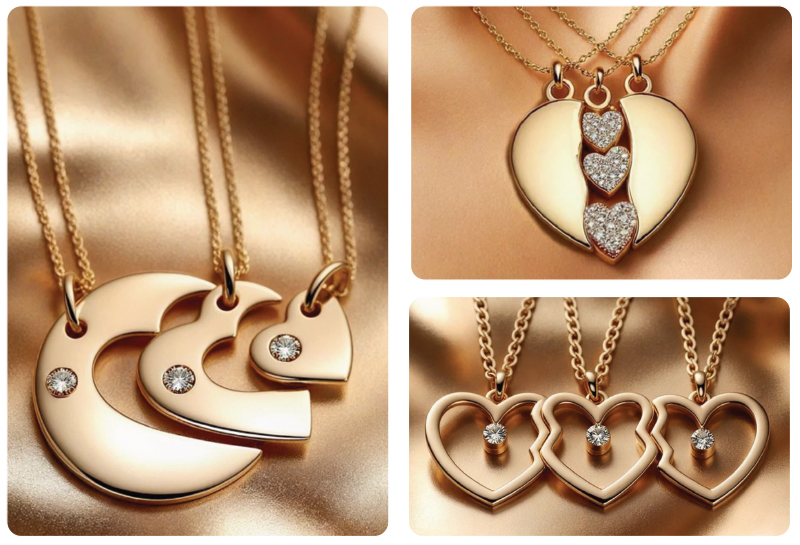
Given basic design direction, AI programs can quickly generate multiple design specs that explore variations in style, stone placement, and overall form early in the creative process.
Closing the Gap Between Image and Object
Turning a gorgeous image into metal and gemstones is where things get tricky.
“So far,” says Baird, “AI just generates a picture. It doesn’t generate a 3-D file…yet.” That part of the process is still being done by a human CAD designer, although Baird knows of several companies working on text- or image-to-3-D and thinks “it’s probably coming pretty soon.”
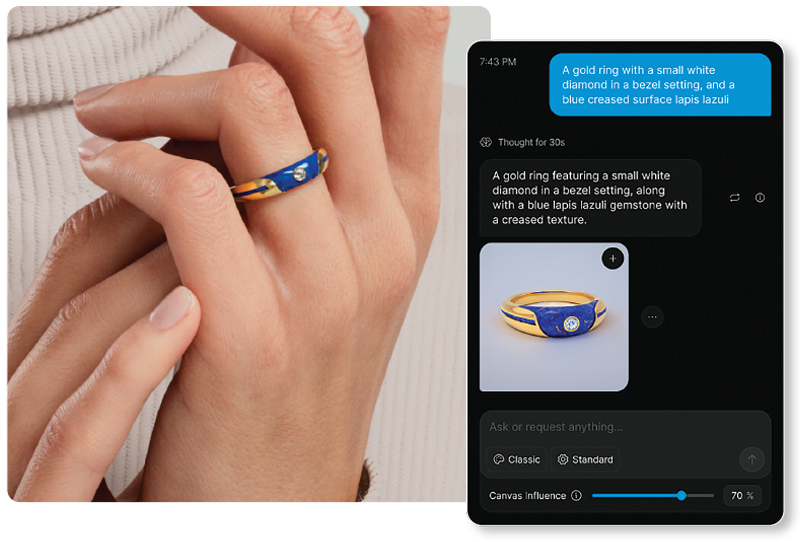
In the BLNG app, a simple prompt—a gold ring with a small white diamond in a bezel setting and blue, creased-texture lapis lazuli—generates a fast concept image to react to and refine.
Magee sees the same trend from a research perspective. “The basis for the technology is there, it just doesn’t understand jewelry at all,” he says of AI programs that generate 3-D meshes from images. The resolution is still too low for manufacturing-grade work, producing models better suited for screen-based uses such as animation and gaming—not precision casting. The bigger problem is that jewelry is unusually complex.
“The geometry of a jewelry piece, especially a ring, is so much more complicated than the geometry of” most industrial or consumer products, he explains. Current AI models are trained on photos of finished jewelry, not on production files. “There are no AI programs that I’ve seen yet that are actually trained on production models and not on finished goods.”
Even without fully automated modeling, AI is starting to influence technical decisions further down the line. At Master Casting and Cad, Baird’s team is in the early stages of using a tool that suggests sprue layouts. “We’ll take a 3-D file, plug it into the tool, it will add in sprues, and then we’ll show it to our CAD guy, who will review it and make any adjustments,” he explains.
His team is also working on an AI model that can provide cost estimates on the designs it creates. “We’ve trained the model on our thousands of designs to detect things like metal, stones, [and] sizes,” he adds, “and [we plan to use that information to give an estimated price”—one of the first answers that a jeweler needs during a custom consult.
Across the industry, Magee sees similar efforts. “There are a lot of people from a couple of different companies trying to tackle the idea of being able to do instant quotes,” he notes, including estimates of metal weight and stone count. So far, he hasn’t seen it done with great accuracy, but he believes that once it is solved, it will change how sales are done at the counter and online.
For now, accuracy still depends on the human feeding the system and checking results. Baird sums it up bluntly: “Garbage in, garbage out.” On the positive side, he says that when inputs are realistic, his team’s pricing model “is getting really good estimates on costs.”
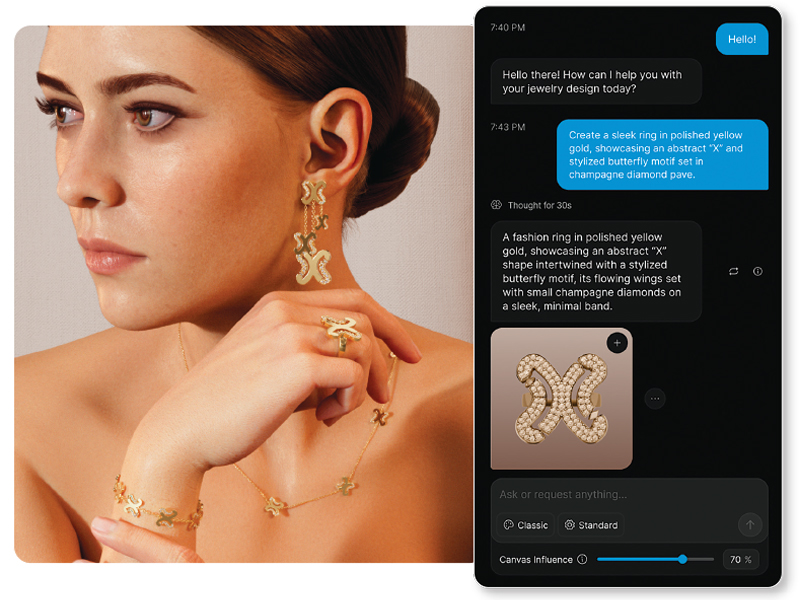
Once a concept is defined, BLNG can display related design variations on a model, helping designers evaluate scale, proportions, and overall wearability before moving forward.
Custom at Scale
One of AI’s most visible effects is how it’s reshaping the custom experience for consumers.
Leblond expects that tools such as BLNG will expand custom work rather than replace it. “We think it’s going to change [jewelers’] ability to make more custom orders,” she says. “We hear from a lot of partners that they want to take their custom order division and multiply it by a factor of 3 to 10—they want 10 times more than they’re doing today.” By helping jewelers move quickly from ideas to visuals and then to shareable 3-D files, these tools streamline the path from concept to production.
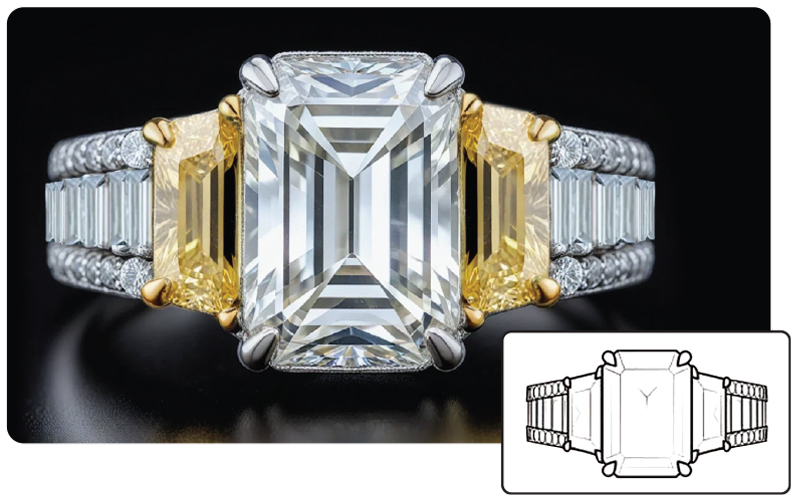
Starting from a simple sketch uploaded into AI, designer Greg Stopka can quickly visualize how a concept could translate into finished jewelry, offering early insight into form, scale, and overall design direction.
Stopka sees AI as perfectly suited to the building wave of redesigns, as inherited jewelry changes hands. “Our generation has got so much jewelry from inheritances,” he explains. “Those pieces aren’t their style, they won’t give them up, but they want something in their style.” Yet while AI helps him show possibilities faster, it does not replace that judgment. That work still demands a designer who can translate sentiment, gemstones, and structural limits into a new piece.
Outside the design appointment itself, AI is quietly changing communication as well. Stopka uses an AI chat agent on his website to stay in touch with clients. “It’s the new way to communicate with people,” he says. Clients can text photos of pieces or ideas, get quick responses, and even book appointments. “The AI agent allows you to stay in contact with people. It’ll answer questions or elevate it to a staff member so they can follow up.”
Magee expects that sort of client-side use to grow. He can easily imagine customers walking in saying, “Here, I built this on ChatGPT and I want you to make this for me.” That will require jewelers to be fluent in both AI’s possibilities and its blind spots, so they can steer those designs toward something that will actually wear comfortably and hold stones securely.
He notes that there are several companies actively working to integrate AI into existing CAD programs such as Rhino to create 3-D models of pre-finished jewelry for production. “We’ll likely see the first of these in 2026 with fairly limited capabilities,” says Magee. “Getting AI to create truly unique designs, fully in 3-D and ready for casting, will likely take longer.”
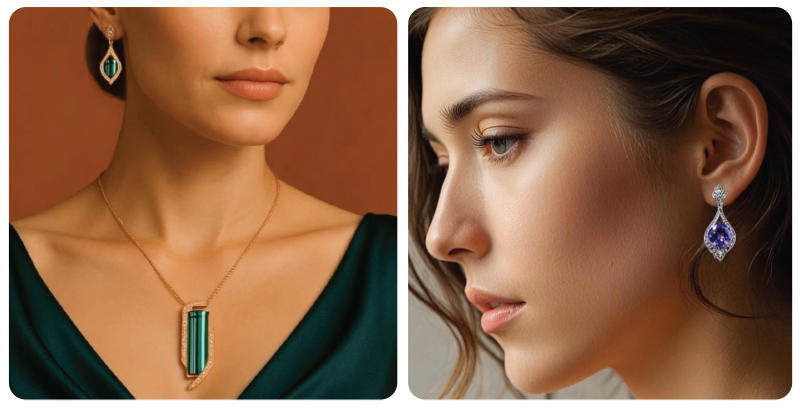
Using AI, designer Greg Stopka creates short marketing videos that quickly tell the story behind his designs, making it easier to showcase jewelry concepts across digital platforms.
Guardrails, Ethics, and the Future of Expertise
As more of the design process happens inside software, questions about intellectual property, ethics, and skills development are becoming harder to ignore.
For many professionals, the biggest worry is that uploading sketches or models will help train systems that competitors can draw on. Magee urges jewelers to adopt the same seriousness when they evaluate any AI tool. He also points to recent guidance from the U.S. Copyright Office, which still requires human authorship for protection, and stresses the need to understand both what you give to a model and what rights you have to what comes out of it.
“If you’re going to use an AI product, go through and read the whole terms and conditions,” he says. “In many systems, for the free models, anything you push up in there, you’re giving it to use to train the model.”
He notes that paid subscription tiers typically offer stronger data protections—your uploads are walled off from training. That’s the case with BLNG. Paying customers get contractual guarantees that the company doesn’t see what its customers are creating and doesn’t use their data for training. However, free accounts are handled differently. “Since they don’t pay, users are asked to consent to data use that helps us improve the technology,” says Leblond. “It’s very clear from the beginning so they know what they’re doing.”
Peitzner worries more broadly about what these models are trained on in the first place. “AI is trained from images on the internet,” he says. “If you can take photos of big brands and designers and use their images for creating something new, where is the ownership?”
With most public-facing AI systems scraping any unprotected website, he sees “extremely blurring” lines around authorship and warns that “at the moment, there are zero consequences” for this. He views regulation as something that’s both necessary and complicated.
“When you regulate, sometimes you don’t innovate,” he says. “To find that balance, I think it’s hard. And at the moment, there’s no balance.”
Stopka takes a more pragmatic view, shaped by years of seeing his work copied long before AI came along. “I know I’ve been knocked off,” he admits. “I told myself it’s just the way things are, and you have to go with the flow.” Rather than retreat, he uses AI to widen the lead between himself and imitators.
“Your mind will be a lot more creative working with AI,” he says. “You now have an infinite amount of design possibilities, so you don’t have to worry about someone knocking you off. They can take what they want, but I have new designs coming up every day.”
Beyond IP, there is the broader question of what ethical AI use looks like. For Magee, the starting point is human authorship. “The more that you can make sure AI is helping you create your own designs—and not just creating them for you—is one of the biggest ethical challenges,” he says. Clients come to designers for their creativity and story, not just a novel image.
“Using your own sketches as part of the AI prompt makes a tremendous difference,” he explains. “Putting human creativity first changes the paradigm from using AI to make ‘a design,’ to using AI to make ‘your design.’”
As the technology progresses, both opportunities and risks will grow. Magee has already seen “metallurgical research on using AI to predict material properties for alloys that haven’t been created yet,” which could lead to new materials. At the same time, he worries about something that is not technical at all: the loss of entry-level learning.
“One of the challenges I do worry about is what we see in coding in the computer science space right now, where you’re seeing a lot of loss of entry-level jobs,” he says. If AI takes over basic CAD tasks, “how do you ever get a new crop of experts if you’re not training people on the entry-level things to actually get there?”
Despite those concerns, no one sees AI wiping out bench or design skills any time soon. Magee believes “bench skills are pretty much safe, certainly in the short term,” and expects that hand engraving, fine stone setting, and other highly tactile specialties will hold their value.
Baird thinks AI will change what designers spend their time on, not whether they’re needed at all. “Right now, it’s definitely reinforcing the need for judgment,” he says. Instead, he expects AI to take over some repetitive work so “designers will be working on things that AI can’t.”
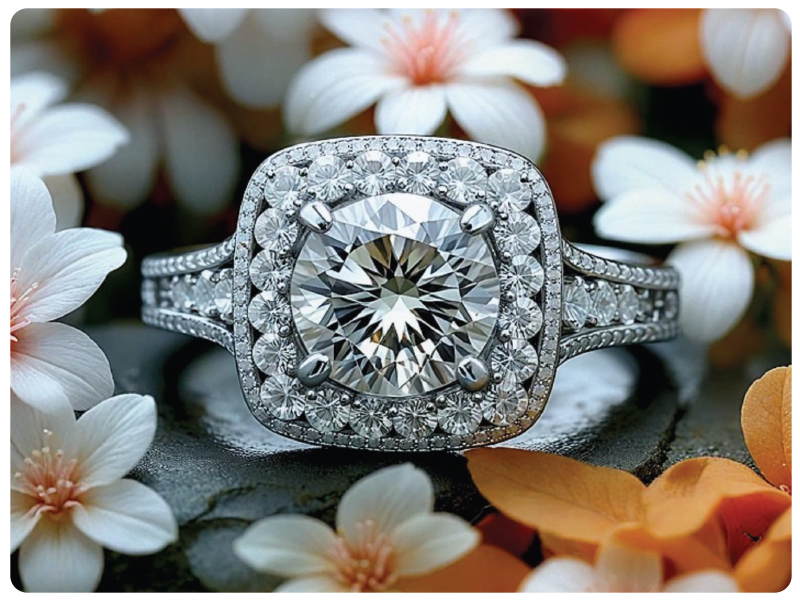
AI gives jewelers more ways to explore ideas and refine designs—without removing the need for expertise.
Peitzner doesn’t dismiss those risks, but he believes they make human creativity more important, not less. “Machines don’t dream, humans do,” he says. He expects AI to create “a huge wave of mediocrity,” where average work is easy to generate and easy to replace. In his view, excellence “will stay with humans,” and that’s especially true of craft.
“Doing something by hand is still something by hand and you can see it,” he says. “Something becomes alive when you can feel that someone has put in the effort.”
Stopka’s advice to his colleagues is simple. “Don’t be afraid of not knowing AI, be afraid of the person who does,” he says. In his view, AI is an asset, “helping just about everything,” as long as the person using it understands scale, structure, and what will survive casting and daily wear.
Taken together, these perspectives paint a picture of an industry in transition rather than in crisis. AI is speeding up ideation, changing how jewelers talk with clients, and inching toward deeper integration with CAD and production. At every step, though, it still depends on people who understand jewelry to check proportions, spot errors, keep clients’ trust, and decide which of the many possible designs deserves to become a real piece.
For now, at least, artificial intelligence is just another tool. It may generate ideas, images, and even rough 3-D forms faster than any human, but it still can’t decide what is beautiful, what will work structurally, and what is ethically acceptable. In those areas, human judgment still counts.