

The Benefits of Partnerships
Better Together
How collaboration can expand markets and stretch creativity.
By Shawna Kulpa
(Originally Published by MJSA October, 2025)
The jewelry industry has always thrived on relationships—between bench jewelers and designers, retailers and clients, suppliers and craftspeople. Many jewelers are now taking the next step and building on those connections to create unique collaborations. Whether between fellow jewelers, fashion labels, or businesses outside the jewelry industry, these jewelers are finding that such partnerships, rather than weakening their individual visions, are amplifying them.
Just ask Presley Oldham.
In 2020, it was a chance introduction through friends that connected the Hudson, New York–based jewelry designer with VADA, a Texas-based eyewear label. VADA was experimenting with sunglasses designed to hold custom chains, and Oldham created pearl strands to drape from the frames. What began as a single project has become a four-year partnership.
“It’s been a wonderful collaboration,” says Oldham. “You’re exposing your brand to an entirely new customer base and market, so you’re getting the benefit of that audience. That’s always good and helpful for growing the company.”
He has gone on to work with fashion designers such as Henry Zankov in New York, creating jewelry for three consecutive runway seasons. The challenge, he says, is invigorating: “I’ve created types of jewelry I wouldn’t put into my main collections, like woven pieces using cording or resin pieces. Just different ways of working that I don’t use every day.”
As with Oldham, collaboration can widen an audience, stretch a design language, and open doors to clients and markets they could never reach alone. And it’s becoming an increasingly important way to grow both creatively and commercially.
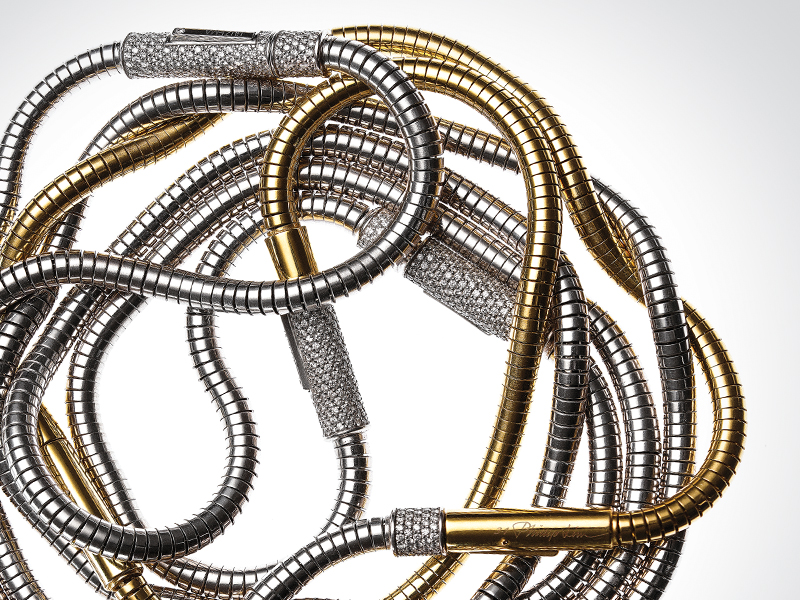
Chains from Guzema’s Snake capsule jewelry collaboration with 3.1 Phillip Lim blended Guzema’s minimalist aesthetic and Lim’s bold, urban sensibility.
The Benefits of Collaboration
Collaboration can be a laboratory, a lifeline, and a launchpad. Mariana Lenha, CEO and co-owner of the New York City–based brand Guzema, credits collaboration with helping to expand her brand globally. She partnered with fashion label 3.1 Phillip Lim to create a capsule jewelry collection that debuted during New York Fashion Week. Named Snake, the collection featured pieces “that fused Guzema’s minimalist elegance with Phillip Lim’s bold, urban sensibility.”
“Our goal was to showcase jewelry as an integral part of a fashion story, not just an accessory,” says Lenha. “On a practical side, we wanted to grow our presence in the U.S. market through a respected partner.”
The results exceeded expectations: coverage in major publications, features on inspiring women, and entrée into new wholesale partnerships. “It opened doors to new wholesale partners and solidified Guzema as a brand capable of playing in the global luxury space,” Lenha says.
Partnerships don’t just benefit smaller companies looking to expand. At New York City–based Oscar Heyman, where jewelry has been designed and produced for more than a century, partnerships are a core business strategy and often take the form of retailer-exclusive capsules. For the company’s 110th anniversary, it partnered with a retailer founded the same year. Together they designed 15 pieces, held a cocktail event, and built excitement with lectures and showcases.
“A year later, all 15 pieces had sold,” says Tom Heyman. “The store got something exclusive; the Oscar Heyman brand was introduced to a new set of collectors.”
Collaboration can also help share the burden of investment in pricey materials. “Very valuable gemstones are often owned by partners,” explains Heyman. “You’re reducing both cost and exposure, while gaining access to material you couldn’t carry alone.” He notes that the company had a partnership with a dealer who had access to a no-oil Colombian emerald, and they split the cost and the exposure. They’ve launched similar partnerships around Paraiba tourmalines and sapphires from Sri Lanka, where long-term memo arrangements allow the company to create pieces without assuming full ownership of the gems.
For metalsmith Chris Ploof in Leominster, Massachusetts, collaboration ranges from white-label work, such as producing mokumé-gane rings for Hoover & Strong, to unexpected crossovers outside the industry. When Noble Audio approached him to create Damascus steel shells for its in-ear monitors, he thought it was a prank call. It wasn’t, and the project opened a new audience for his material. “If I do a collaboration with a company like that, I’m in front of people who would never know I existed otherwise,” he says.
But Ploof admits that sometimes he pursues a partnership simply because it seems fun. Early during the COVID pandemic, he and jeweler Belle Brooke began texting about ways to keep busy. “She said, ‘I have nothing but time right now,’” he recalls. The result was a back-and-forth project in which Ploof fabricated Damascus steel frames, Brooke added her signature tubing inserts, and pieces moved between the two workshops until they were finished and ready for retailers.
“It was really simple and organic,” Ploof says. “And it was fun.”
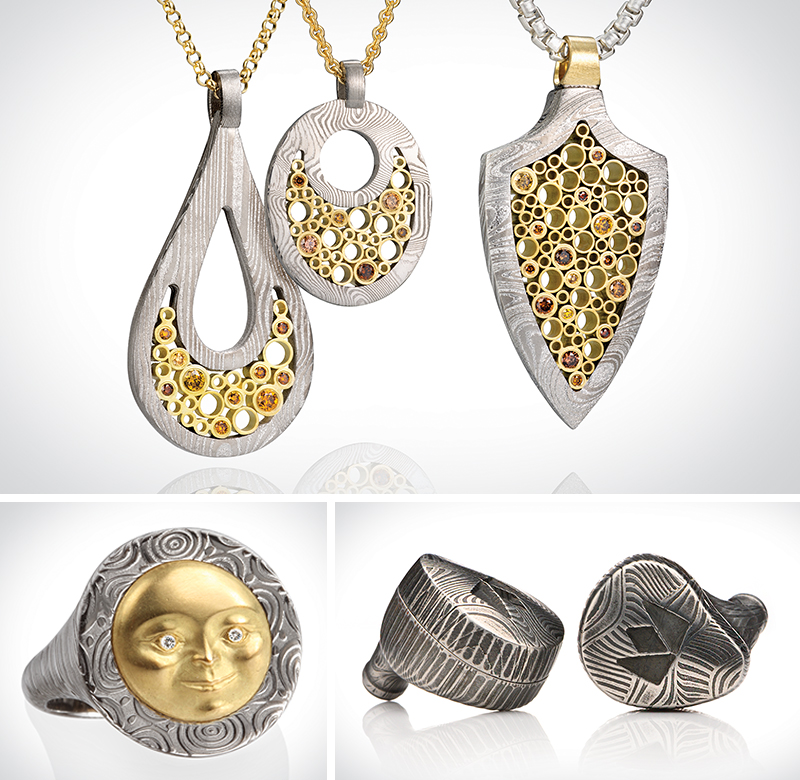
From Damascus steel jewelry with Belle Brooke (right) to custom audio shells for Noble Audio (bottom right) and fantastical creations with Anthony Lent (bottom left), Chris Ploof thrives on collaboration.
Finding the Right Fit
Whether the goal is exposure, access, experimentation, or just to have a little fun, partnerships can be a powerful tool to grow both business and creative practice.
But not all partnerships make sense. The strongest ones start with alignment—of vision, values, and energy.
For Lenha, that alignment was immediate with Phillip Lim. Introduced through mutual friends, she recalls feeling an instant spark. “From our very first conversations…we both felt the timing and vision lined up perfectly,” she says. The partnership worked because both sides respected the other’s craft and shared an interest in strength, versatility, and transformation.
“Choose a partner whose values and aesthetics you genuinely admire,” she says. “Authenticity shows.”
Heyman defines fit in terms of complementary strengths. Retailers bring client connections; Oscar Heyman provides design and manufacturing expertise. With stone dealers, the partnership might be about sharing risk. “You enter a partnership because your partner brings something better than what you could bring,” he says. “Sometimes it’s money, sometimes it’s access to the stone, sometimes it’s marketing.”
Oldham views it more personally. “To call it a collaboration, both voices need to be heard,” he says. “Make sure your voice is valued. Don’t get lost in the mix.” His early collaborations taught him to assert his ideas without overwhelming the shared vision.
“In hindsight, I had to learn how to make sure my voice was heard,” he says, “and also find what my voice as a designer [was] in collaboration with others.”
Oldham also looks for projects that feel natural to his design voice. “That’s not to say you shouldn’t push yourself,” he says, “but make sure it feels good and right.” The early collaboration with VADA worked precisely because both brands already had overlapping aesthetics and audiences. Later fashion collaborations stretched his material palette but felt like organic extensions of his brand identity.
For Ploof, enthusiasm is a critical indicator. “Look for someone as excited as you are,” he says. “Momentum matters. If you have to drag someone along, it’s probably not the right fit.” His most successful projects, such as the Belle Brooke collaboration, were fueled by mutual curiosity and a willingness to experiment.
And above all, every jeweler agrees that there must be trust. A paper agreement or contract might clarify roles, but trust is what makes the relationship sustainable. “The paper is just to make sure everyone has the same understanding,” says Heyman. “The paper doesn’t mean anything if you don’t trust them.”
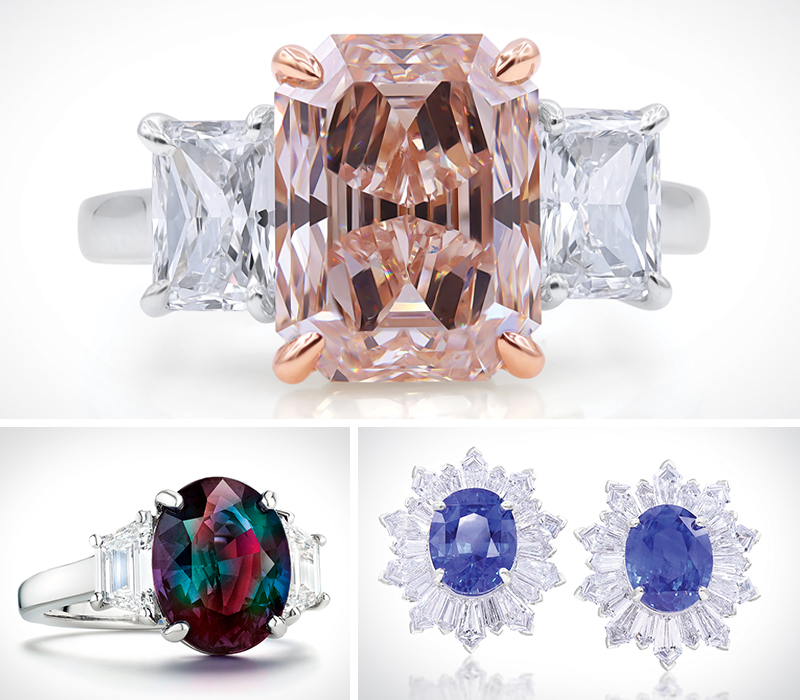
Through partnerships with retailers and gem dealers, Oscar Heyman expands creative possibilities while bringing unique jewels to market.
Making It Work
Once the fit is established, execution makes or breaks the partnership. The most successful collaborations divide roles clearly, maintain regular communication, and put expectations in writing.
Heyman has honed a straightforward system over the years. For retailer capsules, a one-page agreement lays out insurance, pricing, discounts, and what happens if pieces don’t sell. “It avoids unpleasant surprises,” he says. For projects like the anniversary collection, time limits are set; after a year, unsold jewelry can be remarketed elsewhere. The same clarity applies to stone partnerships, where agreements detail how to unwind the relationship if a gem doesn’t sell.
Lenha highlights the complementary role in her work with Phillip Lim. Her team designed and produced the jewelry, while Lim’s team contributed styling, positioning, and runway presentation. “It felt very complementary—each side brought expertise without overshadowing the other,” she says. Key decisions centered on whether the collection should lean bold or minimalist, and how to balance statement with wearability. “We always returned to the idea of alignment,” she explains. “If a detail felt ‘too Guzema’ or ‘too 3.1,’ we asked ourselves: Does this still tell the shared story? That lens helped synthesize our mutual point of view.”
Ploof and Brooke’s project illustrates another model of division. He took charge of cutting, etching, and finishing the Damascus, while Brooke inserted her tubing designs. “As long as you’re clear up front, it’s easy,” he says. The project thrived on simple back-and-forth, and weekly check-ins kept momentum strong. “When those meetings slip,” Ploof says, “so does the partnership.”
Regardless of the relationship between collaborators, clarity is critical. Even when partnering with friends, Ploof insists on having a written agreement, noting that even though it might be a simple arrangement, it’s best to still have everything spelled out.
He’s also found that formal contracts are especially important when working with larger companies. Ploof has learned to insist on upfront commitments. “Too often small workshops end up doing the heavy lifting without being paid fairly,” he explains. “With bigger companies, I want more up front—a contract or deposit.”
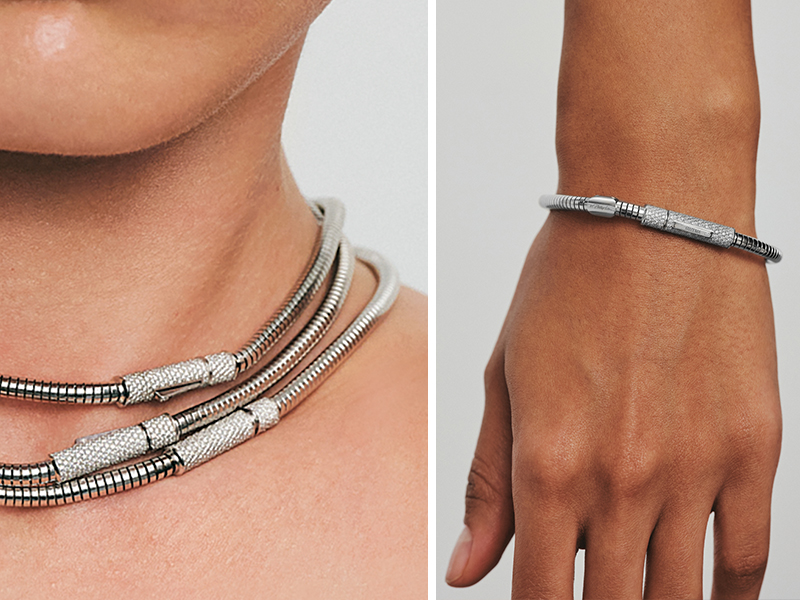
Through collaborations like the Snake collection, Guzema has amplified visibility, secured new partners, and strengthened its standing internationally.
What to Watch Out For
Even the best intentions can go awry. Jewelers point to three recurring pitfalls: unrealistic pricing, one-sided investment, and voice drift.
Heyman remembers a partnership, built on a pink diamond, that had to be unwound. “We were excited to work with the stone, but the value presented to us for the stone was not correct,” he says. “We should have said no. It was too much money for what it was worth. You might love the stone and design, but it still has to make business sense.”
He also cautions against partnerships that drift too far from your identity. “Our expertise is in making our brand. They’re coming to us because they want it to look like us,” he says. “If they want something outside that, maybe it’s not the right partnership.”
Lenha warns against projects that feel one-sided. “If a collaboration feels forced, or if one side is trying to dominate, it won’t resonate,” she says. “A collaboration should feel like an expansion, not a compromise.”
Oldham stresses the importance of being heard. “If you’re not being listened to, I would leave the room,” he says. “Ultimately, you are half of the collaboration. Don’t get lost in the mix.”
But it’s Ploof who provides the longest list of cautions. He has seen collaborations that were essentially consignment in disguise, with one party taking all the risk while the other contributed little.
“Collaborations don’t work unless both people put skin in the game,” he says. He insists on spelling out who pays for what—the metal, machining, finishing—and what happens if pieces come back unsold. “You can’t be too specific.”
He also points to behavioral red flags: partners who start out saying cost doesn’t matter but then demand itemized breakdowns, those who promise communication but begin skipping meetings, and those who move goalposts mid-project. “When someone changes expectations like that, reset or walk away,” he says.
Above all, protect yourself, he says. “If it’s not fun, don’t do it. If you’re not getting paid, stop. If it’s not achieving the goals you set, stop.”
Even when challenges arise, he says, collaborations still provide value. “You’re still learning 5 or 10 new things a day,” he says. “It’s great for energy and for getting your creative juices flowing.”