

Synthetic Gems & Trade Integrity
Know What You’re Selling
The growing misrepresentation of colored stones.
By Deborah A. Yonick
(Originally Published by MJSA October, 2025)
The misrepresentation of synthetic or imitation colored gemstones as natural isn’t just possible, it’s happening. And without decisive action, it risks eroding the integrity of the gem and jewelry trade.
This was the sobering message delivered by Columbia Gem House Founder and President Eric Braunwart at The Jewelry Symposium in Detroit this May.
Mixing synthetic diamonds with natural mined diamonds is well documented, and diamond screening systems are now common throughout much of the trade. Yet even with safeguards in place, synthetic diamonds still slip through.
For colored stones—particularly less expensive varieties such as quartz, small rubies, sapphires, and emeralds—the risk is even greater, Braunwart warned, because screening is rare. Testing costs often exceed the stone’s retail value, and imitations for everything from black onyx and turquoise to malachite and opal are abundant.
While no hard data currently quantifies the scope of the problem, Braunwart noted that through interviews with professionals across the supply chain and a review of published articles and case studies, there is a strong consensus: mixing is happening in colored gemstones.
According to Braunwart, it is common for dealers to unknowingly purchase hammered mixed rough or finished gems that have already been blended without transparent disclosure. “This means many companies are buying these lesser-valued gems already cut and, in many cases, unaware they are selling synthetic stones as natural.”
Many in the industry believe that half or more of the gem beads on the market today are synthetics or imitations. After visiting a large national bead retailer, Braunwart purchased a handful of strands to analyze. All proved to be imitations.
“I met with the retail buyers of the store and pointed out that all the beads I bought—listed as citrine, fire agate, amethyst, black agate, and carnelian—were simulants,” he recounted. “I was surprised by their response that it did not surprise them at all. These same beads were still in the gem bead section three months later.”
Single-crystal quartz, including amethyst and citrine, is widely suspected to be predominantly synthetic. As mineralogist and gemologist Dr. Çigdem Lule of Gemworld International, publisher of GemGuide, told Braunwart, “There’s no quick and economic way of separating the synthetic quartz from the natural.”
One of the veteran gem dealers interviewed for this research, who asked to remain anonymous, said they’ve known for years that synthetic amethyst and ametrine rough has been entering Brazil from China labeled as hammered and mixed with natural rough. The current challenge is that there’s no proof of this practice taking place, as no affordable mass screening is available.
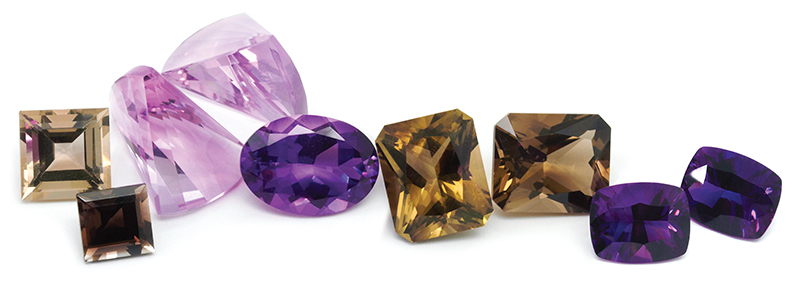
Comparison of synthetic quartz (left) and natural quartz (right)
Complex & Challenging
With more than 45 years of experience in the gem and jewelry industry, Braunwart described the issues as “ethically complex and challenging to research.”
The colored gemstone supply chain spans sourcing, cutting, distribution, and retail, with key trade routes in East Africa, South America, and Southeast Asia. Roughly 80 percent of gemstones originate from artisanal and small-scale mining (ASM).
“These small-scale outputs are typically consolidated into larger parcels to create cutting lots for calibrated stones, a practice that complicates traceability,” Braunwart explained. “Once grouped, ASM material is more vulnerable to the introduction of synthetic or imitation stones, increasing the risk of misrepresentation.”
While most high-value colored stones come with a lab report, gems such as amethyst, citrine, small corundum, or opaque stones with abundant imitations typically do not. Testing costs and access remain significant barriers to widespread screening.
Braunwart reported that screening technologies such as X-ray fluorescence (XRF) or Raman spectroscopy are beginning to be used to identify colored gemstones on a larger scale. However, more research is needed to improve the scalability and affordability of these testing methods for a wider range of colored gemstone varieties.
“The introduction of a rapid, affordable screening system to separate manmade and natural gemstones could play a crucial role in verifying authenticity as gemstones move through the supply chain,” said Braunwart. “With only a few companies performing proprietary colored stone screenings and no labs focused on this, the need for such a system will become even more critical over time.”
On a positive note, Braunwart cited GIA’s recent launch of a new volume screening service for small-sized corundum as a step in the right direction.
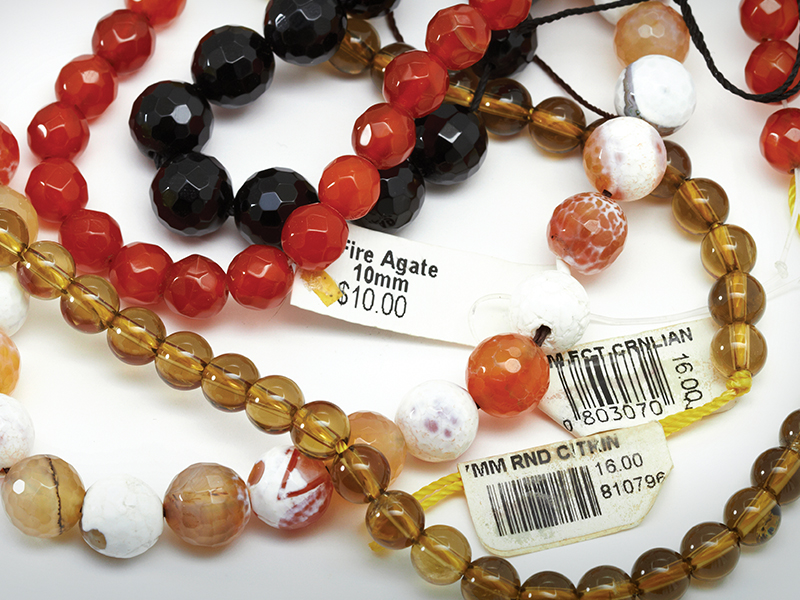
Strands of gemstone beads may look authentic, but many sold as citrine, fire agate, and carnelian are actually imitations, raising concerns about disclosure and trust.
Cultivating Trust
Safeguarding authenticity in this global network demands rigorous and continuous supply chain management, said Braunwart, a pioneer in developing best practices and protocols for Fair Trade Gems nearly 25 years ago.
There is a tendency to think of misrepresentation as a problem only for high-value stones—the $15,000 ruby, not the $15 amethyst, Braunwart noted. But he warned against this mindset, emphasizing that every sale carries reputational risk.
Today’s buyers, especially younger consumers, expect transparency, ethical sourcing, and honesty regardless of price. If they feel deceived once, they’re unlikely to return.
“Inexpensive gems are often starter stones. If the industry wants consumers to keep coming back, we must get the first sale right,” said Braunwart, who is quick to point out that synthetics and imitations have a place in the market, provided they’re disclosed. When they’re not, they compromise the value of the natural gemstones.
“A gemstone is defined by its beauty, durability, and rarity,” he explained. “Synthetics and imitations may have beauty, even durability, but they lack rarity.” Once a process for making a gemstone look-alike is known, the market floods and prices typically fall to the cost of production.
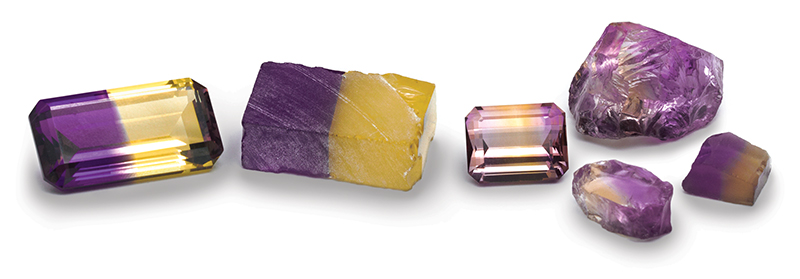
Comparison of nanosital glass imitation ametrine (left) and natural ametrine (right).
Calls to Action
Braunwart sees traceable supply chains as one of the most effective tools the industry can use to address this growing challenge.
He supports documenting each step from mine to market and cautions that not all “traceable” claims are equal. He recommends that jewelers vet suppliers to ensure their protocols are substantive and not just marketing spin.
Ultimately, buyers benefit from a clearer view of the supply chain and face a significantly reduced risk of acquiring synthetics or undisclosed treatments.
“Responsible supply chains depend on accurately identifying and tracing gemstone materials,” said Braunwart. “By understanding their origins and sources, you can eliminate the risk of synthetics being misrepresented as natural. This transparency clarifies any treatments that may have been applied to the gems.”
Traceability also supports the consumer’s desire for authenticity and strengthens their connection to the lands and people who mine, cut, and set the stones.
Among his calls to action, Braunwart advised jewelers to invest in education, equipping both staff and customers with clear, plain-language resources on natural versus synthetic and imitation stones. Resources from the American Gem Trade Association and the Gemological Institute of America can help.
He also encouraged more testing, even on lower-cost gems, to demonstrate commitment to authenticity and verify supply chain claims. Most important, he said, is to lead with transparency. If you are unsure of a stone’s origin, say so. Openness earns loyalty.
As Braunwart sees it, “Buyer beware” is a bad brand for the jewelry industry. “If consumers can’t trust that a gem sold as natural is natural, the entire market suffers,” he said. “By embracing traceability, expanding testing, and prioritizing education, the trade can protect the rarity and romance of natural colored gemstones for the next generation of buyers.”
Gem Look-Alikes
Many popular gemstones have synthetic counterparts that are chemically identical to their natural forms. These include:
- Quartz: amethyst, citrine, rose quartz, smoky quartz, prasiolite
- Beryl: aquamarine, morganite, heliodor, goshenite, emerald
- Corundum: ruby, sapphire
- Opal: play-of-color varieties
- Spinel
- Turquoise
- Diamond
Simulants, also known as imitations or substitutes, are materials that mimic the appearance of a gemstone but differ in chemical composition, crystal structure, and physical and optical properties. Simulants can be either natural or manmade. Examples of encountered simulant materials include:
- Glass: commonly encountered
- Plastic: commonly encountered
- Quench-crackled quartz: periodically encountered
- Ceramic beads: periodically encountered
- Imitation turquoise: periodically encountered
- Imitation lapis lazuli:
less often encountered - Imitation black onyx: commonly encountered