

Finding the Perfect Chain
Chain Reaction
From weight to wearability, what to consider when choosing among styles.
By Shawna Kulpa
(Originally Published by MJSA September, 2025)
Chains may look simple, but selecting the right one for a design can be anything but. A poorly matched chain can disrupt the aesthetics of a piece, make it uncomfortable to wear, or even shorten its lifespan. And with countless styles, gauges, metals, and clasp options to choose from, finding the best match can sometimes feel overwhelming.
“There are so many different types,” says Andrea LeDay, fine jewelry product manager at Stuller Inc. in Lafayette, Louisiana. “The most important part you need to answer is, What are you going to use it for?”
Whether you’re designing a pendant necklace, creating a stackable chain look, or developing a custom piece for a client, understanding how to evaluate your options will lead to better outcomes for both the piece and its wearer.
Start With Function
Before diving into design considerations, start with function. Chains serve different purposes, and each application calls for a different set of specifications. Understanding the intended use of the chain is the first step toward making the right choice. For example:
• Pendant chains need to strike a balance between strength and subtlety. They should be sturdy enough to support the pendant’s weight, yet not so visually dominant that they compete with it.
• Layered chains benefit from variety—slight differences in link size, finish, or length can create contrast and depth when worn together.
• Standalone chains, especially those with bold links or intricate patterns, are often heavier and designed to make a statement on their own, with or without adornment.
Chain suppliers agree that once the function is clear, the next considerations are metal type, color, length, and price point. These parameters shape what’s possible and guide practical choices. For example, when a designer has a specific budget in mind, a supplier can suggest chain styles and weights that meet that range without compromising performance.
“If I know the price point, I can suggest styles that fall within it,” says Rick Winslow, owner of Downeast Trading Co. in Middlebury, Vermont. “If I don’t, I’m just guessing.”
Matching the chain’s metal to that of the pendant is another foundational best practice. “You can technically put an 18k pendant on a 14k chain, but aesthetically, do you really want to do that?” says Winslow, noting that jewelers should “enhance the pendant with a beautiful chain, don’t detract from it!”
This kind of misstep is easy to avoid by setting clear design and budget goals up front—and understanding where you can compromise and where you shouldn’t.
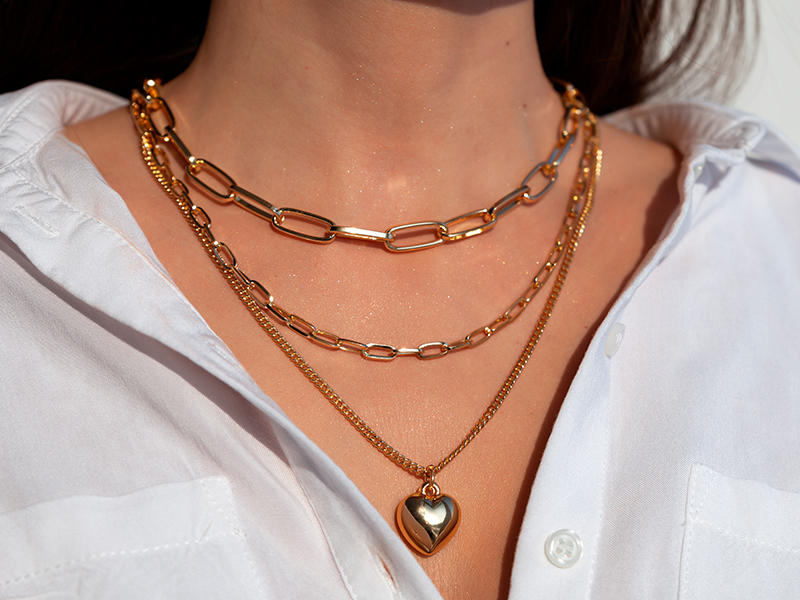
Each chain style brings its own character, allowing for endless design possibilities and visual impact.
Balance Strength and Aesthetics
Visual harmony becomes the next priority. A chain and pendant, for example, should work together visually, reinforcing the design rather than competing with or diminishing it. A delicate pendant on a thick rope chain can appear awkward, while a heavy centerpiece on a thin cable chain may seem insubstantial—or worse, risk breaking under pressure.
David Cappuccino, vice president of M.S. Co. in Attleboro, Massachusetts, sometimes sees customers try to cut corners with chain weight. “They don’t want to spend a lot of money on the chain,” he explains. “They pick a tiny chain and think it’s good enough. But if it breaks or ruins the look, it costs them more in the long run.”
The key is to match both strength and style. If a chain is meant to complement a minimal solitaire pendant, a simple cable or wheat chain might be ideal. Cable chains are known for their simplicity and strength, making them a popular choice for lightweight pendants or delicate designs. Diamond-cut versions add subtle sparkle, while dense cable varieties offer a more substantial look.
“Cable is our most popular chain,” says Winslow. “We make it in all sizes, from 0.8 to 4 mm, in both white and yellow gold. You can’t go wrong with a basic cable—especially the diamond-cut version if you want sparkle.”
Wheat chains, on the other hand, are often chosen for their elegance and flexibility. “They’re strong because of how the links are interwoven, and they’re also great for adding a touch of visual interest without overwhelming a pendant,” says LeDay.
For bolder designs, chunkier curb or rope chains may be more appropriate. Vin Ferrante, vice president of marketing for National Chain Group in Warwick, Rhode Island, notes that rope, cable, and curb chains remain go-to options for many clients. Rope chains, he adds, also work well for designs that require side attachments, such as festoons.
“Rope chains tend to work well for this type of application,” he says, since they can accommodate connections at both ends. “It’s easier to attach jump rings directly into the chain ends compared to some other styles, like curb or box.”
Designer Alexis Taub of Alexis Jae Jewelry in New York City, whose company produces made-to-order jewelry, agrees that aesthetics and strength need to work together. “We’ll sometimes change the chain during the design process if it’s taking away from the piece,” she says. “For example, we often change family engagement rings into pendant diamond necklaces. Recently, we were working with a customer who initially wanted the diamond bezel to be on a paperclip necklace. After showing her renderings, we decided the boldness of the paperclip was taking away from the beauty of the diamond. We ended up switching to a bead chain to keep a modern look but let the diamond shine.”
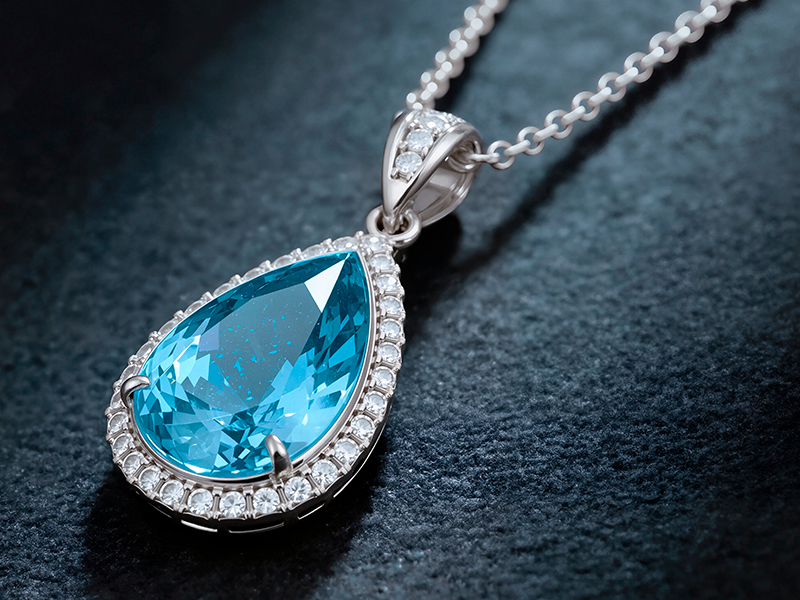
The right chain will complement the pendant, creating a harmonious balance of strength and style.
Prioritize Durability
Durability in chain design goes beyond strength alone. It’s also about construction—how the links are formed, whether jump rings are soldered, and how well the chain resists wear over time. Styles such as wheat, rope, and foxtail are often favored for everyday use because of their interlocking structures and resistance to stretching or breakage.
“Foxtail is by far the most durable,” says Cappuccino. “It’s a woven link, really sturdy, and doesn’t stretch like others can. We use it for stringing beads because it holds up over time.” However, he cautions that foxtail chain isn’t widely produced and can be difficult to source, making it better suited for specific applications rather than as a go-to for all designs.
Rope and curb chains also earn high marks for resilience. “They’re sturdier because of the way the links are made,” says LeDay. “At the end of the day, all chains need to be treated with care—but some are more durable than others.”
In contrast, certain styles are better suited to occasional wear. Herringbone and thin snake chains may look sleek, but they’re more fragile and prone to kinking. Even a small bend in them can be permanent.
“I love a good herringbone chain,” admits LeDay, “but they’re delicate and kink easily. They need to be stored flat and treated with care.”
In addition to style, wire thickness can play a key role in long-term strength. The same design rendered in 0.9 mm versus 1.5 mm will behave very differently in a real-world setting. Choosing a heavier gauge chain for higher-stress designs—such as those supporting a heavier pendant—can help ensure performance and longevity.
Choose the Right Clasp
A chain’s clasp plays a bigger role than many designers realize. A poor clasp can affect not only how a chain functions, but also how it wears and how the piece is perceived by the customer.
Lobster clasps are a preferred choice by many for their strength and ease of use. “Even on our least expensive chains, we use baby lobsters,” says Winslow. “They cost more, but they are more secure and more attractive.”
In addition to being stronger, lobster clasps tend to be easier to operate, especially for customers with dexterity issues.
Being lighter, spring rings are often used on thinner chains where a lobster clasp might be too heavy. “If the clasp outweighs the chain, it can pull it forward, especially when layering,” explains LeDay. “Spring rings are better for delicate chains, but lobster clasps offer more security overall.”
Cappuccino adds that many clients are requesting slightly oversized clasps for ease of use, particularly older customers who struggle with smaller components. “The price difference between clasp sizes isn’t huge,” he says. “It’s worth it for the comfort and security.”
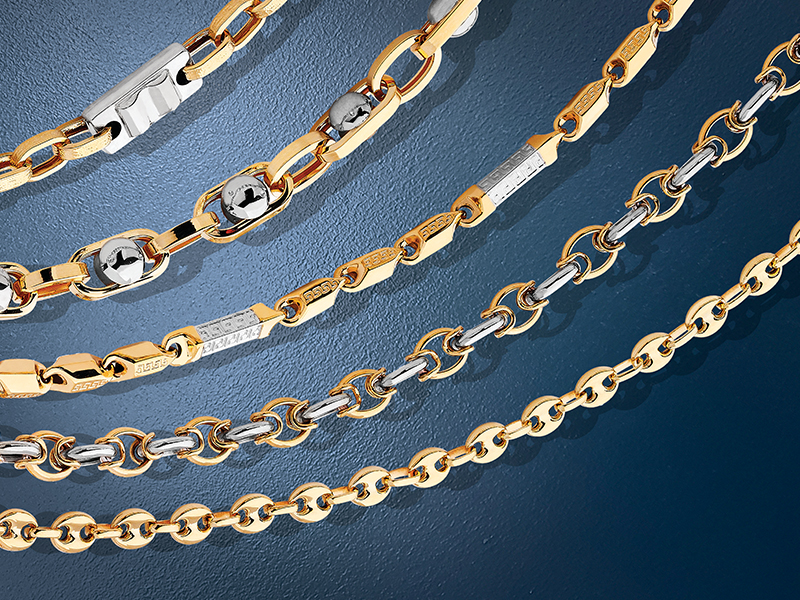
Chains are the backbone of any design, each offering its own balance of durability and sophistication.
Metal and Manufacturing Matter
Durability also depends on what the chain is made of and how it’s made. Metal choice affects not only the look and price of a chain but also how it performs over time.
Gold remains the go-to for fine chains, with 14k being the most popular due to its balance of strength and color. Higher-karat golds such as 18k offer more richness in color but are softer and more expensive, while lower-karat golds offer more durability but less luster. Silver is more affordable and often rhodium-plated to reduce tarnish. Platinum, though denser and more expensive, is highly durable and hypoallergenic.
Equally important is how the chain is constructed. Solid and solder-filled chains will outperform hollow options, especially in designs that demand structural integrity. Cappuccino notes that styles such as herringbones benefit from solder-filled construction because of the way the links are joined.
Jump rings and chain ends also warrant scrutiny. “All jump rings on gold chains should be soldered,” says Winslow. “You don’t want your client to lose a pendant because a ring straightened out.” In silver, jump rings are often left unsoldered to save labor costs, but they can usually be made thicker (and thus sturdier) without significantly increasing the price.
Asking how a chain is assembled (and whether every link is properly reinforced) can help prevent future problems. For jewelers sourcing from suppliers, understanding the nuances of metal quality and chain construction is essential to creating pieces that perform as well as they shine.
Leverage Supplier Tools and Guidance
Chain selection can be difficult even for experienced designers, which is why many suppliers now offer tools to streamline the process. From sample boards to product visuals and online filtering tools, manufacturers have invested in ways to help customers quickly narrow down their choices.
For example, Stuller’s website allows users to sort by style, length, clasp, and metal quality, with visual guides to show how chains look when worn.
National Chain offers catalogs with real-size images and doesn’t hesitate to send out samples for customers unable to visit their facility or see them at a trade show.
“We often send out sample boards based on the customer’s needs,” says Ferrante. “They can touch and feel the chains, see how they look with their designs, and compare price points.”
Many suppliers also allow customers to send photos or physical samples of their designs. “We’ll help them match our chains to their designs and offer suggestions of samples we can send them,” Ferrante adds.
In the end, a strong design comes from collaboration, clarity, and care. And for Winslow, that relationship is the foundation of every successful piece.
“We supply the options; you supply the inspiration,” he says.