

Testing the Foredom MF105 Magnetic Pin Finisher
Spin Cycle
A quick, hands-free method for brightening your jewelry
By Melissa Muir
(Originally Published by MJSA July, 2025)
In jewelry making, finishing can make or break a piece. A clean, bright finish not only adds polish and a professional touch to your design, but it also highlights its most intricate details. Like many jewelers, I started out with the basics: sandpaper, a rotary tumbler, and a hope for the best. And while that approach can yield a decent result, it’s far from efficient—especially when dealing with delicate designs or tight production deadlines.
That’s where magnetic pin finishers come in. Designed to clean and brighten jewelry quickly and gently, these machines are ideal for finishing detailed work without the risk of damage. Recently, I had the opportunity to test Foredom’s new magnetic pin finisher, which was set to launch in mid to late June 2025. Compact and thoughtfully outfitted, it promises to streamline one of the most tedious steps in the jewelry-making process.
About the Finisher
Foredom’s MF105 magnetic pin finisher comes ready to go with two bowl assemblies, both 0.3 mm and 0.5 mm pins, citric acid cleaning powder, and a pin separator basket. The setup is intuitive: fill the bowl with water to the marked line, add your pins and solution, load your jewelry (no more than 50 grams per batch—the included pins weigh 150 grams and the finisher has a maximum capacity of 200 grams), seal the lid, set the timer, and hit start. A soft chime signals the end of the cycle.
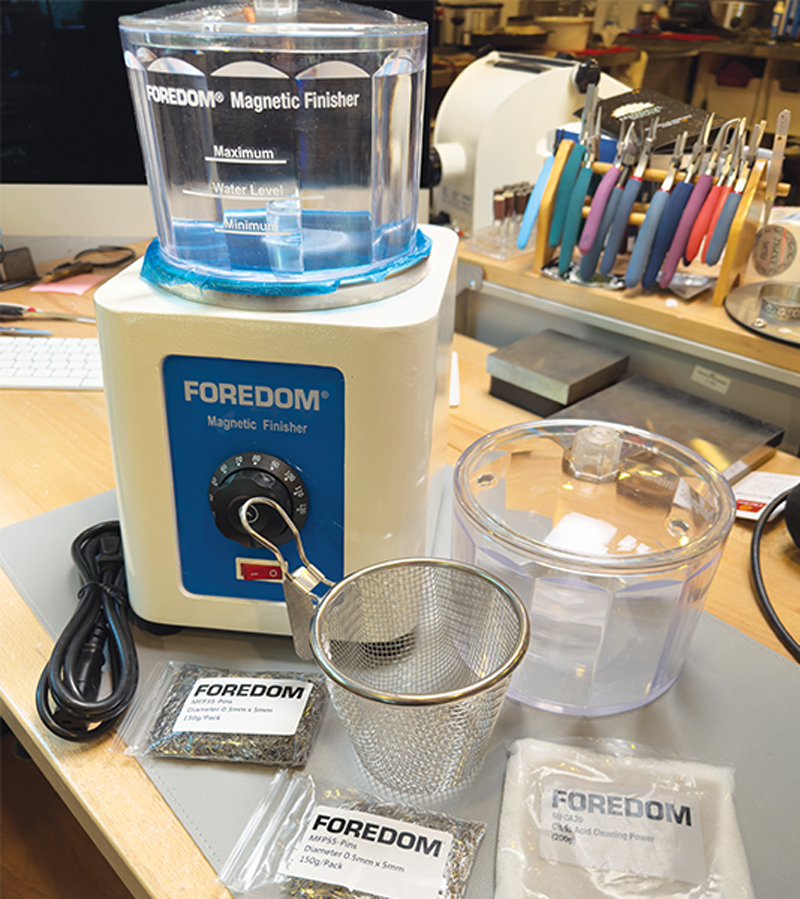
Foredom Magnetic Pin Finisher MF105
Weight: 22 lbs.
Dimensions: 14″ x 12″ x 16″
What’s Included:
- MF105 magnetic finisher
- Two bowl assemblies (5.25″ interior)
- 0.3 mm and 0.5 mm pins
- Citric acid cleaning powder
- Pin separator basket
The machine creates a magnetic field that spins the steel pins inside the bowl, allowing them to reach into crevices and undercuts that would be impossible to polish by hand. Unlike traditional rotary and vibratory tumblers, pin finishers don’t burnish—they brighten. They won’t remove major scratches or burrs or reshape your work, but they will clean and enhance surfaces, particularly on filigree, undercuts, prongs, and solder seams. That makes them a great choice as a final finishing step before stone setting, especially for pieces with delicate details.
Foredom includes a few extras that make setup and cleanup easier. The pin separator basket keeps your jewelry from getting lost in a sea of spinning media. You can also strain using a fine mesh sieve or paper towel—just don’t forget to strain over a bowl or plugged sink, as you never want to pour pins into the drain. For a low-tech option, place a strong magnet inside a plastic bag, use it to pick up the pins, then hold the bag over your desired container and remove the magnet, letting the pins drop off cleanly.
How Well Does It Work?
As with any new tool, a little prep goes a long way. Before your first run, you’ll want to clean the pins by running them for 30 minutes in water with a teaspoon of the included citric acid powder. Rinse the pins thoroughly until the water runs clear. If you won’t be using the machine for a while, dry the pins thoroughly. You’ll also want to change the solution regularly, especially after tumbling dirty or oxidized pieces. If the pins start to look dull, repeat the cleaning. You can also use a burnishing compound (or even a few drops of Dawn dish soap) to keep things moving smoothly.
For testing, I brought my pieces to a 400-grit finish. Since I primarily work with silver and gold, I chose the 0.3 mm pins for a finer touch. For harder metals such as stainless steel, the 0.5 mm pins may be more appropriate, as they can give you a slightly more surface texture.
I tested the machine with both pieces that were ready for final finishing and well-worn items that had lost their original brightness. Most were sterling silver, with a few featuring gold and copper elements. Some had set stones that were durable enough to withstand tumbling, though it’s important to avoid using the machine with softer stones.
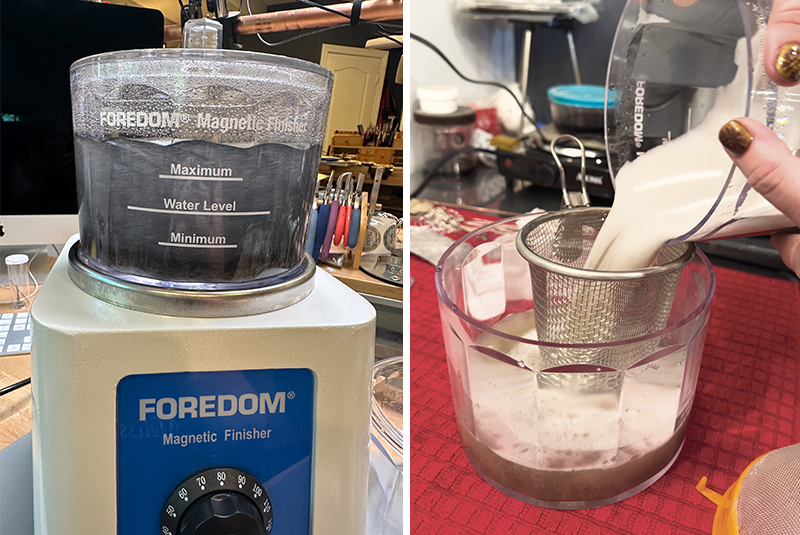
Before using the MF105, the pins must be cleaned in a citric acid solution and then rinsed thoroughly. Keeping them clean throughout use ensures a bright finish and longer pin life.
Cleaning the pins before use took about 35 minutes, including rinsing. After weighing the jewelry to stay within the 200-gram total weight limit, I started with a batch that included both clean items and those with tarnish or natural oxidation, though none had chemical finishes. After 10 minutes, I noticed visible improvements: brighter surfaces and reduced oxidation, even in tight areas. I placed them back in for another 15 to 20 minutes, and they came out much cleaner and brighter overall, with an even satin finish.
Curious about its performance with more intricate designs, I tested a woven wire bracelet. Before tumbling, I gave it a quick pre-clean with polishing paste and a soft toothbrush to remove most of the surface dirt and oxidation. After a 30-minute cycle, I was pleased with the results. The top surfaces were bright, while the deeper recesses retained their rich, dark patina. Some pins had worked their way into the wire weaves and took a few minutes to remove, but even the tightest areas came out with a smooth, consistent finish.
I also ran several rings through the machine, both with and without stones, including prong, wire, and flush-set designs. One standout was a large gold ring with a prong-set stone: The shank came out with a beautiful bright satin finish that extended across all surfaces and into the head beneath the stone. Any bright cutting around bezels or flush-set stones was softened into a satin finish, which also applied to previously polished mirror-like areas. The small pins act like tiny hammers—not highly polished ones—so the result is a satin finish rather than the glossy shine you’d get from stainless-steel shot in a rotary tumbler. That said, bringing the piece to a mirror polish afterward is easy with a buff and polishing compound.
One of the biggest advantages is the convenience. I love that I can load the tumbler, set the timer, walk away, and return to a finish that’s either ready to go or perfectly prepped for the next polishing step. Unlike rotary or vibratory tumblers, it doesn’t take hours to get results.
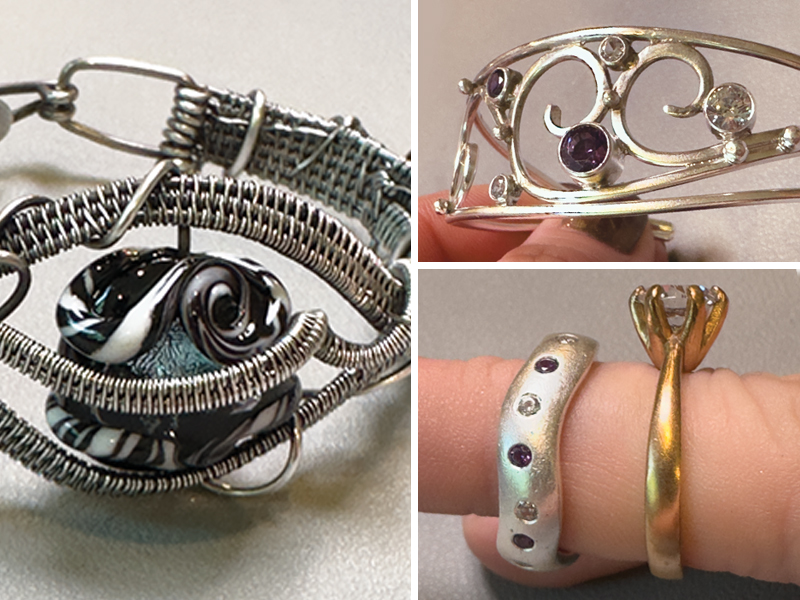
The MF105 tackled everything from a woven wire bracelet to stone-set rings, leaving a consistent satin finish (even in recessed details) without damaging delicate elements.
The bowl itself has large vertical facets inside, which aid in the tumbling process. Rather than the pins simply spinning around as they’re moved by the magnet below, the pieces are stopped and tumbled. I also have a larger pin finisher with a square bowl, which works well, but the magnetic pin finisher is noticeably quieter—a real benefit in a shared or small studio space.
In addition, while the MF105 isn’t exactly small, it doesn’t take up much space either. It fits easily on my tabletop without taking up too much real estate.
The MF105 is a clean, efficient way to get professional results on your jewelry without the wear and tear of more aggressive tumblers. It’s not a catch-all solution, as you’ll still need to do your prep work, but it shines when it comes to polishing fine details and delicate designs.
MJSA would like to thank Foredom for providing the finisher for testing.