

Testing the Bonny Doon Vertical Vice and Forming System
Shape Shifter
A practical way to shape clean curves and refine form
By Melissa Muir
In the evolving world of jewelry design, technique and tools go hand in hand. Whether you’re crafting a delicate bangle or a bold sculptural ring, the form of the metal plays a crucial role in both comfort and visual impact. Among the most effective and elegant ways to elevate your designs are the use of anticlastic (concave) and synclastic (convex) forms. These techniques can add dimension, softness, and wearability—but they require more than just artistic vision. They require the right tools.
Traditionally, achieving these sophisticated forms meant hours of hammering over sinusoidal or mushroom stakes, often accompanied by a steep learning curve. The results were worth it, but the path wasn’t easy. Fortunately, thanks to advances by tool companies, shaping metal has never been more accessible.
Recently, I had the pleasure of hosting Peter Gilroy of Bonny Doon Tools in my studio for a weeklong exploration of forming tools. It was an energetic experience that reminded me just how far tool design has come. Bonny Doon’s forming tools make synclastic and anticlastic shaping faster, easier, and more affordable—without compromising precision or finish.
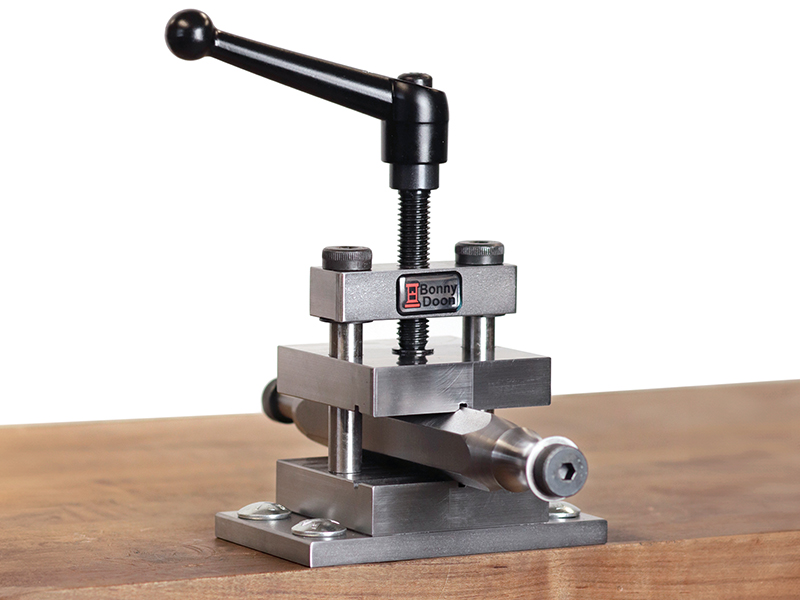
The Bonny Doon Vertical Vice
Dimensions: 5″W x 3″D x 8″H
Shipping weight: 8.427 lbs. (3.823 kg)
Vise jaw dimensions: 3″W x 3″D x 3/4″H
Maximum jaw opening: 1 1/2″
About the Tools
One standout from the week was the Bonny Doon vertical vise, a remarkably versatile piece of equipment that has quickly become a staple in my studio. Available as a bench-mounted tool, the vertical vise has a compact footprint—just 5″ x 8″—making it ideal for even the most space-conscious workbenches. I mounted mine to a 2×10 board using C-clamps, which lets me reposition it easily for filming and demonstrations. That said, for maximum support, it’s best mounted over the leg of a heavy-duty bench or tabletop.
What sets the vertical vise apart is its ability to securely hold mandrels and forming stakes at precise angles during heavy bench work. Unlike standard vises that can shift or loosen under repeated hammer blows, this one stays put. Constructed from cold-rolled steel, it’s built for durability, with a 1 1/2″ jaw opening and 3″ wide grip. It accommodates most bracelet mandrels, provided the tang is at least 2″ long for proper leverage.
When working with hex-shaped stakes, such as Bonny Doon’s double-sided forming stakes, alignment is key. Nestling the hex points into the vise’s center groove locks the stake in place. The same applies to ring mandrels—seating the mandrel into the grooves ensures it stays secure during forming or stretching. The double-sided design of the hex forming stakes adds rigidity, reducing bounce and improving efficiency.
It’s worth noting that the vertical vise uses a shorter handle than traditional vises. The compact design means you may need to apply more force when tightening, especially for heavier work. If your stake shifts during use, simply retighten until secure.
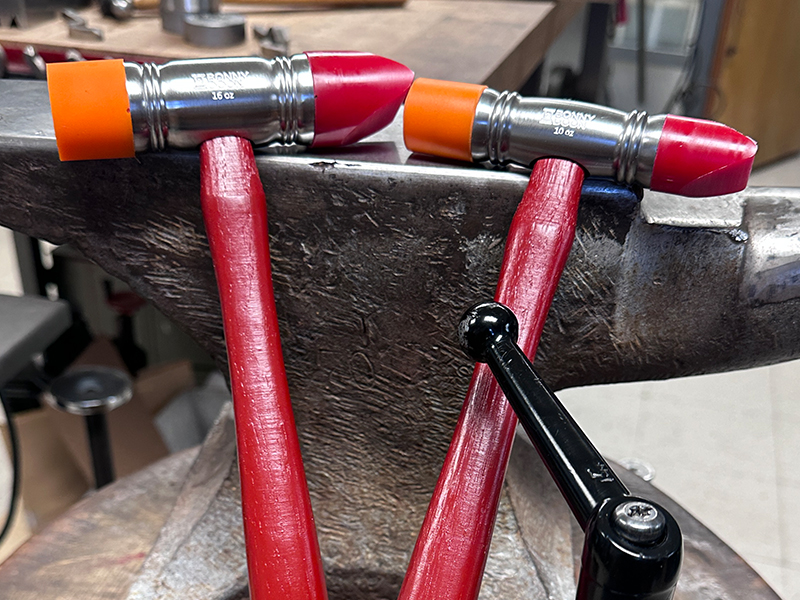
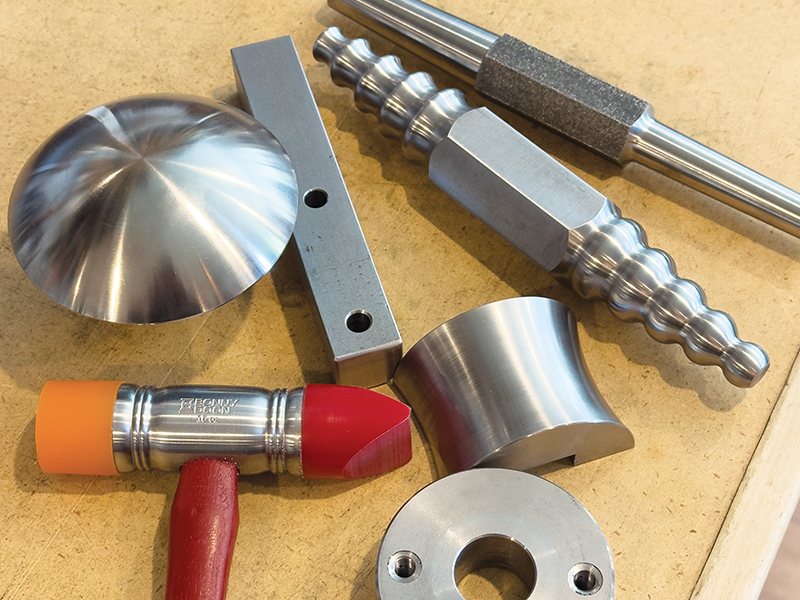
Designed for versatility and ease of use, Bonny Doon’s urethane hammer and forming tools offer jewelers greater control, cleaner results, and the flexibility to shape a wide range of curved forms.
While the vise was designed for Bonny Doon’s double-sided mandrels, the company also offers an adapter system that extends its functionality. This lets you use the vise with many of their other tools, including ring and bracelet forming kits originally intended for use with a hydraulic press. Just align the key with the groove, tighten, and you’re ready to go. The system also works with daps and mushroom formers when paired with the Master Tool Holder.
Unlike traditional forming stakes forged from hardened steel, Bonny Doon’s tools are crafted from mild steel, beautifully turned, and burnished for a polished finish. The ring mandrel, however, is made from a hardened alloy, making it suitable for both forming and light forging. Because these tools are intended for forming—not forging—they should be used with urethane or nylon hammers, not steel ones.
Understanding the difference between forging and forming is essential. Forging alters the crystalline structure of metal through pressure and deformation—stretching and pinching to manipulate density and strength. Forming, by contrast, shapes metal against a form without changing its internal structure.
How Well Do They Work?
During testing, what impressed me most was how securely the vise held the mandrels—they simply didn’t budge. Compared to the constant slipping I experience with traditional vises, it was a revelation. Normally, I must stop every few blows to reposition and retighten the mandrel, which interrupts my rhythm. With the vertical vise, that issue vanished. It held everything firmly in place, allowing me to stay focused on the work.
Another standout aspect of this setup was the performance difference between urethane and nylon hammers. Nylon is rigid, with a small contact area—like a metal hammer—it pushes only part of the metal toward the mandrel. In contrast, the urethane hammer compressed and spread the metal smoothly into every contour. The result was a more even form, greater efficiency, and no surface marring—ideal for finished or detailed work.
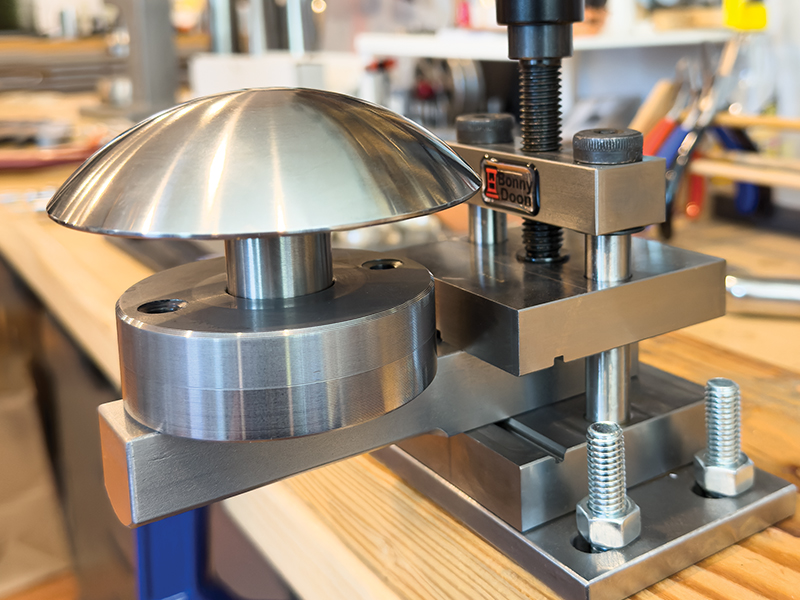
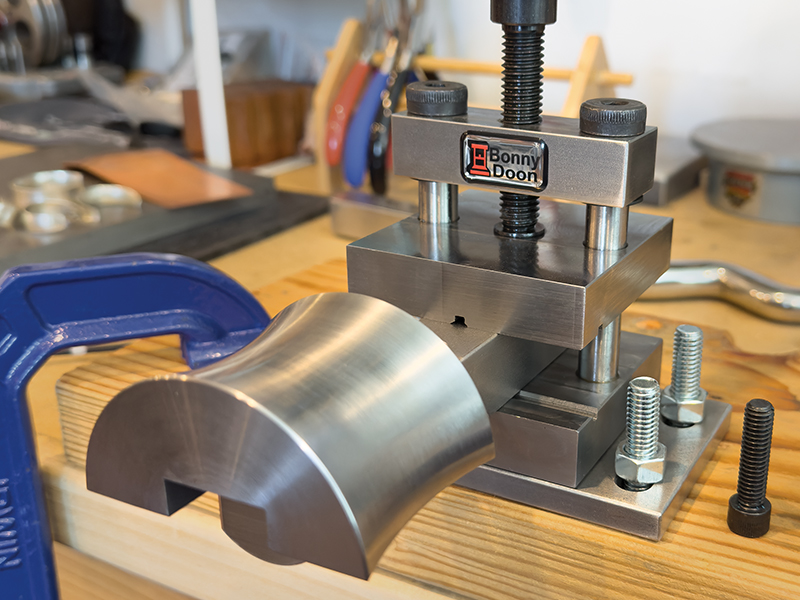
The vertical vise provides firm support for dies and mandrels, making it easier to shape smooth curves with consistent results and minimal tool movement.
When used with a urethane hammer, Bonny Doon’s forming stakes yield smooth, marks-free results—perfect for pierced, engraved, or otherwise decorated surfaces. This finesse makes it possible to produce high-quality, intricate jewelry with minimal cleanup and less risk of damage.
The urethane hammer particularly excelled on layered or pierced pieces, where metal or nylon hammers often struggle. Its softer face adapted to the surface, letting the metal move more fluidly without damaging delicate details.
I also loved working with the double-sided ring mandrel. Each end is tapered to fit standard ring sizes, and the center split (where the vise clamps the tool) adds stability. Though the working length is shorter than a traditional mandrel, the design increases rigidity at the tip, which is perfect for forming smaller rings. And because the mandrel is made from a hardened alloy (not fully hardened), I can still use metal hammers on it when I want to stretch or texture a piece.
Adding the adapter to the vertical vise expanded its capabilities even further. It let me attach tools normally used with a hydraulic press—like ring and bracelet formers and mushroom stakes—directly to my bench setup. For a compact studio, that’s a game-changer.
This vise is still a relatively new addition to my shop, but the possibilities it’s opening up are incredibly exciting. I can’t wait to keep exploring everything it can do.
MJSA would like to thank Peter Gilroy of Bonny Doon Tools for supplying the vise for testing.