

The Tool That Gives Michael Jensen Total Control
Secret Shop Weapons
A traditional engraving block is Michael Jensen’s bench essential
(Originally Published by MJSA January 2025)

Michael Jensen
Michael Jensen Designs
Rio Rancho, New Mexico
We asked Michael Jensen, “If you were stranded on an island (that just happened to have a bench and some metal lying around), what tool would you want to have that allows you to do things you can’t do with any other tool?”
What is your favorite tool?
My standard-size traditional engraving block.
What makes it special?
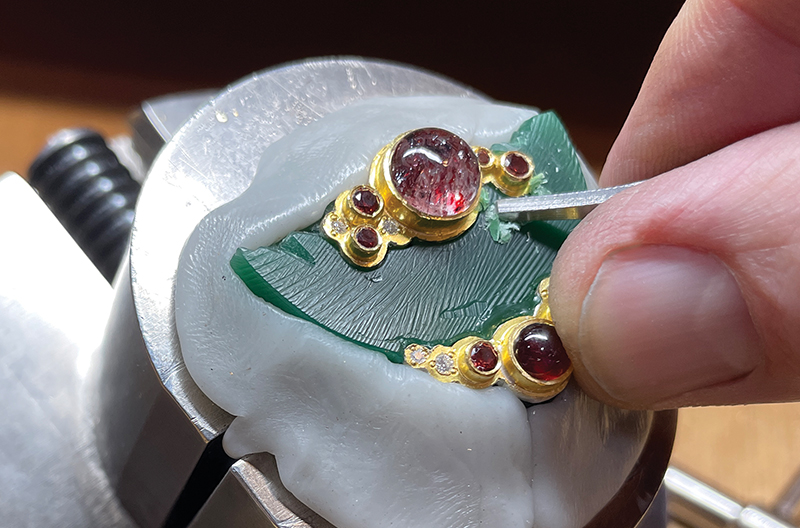
I use it on practically every piece I create. It is the third hand that allows me to use both of mine for tool control.
How do you use it in your work?
It often begins where I start, with the wax carving. Using it to hold the block of wax allows me to use both hands for tool control, which is especially useful when carving fine detail. During soldering, it can hold locking tweezers and rotates easily to ensure even heating. For fine detail filing and finishing, the ball once again allows me to use both hands.
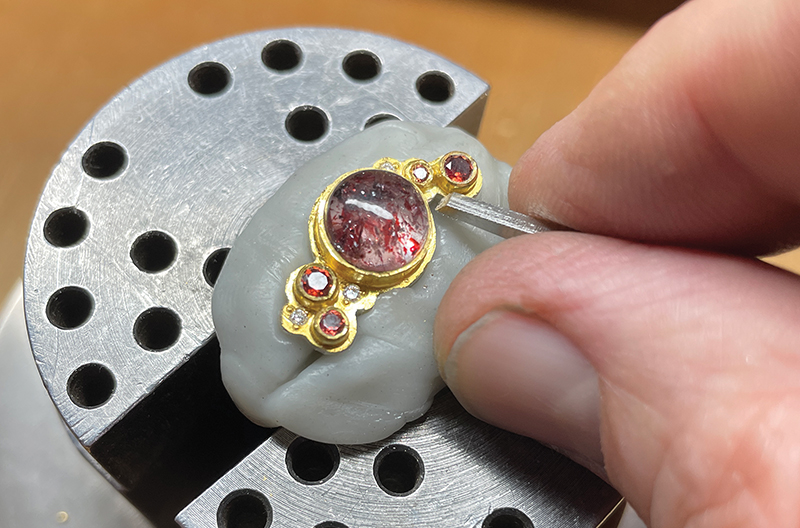
Of course, the ball was made for setting and engraving, which was my original reason for purchasing it more than 30 years ago, but I’ve since used it in a variety of ways. It holds my flex-shaft handpiece securely, allowing me to grind, sand, and polish as I would with a mini polishing motor but with adjustable speed via the foot control. Additionally, it accommodates a small steel anvil block for light hammering and stamping operations, where the mass of the traditional heavyweight engraving block really is required.
What discoveries or breakthroughs have you made with it?
I’ve made several adjustments to optimize the setting ball’s versatility and my bench posture. One breakthrough was creating multiple mounting locations at different heights. For example, while I can position it directly on my benchtop, I discovered that using an optional utility shelf brings the ball closer to the bench pin, which is ideal for convenience.
My favorite modification involved reinforcing my lap drawer and cutting a 4 inch hole in it, allowing the setting ball to sit at the perfect height for using a microscope during detail and setting work. As a bonus, this setup not only supports optimal posture, but also prevents stones from scattering as the high-sided drawer catches any dropped stones during setting work.
While I have tried (and own) many of the accessory clamping jigs that are on the market, I most often pair my setting ball with a thermoset plastic, which handles almost all of my single-use and limited production clamping needs. When the need warrants repeatable clamping, I have created specific dedicated fixtures from brass or steel that have lasted through hundreds of uses over many years of production.