

Researching 3-D Model Surface Textures and Castability
Smooth Operator
Exploring the surface texture of 3-D printed patterns and what it means for casting
By Sarah Loveland, Vice-President & Joel Meltzer, Director of Manufacturing
Techform Advanced Casting Technology LLC
(Originally Published by MJSA October 2024)
The majority of jewelry produced in the U.S. is now cast from digital patterns. A variety of 3-D printing technologies exist for this purpose, and all have unique attributes when it comes to output qualities. As printing technology and materials continue to evolve, bench jewelers and casters alike are constantly adapting to changes in surface texture, castability, and design capabilities.
As a contract caster, we work with hundreds of clients, custom pieces, materials, and technologies, and the issue currently getting the most attention is pattern surface texture. Its prominence in discussion and impact on manufacturing has increased as technological improvements have mitigated some of the other pressing issues with 3-D patterns, such as dimensional stability and castability.
Knowing that a casting’s surface finish is top-of-mind for bench jewelers, we embarked on detailed research in the spring of 2024 to examine and quantify differences in pattern texture between eight different mainstream printer outputs used in the jewelry industry. We sampled dozens and narrowed the field to focus on the most widely used printers and materials. These are the materials and printers that our customers use in their own shops or encounter in casting results from trade casters across the country. This snapshot helps to understand the differences in what has been available to the industry as well as demonstrate the character of surface texture in a way that the naked eye, or even bench microscope cannot.
The Research Design
When designing our research, we knew that the comparison of surface texture had many more contributing factors than just the 3-D printer model and material properties. In many ways, the output depends just as much on a machine’s maintenance and calibration, operator methods, and file printing orientation. We evaluated the best ways to control these myriad factors without needing to have every possible iteration under our own roof.
We settled on a simple test geometry that would exercise the performance of the printer and material on a curved surface while also requiring a fixed orientation across multiple machines and prints. We could not control for machine calibration and operator method on machines that we did not have in-house, but rest assured, it was a point of discussion as we reached for definitive answers in an imperfect world.
The Anatomy of Surface Texture
Not all peaks and valleys are created equal. Height, depth, spacing, consistency, and their impact on the jewelry piece’s various features all make a difference in finishing operations at the bench. When we view the profilometer scans as a heat map, we can see the peaks and valleys represented by a defined range of colors, much like a topographical map measured in microns. Are we looking at the Great Plains, Rocky Mountains, or the glacial-aged Appalachians?
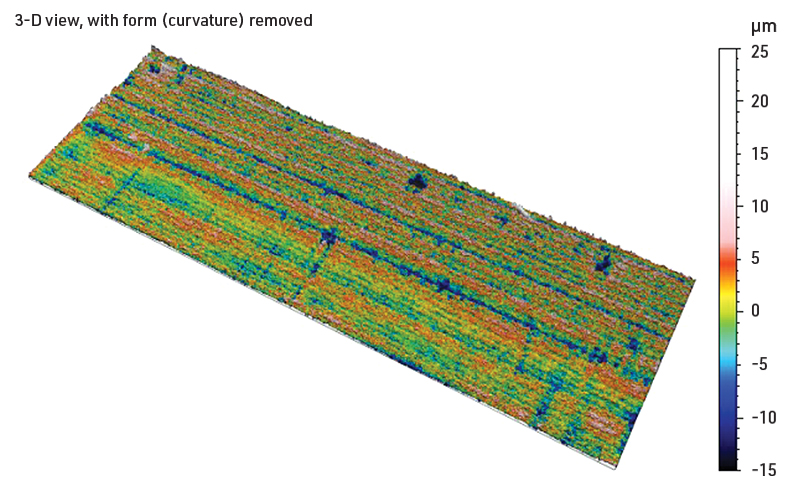
3-D view, with form (curvature) removed
For the purposes of evaluating the data, the darkest blues and blacks indicate the deepest valleys, while the highest peaks appear in reds, fading to pink and white. The more prominent and prevalent the yellows and greens are, the smoother the surface generally is.
Let’s also take a moment to highlight the impact of peaks and valleys on bench operations and finishing results regardless of printer or material. Visually, the highest peaks represent metal that must be sanded away, but beware the deepest valleys! This is especially true in platinum, but to some extent in gold alloys as well. When finishing, all surfaces must be sanded to the deepest valleys. Otherwise, those small, scattered, and often invisible low spots in any output will suddenly appear at final polish and resemble scattered porosity in the casting surface. What is actually being seen are the last vestiges of the lowest valleys of the pattern surface texture.
The Research Methods
With the test geometry and print orientation established to provide consistent results that reflect real-world jewelry practices, the 3-D printed patterns were either acquired or printed in-house from a defined set of mainstream materials and printers. The materials were broadly classified by their chemical composition as photopolymer, photopolymer/wax hybrid, wax, and thermoplastic. Each material was given an alpha label in place of the brand name in order to bring focus to scientific results without commercial elements.
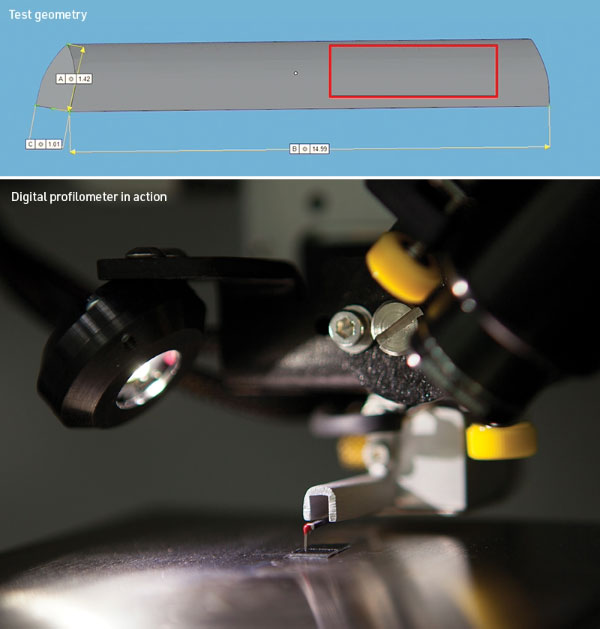
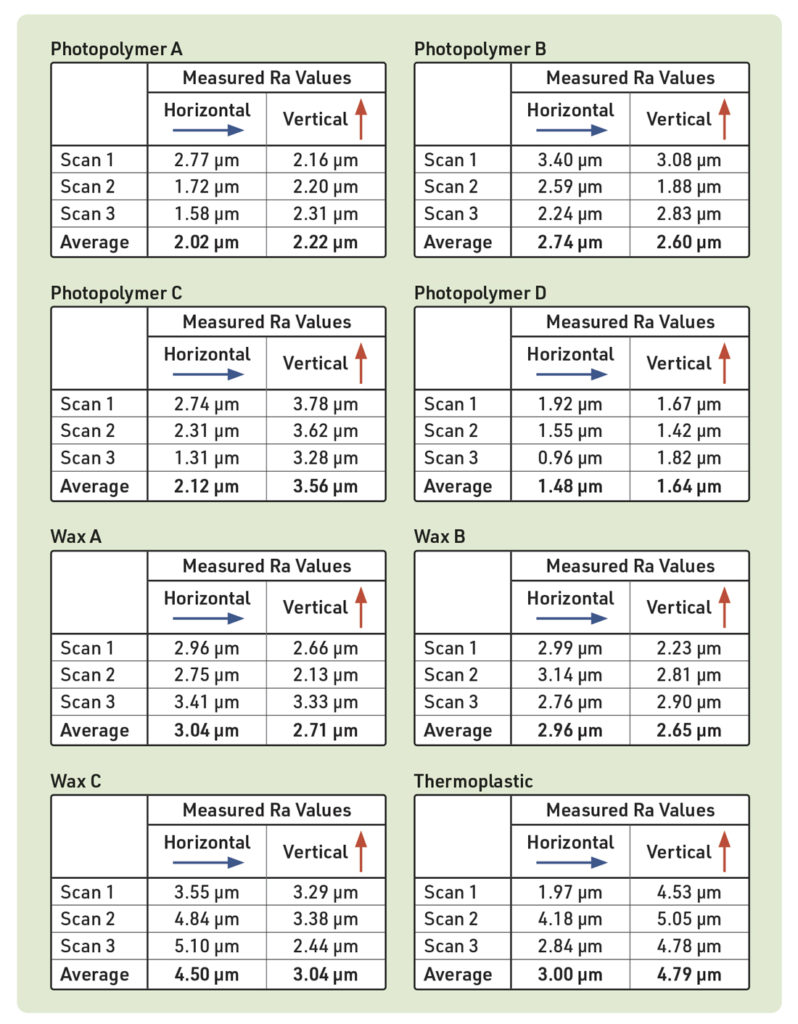
A digital profilometer was used in accordance with the control standard ISO 4287 to measure identical surface areas on each sample geometry and reveal the extent of each print surface’s peaks and valleys. Three scans of each surface were taken in both the horizontal and vertical directions and then averaged. Measurements are reported in Ra units (µm = microns), as is typical in engineering methods that report surface finish. Ra, or “Roughness Average,” is the mean of the absolute height values, i.e. peak and valley mean heights. The magnitude of the surface topography was also calculated from these scans, which illustrates the variance of the highest peaks from the deepest valleys and is listed under Topography Range in the chart below.
The Results
• Photopolymer samples had the lowest average Ra values at 1.6 µm and, therefore, the smoothest surface. Photopolymer D had both the lowest Ra values and topography range. It was an exceptionally smooth print, and the texture was consistent across the full bed of parts. So why have we all not adopted this resin as the winning solution? Its unique drawback, in addition to typical photopolymer defects, is that it does not adhere to wax well and makes assembly on a tree or even a small button very unreliable.
• The photopolymer/wax hybrid category had the next lowest Ra value at
2.8 µm. The surface texture of this material was slightly better than the wax jet options, but the topography range (measurement from the highest peak to the lowest valley) was equal to the roughest wax jet sample at 25 µm. While the surface is relatively smooth to the naked eye, the inconsistencies in some areas of the sample create variances that need to be evenly sanded on your way to a quality finish. This resin and printing technology enjoyed wide adoption but suffers from dimensional inconsistency and air bubbles, along with many of the common problems associated with resin burnout and thermal expansion. The wax content does mitigate many of the issues, but the underlying mechanical properties of resin remain.
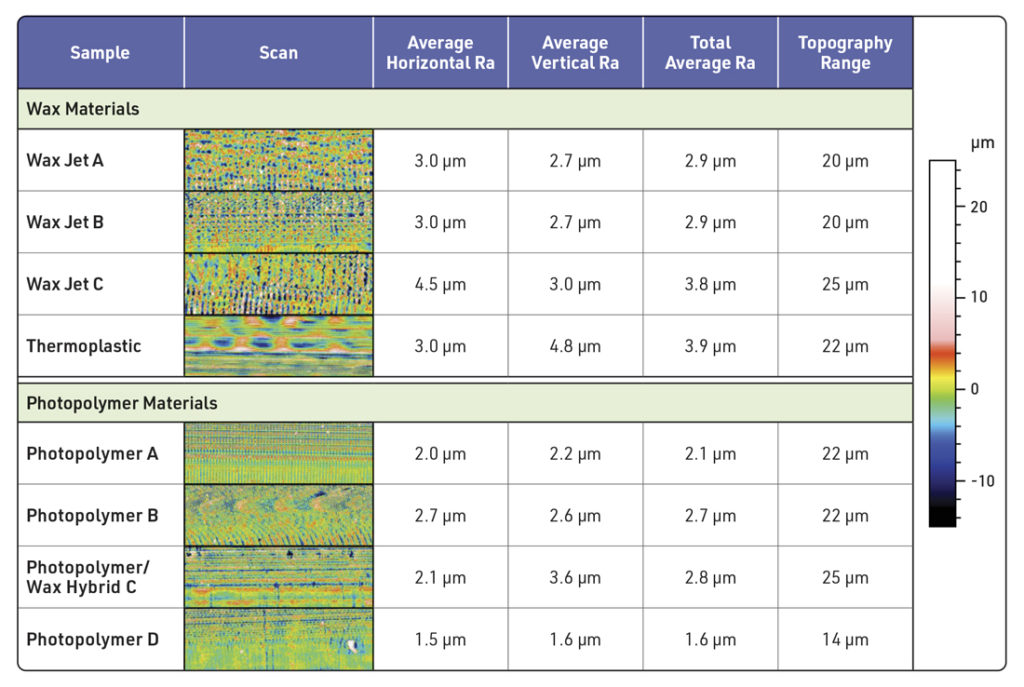
• The wax jet samples all had higher surface roughness than the photopolymers and the photopolymer/wax hybrid. Average Ra for these materials were up to 2.2 µm greater than the lowest photopolymer samples. While that translates to the extremely small measurement of a 0.0022 mm difference, in real terms, it is twice the average roughness and a 40 percent increase in the topography range. Depending on the alloy, design, and aspect, it can be a challenge to sand away the texture thoroughly, and features such as prongs may require an increase in finishing stock. This technology and material have been widely adopted due to both speed and castability, but the surface texture has caused bench pushback from many sectors, especially in its earliest and roughest iterations.
• The thermoplastic had the highest average surface roughness of all the materials tested. Average Ra was 3.9 µm with a topography range of 22 µm. The character of this texture makes it appear much smoother than the data might suggest. While the total roughness and variation are high, the “rolling hills” characteristics of the surface, instead of sharply defined peaks and valleys, present a visually smooth surface that masks the true variability in the pattern. A very widely adopted technology and material, thermoplastic is both castable and visually smooth; it is also durable enough to ship and easier to handle in assembly than wax jet materials. The primary drawbacks are print speed and capacity, which limit production volume.
The Trade Offs
Although the photopolymer samples were measurably smoother than all other outputs, it is widely known that these materials are prone to casting defects that have kept them from dominating the jewelry industry. The impact of incomplete burnout, pattern thermal expansion, support design and removal, and chemical reactions between investment and pattern materials have caused both jewelers and casters to make difficult trade-offs when considering manufacturing methods.
On the other hand, wax jet materials are widely known to be very castable without pattern-related casting defects aside from the roughness of the surface finish documented in this study. In a separate analysis of multiple printers and materials, we also found that wax jet materials were more dimensionally consistent than resin and thermoplastic outputs. For these reasons, wax-based technologies and materials have come to dominate production jewelry casting and manufacturing. In the shops using this output, adjustments to bench operations have proven effective in handling the current state of surface texture where it is required.
In Search of the Satisfying Conclusion
Like so many parts of life and business, there is no clear-cut, satisfying conclusion, even as we see colorful and definitive data points. Does a 0.011 mm increase in topography range translate to a real impact on casting cleanup time? Feedback from the bench suggests it does. Are the first impressions of the naked eye influencing our perception of the magnitude and character of surface peaks and valleys? Do we accept a rougher pattern surface texture because the material is more castable and, therefore, the surface finish ends up being superior due to lack of casting defects? For some, the answer has been yes.
Jewelers should determine their best option for 3-D printed outputs based on a piece’s individual design needs. Until one technology or the other makes the leap we have all been working toward, the choice remains between a smoother surface with a higher probability for pattern-related casting defects such as porosity or inclusions, or a casting that is relatively free of those defects, albeit with a slightly rougher surface finish.