

Rachel DePasquale’s Amaya Pendant
Teach Your Parents Well
Blending motherhood with modern efficiency
By Tina Snyder

Rachael DePasquale
San Francisco
(Originally Published by MJSA October 2024)
The first few months of motherhood are an incredibly special time. For San Francisco Bay Area jewelry designer Rachael DePasquale, taking care of her newborn inspired not only a jewelry design, but also a change in her design process.
“I live in a Victorian home that has many of the old period details still intact,” she explains. “The idea for this pendant came when I was on my maternity leave during the daily feeding routines with my newborn daughter, Amaya. She seemed to express such wonder and curiosity looking at the shapes and silhouettes of an elegant ceiling medallion that is a focal point in her bedroom. It was because of this experience that I decided to design this piece of jewelry.”
The medallion served two purposes: to commemorate the birth of DePas-quale’s daughter and to become the debut piece in a capsule collection that represents her interpretation of Victorian architectural design elements as jewelry. The precious little free time available to a new mother meant that her traditional design process of sketching and hand-carving wax were not feasible. So, for the first time in her career, she turned to CAD.
She provided a rough pencil sketch of the ceiling rose to a local CAD designer. It featured convex stacked petals that curved up to become the seat for the stone as well as a milgrain outer rim to hold melee stone accents. It took her several days of stolen moments during her baby’s naps and feedings to finalize the sketch and measurements for the pendant so it could be cast in 14k gold.
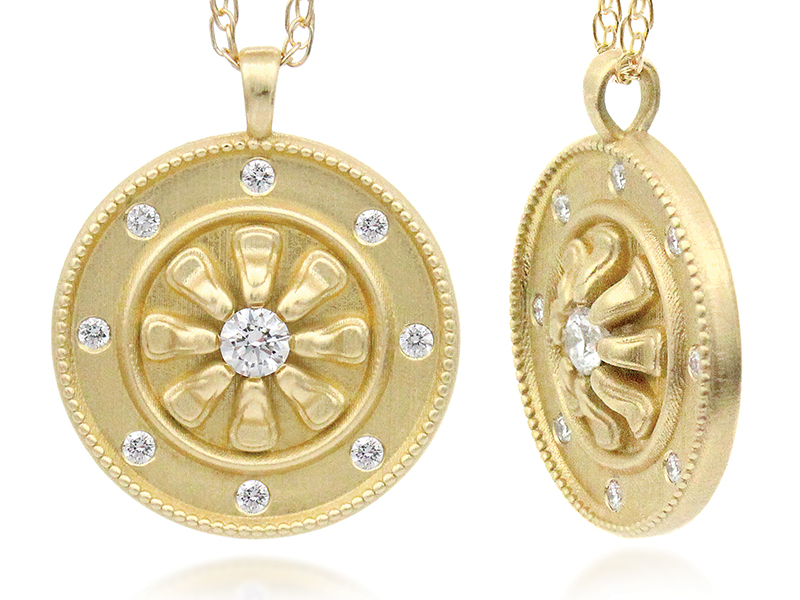
“I wanted something substantial, but not too hefty, that could be worn every day, so I decided on a 15 mm diameter for the overall size of the piece,” she says. “I wanted a 2.5 mm diamond that I had been gifted to be the center point of the design, with 1.2 mm melee complementing on the rim, which I estimated at 1.5 mm thick for setting purposes without being too heavy of a cast.”
New to CAD, DePasquale was uncertain of the exact dimensions required for the eight center petals to be able to function as the stone seats. She worked with her CAD designer to estimate the dimensions based on the size of the stone.
After conversations, the pair settled on a total thickness of 1.7 mm for the milgrain edge, graduating up to a height of 2.8 mm at the top of the petal seat.
DePasquale received a wax model of the finished CAD design, and at that point decided to shrink down the bail, as it looked too bulky. Once the piece was cast in 14k gold, another surprise arose: the tops of the petals were too short to overlap the center diamond girdle. She realized that this was the result of the original stone measurements being off. The fix: She had the setter add additional gold to the petal tips so that the diamond she had intended to use would fit properly in the seat. (In later renditions of this design, DePasquale is using slightly larger diamonds, which suit the pendant perfectly.)
One of the biggest lessons DePas-quale took away from her first experience with CAD is that you can’t underestimate the importance of measuring: “Measure, measure, measure,” she says. “This could have been quite costly for me if the setter wasn’t willing to add the metal for me. I would have had to source a larger diamond.”
Having learned such valuable lessons in this first go around, DePasquale now turns to CAD often. “It’s such a time saver. I use CAD for many of my new pieces, especially my custom work, because the process is so much faster.”
In addition to increasing efficiencies, this pendant will always serve as a tangible reminder of those early, cherished days between a mother and her daughter.