

Tips and Tools for Keeping Chains Intact
We’re Working on the Chain, Gang
Overcoming the chain repair blues
By Sharon Elaine Thompson
(Originally Published by MJSA September 2024)
In a jeweler’s studio, if you hear a lot of sighing and groaning amidst the rhythmic clinking of tools, you’re likely hearing the sound of the men (and women) working on the chain gang. Chain repair, a task that can test even the most skilled artisans, often elicits a chorus of exasperation worthy of a bluesy tune.
Among the various repairs a jeweler might face, chain work stands out as one of the most challenging. The delicate nature of tiny links and the potential for irreversible damage make it a dreaded task.
“I wouldn’t say it’s most dreaded, but it’s definitely up there,” says Scott Bradford, technical sales engineer at Gesswein in Bridgeport, Connecticut.
But as long as consumers love to wear chains, jewelers will need to continue repairing them. Understanding the common challenges they pose can help in mastering the techniques needed for successful repairs.
Why the Fear?
Several factors contribute to the challenge of chain repairs. “Because everything is so small, so thin, and so tightly compacted into a very small area,” says Bradford, “it’s super easy to melt a link.” And if you’re using a torch, “it’s very easy for solder to just flow everywhere, all throughout that chain. Then you have a section [of chain] that is permanently locked into its new shape.”
Bradford explains that he has worked on chains so fine that just the radiant heat from the torch flame drawing near was enough to cause the solder to flow. Chain repair, he says, is “definitely one of the trickier aspects of repair work.”
Among those dreaded chain repairs, hollow rope chains are particularly notorious. Chuck Koehler, principal at CMK Co. in Nashville, Tennessee, notes, “A lot of jewelers, when they open up a job envelope, and see it’s a hollow rope, they just lose their mind, like ‘Oh my God, why do you hate me?’”

When repairing interlocked chains, using a sawblade rather than shears or cutters to open the link will provide a flat cut that will make the link easier to solder or weld.
He’s not wrong, as two categories of chains are known for being particularly difficult to repair: hollow chains and flat, compact, interlocked chains such as herringbones, serpentines, and snakes.
Hollow chains, often ropes or figaros, are common in Koehler’s trade work business, where he estimates handling 40 to 50 such repairs monthly. They are problematic because they are “nothing more than thin-walled tubing,” explains Koehler. “There’s absolutely zero structural integrity in them.” If one of these chains catches on something—a sweater or coat being pulled off—or an infant wraps a tenacious fist around one, they simply pull apart.
Chains such as herringbones, serpentines, and snakes, composed of flat, V-shaped, interlocking links, present another challenge. When they break, it’s difficult to get the solder onto just the part of the link that requires repairing. Instead, the solder can flow everywhere, resulting in stiff spots on the chain.
Tools & Techniques
So, how do jewelers tackle these challenging repairs?
The first decision is whether to use a torch or a laser welder. Both tools have their advantages, and the choice often comes down to personal preference.
Koehler prefers a torch and has perfected his hollow chain repair technique with it. But he says that there are several things to bear in mind when repairing a hollow chain with a torch.
The first thing is to use an easy-flow or low-temperature solder. “I want the solder to flow long before the chain starts buckling and melting on me,” he explains.
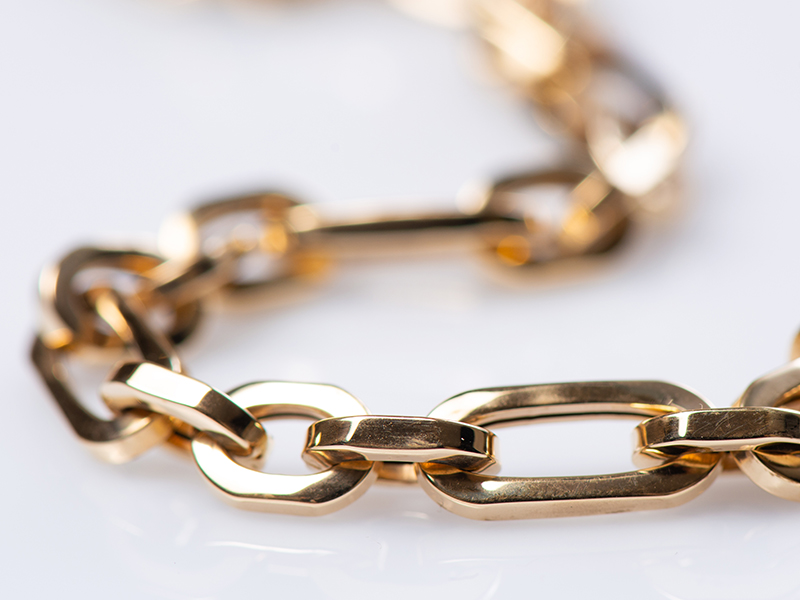
The delicate nature of tiny links and the potential for irreversible damage make repairing chains a dreaded task for many jewelers.
Second, every jeweler knows that when soldering a small piece of metal to a large one, it’s necessary to heat the large one first to ensure the solder flows before the small piece of metal melts. The same is true when you solder a chain on a soldering pad, explains Koehler.
“The thermal energy that’s coming out of your torch is going to the solder pad before it’s going into the chain because heat always flows to the coldest point,” he says. The solder will probably not melt before the chain does, so Koehler recommends that, if you are going to solder a chain lying on a soldering pad, first heat up the soldering pad.
Bring up a torch flame that is hotter than the one you intend to use to solder with, he says, and “get your soldering pad good and hot.” When you lay the chain onto that preheated area, the heat from the torch will flow into the chain and not into the pad, and the solder will flow quickly.
Koehler doesn’t always work on a solder pad. When working on a hollow figaro chain, for example, Koehler uses a third hand in order to isolate the broken link from the rest of the chain.
After applying boric acid to the area of the figaro he’s going to repair, Koehler marks the break with a Sharpie pen since once the broken ends of the link are brought together, it looks like all the others. It can be hard to find the break when soldering, and especially hard to find if he drops the chain between fitting the broken link ends together and getting it set up in the third hand.
For good temperature control, Koehler chooses a small torch tip, and, in order to quickly and easily adjust the flame temperature, he holds his Smith Little Torch in such a way that his hand is always on the gas controls. “I will change the [size of the] flame an infinite number of times during the process,” he says. He also moves the torch in and out, heating the link gradually until the solder flows.
On the other hand, Bradford prefers a laser welder for its precision. “It’s more like a scalpel, it’s a bit more surgical in your approach,” he says. Laser welding avoids the issue of solder flowing uncontrollably and creates a stronger bond by welding with matching metal wire rather than with solder. (Bradford recommends an arc welder as a good second, less expensive alternative to a laser welder.)
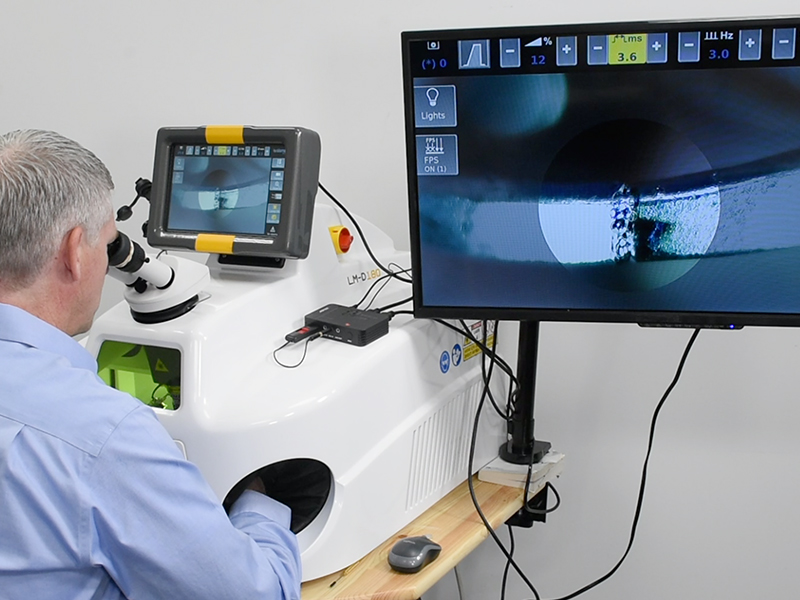
Many jewelers prefer to use a laser welder to repair chains as it avoids the issue of solder flowing uncontrollably and creates a stronger bond by welding with matching metal wire instead of solder.
Bradford also appreciates the speed with which a chain can be repaired using a laser welder. “You don’t have to clean up flux afterwards, so you’re skipping the ultrasonic and the pickle solution,” he says. “In a repair shop, time is money. So being able to do a quick weld, clean up any oxidation that may be around the weld site, and then hand it back to the customer, that’s great.”
He says the only issue he has with laser welding is that, like many jewelers, over the years his hands have become desensitized to heat. So, when he cleans the oxidation off the weld, “I’ll go a little longer cleaning it up, because it’s probably a little hot at the moment, and I don’t want to hand it back to the customer right away.”
Overcoming Common Challenges
Bradford finds chains with overlapping, interlocking links, such as herringbone, serpentine, and snake chains, especially challenging. “They’re inherently difficult just because of how they’re put together,” he says. Because the links essentially fold over each other, breaks are usually hard to access. If you’re using a torch, he says, “it’s difficult to get any solder [into the break]. Even with a laser welder, it’s kind of hard to see the area you need to weld.”
Another chain Bradford has repaired frequently is a box chain. “When you have a box chain, typically one link has been splayed and is bent,” he says. Rather than try to get that twisted link back into shape, he discards it. Using a sawblade rather than shears or cutters, he cuts through one flat side of the box next to it. Then he opens the link just enough to get the unbroken link beside it connected, and pinches it closed. “The sawblade provides a nice, flat cut” making the link easier to solder or weld.
For any chain repair, Bradford advises using paste solder instead of sheet or wire solder. “Paste solder is your best friend,” he says. “You can paint your solder in there, on the spot where you need it, close the link down, then just put some heat on it. Paste solder generally doesn’t flow as far as sheet or wire because you’re using so little of it. There’s less of a chance of locking those links down.”
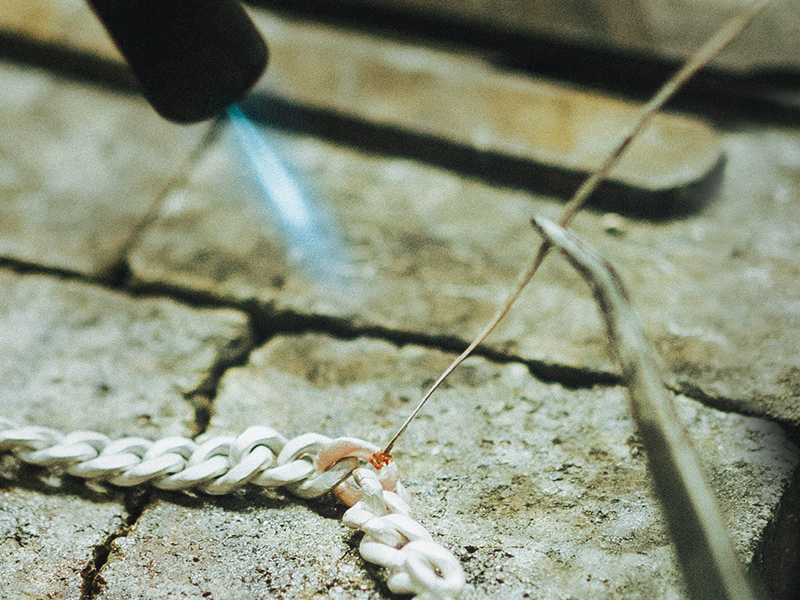
To master chain repair, jewelers need excellent torch heat control skills, a light touch, and close attention to detail.
If you find yourself working on a number of chains in your business, “get yourself some really good chain nose pliers,” says Bradford. And if you use cross-locking tweezers or a third hand to hold the chains when you repair them, “grind them into a fine tip.” It will be much easier to isolate those small links before you try to solder them. “I can pinch them on the link I want. The rest of the chain hangs down so I can really get in there and see what I’m doing.”
Chain repair doesn’t have to be dread-ed. With excellent torch heat control skills, an understanding of heat flow, a light touch, and close attention to
detail, jewelers can master this challenging task. And when they do, the sighs and groans will fade, leaving behind the steady, rhythmic sounds of a job well done.