

Beth Farber’s Australian Boulder Opal Woven Collar
Dream Weaver
Bead weaver Beth Farber elevates her jewelry design to the next level
By Tina Snyder
(Originally Published by MJSA Spetember 2024)

Beth Farber
New York City
An experienced bead weaver, Beth Farber of New York City took up goldsmithing a few years ago in an effort to elevate her jewelry designs to the next level. “I was very surprised at how much I fell in love with metal and classical goldsmithing techniques,” she says. “I love the color of 22k, and I love working with it in my designs.”
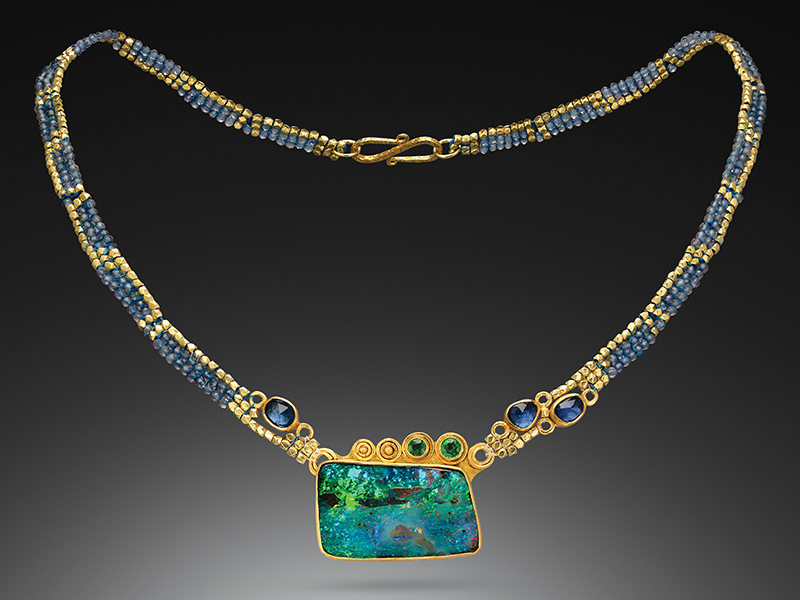
Traditionally, in Farber’s woven neckpieces, the focus of the design has always been on the weaving. In this piece, she wanted to spotlight a spectacular Australian boulder opal, which would also bring attention to the unique 22k gold setting she designed for it.
Creating her first neckpiece in which the center stone was the star brought with it a number of challenges.
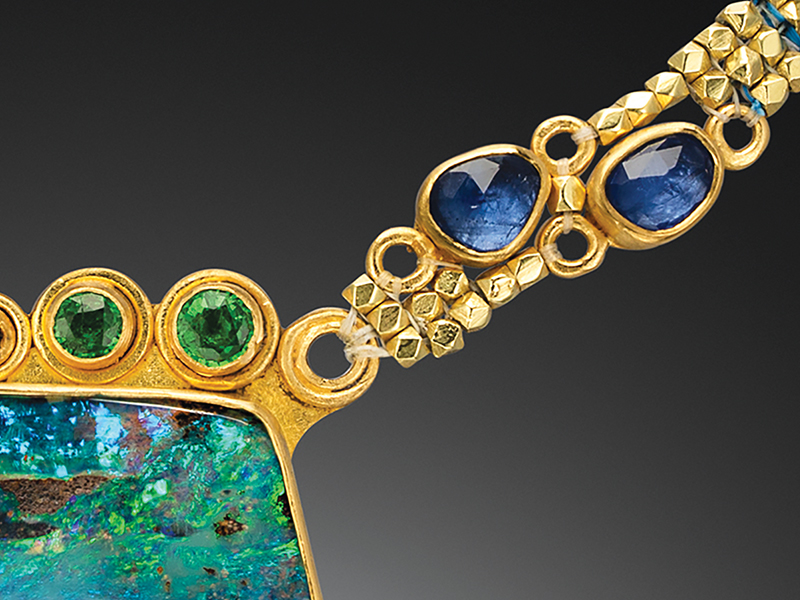
Selecting accent stones. The first challenge was selecting a group of smaller gemstones that would enhance the colors and flash in the boulder opal. Farber also wanted the accent stones to interact with the unusual shape of the opal to give it a sense of flow and balance.
“Once I had selected an array of possible stones, in this case tsavorites and sapphires, I laid them out and moved them around the opal, taking tons of pictures until I was mostly satisfied with the design,” she says. “I also sketched a number of options that helped illustrate the vision in my head.”
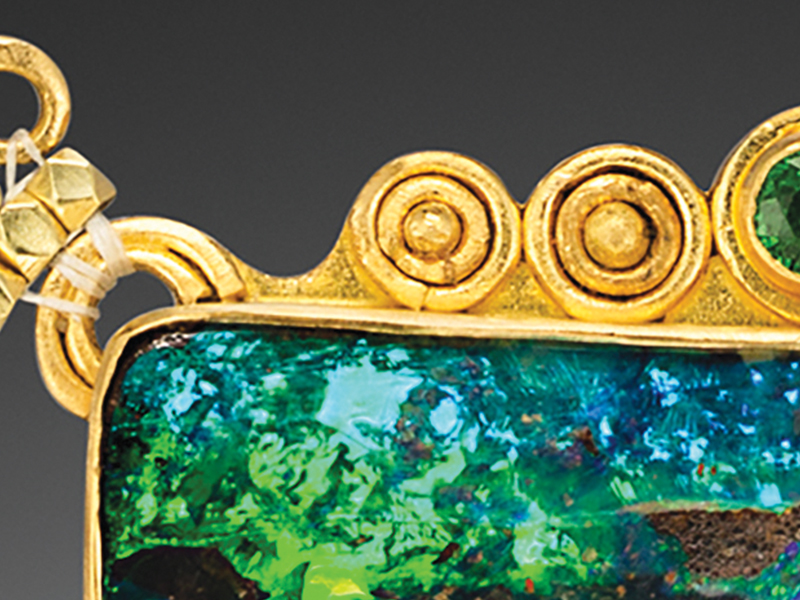
Mastering the goldwork. The next challenge was figuring out how to build the setting: to fuse or solder? Farber opted to fuse the larger pieces first, starting by fusing the bezel for the opal to a back sheet in a beehive kiln. She then fused the jump rings that attach the wire, as well as the tiny bezels for the sapphires and tsavorites.
The only components she chose to solder in the piece were the jump rings that attach to each side of the sapphire bezels. “With a tiny bit of solder they look almost perfect, whereas one false move with a torch trying to fuse something that size and it’s a puddle,” she says.
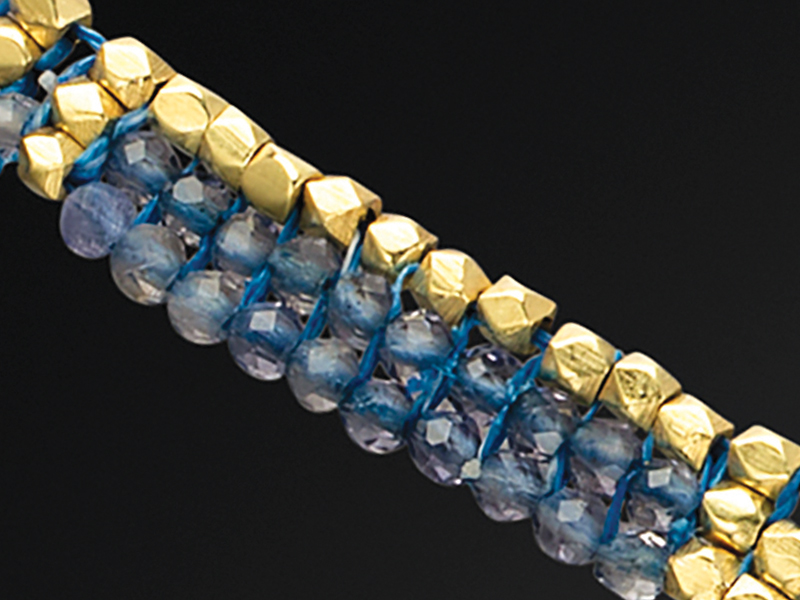
Weaving the beaded collar. The third challenge was selecting the stone beads to use for the woven collar. Farber wanted an interesting and subtle effect that would emphasize the center stone. “I pulled out strands of tiny stones in many shades of blue, and I wove samples of each stone with different colors of thread,” she explains. “Ultimately I found that the tanzanite beads with the blue thread were the best choice for my aesthetic.”
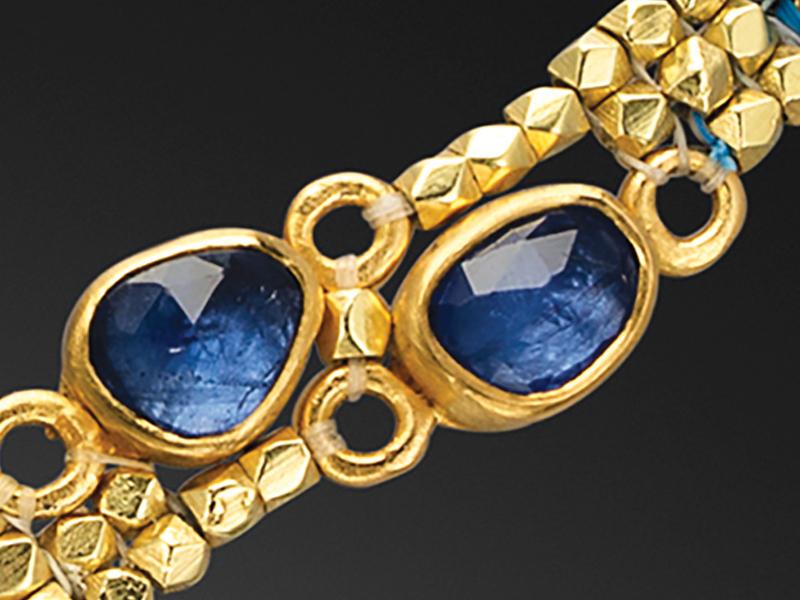
Integrating the bezel-set blue sapphires into the woven collar. The final challenge was weaving the tanzanite and gold beads together with the blue sapphire bezels, to produce a design that would lay flat and drape softly around the neck. This required much trial and error. “I must have tried 10 to 20 different ways to weave the sapphires together with the gold beads—differently on each side—finally landing on a technique that gave me the most elegant design,” she says.
The final product is a testament to trying new things: Farber’s first piece where both her weaving and her goldsmithing shine equally.