

Unveiling the Potential of Metallic Glass Jewelry
Metallic Magic
Exploring the promise of metallic glasses
By Shawna Kulpa
(Originally Published by MJSA May 2024)
It’s the dream: to craft jewelry that not only dazzles with its brilliance, but also boasts unparalleled hardness and scratch resistance. It’s a dream that goes beyond the conventional precious metals that have long been the go-to for jewelers. But the quest—for brilliance, hardness, differentiation, and excellence—continues, and it has led to an exploration of unconventional materials.
Enter metallic glasses.
These innovative alloys, characterized by their non-crystalline atomic structure, present a novel frontier in jewelry making. Offering unique properties that challenge the limits of traditional metals, metallic glasses hold the potential to revolutionize the industry. They’re not quite ready for prime time within the jewelry industry—and even then, conventional metal alloys will still be around. But current research is demonstrating that metallic glasses, with all their potential challenges and creative possibilities, may one day offer an option for jewelers.
What Are Bulk Metallic Glasses?
When you hear the term metallic glass, you may envision a material similar to the one that fills your windows, perhaps with a metallic sheen to it. However, metallic glasses look just like conventional metal alloys. In fact, by appearance alone, it would be difficult, if not impossible, to visually tell the difference between them.
“Metallic glasses are glass, but they are not transparent,” says Dr. Ulrich Klotz, head of the department of physical metallurgy at the fem Research Institute in Schwäbisch Gmünd, Germany. “They look like ordinary metal.”
So then, how do they differ from conventional alloys?
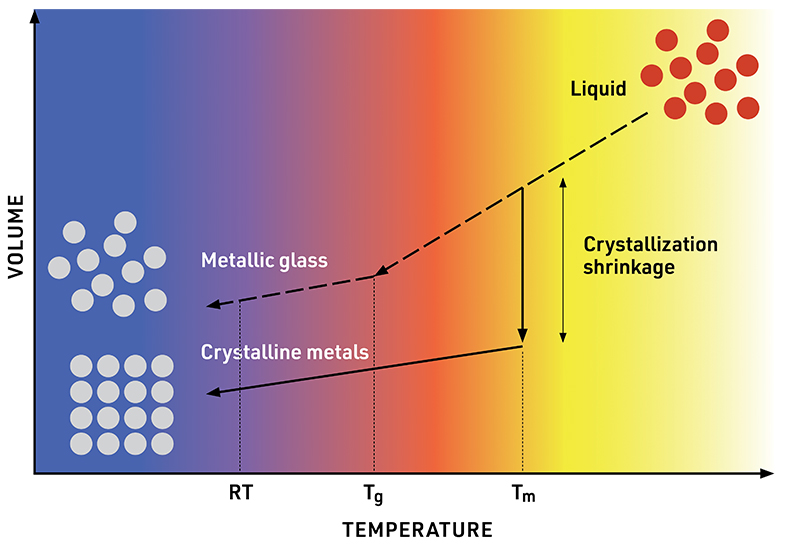
Bulk metallic glasses are formed by quickly cooling the melt, which prevents the atoms from arranging themselves into a crystalline formation.
Metallic glasses (also known as amorphous alloys) are created when a metal alloy is heated into its liquid state and then quickly cooled. As it cools, the melt becomes more viscous, which prevents atoms from arranging themselves to form a crystal. When the metallic glass alloy can be produced with a thickness of at least 1 mm or more in all directions, it’s referred to as bulk metallic glass (BMG).
“There are two requirements to form a BMG,” says Klotz. “First, BMGs are formed at very special and narrow composition ranges. Second, the alloys have to be cooled extremely fast. The melt has to be quickly chilled so the atoms have no time to arrange themselves in a regular order.”
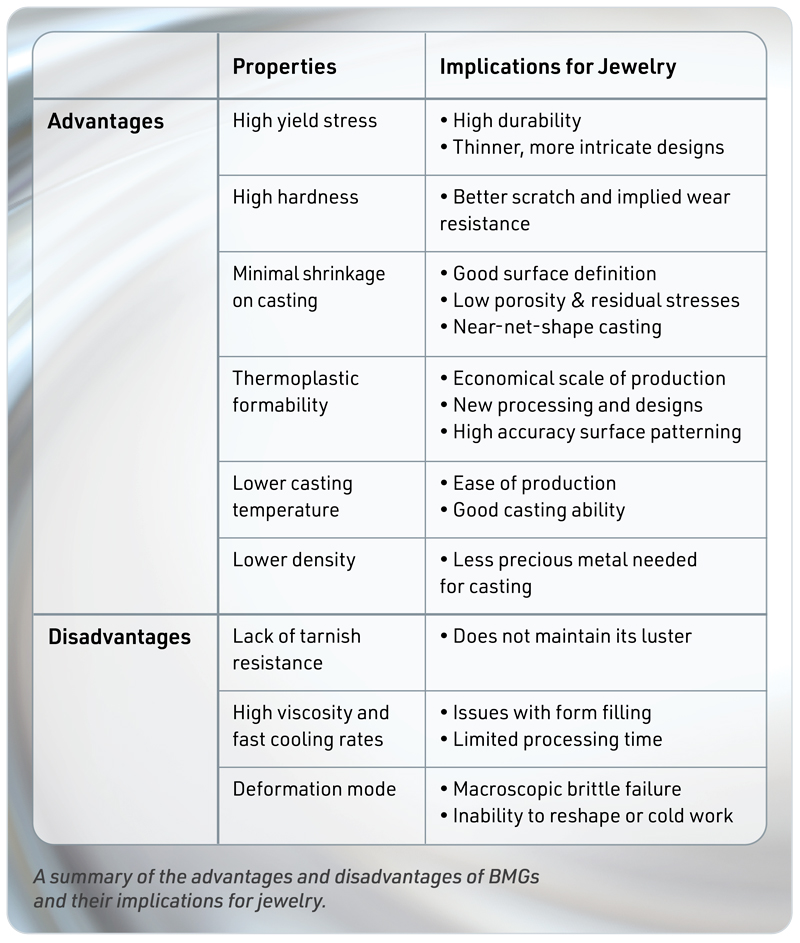
The high cooling rate needed to achieve the right solidification rate means that the materials can be challenging to manufacture. But when done properly, the metallic glass material has a high as-cast hardness, good corrosion resistance, and outstanding surface quality—all qualities that are attractive to jewelers.
The Advantages of BMGs
Although they may look identical to conventional metal alloys, BMGs differ in some pretty significant and beneficial ways.
One of the biggest advantages that BMGs offer is an exceptional hardness compared to crystallized precious metal alloys.
“Conventional platinum alloys are usually quite soft—we’re talking about hardness levels between 100 and 200 Vickers,” explains Klotz. “But for BMGs, we’re looking at over 300 Vickers, which is a very high hardness for a jewelry alloy.” That high hardness also makes BMGs extremely scratch resistant. (They’re also extremely elastic, behaving much like a rubber ball.)
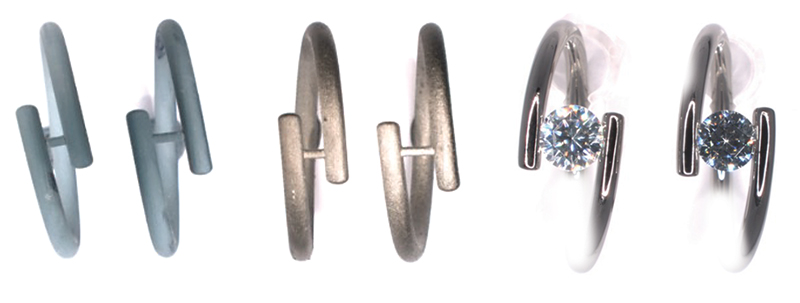
Current research into BMGs has shown that it is possible to cast jewelry wax patterns (left) that have smooth as-cast surfaces (center) and can then be set with a spring-loaded gemstone (right).
Another advantage that BMGs offer over conventional alloys is their low melting temperatures, which makes it easy to melt and cast them. Klotz points out that the platinum 850 BMG, which he believes is currently the most promising when it comes to potential jewelry uses, melts at only 600°C, which is 1200 degrees lower than a conventional platinum alloy. That lower melting temperature also means less wear and tear on consumables, such as crucibles, preserving resources.
When cast, BMGs can have much higher-quality surface finish than a traditional metal casting. “You’d still need to polish it, but the number of surface defects would theoretically be lower,” says Owain Houghton, a postdoctoral research associate at the University of Cambridge. And just like when casting conventional metals, the quality of the surface is only as good as the surface of the mold. “If you have a high-quality mold finish, you can get a high-quality metal finish.”
And thanks to their amorphous structure, BMGs exhibit minimal shrinkage following casting. However, while BMGs can be cast, Houghton recommends casting with metal molds instead of with investment molds. Metal molds, he says, are how we typically achieve the necessary high cooling rates.
Another benefit BMGs offer is a lower density than that of conventional alloys. “For the user, they can feel lighter because they’re less dense,” says Houghton. Because of this characteristic, the amount of BMG gold or platinum needed to fill a given mold is much lower.
“The density of a typical crystalline 18k gold alloy is just over 15 grams; for an 18k BMG alloy, it’s under 14 grams per cubic centimeter,” he says. “Jewelers can save some money on raw material and make the same size piece.”
Although it’s still early, researchers believe that the unique properties of BMGs will offer the potential for new jewelry designs, as well as fast mass production. Houghton notes that BMGs show promise for use in additive manufacturing.
The Limitations of BMGs
Still, BMGs aren’t without their disadvantages. While some are resolvable, others are not and present a new set of concerns for the bench jeweler. Perhaps the biggest (and most unique) challenge for jewelry-specific BMGs is hallmarking and stamping—specifically, having enough precious metal to meet the regulations, especially for platinum, palladium, and sterling silver.
Although there have been attempts to create 950Pt, 950Pd, and 925Ag BMGs, these alloys exhibit marginal glass-forming ability. According to Houghton, to ensure that the liquid is as stable as possible, most BMGs have complex compositions, often involving four to five different elements to frustrate crystallization. The addition of precious metals—especially in the amounts needed for a 950 or 925 stamp—gives a higher chance of the melt crystallizing.
“With platinum and palladium, you have to add in substantial weight fractions of elements (such as phosphorous) to form a glass, so you have to go with lower percentages of the precious metals. This makes it quite difficult reaching 950 hallmark,” he says.
Houghton notes that although the 18k gold hallmark gives some room to add in elements that help to form a glass, two of the additions often used in 18k BMGs are copper and silicon. In the presence of copper, silicon creates tarnishing issues, and the interplay of the two in these BMG alloys leads to a rapid discoloration, often within just a matter of weeks.
“It’s a different tarnishing scale to sterling silver, it’s more adherent,” Houghton says of the tarnishing that afflicts gold BMGs. “You can grind if off, but it’s not so easy to polish off like with sterling silver.”
Houghton notes that while 14k gold BMG compositions do exist, they also undergo the same tarnishing problem. “The science is quite complicated,” he says.
But the greatest limitation of BMGs is that they can’t be treated the same way as conventional alloys in the jeweler’s workshop. While BMGs’ different atomic structure leads to high hardness, “you can’t work-harden BMGs,” says Houghton, and “you can’t cold-work them like a normal crystalline material. It requires a new way of thinking in terms of workmanship.”
For example, while you could cast a ring with BMGs, you would not be able to size it afterward because “it’s not possible to anneal the ring with a torch because this will result in the melting or embrittlement of the alloy,” Klotz says. “If you’re doing a heat treatment, the BMG will lose its amorphous structure and form a crystalline structure. This also means that it loses its elasticity. The hardness will stay, but it will become very, very brittle. Uncontrolled heat treatment can destroy the properties and cause a failure of the jewelry piece. This is an important point that has to be considered.”
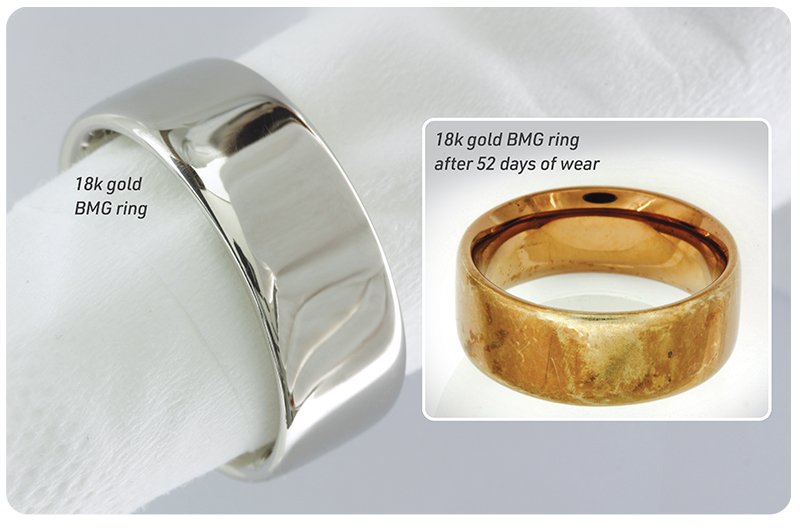
Within weeks, thanks to the required presence of copper and silicon, 18k gold BMGs experience tarnishing that is more adherent than sterling silver tarnish and needs to be ground off the metal.
Although he admits that his research team works with BMGs with conventional machines and materials, “there are tricks and you have to know some techniques and how to handle them,” says Klotz. “In principle, a jeweler can make a piece of BMG jewelry. But not all jewelers can make jewelry at the same level, [and] it’s the same with BMGs—you have to learn it, train it, and know some tricks.”
Given BMGs’ high hardness, Houghton says jewelers working with them should expect faster tool wear. He notes that though the materials can be machined, if worked in a mill or a lathe they are likely to behave in a brittle manner.
The Future of BMGs
Although we’re still a long way from seeing BMG jewelry filling store cases, researchers think the materials hold much promise for use in jewelry, watchmaking, and luxury goods.
Already, BMGs are being put to use in some industries. Thanks to their high hardness and scratch resistance, zirconium-based BMGs are being used to create bezels for luxury watches. And Houghton notes that contract manufacturer Liquidmetal Technologies has been using BMGs to create golf club heads. “They’ve been banned by the USGA for being too good,” he says.
For now, the focus of some BMG research is on in-person wear tests for the alloys currently available, so that researchers can better assess their mechanical wear properties in the real world.
“We are in the beginning of using these materials in the jewelry field,” says Klotz. “I think that as the material becomes more well-known and the first applications are realized, it requires the input of designers who have ideas [on] how this could be used for exciting pieces of jewelry.”
But researchers assure that jewelers won’t wake up one day to discover that BMGs have supplanted conventional precious metal alloys. Instead of replacing the traditional alloys, research remains focused on discovering how BMGs can be used to create new jewelry designs that weren’t previously possible.
“BMGs are never going to completely replace crystallized alloys, but with certain applications, there will be a rise in their use,” says Houghton. “BMGs will definitely find applications, but don’t think that in 20 years everything will be BMGs. There’s definitely a lot of excitement and interest, and we’re working toward finding the perfect alloys and seeing what they can do, but there won’t be a complete takeover of the industry.
“As scientists, we’re not artistically creative like those in the industry,” he adds. “That’s what’s exciting—we make these alloys, share them with industries, and find out what’s possible with them. What amazing things can you do with them?”