

Laser Welding Options for Jewelers
Unleash the Magic
Exploring jewelers’ laser welder options
(Originally Published by MJSA March 2024)
In every jeweler’s studio, there’s a quiet hero waiting patiently to be called upon to work its magic. As if with the wave of a wand, the laser welder makes precision and beauty possible with just a beam of light.
Need a seamless join in a ring? Zap!
Discover a bit of porosity you need to clean up? Zap, zap!
Have to repair a prong next to a heat-sensitive stone that can’t be removed? Zap, zap, zap!
In many workshops, the laser welder’s efficiency has made it an indispensable tool. If you’re finally ready to invest in one for your shop, you’re in the right place. This comprehensive guide highlights the specs of 19 laser welders geared toward use in jewelry. From pulse energy to spot size, we break down the technical jargon to help you find the perfect match for your jewelry-making needs. After reviewing your options, you’ll be zapping your way to welding success in no time.

Deciphering Laser Welders
As you venture into the world of laser welding, navigating the technical specifications of laser welders can be daunting. What’s the difference between pulse energy, pulse length, and pulse frequency? How to best determine the necessary spot diameter, or the maximum power you’ll need? While you should discuss your specific needs with a laser supplier, who can help identify the best welder to meet those needs, this primer on laser welder specs can help you make a more informed decision.
Maximum Peak Power
This is the maximum power output of the laser in a single shot. However, while a laser welder may be able to reach and sustain a specific output level, it doesn’t mean that the machine should regularly do so. Operating at maximum power causes a lot of stress on the welder, which increases the wear and tear.
Ideally, you should select a laser welder where the maximum amount of power you’ll need for your work will fall in the middle of the welder’s range. “You don’t want something running at 100 percent power all the time,” says Phillip Scott, a technical support specialist at Rio Grande in Albuquerque, New Mexico. “That’s a lot of stress on the machine.”
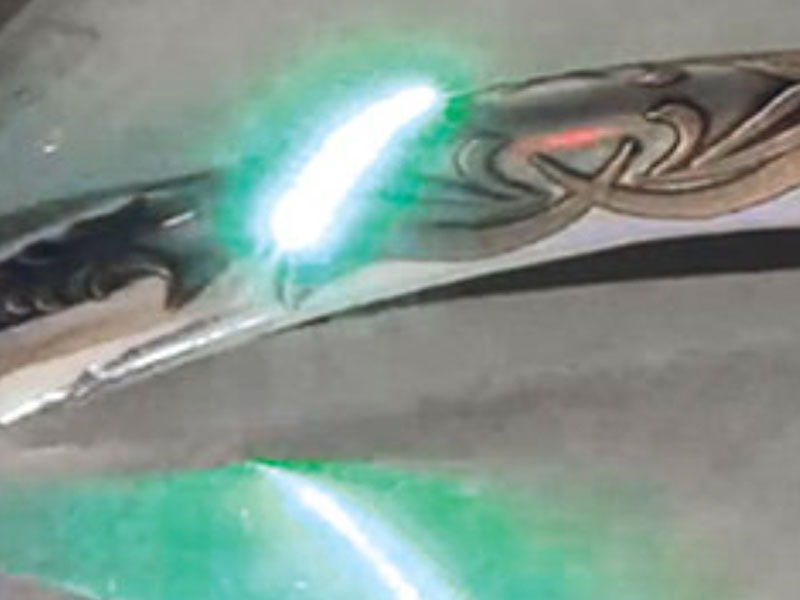
To determine how much power you’ll need, consider the metals on which you’ll be working. Gold is easy to weld, requiring the least amount of power, so you could easily get by with a laser welder with a maximum peak power lower than 100 joules if that’s the only metal you’ll be welding with it. Because of its reflectivity, silver is one of the most difficult metals to weld. To weld silver, Scott recommends looking for a welder in the 120 to 180 joule range. “It has to be over 100 joules to effectively weld silver,” he says. “Lower power machines can do it, but they’re slower and can’t recuperate the power as fast; they’re not built for that.”
Average Power
Average power refers to the average amount of energy delivered by a laser over a certain period of time. Unlike maximum peak power, which represents the highest power output achieved in brief pulses, average power provides a more sustained measure of the laser’s energy output over a longer duration.
Pulse Energy
Pulse energy is the amount of energy contained within a single pulse of a laser beam. In other words, it measures the total energy delivered by the laser during one pulse cycle. Finding the right pulse energy to successfully weld a piece can take some trial and error, as it’s easy to apply too much power to a piece, which can result in brittle welds or frying the metal.
“Knowing how to create the weld is important,” says Scott. “Just throwing more power at a piece doesn’t create a better weld.”
Pulse Length
Also known as pulse duration or pulse width, pulse length is the time (typically expressed in milliseconds) over which a laser emits energy in a single pulse. Longer pulse lengths can create cleaner, stronger welds, as the longer the light stays on the metal, the more it produces a homogenous puddle of molten metal that smooths out. Shorter pulse lengths, on the other hand, allow you to use the welder like a drill, as the pulses are so short that the metal doesn’t have a chance to puddle and fill in the hole.
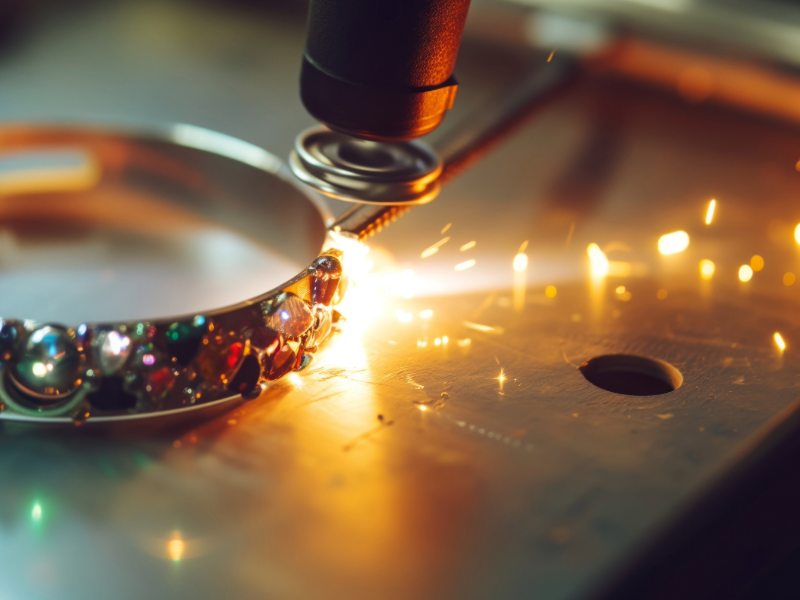
If you’re welding and start to notice vaporized metal, soot, black welds, or splatter in the weld, your pulse length is likely too short. When that happens, Scott recommends decreasing the power and adjusting the pulse length until you start seeing a clean weld.
Pulse Frequency
Pulse frequency is the speed at which the laser welds. If you’re just starting out, Scott recommends aiming for three welds per second, as you’ll easily be able to see the light hitting the metal and control where the welds are made. He cautions against starting out too slow, such as one pulse per second, because if your hands move a little between pulses, the weld could wind up a little off. “It’s easier to go a little faster and overlap the welds,” he says.
That said, it is possible to go too fast with the welder. While some welders will allow users to make 10 to 15 pulses per second, it will cause the metal to heat up quickly and become hard to hold. You’ll also want to be cautious if you’re welding near heat-sensitive stones set in a metal with high thermal conductivity, as the heat generated by the quick pulses could damage them.
Spot Diameter
This is the diameter of the laser beam where it contacts the surface of the metal. If you have a super small spot, the weld will go deeper into the metal. If you use a large spot, the weld will be shallower. Scott says most jewelers will use a range of spot sizes for a project; you could start with a small spot to go deep, and then gradually change the diameter to help smooth the surface of the weld.
“Everything you work on will be different,” he says, noting that to determine the best spot diameter, you’ll have to consider the item you’re welding, the type of metal, and the metal’s thickness. “If you’re attaching an earring post you’re not going to use the same setting as if you’re sizing a class ring.”