

Knowledge Is Key to Overcoming Industry Challenges
Change Is Afoot
The Jewelry Symposium offers fresh perspectives and cutting-edge technologies
By Deborah A. Yonick
(Originally Published by MJSA April 2024)
In the ever-evolving landscape of the jewelry industry, this year presents a host of challenges that demand innovative solutions. From labor shortages to soaring material costs, traditional practices are being tested as never before. As the industry grapples with these pressing issues, there’s a growing recognition of the need for fresh perspectives and cutting-edge technologies to drive progress.
Some of those perspectives and technologies will be shared during The Jewelry Symposium (TJS). Held May 18-21 at the Detroit Marriott Troy in Detroit, Michigan, the TJS is continuing the 34-year history of groundbreaking work of the Santa Fe Symposium, which was founded by Eddie Bell and Dave Schneller to eliminate barriers to information sharing within the industry.
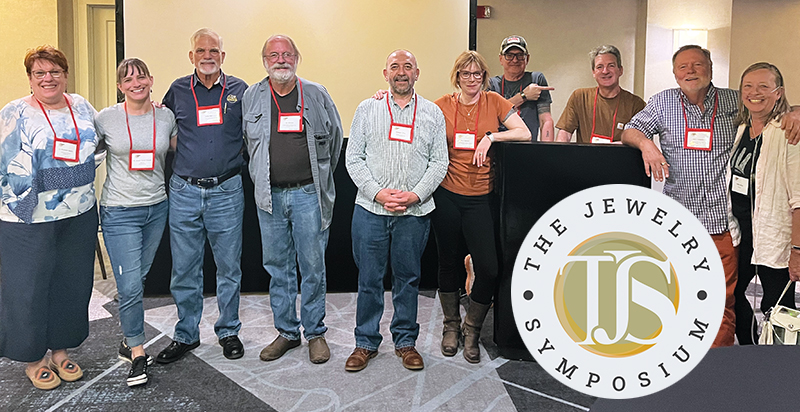
The team behind the inaugural Jewelry Symposium helps lay out the groundwork for collaboration and advancement in the industry. Their dedication and expertise set the stage for progress, uniting minds to tackle challenges and drive innovation.
Dedicated to the advancement of jewelry manufacturing technology, TJS serves a big audience made up of bench jewelers, jewelry designers, manufacturers, retailers, and students. And its board is just as diverse as its audience. Linus Drogs, owner of Au Enterprises in Berkley, Michigan, serves as chairman of the board. Other directors include Stewart Grice, vice president mill products at Hoover & Strong in North Chesterfield, Virginia; Ann Cahoon, director of manufacturing and repair at Long’s Jewelers in Burlington, Massachusetts; Jim Binnion of James Binnion Metal Arts in Bellingham, Washington; John Berg, former vice president of manufacturing at David Yurman in New York City; Chris Corti of COReGOLD Technology Consultancy in Reading, United Kingdom; and Jason Yakubovich of MJJ Brilliant in Long Island City, New York.
“Having a network across different industry tiers helps to expand the data points with how our industry is changing and adapting,” says Drogs, noting that good information is vital to advancing one’s business. “First-hand data is even more valuable, mainly if your company participates on the cutting or bleeding edge.”
The purpose of the symposium is to highlight new technologies for attendees to pick up ideas and run with them, says Grice. “Sometimes we discuss revolutionary game changers like CAD design, which was quite a revolution when it first hit the industry. Who knows? Maybe AI could be the next big game changer. Other times, we learn more about smaller scale technologies at TJS. But the sharing of ideas is critical and can spawn some significant advances for our industry.”
Big Issues to Face
According to Drogs, there are three main issues the jewelry industry faces. “First is jewelry talent. Jewelry technicians are getting older and retiring faster than new talent is embracing our trade. Second is the rising cost of raw materials. Some precious metals are at near lifetime highs, and with other economic pressures, the consumer is spending differently than two, three years ago. Third is lab-grown diamonds are more accepted, reducing retailers’ profitability, domestically.”
Cahoon concurs that finding skilled workers to do the very specific hands-on work that keeps this industry running at all levels is a huge challenge. “I see the shortage of bench jewelers as particularly pressing, but it’s certainly affecting manufacturing more broadly. Skilled technicians are vital in so many roles, and they’re fast becoming our scarcest resources as folks age and retire. Engaging with young people, and career changers, and showing them our practical, hands-on careers (that happen to pay well and offer incredible opportunities) is mission critical.”

In his keynote presentation during the inaugural Jewelry Symposium, Santa Fe Symposium founder Eddie Bell encouraged attendees to embrace curiosity, push boundaries, and foster a culture of learning and discovery.
Piggybacking on what Drogs cites about raw materials, Grice says the rise in gold prices will be a major challenge for fine jewelry makers at a time when consumer demand is down. “Tough decisions will need to be made,” he says. “Do brands opt for other precious metals and/or alternative metals? Do they try lighter- weight styles with innovative designs? Or add value with versatile/transforming options, distinctive gemstones, or branding? R&D for new design is challenging when the gold price is so high.”
But people are still getting married, says Drogs, citing recent data that suggest an engagement bubble is on the horizon. “Some data also show that metal fundamentals are still strong, and the record pricing of gold may be pure speculation. Anticipating the shift will allow one to prepare for capacity needs or new supply change requirements.”
According to Grice, the greatest opportunity for jewelry companies in 2024 is to embrace technology. “Technology can help jewelry companies truly optimize what they specialize in, what they’re good at,” he says. “As technology continues to evolve, jewelry can be made more innovative and/or more cost-effective. Taking advantage of new technology can be challenging and sometimes even scary, but as consumers continue to adopt new technologies, so must brands and manufacturers.”
AI is a good example, Grice notes. “AI has the potential to offer unique design capabilities and efficiencies, and it could also now help with predictive modeling of gold and silver alloys, as we will learn at TJS. It’s a great opportunity for jewelry creators to see what others are working on that’s new. Right now we don’t really know where AI is going in our industry, which is why we have technical symposiums to discuss such technology to see what applications there may be for it. We’re hearing about AI in marketing and advertising, jewelry design, and alloy design where you may need a material with specific applications.”
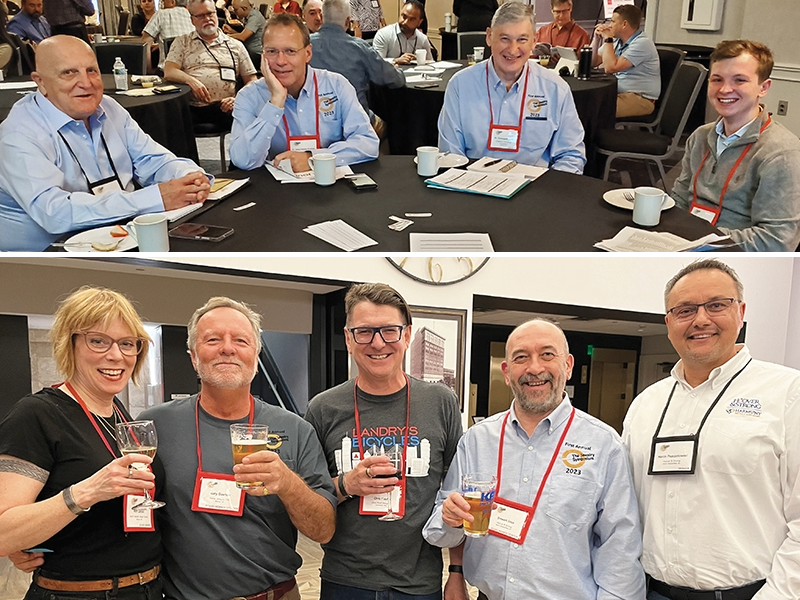
The Jewelry Symposium brings together attendees from all areas of the jewelry industry, forging connections and camaraderie as they unite under a shared passion for advancement.
Among the presentations at TJS delving into the topic are “Leveraging Artificial Intelligence and Big Data in Predictive Modeling of Physical, Chemical, and Mechanical Properties of Gold and Silver Alloys for Jewelry Manufacturing” by Dr. Valentina Allodi, R&D manager at ProGold; and “Generative AI as a Tool for Jewelry Design” by Michael Magee, senior subject specialist for GIA’s Jewelry Manufacturing Arts, on how designers are leveraging AI to advance creative output.
Cahoon recommends that 2024 be the year jewelry businesses take the next steps to invest in technology. “Do your research and trust that the right investment will improve your bottom line,” she says. “I don’t believe there will ever be a replacement for a skilled technician, but I’m confident that we support our teams with the thoughtful implementation of the right equipment.”
A firm believer that knowledge, technology, and networking are the foundation for nimble problem solving, Cahoon says that while the speed at which technology is moving can be challenging, being a part of a network like TJS that shares its collective knowledge offers a tremendous advantage.
“Staying open to change and being genuinely curious about changes in the business is crucial,” says Cahoon. “I’ve seen folks miss opportunities because they are change averse or underinformed. As basic as it sounds, knowledge and networking can help you stay on track.”
For more information about TJS, visit thejewelrysymposium.com.