

Everett Walker Redus’s Succulent Ring
Personal Growth
To highlight his personal connection with nature, Redus combined the three natural materials of wood, stone, and metal in his ring design
By Tina Snyder
(Originally Published by MJSA October 2023)

Everett Walker Redus
Everett Walker Jewels | Dallas, Texas
When Everett Walker Redus of Dallas read about the American Jewelry Design Council’s call for entries in the 2023 inaugural Jose Hess Design Awards competition, he was excited to throw his hat into the ring. Relatively new to the jewelry field, having only started to learn how to make jewelry in 2018, Redus was working at the bench for a bridal company at the time and was eager to push himself beyond the traditional jewelry pieces he worked on daily.
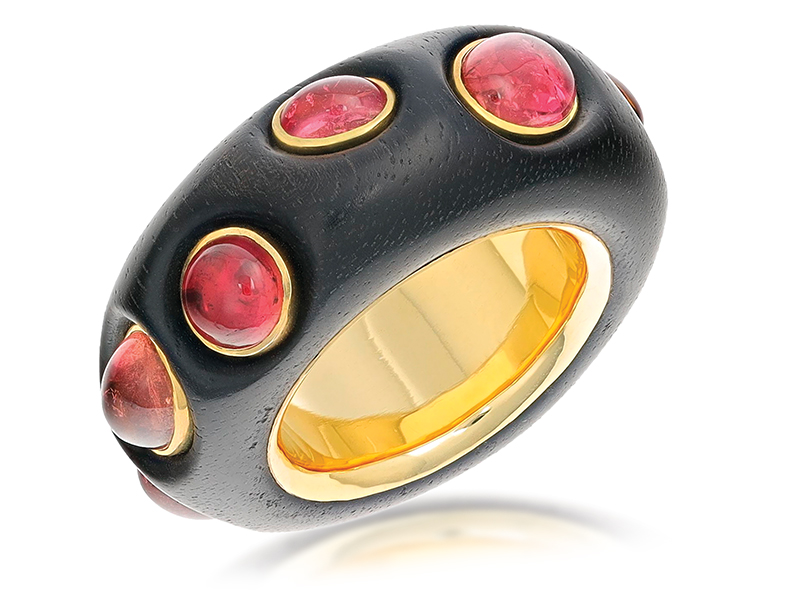
Redus hand-carved an ebony ring in a free-flowing design for the theme “Connections.” Rubellite tourmalines set in yellow gold bezels emerge across its surface. The darkness of the wood is contrasted by an 18k yellow gold inner band that strengthens and brightens the design.
“I approached the theme more from the physical sense of the word ‘connection,’ or the points of contact between two objects,” he explains. “I was thinking in terms of the difference between how a hard and soft material interact with each other. In this case, the tourmaline is the hard material and the wood is the soft, and I’m showing what it would look like if the tourmaline were emerging from the wood body or the reverse—sinking down into it.”
As this was the first time Redus used wood in his designs, there was a learning curve working with the material and pairing it with the more traditional gold and gemstones. “I’ve hand-carved other rings in solid stone with a gold band on the inside, but I needed a lighter material for this ring due to its size, so I chose the ebony for tactical reasons,” he says. “I was surprised at how hard the ebony was. I went through a few of my piercing saw blades to carve it from the initial wood blank and cut out the finger hole, then [used] large burs, files, and sandpaper for countering and cutting recesses. It was definitely quicker than working with stone, but I didn’t fly through it like I initially expected to.”
Once he carved the body of the ring from solid ebony, Redus had to construct the gold bezels before carving the recesses for them. He soldered a silver post to each of the nine 18k bezels and drilled a corresponding hole through the ebony ring, so the bezels could be set into the body of the ring with the post. The bezels were countersunk 3 to 4 mm into the surface of the ring. The posts were riveted to the wood on the inside of the band before the gold sleeve, which is held in place by tension, was inserted. The final step was setting the rubellite tourmalines into the bezels and polishing the ring.
“I got the wood to as high a finish as I could and used a few rounds of tung oil to stabilize the surface and give it a nice luster,” says Redus.
While he had originally planned to use multicolored tourmalines, Redus changed his mind when he started to craft the ring, as he felt using a single color added a continuity and flow that better kept with the competition’s theme of Connection.
“Not until I completed the ring did I realize all the different ways it really represents ‘connection’ for me,” Redus adds. “It really is kind of indicative of my personal connection with nature. Being that it incorporates the three natural materials of wood, stone, and metal—and it literally looks like those materials are all growing together in the piece—it is the closest I’ve come in my work so far to exhibiting that connectivity.”