

Darci Shea Bogdan’s Award-Winning Enamel Necklace
Wild Thing
Darci Shea Bogdan’s cloisonné enamel necklace highlights the connection between humans and a fragile environment
By Tina Snyder
(Originally Published by MJSA September 2023)

Darci Shea Bogdan
Darci Shea Studios | Santa Cruz, California
As a child, designer Darci Shea Bogdan lived on a sailboat with her parents, traveling up and down Central and South America. Her nomadic upbringing instilled in her an appreciation for wildlife and the environment that is present in her cloisonné enamel work today. In her Endangered necklace—one of the winners of the 2023 Jose Hess Design Award with the theme “Connections”—she showcases the eyes of nine endangered species on the front of nine separate gold and silver panels, with depictions of their habitats on the backs. The components are held together by lab-created sapphire bead strands that close with a box clasp featuring a human eye.
“My concept for the piece was to portray the connection we as humans have with our environment and its fragility,” she explains. “I chose to showcase this with the panels being connected to each other via hinges. Each of the enamel panels are then connected with their correlating environments. Lastly, the delicate connection of the strung sapphire beads bears the weight of the endangered species to the human eye clasp, which keeps the whole piece together.”
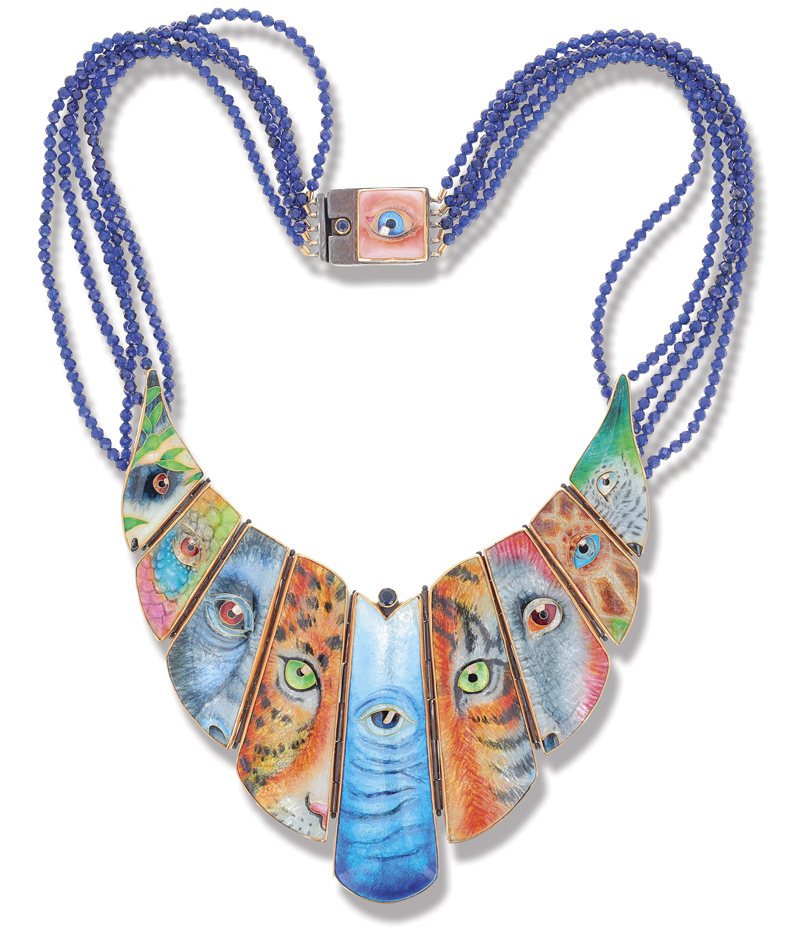
Endangered is a classic cloisonné enamel necklace made from glass enamel, 24k gold, 22k gold, 18k gold, sterling silver, fine silver, and sapphires. Bogdan began construction by melting down fine silver, rolling it into a 26 gauge sheet, and sawing out each panel. She domed the panels with a wood dapping block, flash fired them using a torch and a hobby kiln, and sifted glass enamel flux onto the surface. She fired each panel in her Paragon kiln to ensure the glass fused and coated the surface of the silver. Next, she coated the back with a blue counter enamel to stabilize the silver, essentially making a cabochon-like surface to build on called a blank.
To create the eyes of each endangered animal, Bogdan used her rolling mill to roll out 26 gauge, 24k gold wire into a thin ribbon. Using tweezers, she bent the gold ribbon into the shape of the eyes, placed them on the silver blanks, and fused them into the glass with the kiln. Once the gold wires were fused in place, she applied glass enamel and mason stains in a painterly layering process and kiln fused each layer.
“The layering process allows me to develop depth and texture, giving each panel a three-dimensional and life-like appearance,” she says.
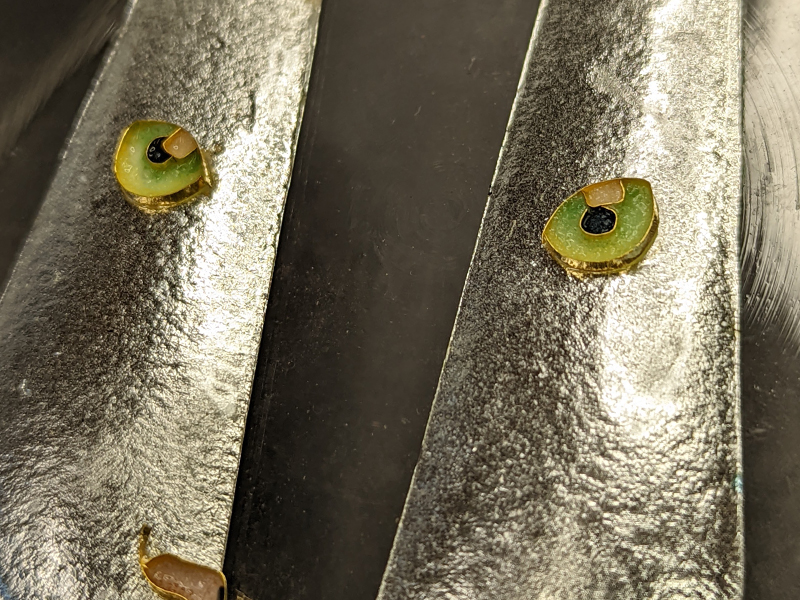
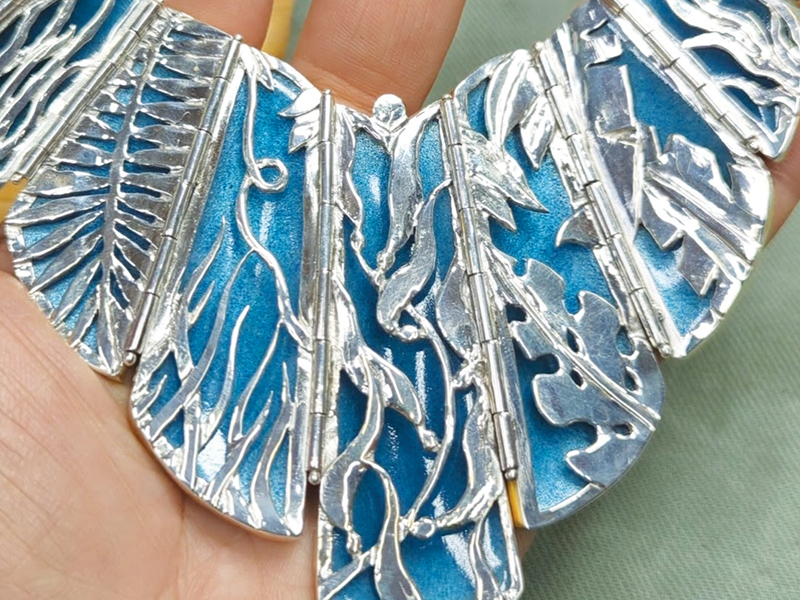
(Left) Shaped using gold wire, the eyes feature layers of glass enamel and mason stains to create depth and texture. (Right) The silver on the back of each setting is pierced out, depicting the habitat of each animal.
Once the enameling process was completed, she ground the surface with diamond grinding tools and polished it much like you would a gemstone. The finished panels were then set into 22k gold and sterling silver bezel settings, each attached to each other with hinges. On the back of each of the settings, she pierced out the habitats of each animal, allowing the blue counter enamel to show through.
The box clasp consists of two connecting parts: the receiving box and the locking pin that clicks into place, both made from 20 gauge sterling silver. Bogdan bent the box into shape, soldered it to a base sheet of silver, and then folded and filed the receiving pin until it fit perfectly into the box. She then soldered a lid to the top of the receiving box and sawed out a hole for the release button. She finished the clasp by soldering 22k gold bezels for the cloisonné human eye and the sapphire gemstone release button.
“Overall, I am incredibly proud of what I was able to accomplish in this design,” she says. “I am so grateful for the opportunity to participate in the Jose Hess Awards, but also in the pushing of my own boundaries.”