

Chris Ploof’s Yanone-Style Pendants
Bringing History to Life
Finding inspiration with Chris Ploof
By Deborah A. Yonick
(Originally Published by MJSA September 2023)

Chris Ploof
Chris Ploof Designs | Leominster, Massachusetts
The inspiration for Chris Ploof’s latest pendant collection has roots in childhood trips to an arms and armor museum near his home in a small town in Massachusetts; there the acclaimed master goldsmith was first exposed to yanone, a Japanese arrowhead dating back to the time of the samurai.
“The museum had several examples of yanones that were beautifully crafted, with as much art in these small items as there was in the samurai swords and armor on display,” he says.
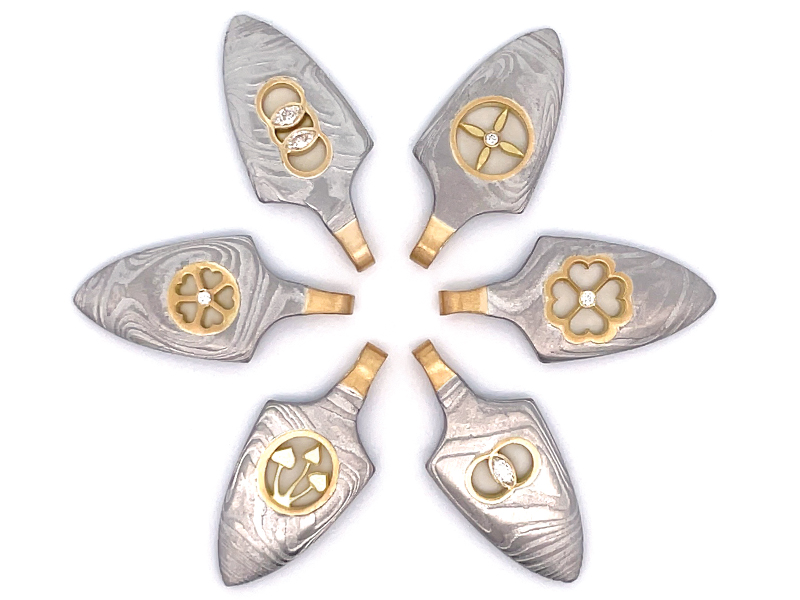
The arrowheads were typically fitted with relatively plain heads of varying shapes based on their intended use in battle, hunting, or sport. But master craftsmen also produced larger arrowheads with exquisite detail that were admired for their beauty and metalwork artistry and used as gifts, presentation pieces, and offerings at shrines.
Modern-Day Arrowheads
To create his yanone pendant collection, Ploof turned to photographs of historical yanones, the parts of which he sketched in Shapr3D.
“While they did not contain 18k gold, they did have the same strong visual imagery that I sought to imitate and combine with our Damascus stainless steel,” he says.
The resulting pendants are crafted in Damascus stainless steel, 18k recycled gold, and diamonds. Among the motifs recessed in his pendants are crosses and flower buds, diamond-centered clovers of hearts, and intersecting circles, some set with marquise-shaped diamonds.
“The main body of the yanone is our house-forged Damascus 304 and 316 steel,” says Ploof. “We forge it to a bar of proper thickness, and use our water jet to cut it out. Then, we hand grind each piece to its final shape, assemble it by soldering, and etch it to reveal the Damascus pattern.”
Ploof and his design company is a leading supplier of Damascus steel raw material and finished products. Technically demanding and time intensive, the technique that creates the iconic wavy light and dark surface pattern for which Damascus steel is known is achieved by hammer welding strips of two grades of stainless steel and repeatedly heating, twisting, carving, and forging them. The company’s 304 and 316 grades of stainless steel, which cannot rust, are so stable as to be considered surgical grade.
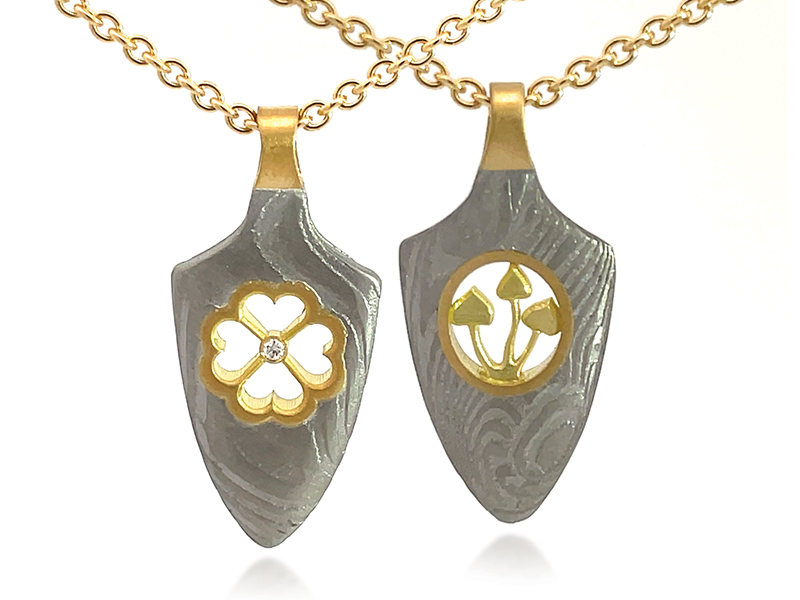
“I love using Damascus steel for this collection as a nod to the originals that were crafted out of folded steel,” says Ploof. “The technique is different, yet both feature many layers of material.” He also likes the way they look in the steel alloy, especially with accents of gold. To help bring the arrowheads to life, Ploof uses an outside casting contractor for the gold inserts in the designs. “They are grown each time and then cast,” he explains. “The bails are hand fabricated from gold sheet.”
While Ploof has dabbled before with basic yanone-style pendants in larger sizes, for this collection he wanted something more talisman-like. “These small, hand forged and crafted talisman are perfect for anyone who emulates the spirit of the samurai and wants to wear a personal treasure around their neck.”