

A Guide to Workshop Gases
Fuel the Fire
An in-depth look at the six types of torch gases for your bench
By Sharon Elaine Thompson
(Originally Published by MJSA September 2023)
Quick Links: Natural Gas • Propane • Acetylene • Butane • MAPP Gas • Hydrogen • Safety
A torch is a fundamental jewelry-making tool. But a torch is nothing without a fuel gas to burn. There are six different torch gases used by makers—natural gas, propane, acetylene, hydrogen, MAPP gas, and butane. Which is best for your needs? To help you decide, we checked in with experienced jewelers who share the basics behind each type of gas and what you need to know about using them.
Natural Gas
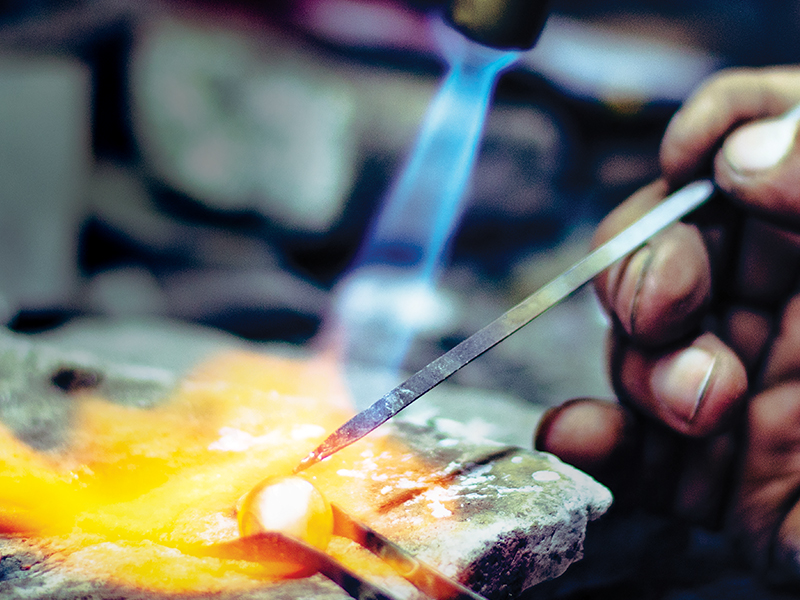
Natural gas is one of the most commonly used torch gases because it is clean and widely available. It is often supplied through city lines where natural gas is available. It is usually combined with oxygen from a pressurized tank or a concentrator.
Cost: $$-$$$
If your location does not have natural gas already plumbed in, it must be professionally installed, adding to the initial cost.
Burn Temperature: 1960°C (3565°F) when combined with air; 2770°C (5120°F) when combined with oxygen.
Pressure and Flow Control: Requires the use of a regulator to control the flow of gas to your line. “Too much pressure in either the oxygen or natural gas, it’s going to make [your torch] difficult to light, too little, it can start to flashback into the torch,” says Joe Silvera, founder of the Silvera Jewelry School in Berkeley, California.
The natural gas in the city’s lines does not usually flow at a high enough pressure to drive your torch, so you’ll also need to install a booster to raise the flow to the correct psi necessary for your torch, says Silvera. You should also have flashback arrestors in place to prevent sparks from being sent back up the gas line. Flashback arrestors should be installed as near the torch as possible.
Torches: Suitable for use with any jewelry-making torch.
Safety: Use a flashback arrestor to prevent a spark traveling back up the gas line to the tank or the city supply and causing an explosion. Check hoses and fittings regularly.
Type of Work: Suitable for use with many metals, including silver, gold, and platinum, natural gas/oxygen can be used for all kinds of jewelry work: fine soldering, melting, annealing, casting. “It gets hot enough for the bench work, for soldering,” says Michael Kosinski, founder of Metal Arts Academy in Auburn, California, who uses natural gas at his students’ benches. “You can use it to solder platinum as long as you have the right oxygen mixture. It works great.”
Pros: Readily available, reasonably priced, clean, and it can be used with any professional level jewelry torch.
Cons: Must be plumbed professionally.
What Jewelers Say: “Natural gas is wonderful to work with,” says Silvera. “It’s one of the few where, with the torch that you’re using, you can get a true annealing flame, a really nice reducing flame.”
Natural gas is “probably the safest of all the gases,” says author and educator Nanz Aalund. “As far as any off-gassing when you’re actually using it, there’s nothing that’s coming off of it that’s dangerous.”
Natural gas is a “cooler flame,” says Charles Lewton-Brain, a jeweler, author, and educator in Alberta, Calgary, Canada. “This means that it’s slightly larger, which means that it’s very effective for silver and the materials that might become oxidized or dirty quickly. It heats masses rapidly, whereas if you’re using gold, and you’re only making rings, it’s a bit slow. You could use a different system that’s way hotter and you could probably double your speed of operations.”
“Anything [like natural gas] that gives you a big flame will allow you to do larger objects and other metals [bronze, copper, silver] more easily,” says Lewton-Brain. “Whereas if you’re only using a tiny little micro torch, which is standard for most jewelers because of the size they’re working in, this can be problematic for larger objects. Ninety percent of jewelers will not have to worry about larger objects.”
Propane
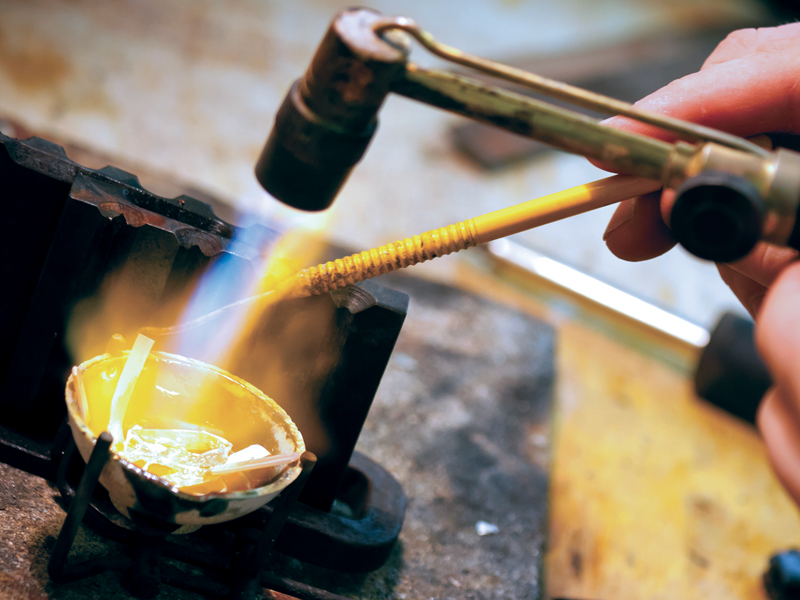
Propane is highly favored for jewelry making as it is clean, widely available, and comes in a variety of container sizes, from small, 1-pound, disposable camp-sized tanks and refillable tanks used for barbecues and RVs to refillable exterior tanks large enough to supply household needs. It is commonly used with oxygen or compressed air.
Cost: $$-$$$
Burn Temperature: 1925°C–1980°C (3497°F–3590°F) when combined with air; 2526°C–2900°C (4087°F–5252°F) when combined with oxygen.
Pressure and Flow Control: Requires a regulator, possibly a pressure booster if you are working with a home propane system, and a flashback arrestor.
Torches: Suitable for use with professional jewelry torches. Small canisters can be fitted with a simple torch that is threaded onto the canister.
Safety: Store canisters away from sunlight, direct heat, and temperatures that exceed 122°F; do not store them in cars. Extreme heat may cause an explosion. Store them indoors and standing upright.
Exhaust as much gas from the cylinder as you can before taking to a hazardous waste disposal site.
Inspect the tank and any hoses for leaks before use and before storing. Propane is heavy and can flow to the lowest point in the shop, creating a fire hazard. Do not store canisters near a gas appliance as a pilot light can ignite leaking gas.
Type of Work: A propane/oxygen mix is suitable for all types of jewelry work including fine soldering, melting, and casting. It can be used with all precious metals.
Pros: Widely available. Clean, reasonably priced, and suitable for use with almost any jewelry-making torch. Comes in a wide variety of container sizes. Burns a bit hotter than natural gas. Good for residential spaces when used in small canisters. Less expensive than acetylene and safer to transport.
Cons: May pool in low areas and create a fire risk. Small canisters must be disposed of as hazardous waste. Cannot be used with Number 2 Smith Little Torch tip as the pressure it is under is too low, says Silvera.
What Jewelers Say: Soldering kits for disposable canisters have a regulator, but it only opens and closes the valve on the bottle. To determine how much is remaining in the canister, Silvera suggests weighing the canister with the regulator on it when it is full. Weigh it again when it is empty. In the future, taking weights at intervals will tell you how close you are getting to empty.
Acetylene
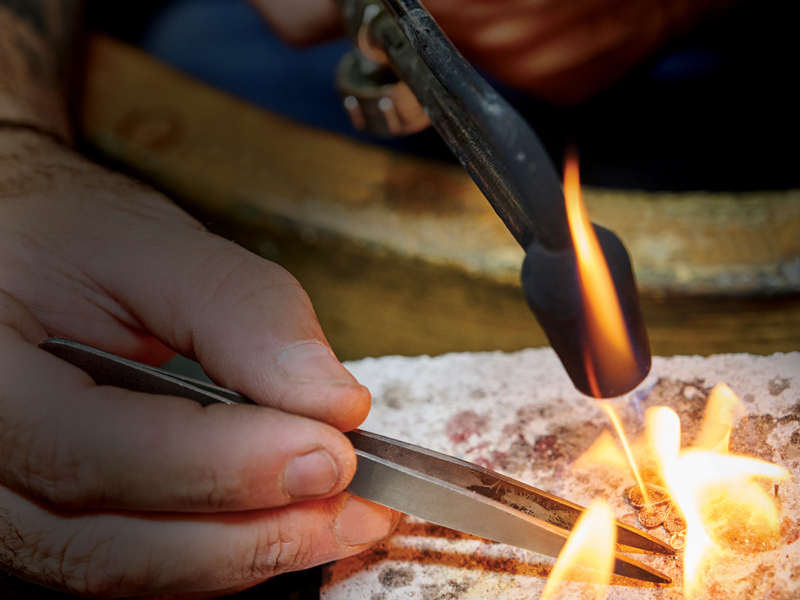
Acetylene produces a hot flame most commonly used for welding. It can be used for jewelry work, but it is not loved by many because it produces soot when it burns alone, which can contaminate metal. Combining it with oxygen helps it burn more cleanly. It is supplied in tanks from welding supply companies, which makes it less readily available than natural gas or propane. It is also more volatile than other gases and must be treated with care when storing and transporting it. It should be used with a ventilation system that draws fumes away from your face and vents them outside.
Cost: $$$$
Burn Temperature: Acetylene burns at between 2120°C–2500°C (3848°F–5720°F) when combined with air; 3100°C– 3480°C (5850°F–6020°F) when combined with oxygen.
Pressure and Flow: Acetylene is under high pressure and must be used with a regulator and flashback arrestor.
Torches: Acetylene can be used with most jewelry torches. Atmospheric/acetylene torches such as a SilverSmith or PrestoLite, which draw in oxygen from the surrounding environment, “do not offer the easy adjustment to a wide range of flames provided by professional grade torches, such as the Hoke, Smith Little Torch, or the Meco Midget,” says Aalund.
Safety: When transporting acetylene, transport tanks upright and always be sure the steel cap is securely in place, says Gary Dawson, a custom jeweler and designer in Bisbee, Arizona. If a tank falls over and the steel cap is not in place, or the valve at the top is broken off, the bottle of acetylene “turns into a rocket,” says Dawson. “It will go through concrete buildings.”
“When you hook up your lines to the regulator, you need to check all the connections into the bottle and all connections all the way out to the end of the line for leaks,” he adds. Be diligent about three things, says Dawson: never transport the bottle of gas without the steel cap on; always check for leaks when you set it up, and secure it in an upright position.
When using acetylene and compressed air with a jeweler’s torch, such as a Smith Little Torch, you are “basically creating a teeny tiny welding and steel cutting flame that gives off radiation,” warns Aalund. “That can affect your cones in the back of your eyes. The radiation will burn them.” She notes that if you are going to do this, you should wear welding safety glasses to protect your eyes from this radiation.
Type of Work: An atmospheric/acetylene torch is “very effective on copper, brass, and silver,” says Aalund. But it is “a little too sooty for casting. The soot can also embrittle certain gold alloys, such as 18k palladium white gold.”
Pros: Produces a hot steady flame.
Cons: Dirty gas that produces a lot of soot. Not readily available, expensive, and volatile. Not for use with platinum, as the soot it produces will contaminate the metal. Use extreme care when transporting and when storing.
What Jewelers Say: Acetylene gets “a lot hotter, a lot quicker,” says Kosinski.
Although it can be dirty, Dawson, who uses oxy/acetylene at his bench, says, “It has to do with how you light your torch and how you balance fuel with oxygen. That really makes a huge difference as to whether or how dirty acetylene is.”
To “minimize or even eliminate the amount of carbon that flies off the burn of pure acetylene,” Dawson advises, “introduce a little oxygen prior to lighting the flame.”
If you pour your own ingots, you can use the production of carbon to your advantage, says Dawson, who rolls and mills his own wire and sheet stock. “You can use the carbon that comes off the flame to cold coat ingot molds.”
Aalund cautions that you should not use the same hoses and regulator for your acetylene as you do for propane, as the acetylene leaves a residue in the lines and regulator that will react with propane.
Butane
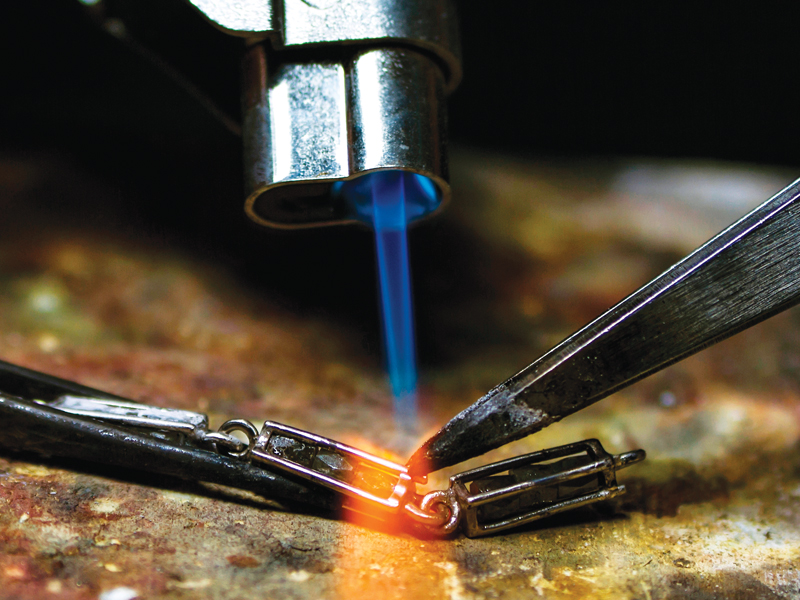
Butane is often the entry level gas used by hobbyists. Because it is familiar from its use in cooking (the so-called crème brulee torches), it is less intimidating to beginners than other gases that come in large tanks and require jeweler’s torches to burn. This affordable gas comes in small canisters and is easy to use. It requires no special permits to use it at home. Canisters may be disposable or refillable.
Cost: $-$$
Burn Temperature: Butane has a fairly low burning temperature: 1430°C–1970°C (2500°F–2610°F). The gas burns in combination with air.
Pressure and Flow: Butane requires no regulator; the flow adjustment is built into the torch.
Type of Work: Butane is ideal for small work such as soldering jump rings or sizing thin ring shanks, and is usually used with silver or non-precious metals. The flame is not hot enough to be used with platinum or for any large melting tasks, such as casting. It will not heat a large enough area for reticulation.
Torches: Requires torches made specifically for butane. Air is drawn into torch at ignition; often the flow of gas and air can be adjusted minimally.
Safety: Store canisters away from sunlight, direct heat, and temperatures that exceed 122°F; do not store them in cars. Extreme heat may cause an explosion. Store them indoors and standing upright. Inspect for leaks before use and before storing. Exhaust as much butane gas from the cylinder as you can before taking to a hazardous waste disposal site. Do not throw them into the garbage with your other trash.
Pros: Widely available and unintimidating. Torches are often self-igniting; flame size and amount of air can be easily adjusted. Clean burning; excellent for occasional use in an in-home studio. Inexpensive. Does not collect and pool like propane, natural gas, and others.
Cons: Tanks last only for a short time (about one to two hours of continuous use). Can become expensive if it’s your only source of fuel.
What Jewelers Say: “You can’t get the small, precise flame that you can with a mixture of oxygen and propane or natural gas,” says Kosinski.
Small butane torches, like a crème bruleé torch, are limited as to the size of work you can use them for. “Thick, big rings over one inch in size, or a pendant or something with too much material, the butane just can’t heat it up,” says Silvera.
For jewelry work, the butane should be as pure as possible. Look for things such as “99.9 percent pure, ultra-refined, super refined.” Cheaper brands of butane are “greasy” says Silvera, and will foul the self-igniting system on the butane torch. The torch will still work; you’ll just have to light it with a sparker.
MAPP Gas
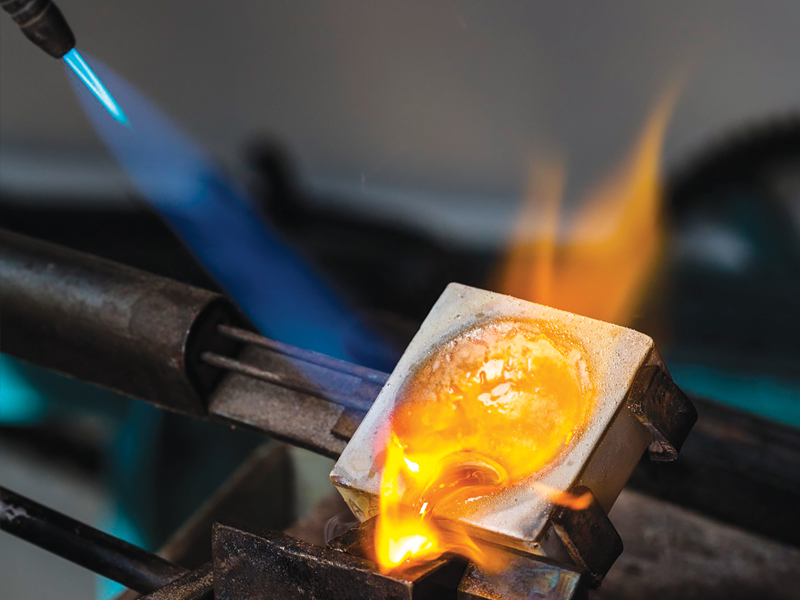
The original MAPP gas was a combination of methylacetylene-propadiene. (It has now been discontinued.) However, there are several makers of MAPP gas with different formulations and burn temperatures. MAPP gas is widely available in hardware stores as it’s often used when soldering plumbing. It comes in small, disposable canisters. You can use them in a residential setting without permits. It is an excellent choice if you only need it occasionally.
Although the temperature at which MAPP gas burns approaches that of acetylene, it is clean, widely available, and much less expensive than acetylene. MAPP gas torches pull in air from the environment.
The flame size is adjusted by adding or subtracting the amount of gas flowing from the torch. Lewton-Brain uses MAPP gas for fold forming.
Cost: $$ Although the gas is inexpensive, if you use it as your sole gas for a lot of jewelry work, it could become expensive over time.
Burn Temperature: 2010°C–2050°C (3730°F–3670°F) when combined with air; 2925°C–2980°C (5200°F–5300°F) when combined with oxygen.
Torches: There are specific torches made to be threaded onto small canisters of fuel. MAPP gas-type torches generally produce a flame that is too hot and too broad for fine jewelry work.
Safety: Store canisters away from sunlight, direct heat, and temperatures that exceed 122°F; do not store them in cars. Extreme heat may cause an explosion. Store them indoors and standing upright with the protection cap in place and secure. Inspect for leaks before use and before storing. Exhaust as much gas from the cylinder as you can before taking to a hazardous waste disposal site.
Pros: Inexpensive, widely available, doesn’t need oxygen or compressed air, very hot, clean.
Cons: Canisters are not recyclable and must be disposed of as hazardous waste.
What Jewelers Say: “One advantage of MAPP gas,” says Lewton-Brain, “is it is so hot that a canister lasts forever because you can work so fast. The task is over very quickly.”
“If somebody wants to have a small casting setup and doesn’t want an expensive torch system, as long as you limit the amount that you have to heat, then the MAPP gas torches work great for that,” says Silvera.
Hydrogen
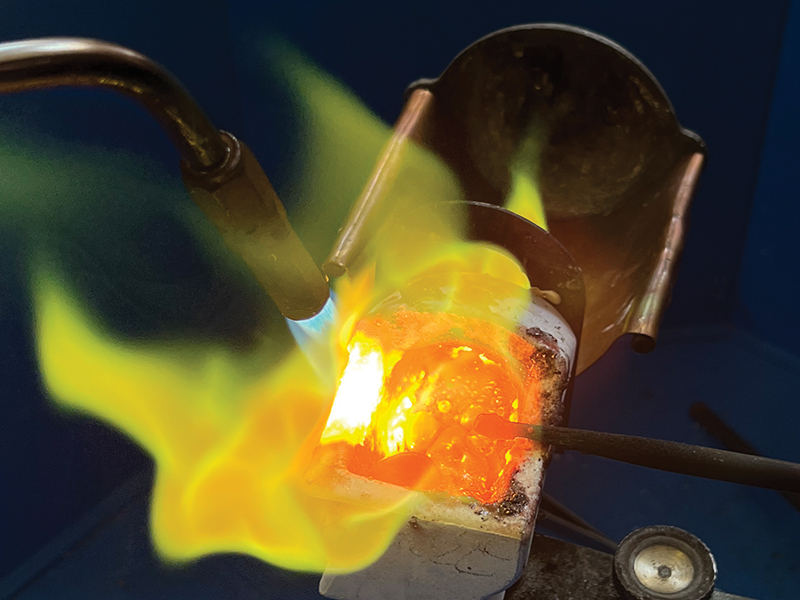
Hydrogen is favored by jewelers who specialize in platinum because it is very clean and achieves the high temperatures necessary to weld or melt platinum. It comes in tanks from specialty suppliers and is not widely available.
Cost: $$$$
Burn Temperature: 2210°C (4850°F) when mixed in air; 3200°C (5070°F) with oxygen.
Pressure and Flow: If you are not using a concentrator, the tank requires a special regulator to control the flow of gas and the size of the flame. On a hydrogen regulator, says Dawson, the overflow valve on the back of it must be vented outside. Use a flashback arrestor.
Torches: Hydrogen can be used with some torches, however, “You have to use a special torch tip for hydrogen,” says Dawson. “I use the rosebud torch tip, a Victor number one.”
Type of Work: Because of the expense and the difficulty of finding it, hydrogen is not the first choice for most jewelry work. But if you specialize in platinum, hydrogen is an excellent choice.
Safety: The tanks are pressurized, and like acetylene, they should be stored upright and secured to a wall.
One thing to be aware of when working with hydrogen is that, before you add oxygen to the flame, the gas burns so cleanly it is invisible.
“If you open a hydrogen tank without a regulator on it, just the friction of the gas passing through the valve can heat it up enough to ignite the gas,” says Dawson. “You might not see that happening because of the purity of the gas, and that can create a huge problem.”
Pros: Extremely clean, very hot, and perfect for platinum.
Cons: Very expensive, volatile, and can be hard to find.
What Jewelers Say: “I love using hydrogen,” says Kosinski. “It burns super clean, super hot, and gets the job done quickly. If you’re doing a lot of platinum work, I highly recommend that you use it, if it fits into your budget.”
Another advantage of using a hydrogen torch, says Lewton-Brain, is that, if used on silver and used with the correct mixture of hydrogen and oxygen, you don’t get firescale.
Safety First
• With the exception of natural gas that’s delivered by the city, all gases come in pressurized tanks, bottles, or canisters. These large tanks or canisters should be stored upright and secured in position. Chain them to a wall or sturdy bench to prevent them from falling.
• Understand how your gas/torch system works and how to set it up safely. If gas must be plumbed into your workspace, have the work done by licensed professionals. If the gas comes in refillable tanks, know how to refill them safely. If they come in disposable tanks, know where and how to dispose of them.
• Whatever fuel gas you use in your studio, consider getting an explosive gas detector, which can detect when there is too much fuel gas in the air so that you can shut everything off and ventilate. You can find them at hardware stores or online.
• You’ll need a regulator for natural gas, propane, hydrogen, and oxygen to control the flow of gas to your line. Given the important role it serves, invest in a good quality regulator.