

Increased Demand for Recycled Gold Has Led to a Growing Crisis
Looking Beyond Reusing
With demand for 100 percent recycled gold growing, suppliers are struggling to keep up
By Rafael Amador
(Originally Published by MJSA July 2023)
The jewelry industry is facing a metals crisis that many jewelers may not even realize exists. As consumer interest in responsibly sourced products has risen, many jewelers have responded by creating and promoting collections made with 100 percent recycled gold. But this growing demand for recycled gold has led to problems for metal suppliers, who are struggling to provide enough of the metal to satisfy their customers. To understand this growing problem, we first need to look at how the jewelry industry defines recycled gold.
What is Recycled Gold?
If you walk the floor at any jewelry trade show and ask dozens of jewelers what “recycled gold” is, you’ll likely get dozens of different answers because there is no universal definition within the industry. So, what technically is recycled gold?
All gold comes from the earth. When gold is mined, it usually comes out in a rough nugget form, or it can be panned from dredges or rivers in a sand or raw grain form. Because it has been mined from the earth and is still in its original form, this metal is not considered recycled. While some people believe that once mined gold is smelted and is changed into an ingot or nugget that it has been recycled, that it not the case. Simply changing the form of gold does not make it used or recycled.
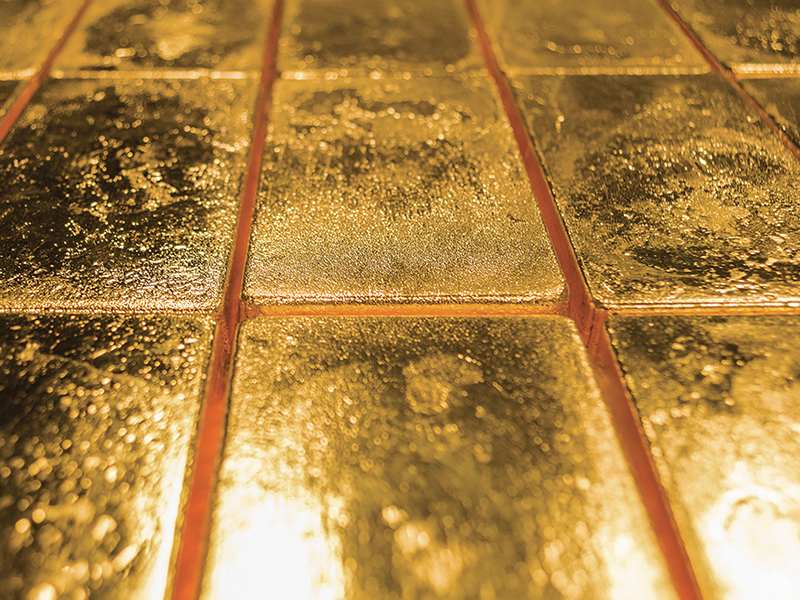
The ingots and nuggets that were formed from mined gold are processed and refined, taking it to 24k or 0.9995+ pure gold, which is then sold to banks and refiners around the world who use it for various purposes, such as investments and jewelry manufacturing. This initial refining process simply removes the impurities that were contained in the mined material and separate the gold from the other raw materials that were included in the mined gold. Many of these raw minerals can be harmful and are easily detectable during analysis, allowing refiners to identify when gold comes from mines versus actual recycled scrap and jewelry manufacturing byproducts. However, some agencies believe that this refined gold is considered recycled because it has been taken from its raw form to its purest form.
For example, under current SCS Global Services guidelines, refining gold to its purest form makes it recycled material. On the other hand, the Responsible Jewellery Council is in the process of re-evaluating its definition of recycled gold, which currently excludes investment bars.
“Some certifying agencies do in fact include investment bars in their definition of 100 percent recycled gold while others have eliminated investment bars altogether,” says David Siminski, international sales and refining at United PMR in Alden, New York. “The inconsistencies have led to much of the confusion in the industry among manufacturers, metals suppliers, and refiners alike.”
Once gold has been used in the creation of jewelry, some would say it has fulfilled its purpose. The form of the gold has gone from mined gold to refined gold to casting grain or fine gold grain mixed with alloy to a jewelry product (cast or fabricated). At this point, the form of the gold has truly been changed, but…it is still not yet 100 percent recycled gold.
So, when does mined gold actually become recycled?
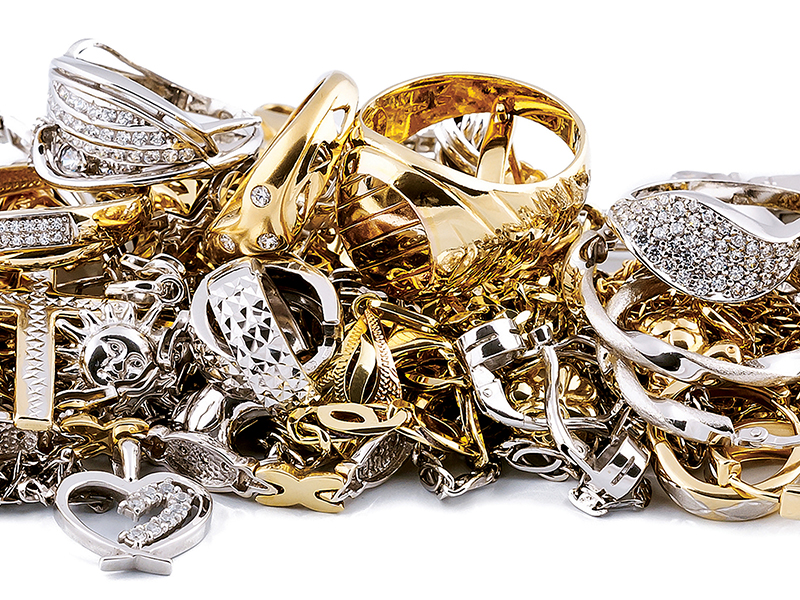
Jewelry manufacturers, repair shops, wholesalers, and pawnshops all play a pivotal role in the creation of recycled gold. That’s because once jewelry has been made, we now have the possibility of obtaining actual recycled gold.
In fact, the jewelry scrap from old jewelry sold to pawnshops is a perfect example of 100 percent recycled gold. Because that gold is coming in as scrap jewelry, when refined, the fine gold that is recovered can be considered 100 percent recycled gold. The same goes for bench sweeps, polishing dust, cuttings, or clippings from the bench and all jewelry repair or manufacturing byproducts. These materials were used in the creation of jewelry and when processed and refined, the gold recovered can be considered 100 percent recycled.
“To add to the confusion, changes to the standard are evolving even as you read this article,” says Siminski. Certifying parties as well as the Federal Trade Commission are getting involved with formulating a more definitive definition of not only what recycled gold is, but also what the terminology should be. Some argue that the term “recycled” is not accurate because the gold was never actually thrown away. Accordingly, other terms are being discussed such as “reimagined” and “redefined.” So, with all this happening, it is easy to see why confusion exists among industry professionals.
How is Recycled Gold Verified?
Refiners take in tens of thousands of ounces a day so how can they be sure that the gold they process (and then sell to you) is in fact 100 percent recycled?
Analytics play a key role. At precious metal laboratories, scientific processes and state-of-the-art equipment is used to analyze metals for a variety of purposes. One such process is testing with X-ray fluorescence (XRF). When processing metals, an XRF spectrometer is used to take an X-ray of a sample pulled from the molten core of a refining lot to identify what elements or precious metals are contained in it. A standard jewelry lot will contain the obvious precious metals—gold, silver, platinum, palladium—in addition to base metals and master alloys added for karating and color. In mining metal, you will see the presence of other non-jewelry related minerals, such as calcite, tellurium, and magnesium, as well as various levels of lead, zinc, or copper, which are used for jewelry making. Properly identifying these metals will allow the lab to determine if the sample is from a jewelry lot, a mined gold lot, or a mixture of both.
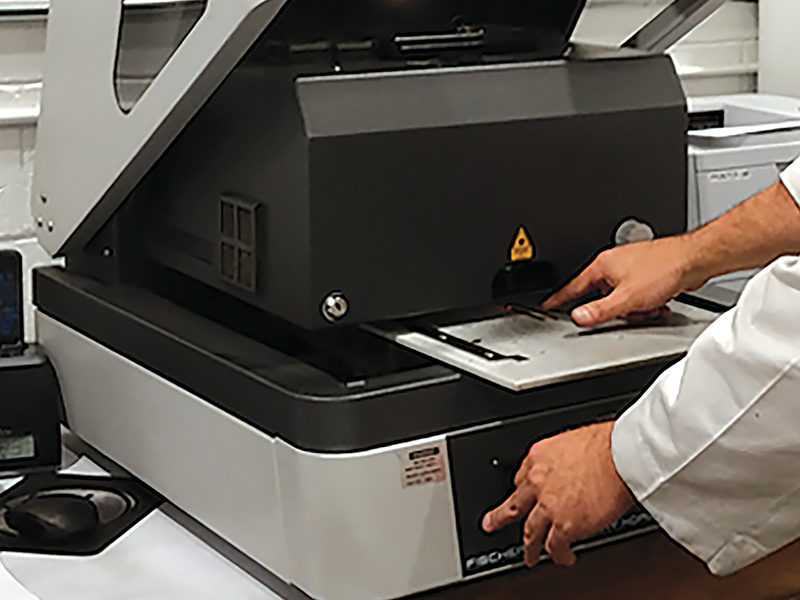
Analytics play a key role in helping refiners identify if metal came from a jewelry lot, a mined gold lot, or a mixture of both.
This type of routine analysis is required for refiners to achieve certification from a third-party organization such as SCS Global Services. In addition to testing lots and holding third-party certifications, some refiners have taken more drastic steps to guarantee that the gold they sell is 100 percent recycled. For example, United PMR has refused to take in and process any mined gold and focuses solely on refining metal used in jewelry manufacturing.
What Can Jewelers Do?
The global climate has shifted in recent years for businesses with an increase focus on preserving the environment. One such push has been aimed at minimizing mining operations that are harmful to the environment and that decimate landscapes in regions where mining is occurring. Gold mining has been around for thousands of years, and while safety measures are always being implemented, the effects of mining are without a doubt detrimental to the environment and the earth.
As more consumers have become concerned with the care and welfare of the earth, they’ve been asking jewelers for jewelry made from responsibly sourced materials. As a result, the jewelry industry has pivoted toward minimizing the use of mined gold whenever possible, leading to an increased interest in recycled gold. And therein lies the problem. As more industry giants join the “green gold” movement to ensure their collections are made using only 100 percent recycled gold, the availability of actual recycled gold will become increasingly scarce. There is only so much scrap gold that is being refined that can then be sold as 100 percent recycled gold. There’s simply become too much demand for not enough supply (unless the definition of recycled metal changes).
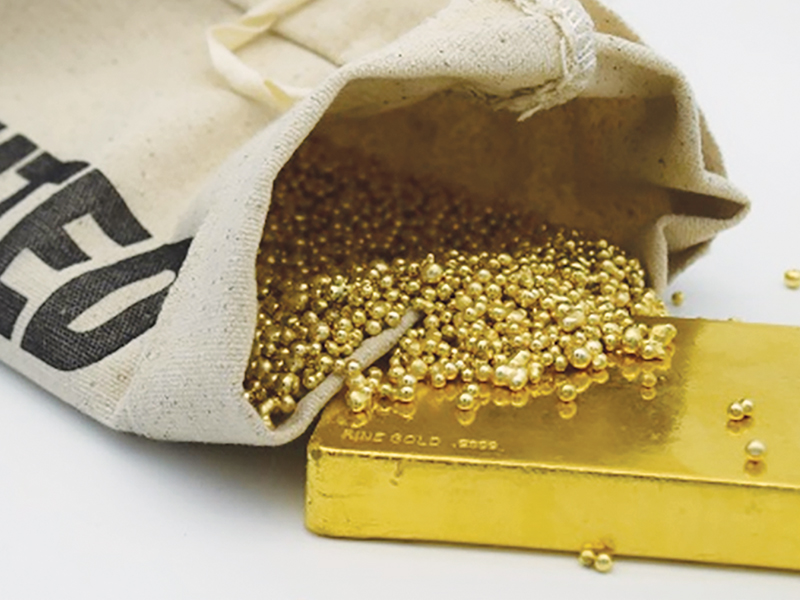
As more industry giants join the “green gold” movement and purchase only recycled gold, the availability of actual recycled gold will become increasingly scarce.
But that doesn’t mean that jewelers have no other options. First, scrapping more would generate more recycled metal. Jewelers could send in their scraps for refining more regularly. Many jewelers may not realize that they could be recovering metals from their sink traps, vacuum filters, carpets, and more. All this recycled metal would greatly benefit the cause of generating more 100 percent recycled gold.
In addition, small-scale and artisanal mining operations can begin to thrive as the need for the precious yellow metal has grown in all business sectors, not just jewelry. Organizations such as FAIRMINED have taken the lead on creating and implementing procedures for assurances that certify gold from empowered responsible artisanal and small-scale mining operations that meet the world leading standards for responsible practices. Their efforts are gaining traction and many in the industry are hopeful for the changes to which they can lead.