

Customization Fuels Migration to 3-D Printing & AI Tools
The Future Is In Progress
How new technologies allow skilled jewelers to focus more on creativity, artistry, and quality control
By Deborah A. Yonick
(Originally Published by MJSA July 2023)
Fine jewelry manufacturing is evolving in the 21st century at an exciting rate. Computers and machines are replacing much of the handwork involved in the creation of fine jewelry, freeing up the time of skilled jewelers to focus more of their attention on creativity, artistry, and quality control.
That’s how Christian Tse views tools and technologies such as direct metal 3-D printing, polishing robots, and semi-automation of some more mundane and time-consuming parts of the jewelry-making process.
A Game Changer
A third-generation jeweler, Tse is an award-winning jewelry designer and industry disruptor. After starting his own designer line in 1996, Tse reinvented himself as a manufacturer of fine jewelry for some of the world’s most recognizable brands.
In recent years, Tse has seen a steady migration to 3-D printing by almost all clients of Christian Tse Design & Manufacturing. That’s not surprising: Recent research reveals that Google searches for “3-D printed jewelry” are on the rise. In fact, the overall 3-D printing market is expected to grow by 24 percent over the next three years, reaching $44.5 billion by 2026, according to Hubs.com.
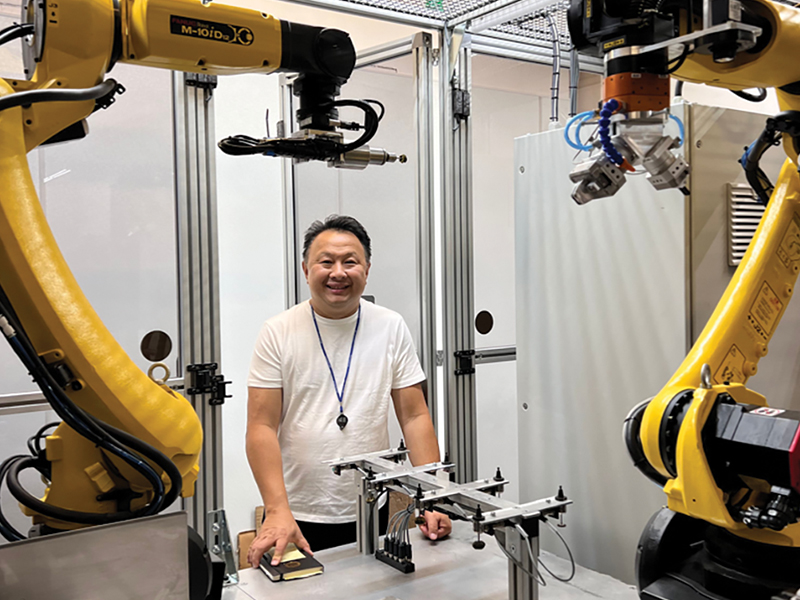
According to Christian Tse, 3-D printing and artificial intelligence give jewelers the time to focus more of their attention on creativity, artistry, and quality control.
3-D printing has helped jewelers tremendously, says Tse. It has given model makers and designers a way to more quickly and efficiently design and produce accurate, clean, consistent design for jewelry manufacturing.
“3-D printing enables brands to roll out new collections much more efficiently than in the past,” says Tse. “Customization is a significant revenue stream for the jewelers who have adopted 3-D printing. Designers are able to customize jewelry through CAD software. 3-D printers enable multiple variations of a design to be made simultaneously in one print bed. This brings new designs to market faster, allowing for more flexibility and customization by the client.”
Among the pioneers in 3-D printing technology, Tse’s Formula 3D company has developed precious metal print powders for 3-D printing on binder jetting systems. Similar to ink for an ink-jet printer, these print powders are ionized and maximized for use in 3-D printers to efficiently produce high-quality fine jewelry in volume.
“3-D printing of precious metals has the potential to grow the market-share for precious metals and luxury goods in general,” says Tse.
According to Tse, the technology radically shortens R&D by giving luxury brands the freedom to experiment with new product designs, prototypes, and markets.
“With 3-D printing, my team and I can accomplish in two hours the same tasks that would take two days by hand,” Tse says. “It enables jewelers to adopt an entirely digital and agile manufacturing workflow. We can have greater design flexibility and control, allowing designers and manufacturers to scale new designs previously impossible or difficult to achieve, like chain link bracelets or necklaces where the links can be 3-D printed in place as one piece.”
Automation Is Needed
As highly skilled labor is increasingly difficult to recruit and maintain, Tse finds that jewelers are increasingly looking to semi-automate their processes.
Tse has been exploring automation in fine jewelry manufacturing for years. Pandemic-related social distancing restrictions increased the urgency of his need for robotics, so he reached out to Flexible Robotic Environment (FRE), an engineering firm specializing in automated systems, for a polishing system that could be customizable by jewelry design. In collaboration with Tse, FRE developed the custom VDK-2300 robotic arms with the latest motion, vision, and control technology.
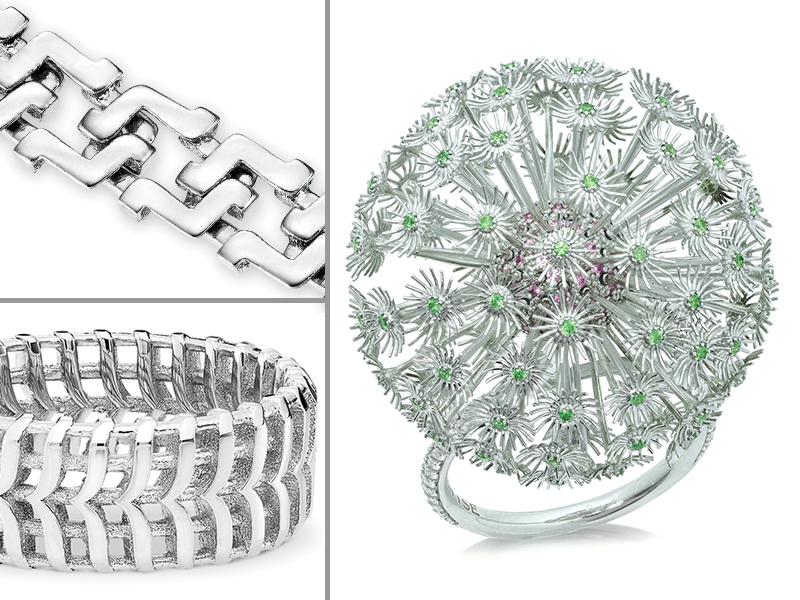
3-D metal printing radically shortens the R&D for product development and allows designers to create designs previously impossible to print, such as chain link bracelets.
“The tandem-robotic polishers allow optimal efficiency and cost-savings for the fine jewelry brands we manufacture,” Tse says. “They capitalize on the benefits of automation, enabling high productivity, efficiency, and accuracy while still delivering artisan-like results at lower production cost. For the designer brands, these bots actually save on production costs, and the precision ultimately creates a better-finished product for the end consumer.”
Artificial intelligence is also being deployed for quality control of castings. “Software can recognize casting porosity in 3-D printed pieces through camera feeds,” Tse explains, “allowing better and more efficient quality control.”
Despite the advantages these technologies offer, it will likely take time for them to make headway within the industry. The reticence some jewelers have about automation, reminds Tse of when CAD was first introduced.
“Many people fought it, while others embraced it,” he says. “But progress only moves one way. Eventually, the entire design industry converted to CAD. We’re now in that same early phase with automation. Soon, perhaps in another five years or so, automation will be widespread like CAD is now.”