

Tuggle Designs’ Alexandrite Wedding Set
Colorful Couple
Behind the design of a custom alexandrite wedding ring set
By Tina Snyder
(Originally Published by MJSA June 2023)
Denver-based jewelry designers Lauren and Matthew Tuggle of Tuggle Designs share a passion for making one-of-a-kind jewelry that puts a modern spin on traditional design. Inspired by patterns and architecture, the husband-and-wife design team were thrilled when they received a request for a custom alexandrite wedding set from a client who discovered them on Instagram.
“The only real direction the client provided for the rings was that he wanted natural alexandrite and loud ‘party colors,’ while hers should be more traditional,” says Lauren. “She showed us photos of rings she liked, but they pretty much gave us creative freedom.”
The first challenge was sourcing the gemstones. Unlike diamonds or sapphires, natural alexandrite availability is limited. “We worked with our sources across the country and ultimately found four marquises to show them,” says Lauren. “It took multiple meetings to find their perfect stones, but with limited options, we were glad they found ones they loved!”
Matthew sketched four designs for each ring. The client selected one of the four immediately for himself, but it took his fiancée a few rounds of revisions to get hers just right. “We presented options that she found difficult to choose between, and we spent more time picking the perfect color combo for her side stones.”
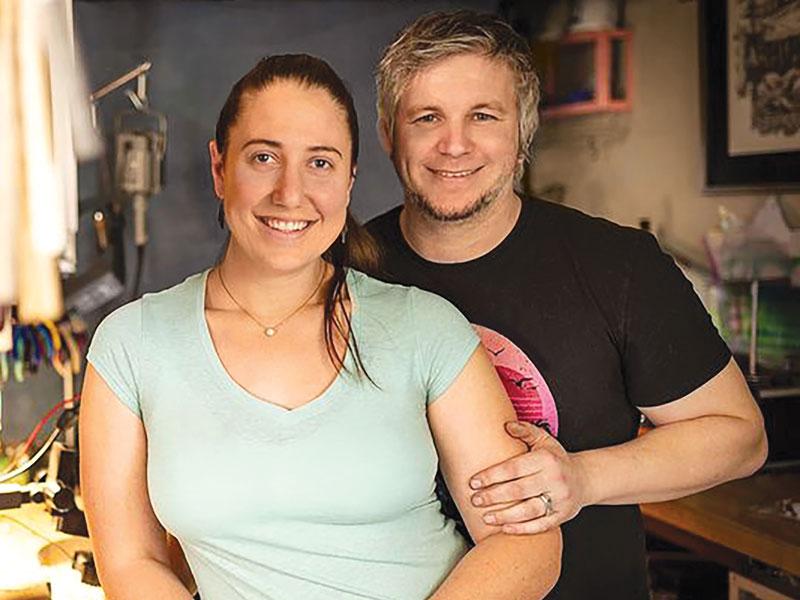
Lauren & Matthew Tuggle
Tuggle Designs, Denver, CO
With the stones selected, Matthew moved on to hand fabricating the two rings—a process he does with 18k yellow and white gold sheet and wire that was alloyed in-house. The woman’s ring proved more challenging to build, as the shape on the top is really unique.
“The top of the woman’s ring is really complex, and I was trying to ensure it wasn’t huge on the finger while still being able fit in all those nice details,” explains Matthew. “I began by making the 18k yellow gold top plate, scoring sheet and working with wire to build it. I added the center head for the [1.21 carat Brazilian] alexandrite marquise and the pear bezels, then cut the marquise diamond seats right into the gold sheet.”
Once he had the top formed with seats for the stones, he began fabricating the 18k white gold shank and adding it on as well as creating white gold rays beneath the top plate. “I like to do a lot with two-tone metals and am always considering how I can balance the colors of the ring when you look at it from different angles,” he says.
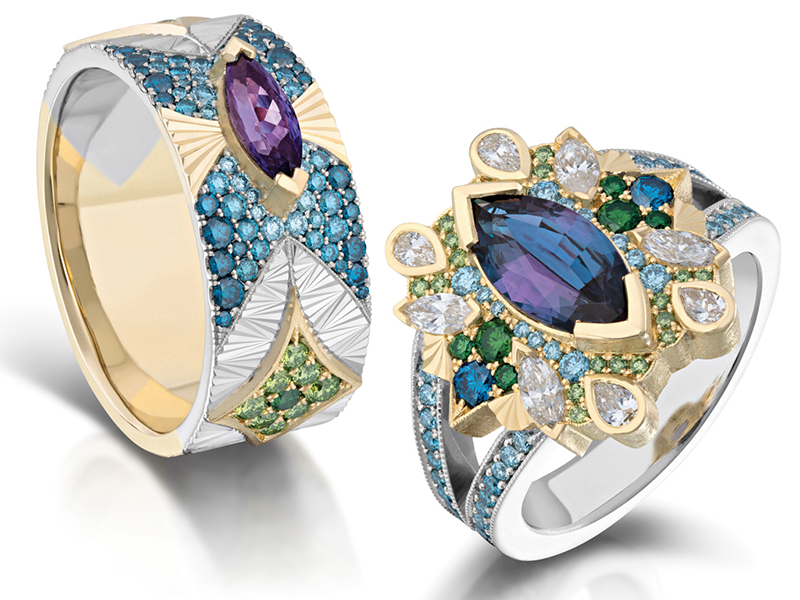
To make the band’s ombré effect appear seamless, the Tuggles had to ensure the diamonds were set tight together to prevent metal and gapping from appearing between the stones.
Much planning was involved in laying out the colored diamonds for the piece. Pavé setting in this compact design was a labor of love. “The goal is to get the stones as tight as possible, so you see the color block,” says Lauren. “If you get a stone that is 0.05 mm too big, you’re going to have an issue because the tolerances are so small.”
Planning gradients was one of the biggest challenges for the man’s band, which included keeping track of the dozens of ombré colored diamond brilliants, ranging in size from 0.7 to 2.5 mm. “This is probably the most difficult pavé job we’ve done to date in terms of tracking colors and sizes,” admits Lauren.
Lauren adds that the blue area around the alexandrite was one of the most difficult sections to plan out to get the fade effect. “All of these diamonds are super tight, so you don’t see a lot of metal and gapping between the stones, and the color fade has to be seamless.”
The Tuggles attribute their ultimate success to their attention to detail on the front end of projects like this. “As long as you have a solid design and you focus on the integrity of the piece, the stone setting in the end goes pretty smoothly,” says Matthew. “If you get the structure right in the beginning, your piece should be a success.”