

Reducing Your Business’s Environmental Footprint
Walking Softly
Advice on adopting sustainable practices in your business
By Sharon Elaine Thompson
(Originally Published by MJSA April 2023)
With daily news stories about forever chemicals, toxic chemical spills, and plastics in our water, food, and bloodstreams, it is impossible anymore to ignore the human impact on our global environment. Some of us have become inured to these stories to the point that they no longer move us. Many of us feel helpless to be able to change or affect the situation.
However, we are not helpless, and there are steps you can take in your business as well as at home to reduce your environmental footprint. While there may be upfront costs to some of these steps, in addition to helping to make your business more environmentally friendly, many can save you money in the long run. Some of these changes, depending on your state, may even earn you tax rebates.
And there is not a better time than now to start taking action. A growing number of customers are beginning to ask questions about the sustainability of not only the products they purchase, such as the sources of the gemstones and metals in their jewelry, but they also want to work with companies who are as concerned about the environment as they are. Adopting sustainable practices in your business can only enhance your reputation.
 Reduce, Reuse, Recycle
Reduce, reuse, and recycle is the sustainability mantra. It is the first step that should be taken in a business that wants to lessen its impact on the environment.
“Reducing any and all input materials should be the first step for jewelry businesses,” says Victoria Waugh, co-founder of the V&V Sustainability Consultancy and director of Considered Jewellery in London. Input materials are just about anything coming into the business.
“Jewelers tend to think about minerals, packaging, and chemicals used in the workshop,” she says, “but perhaps don’t consider other things that they are procuring—stationary, display cabinets, furniture, energy, etc. They all have a social and environmental impact and should be considered as part of a sustainability strategy.
“When no further reductions can be made, then choose more environmentally friendly options,” continues Waugh. “For example, ensure any forest products (printer paper, notebooks, card, paper towels, packaging) are made from recycled content or are certified as sustainably sourced by a scheme like the Forest Stewardship Council.”
 Saving Electricity
Fossil fuels still provide much of the support for the electricity we all use. The issues around fossil fuels have been well explored elsewhere, so there is no need to go into that further here. If, however, your company chooses to reduce its dependence on fossil fuels, there are many ways to do so.
For example, if your local utility offers it, you can simply choose a clean energy option—either wind or solar—on your electric bill. “That’s a very easy switch and the pricing is comparable,” says Tara Levy of TL Projects in New York, who is a consultant to the jewelry and fashion industry on sustainability and social impact.
Depending on where you live, installing your own solar energy system is also an option, albeit an initially expensive one. If you own your own building, and the structure will support the installation, you can install rooftop solar panels. For years, solar panels mounted in ranks over the parking lot at Rio Grande in Albuquerque, New Mexico, have provided enough energy to power virtually all the company’s operations.
In nearby Santa Fe, New Mexico, Marc Choyt, owner of Reflective Jewelry, could not install solar on the roof of his building because the roof beams would not carry the load, and he had no parking lot. However, the solar installation in his home returns enough energy to the local power grid to offset the use of electricity in his shop.
There are also innumerable small ways to reduce your electricity use, some of which you may already do at home. First, of course, is switching to LED lights in all the fixtures where they are practical.
Second, install switches that turn off the lights when no one is in the room. They could be used in offices, breakrooms, or restrooms that are only occasionally occupied during the day.
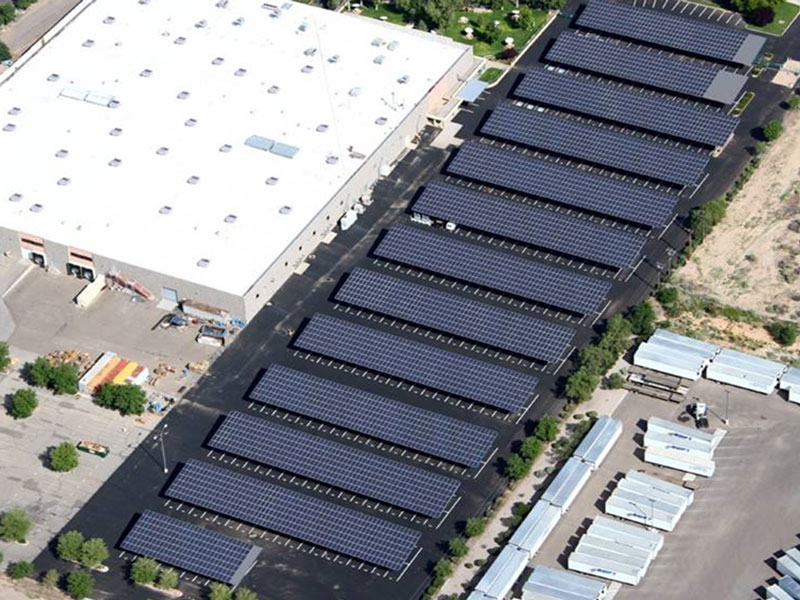
Solar panels at Rio Grande in Albuquerque, New Mexico
Third, set thermostats to maintain lower interior temperatures overnight or when the business is closed. If you use major appliances, such as washers, dryers, or refrigerators in your breakrooms or to clean uniforms or shop towels, switching to Energy Star appliances can reduce your use of electricity.
“These are things that can make a big difference over time, that are easy fixes, they don’t cost a lot of money. They might even save you money in the long run,” says Levy.
Depending on the types of work your business is engaged in, outsourcing can also help you reduce your electrical footprint. Designer Alexandra Hart, based in the San Diego area, does little casting for her work. Instead of firing up a kiln just for a small number of castings, when necessary, she sends the work out to a casting company. It’s more efficient, it saves Hart the cost of having casting equipment she uses only infrequently, and she pays only for the fraction of the electricity it costs to cast her pieces, not the entire cost of running a kiln and vacuum machine.
“Energy use is something a lot of manufacturers are looking at, because that’s also a large cost,” says Levy. “If you can create efficiencies, you’re also bringing your cost down.”
 Reducing Packaging
Whether it’s the plastic clamshells you take restaurant leftovers home in, the multiple layers of plastics around electronic items, or the jewelry boxes you send home with your customers, packaging is probably one of the largest sources of waste going into the landfills. Even if jewelry boxes are largely made of cardboard, it is often bonded or glued to cotton and plastics, which are impossible to recycle. Yet, packaging is an important part of the jewelry presentation as well as your branding and advertising.
“My suggestion for packaging is to reduce it,” says Levy. Consider what is essential to your brand, then look carefully at what your customers are actually keeping. Will they really keep their jewelry in that box? Can a box be replaced with a cotton or suede pouch? Choyt uses handspun cloth bags he imports from a small artisanal maker in Bangladesh, supporting the small business and the workers there.
Also, look at how you are delivering that box or pouch of jewelry. Do you need to deliver it in an extra bag or include tissue? Is the sack itself reusable or recyclable or will it go directly into the trash at home? Ask your customers if they would like a bag—many will not choose to take one.
If you ship products to customers, you may use a branded box inside a cardboard shipping box—not to mention packing material. However, there are alternatives, such as custom mailer boxes made from recycled materials that can be composted or recycled. “There are now some really nice solutions that are just one box. When you open it up, the branding is still inside, but you’re not using a cardboard box and a branded box,” says Levy.
“The best way to lower your packaging imprint,” she adds, “is to reduce as much as you can, while also keeping your branding and your luxury standards that fine jewelry companies need.”
In addition, if you ship, try not to use overnight shipping, suggests Levy, which reduces the amount of fuel needed to deliver your package.
 Saving Water
If water use is a concern, determine your water usage by looking at your bill, consider the ways you use water in your business, and then figure out how you can reduce that use, such as by installing low-flow faucets or toilets.
Also be sure that you are not sending toxic materials down your drains, such as some of the acids and chemicals used in jewelry workshops. In lieu of harsh chemicals, Choyt uses a non-toxic, citric acid pickle to clean jewelry after soldering. This can go into the city water purification system without harm.
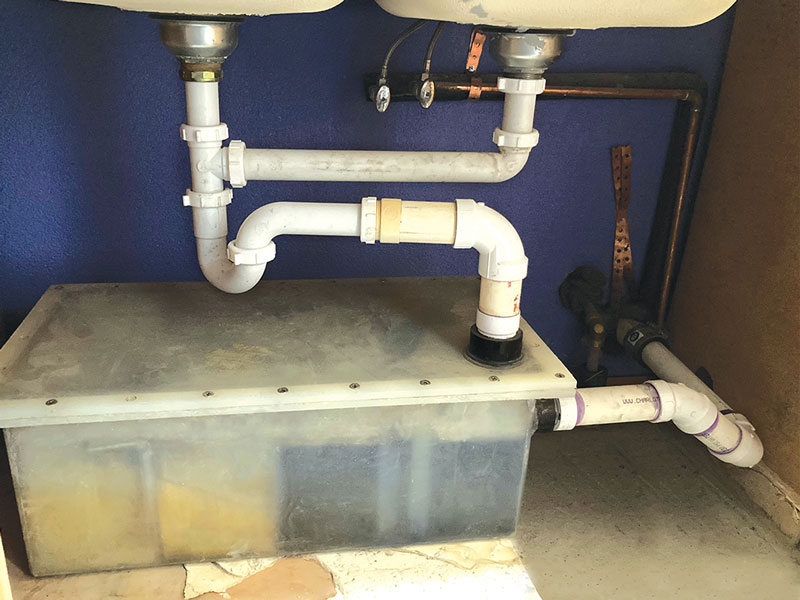
To prevent precious metal particles from being washed down the drain and into the city water system, Marc Choyt rigged up a system under his shop sink that filters out heavy metal particles. The particles are collected in a plastic bin and eventually sent in for refining.
Choyt also filters out any of the heavy metals that might end up going down his drain. When washing the tumbling shot and medium after tumbling his castings, minute particles of precious metals can go down the drain. Many years ago, he rigged up a system under his sink that filters the heavy metals out of the water before it goes into the city system. The residue is concentrated at the bottom of a large plastic bin. Every year or two, he removes the sludge, dries it, and then sends it with his other sweeps to the refiner.
“It really makes a lot of sense,” says Choyt. “Because if you’re not collecting the metals out of your tumbling, then you’re basically pouring money down the drain.” (You can find a number of DIY filtration systems online, if you want to try this yourself.)
Because she works from home, Hart has the freedom to address some issues that a mall store, for example, might not be able to. Aware that runoff from hard surfaces, such as streets and parking lots, goes only into sewers and water treatment plants, not back into the water table, wherever possible around her home, Hart has installed permeable surfaces. “Because I live in Southern California, I make beautiful pathways with mulch and gravel,” says Hart. Permeable walkways, driveways, and patios allow rainwater to percolate back into the ground. This not only allows natural water filtering, but it also helps replenish the groundwater, providing water for generations to come. “You don’t sacrifice anything by doing something that is environmentally helpful as opposed to harmful,” says Hart.
 Reducing Plastics
Plastics are probably the most difficult problem when it comes to making your business more environmentally friendly. Plastics are everywhere, from the depths of the ocean to the interiors of our bodies. They kill untold numbers of wildlife, and we have yet to determine how they affect human health. And they never go away.
Yet plastics play vital roles in a jewelry business. Plastic containers hold dangerous liquids that, in the event of an accident, can prevent those liquids from spilling. They are, of course, in all of the seals and gaskets in your equipment. Plastics also play a central role in 3-D printing. While it’s impossible to eliminate these kinds of uses, there are other places in your business that plastics can be reduced or eliminated.
Most shops use hundreds of small Ziploc bags: They hold pieces taken in for repair or small parts, such as jump rings, bails, and gemstones. Too often they are used once and are thrown away, but they don’t need to go into the landfill. “We have a lot of old plastic bags that we just reuse and reuse,” says Choyt.

Instead of using plastic bags, Alexandra Hart packages her designs with cellophane, a clear, crinkly material often made of wood, cotton, or hemp. Once used, the cellophane bags can be composted in a backyard compost bin.
It is even possible to transition away from plastic bags altogether. Hart has transitioned to using cellophane, the clear, crinkly material that is made from wood, cotton, or hemp.
“It’s a lot like a plastic bag, it’s just a little more stiff, and you fold it over,” says Hart. Cellophane bags don’t lock, like plastic bags, but small pieces of tape can hold them closed if necessary. They can be composted in a backyard compost bin. Cellophane, says Hart, “has a single use. Maybe it has two uses. But at least it won’t stick around. If it gets into the ocean, it’ll dissolve.”
If you switch to cellophane, be sure that it is truly made from cellulose. Polypropylene is a clear and crinkly plastic that looks like cellophane, but it cannot be composted, and some recyclers don’t accept it. Although cellophane can be composted, it cannot be recycled. If your local garbage hauler takes compostable material, ask how to dispose of cellophane, then advise your customer if you use these bags to deliver jewelry.
Water in plastic bottles packaged together in large flats and shrink-wrapped has become ubiquitous, and it’s not unusual for businesses to supply drinking water to staff and customers this way. But the amount of plastic generated by these bottles is enormous. A return to a single water cooler, or, better yet, a water filter on the breakroom tap, reduces the amount of plastic you send to the landfill, but still provides clean drinking water to your employees and customers.
 Supporting Wildlife
The environment is not something that is far away. It’s right outside the front door of your business. Some jewelers are not only beautifying those spaces but are also making them healthy for wildlife and even sometimes for themselves. For example, Choyt has established a wildflower garden in the front of his shop. It is not only a haven for bees, butterflies, and birds, but it also has fruit trees and occasionally vegetables, such as cucumbers and snow peas, that make their way to Choyt’s dinner table.
“If we want to make beautiful things, then we should have a beautiful place,” he says. “Beauty is a really, really critical part of human connection and human sustainability.”

Marc Choyt’s efforts to protect the environment extend beyond his studio. He established a garden featuring wildflowers, fruit trees, and even some vegetables in front of his shop that’s not only beautiful, but also serves as a haven for bees, butterflies, and birds.
Hart agrees. “The landscaping is part of life, part of caring for the land,” she says. Around her home she uses excess water from the shower to water the trees that were planted before she bought her property. Elsewhere, she uses xeriscaping, which uses zero water. “With a slight adjustment of what you believe is most beautiful and working with native [plants]…you will be able to make something beautiful. It just won’t be an English garden in Palm Springs.”
 Advocacy and Community Engagement
Jewelers make an impact globally by purchasing responsibly sourced gemstones and metals. But often they can make an impact much closer to home through advocacy and community engagement.
Choyt led a campaign to stop a gold mine near Santa Fe. The new mine, he explains, was very close to the site of another gold mine that now requires constant remediation to prevent acids that resulted from that mining from leaching into the water table. The alliance he was part of feared that the new mine would also require this kind of ongoing and very expensive remediation. In addition, the new mine would have required removal of 165 tons of rock to produce one ounce of gold, says Choyt, and it would have pulled millions of gallons of water away from residences in the area. The new mine would also have been located in the Galisteo Basin, an important wildlife corridor that connects the Sonoran Desert to the Rocky Mountain chain. The alliance stopped the mine, but then Choyt, aware that mining in the southwest was not going away, participated in the writing of a new Santa Fe County mining ordinance, which has proved to be a model that other counties can now use.
“Where it matters most to you,” says Hart, who describes herself as an activist, “it’s our responsibility to help make those decisions [that affect the environment].” Even when decisions seem to be out of our control, she argues, if it’s important to us we need to vote and to let representatives know how we feel. “The big [decisions] are not entirely out of our hands, because they’re supposed to be about us.”
 Getting Started
Because there are so many different aspects to reducing your business’s environmental impact, it can be overwhelming to know where to start. It’s not unusual for people to “feel a little paralyzed,” says Levy. “So, what I suggest businesses do…is to think about what’s important to you and your business and pick one area to start with.”
Begin by doing some research. With so many people and organizations working to reduce human impact on the Earth, there are any number of websites and books to help guide you in making your choices and getting started.
It’s important to involve your employees, too, says Levy. “A lot of people who want to do what’s right are very interested in sustainability.” Spend some time walking around your business and talking to employees, asking for their suggestions. This, says Levy, is a way to get your staff interested and motivated to help you reduce your business’s environmental impact. And often, staff sees something that you might not.
Finally, keep in mind that few changes to a more sustainable alternative are simple. Switching to an electric vehicle, for example, leads to questions about the extraction of lithium for the batteries. In the jewelry industry, the choice to use recycled gold has become fraught as the designation can be applied to bullion transformed into jewelry even though the bullion itself is the result of fresh mining.
“There’s always going to be more than one right answer and that answer might be right in some respects and not right in others,” says Levy. Even the use of Fairmined gold, she says, while an excellent way to trace your precious metal, results in a higher product price. “Are your customers going to pay that premium, and do they understand what it is?”
A growing number of customers want the companies they do business with to share their views on sustainability and social impact. “You have to put sustainability into your storytelling and your communications,” says Levy.
“I would say for any company going on a sustainability journey, they should really look inward first,” Levy says. “Because if it’s not authentic to you and your staff and your team, it’s not going to be authentic to your customer.”