

Creating a Social Media Marketing Game Plan
Connecting Socially
How to create an effective social media marketing strategy for your business
By Sharon Elaine Thompson
(Originally Published by MJSA May 2023)
Social media. Love it or hate it, it’s a necessary part of doing business these days. For jewelry makers, it serves as a combination of advertising, content marketing, satisfied customer referrals, and good old-fashioned, across-the-counter relationship building. Done thoughtfully, social media can help you stay top of mind with your current customers, build your credibility and relevancy in your marketplace, attract new customers, and lead to sales. But as with any type of marketing, your approach to social media should be well planned.
The four most popular social media platforms within the industry are Instagram, Facebook, LinkedIn, and TikTok. Each has its own use and its own audience, and each demands a different approach. Deciding on which ones make the most sense for your business and then using them well, is something you need to understand, even if you won’t be the one creating and posting content on them.
Content Marketing
While social media provides an excellent way for you to keep up with your current clientele, it seems almost custom-made for content marketing, which involves creating and sharing online material to stimulate interest in your products and business. Content marketing allows you to establish your credentials and your expertise with your target audience by providing useful information or insights into your business. Jewelers, designers, and manufacturers can showcase their skills, knowledge, and expertise, usually via short videos.
For that reason, Instagram is the most popular social media platform for designers and manufacturers because of its highly visual nature. The platform allows you to post individual images, short videos, and slideshows of images that tell a story.
Designer Michelle Pajak-Reynolds of Stow, Ohio, uses Instagram Reels (short videos) to show her work process. “Sometimes I’ll do a full fashion editorial with some of my photographers, model, hair, and make-up, and I’ll show behind the scenes for that,” she says.
Contract manufacturer Riva Precision in Brooklyn, New York, uses Instagram and Instagram Reels in a variety of ways to build confidence in the company’s brands and its expertise as well as to introduce potential customers to and remind current customers of the range of services it offers.
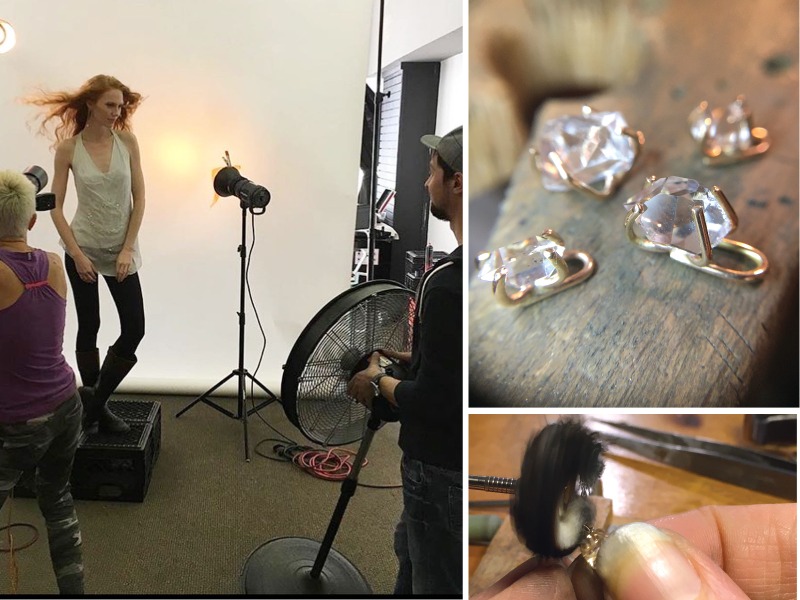
Growing your brand online requires more than just posting photos of pretty jewelry designs. To establish her credentials and build interest in her brand online, Michelle Pajak-Reynolds will sometimes post short videos on Instagram featuring a behind-the-scenes look into a photo shoot of her pieces.
For example, the company may feature Ted Doudak, owner and CEO of Riva Precision, and his wealth of knowledge. A video might show his history with the company and the jewelry industry, his problem-solving skills, or it might provide information or guidance that a designer might be able to use, such as the top three mistakes designers make when approaching a manufacturer. This willingness to share helpful information in a nontransactional way “might not specifically lead to direct sales,” says Rebecca Doudak, creative director of Riva Precision, “but it shows people who we are, and it makes them more comfortable with working with us, or it makes them more confident to work with us.”
Although Riva has had a lot of success with its Instagram page, Doudak admits to preferring social media platforms LinkedIn and TikTok. LinkedIn, she says, is where professional contacts are made. “LinkedIn is our most professional platform,” she says. “We have a lot of designers on LinkedIn. Not only our current clients but a lot of prospective clients.” She estimates that her father has nearly 15,000 connections on LinkedIn. “LinkedIn is where we spend a lot of time shaping our public image.”
Doudak also posts on TikTok, though she admits that it’s “mostly for fun.” However, it is fun with a purpose. Last year, Riva launched a small direct-to-consumer line, Riva New York, which is targeted to a young urban audience—a demographic that spends a lot of time on the social media platform.
“Our audience for Riva New York is usually young people who live in cities,” she explains. “Because of that, we create content a lot differently.” While she may use the same base video for both Instagram and TikTok, Doudak explains that they are edited very differently. “For Riva Precision, we make sure the clips are longer, the music is calmer. For Riva New York, the clips could be 10 seconds long. They are usually very fast, otherwise people won’t pay attention. Younger people have very, very short attention spans.”
Social media can help you seek out new customers who might never otherwise know that you exist by looking for what Andreas Argentinis, owner of Metal Pressions in Savannah, Georgia, describes as “watering holes or honey pots.” These are groups or topics within social media sites where the users, who match your ideal customer demographic but don’t know about you yet, gather to talk about topics they are jointly interested in.
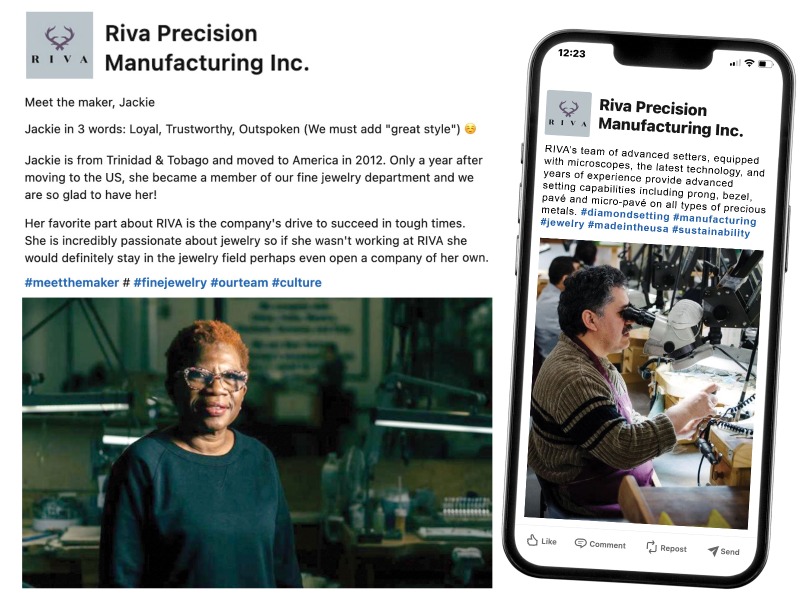
Although Riva Precision posts on Instagram and TikTok, LinkedIn remains a favorite platform of the company due to the professional contacts it can make there. The company uses the platform to help shape its public image.
For example, Argentinis’s line of customized fine jewelry is well suited to young mothers and creative people, such as graphic designers, illustrators, and architects. So, he engages on a grassroots level. How? Simply by liking and commenting on posts by the audiences he follows. By seeking out those groups and opening up honest conversations with the participants, he can build awareness of his product among an audience that is not familiar with his brand. He also notes that the same strategy works with existing and potential retail and industry partners as a “front of mind” outreach strategy.
Argentinis says that he doesn’t always expect the posts to bring in new customers at this time. “Customers that might find us through other channels look at our social media and use that to see if we’re current and active, that we are a real brand, that perhaps we responded to people that commented on a post. It’s a validation for people.”
Paid Advertising
While most people may think of social media in terms of growing their audience organically, it’s actually better to think of social media as another advertising pathway, says Shane O’Neill, vice president of digital marketing at Fruchtman Marketing in Toledo, Ohio. “Organic reach, on most social channels, is pretty much nil,” he says. “Even if you get a lot of organic reach on those channels…the question is, is it local? If it’s not local, then it doesn’t matter how much organic reach you have. That person isn’t likely to become a customer unless you have a solid e-commerce reach.”
Even though they may offer e-commerce, many independent jewelers still see most sales in-store, especially for larger ticket items. That’s because customers would still prefer to stop in and see, touch, and feel the jewelry items they’re interested in purchasing.
“If you want to promote yourself locally on social media, and you want to build a fan base of people who are in your local area, you’re almost forced to do paid advertising,” says O’Neill. If you’re not advertising to your target market, getting customers and sales “is a huge uphill battle.”
O’Neill cites the case of a retail jeweler who, in the early days of Facebook, had more than one million followers. Although it looked like he had a lot of free marketing, “when I looked into that jeweler’s page, 99 percent of all his fans were not even in the local community,” says O’Neill. “More than half of them were overseas. The rest of them were all in different states. He was getting a lot of organic reach, but to what end? That’s why we always talk about advertising, because advertising allows you to push that video or Facebook or Instagram post directly to people you know are in your local community and fit a particular demographic for you.”
Of course, says O’Neill, “if you’re a retailer who primarily is generating revenue outside of your store, or maybe you don’t have a store at all,…organic reach is going to be very important. The only problem is you can’t target people. So, while your organic reach might be super high, the demographic profile of the people [you reach] may be all over the place.” This is why while he admits that organic reach is important, he still believes that paid ads are vital. “Your biggest online retailers do paid ads all the time because they can target very specific people.”
As with any other advertising channel, it’s important to think about your budget and target your audience. For retail jewelers and designers, the primary social media channels, says O’Neill, are Facebook and Instagram. “Those are the first ones that need to be exploited and they need to be done well. If you have marketing dollars above and beyond, then you can consider adding another social media channel. But make sure that it fits your objective.”

Companies should be willing to share a wide range of images and videos on their social media pages, as you never know what will connect with viewers. One of the most engaging posts Metal Pressions posted was of customers using its jewelry design kiosk at a retail partner’s store.
Be sure that you first understand the needs of a platform and the expectations of its users, and second, that you are not spending those extra dollars simply to overlap a channel you already cover. For example, TikTok is a booming social media platform that is less commonly used by retailers, manufacturers, and designers than the other social media platforms. It has a specific audience of younger users who are seeking entertainment primarily. It also has a format of very short, dynamic videos, the optimal length being 21 to 34 seconds, certainly less than one minute. However, because it reaches a young audience, it may seem to make sense to advertise bridal there.
“The question is, do you have the ability as the jeweler to create short-format video that fits into the TikTok ecosystem?” asks O’Neill. “Even if you or someone on your staff do have those skills, ask yourself if you are already covering that market, say, by advertising on Instagram or Facebook.” If you are, you’re probably already targeting that person. “The reason I say that,” says O’Neill, “is because nobody’s primary social channel is TikTok.”
The worst thing you can do is post generic ads or content on social media that doesn’t fit into the expectations of the audience on that channel, says O’Neill, as that will show that you are out of touch with that particular audience. This may be one reason, according to O’Neill, that you might want to engage an experienced marketing agency to take on your social media postings.
“Social media is very time consuming,” he says. You need to do it fairly consistently, “at least one or two times a week, and push advertising with that post.” If you are working with a marketing agency already, they can help you integrate your social media presence with your overall marketing strategy.
However, not everyone believes that social media marketing needs to be outsourced.
“I don’t believe in agencies for social media,” says Doudak. “They don’t know you, and you still have to feed them the information, which is the hardest part. So, you might as well do it all yourself. When you hire someone to do your social media, even if you’re hiring them in-house, they have to truly care about what you do and what you stand for. Otherwise, they’re not going to portray it well enough.”
Doudak does much of the social media for Riva Precision and Riva New York herself. “If we didn’t have me, we’d have someone else in my position. They’d have to be trained and get familiar with everything before they started working. You can’t really do that with an agency you hire.”
DeJonghe Original Jewelry in Saratoga, New York, uses a combination of self-posts and those uploaded by a local marketing company with which it works. Sarah deJonghe usually takes care of the everyday posts. “We generate them here, and I post them,” she explains. “Then the marketing company that we use will take our content, and they’ll put money behind that because they know how to target more people through paid advertising.”
Getting Sales
Advertising, content marketing, referrals, and relationship building all lead to one thing: sales. Because, in the end, you want potential and existing customers to know what products you offer, to have confidence in your abilities and knowledge, and often to know that someone they trust also trusts you.
But you can also encourage sales directly from your social media content. O’Neill says that they have moved away from focusing on Facebook page post promotions and, “we put a majority of our marketing dollar budget into what’s called carousel ads.” This is essentially a slider of 8 to 10 products that link directly to your website. “It doesn’t encourage comments, likes, and shares,” he says. “It’s meant to encourage [a viewer] to shop now. Our objective here is to take people off of Facebook and get them over to your website because, in the end, you want them shopping your store.”
While you can sell on social media directly, and that may make sense for certain products, O’Neill says, “my preference would be to get them to your website because I feel they have a better propensity to buy once they go to your full e-commerce shop.” There they can get the full experience of your brand, including company history, all your products, what makes you unique, and all of the services you offer. “The website is really the number one salesperson for any jeweler. I want any consumer to talk to my number one salesperson. That means I have to get him there.”
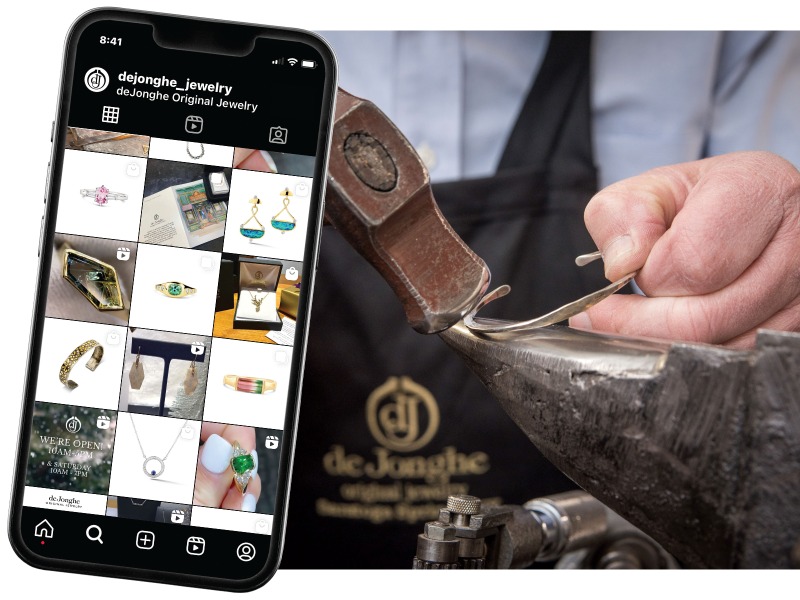
Make sure to vary the look of online photos and be aware that the jewelry images that tend to get the most attention include hands, even if they’re working with the jewelry instead of wearing it.
One way the deJonghes have tried to expand their customer base is by using giveaways to capture e-mails and addresses. Their marketing partner also cross-promotes the company’s giveaways with its own marketing efforts. “By doing that, we capture a whole new audience,” says Evan deJonghe.
Last year the store celebrated its 40th anniversary in business. As part of the celebration, “we decided to give away a pair of earrings every month. We blasted that giveaway post across Instagram, Facebook, and e-mail, using certain hashtags, such as #giveaway and #JewelryGiveaway. There are people out there who follow those hashtags and enter the giveaway,” says Sarah deJonghe. “The giveaway requires them to tag friends. We started gaining other followers just from social media word of mouth.” They had winners from their local area as well as people in California. While a contest winner in California might not turn into an immediate new client, the deJonghes are also using social media to begin a national campaign for their more niche products such as their equestrian collection.
How do you know if your presence on social media is working? “How do you know billboards are working?” asks O’Neill. The answer is you don’t. But for the same reason you might use a billboard ad, you use social media. You place a billboard ad, “because 300,000 cars pass it a day. You don’t know how old those people are, you don’t know what their gender is, you don’t know what their interests are. You just put up a billboard because people pass it. Facebook is sort of like a digital billboard. Eyeballs are scrolling through their feed and they could potentially see your ad. But if you’re advertising, you can determine whom you want to have see your ad. For example, if I’m doing an ad for bridal, I want the age to be between 25 and 42, I want them to be in a relationship, and I want them to be interested in engagement rings. That’s a huge narrowing down of that audience.”
It’s not that you shouldn’t do billboards anymore; you just need to justify and understand what you are doing in your marketing mix. And the best way to know if your strategy is working is if your sales are increasing, says O’Neill.
Deciding What to Post
So, what do you post to capture attention and drive sales?
Doudak explains that there are two types of content that they post. “One reaches out and grabs people,” she says, “and the other one feeds your current audience. Sometimes you make a post, not because you think it’s going to get really high engagement, but because you think it’s essential for the audience that you already have.
“Sometimes you do things that are…not that deep, but they’re catchy,” she adds. “They make the viewer watch a bit longer.” Then those people may subscribe to your social media channel and watch more often. It’s essential, says Doudak, to balance the two types of content.
“The most eye-catching stuff that gets the most attention is how something is made from start to finish or watching people at work,” says Doudak. However, she takes pains to balance eye-catching posts with those that contain more information about the business, explain what makes their business unique, or share information that their audience can use.

DeJonghe Original Jewelry will occasionally run giveaways to expand its online following and potential customer base. It works with a marketing agency to cross-promote the giveaways.
It’s important to remember that social media platforms have their own needs as well. Naturally they want people using their sites, so they emphasize the kinds of posts that their audiences are seeking out. For example, says Doudak, “Instagram stopped pushing photos a while ago. Even if it’s a beautiful photo, even if the jewelry in the photo is gorgeous, Instagram won’t show it to your followers.” The only time she posts photos of product, such as their Fairmined gold chain, is if it is important that viewers be able to zoom in and see the quality of the product. Although she knows those photos will not do well in terms of engagement, she feels it’s more important that clients and potential clients be able to take a very good close look at the product online.
“Your goal in social media shouldn’t always be to chase the piece of content that gets you the most views,” says Doudak. “You need both types, even if one doesn’t get that many views.”
When posting on social media, especially on a visual platform such as Instagram, pay close attention to the quality of your photography and videos. “We have invested a lot of time and money in our photography,” says Evan deJonghe. “It gives a more professional look, and we can compete with larger brands. It’s extremely time-consuming, and it can get expensive, but [having high-quality photography] as your first point of entry for someone to click on, I feel, is quite important. If there’s one piece of advice for jewelers out there who are trying to get more traction, it’s to get your photography in order.”
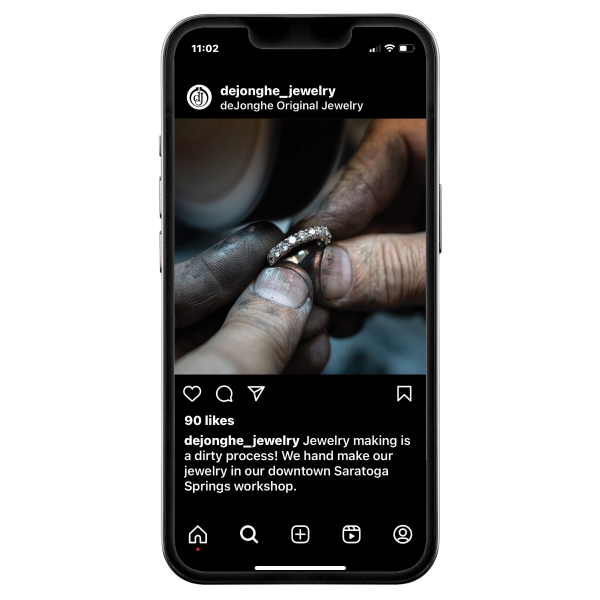
In addition to the quality of the image it’s necessary to consider what you are featuring in that image. Many jewelers agree that images of jewelry on a plain background don’t engage the audience very well. Instead, images that include hands will often get the most attention, whether it’s someone working with jewelry or someone wearing the jewelry.
“We have a behind-the-scenes photo of polishing a ring that has something like 5,000 views,” says Evan deJonghe. An image of jewelry only on a plain white background, by comparison, may have fewer than 200 views, he says.

“Sometimes you make a post not because you think it’s going to get really high engagement, but because you think it’s essential for the audience that you already have.” —Rebecca Doudak
Sometimes you don’t even need jewelry in the image for it to be engaging to a social media audience. Argentinis says that one of his best posts in terms of engagement was of their personalized jewelry design kiosk at a retail partner’s store. “There were a couple of women in front of it using it,” he explains. “It was a static image and not even a video.” He thinks it was appealing because it gave people a feel for the unique jewelry design experience they are bringing to stores around the country. “You have to let people know a little bit more about your brand.”
One thing noted by the deJonghes and Argentinis is that posting on social media can be time-consuming, especially as you begin to learn the platforms. As a result, sometimes they end up posting after hours.
If you are not comfortable creating social media content on your own, Sarah deJonghe recommends that you can hire an intern, somebody who wants to add something to their résumé. “There are so many kids out there who are so adept at all the new social media platforms,” she says. “They are just hungry to be posting content, and they know how the platforms work.”
Evan deJonghe notes that they had such an intern during the summer. “She was great,” he says. “She did a lot of our videos. She had no experience with jewelry or retail. She just knew how to use Instagram.” Naturally, working with an intern will require you to spend some time explaining how you want to present yourself online and training them about your business and your brand.
When starting out, says Sarah, “don’t get too picky about what you post [or] tied up in ‘This song is not right’ or ‘This doesn’t look right; the tag is showing.’ At the end of the day, the everyday person watching this content is not picking up on the fact that your nails aren’t done or the tag is showing in the background. It’s a matter of getting over that perfectionism and just posting content as much as possible.”
“The key in the beginning is to keep it simple and just get consistent,” says Argentinis. “A lot of times, the apprehension is that you might get egg on your face, do something silly, post a bad picture.” If you worry too much, though, what happens is that the quality of your content goes down. “Because the content is so benign, it attracts no attention. Or, if you’re just trigger shy, you don’t do anything.”
But Doudak warns that it’s important to “think very hard before you post. People love to get personal on social media,” she says. “I’m not saying don’t do that, because you want to make that personal connection with people—otherwise, there’s going to be no reason for them to come back. But keep it professional. Don’t rant about random things that might ruin your self-image. Social media is a really awesome tool. But everything you post on social media is permanent; if you are not proud for it to be there forever, don’t post it.”
One thing it might pay to think twice about before diving in is a partnership with influencers, says Pajak-Reynolds. “I’ve had stuff worn by celebrities. I’ve had stuff on the red carpet. And while my core clientele thinks that’s awesome and they want to brag about it,” at the end of the day, it may not turn into sales. “It’s very hard to take something that’s gone viral on the internet and turn it into dollars,” she says. “A million people may have seen your video about so-and-so wearing your work, but did that actually translate into more dollars for your business?” Most of the people who look at those posts, she thinks, are engaging with the celebrity, not your jewelry.
So, in the end, is it worth the time commitment?
“At the end of the day, the everyday person watching this content is not picking up on the fact that your nails aren’t done, or the tag is showing in the background.”
—Sarah deJonghe
“I think it depends on what your goals are,” says Pajak-Reynolds, “and knowing who your clientele is and where they like to play. It certainly can’t hurt to be on social media. Just make sure the reason you’re doing it is in alignment with who you are and what your values are. Because that will guide what your content is. No matter what it is, in business or in your personal life, if something’s not in alignment with what you truly value, don’t do it.”
Pajak-Reynolds suggests that if you are thinking about social media, talk to some of your favorite customers. “If all 10 of your top 10 clientele say, we’re all on Instagram and we love it, then get on Instagram. Ask what their handles are and start from there. Even if you’re talking to those top 10 people all the time, you can make a pretty good living from just a handful of clients.”