

Business Automation for Every Size of Business
Bring On the Robots
Learn how automation can increase efficiency, productivity, and accuracy in your business
By Andrea Hill
(Originally Published by MJSA April 2023)
If you’re not taking advantage of business automation, you’re missing out on essential efficiency and quality tools that will make your business more competitive. Business automation is the use of technology to automate the dozens of business processes, tasks, and workflows that make up your administrative functions. Just like manufacturing automation increases efficiency, productivity, and accuracy in your production, business automation provides the same benefits to your administration.
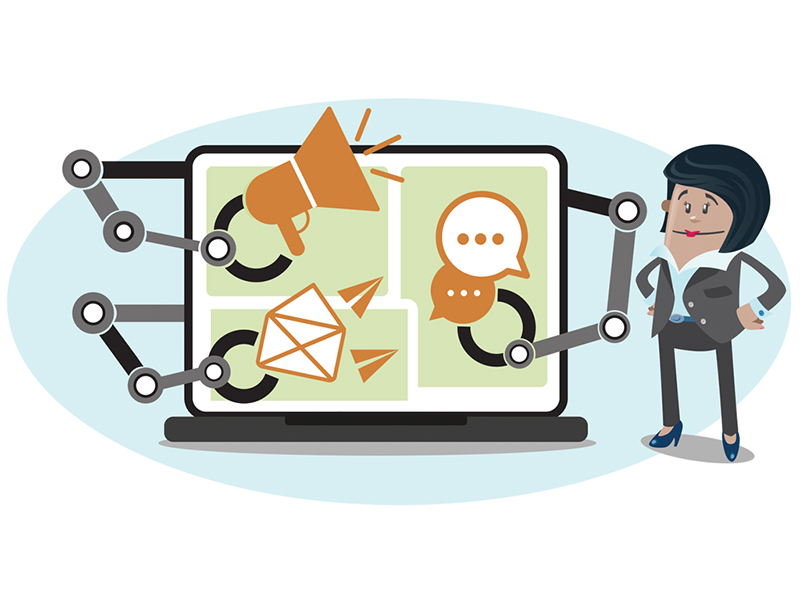
The tools for business automation have become so affordable that even the smallest of small businesses can afford them. Yet they are sophisticated enough to integrate with enterprise resource planning (ERP) and marketing systems to support the more complex needs of large businesses. At a time when labor scarcity is top-of-mind for everyone, business automation can fill critical gaps, but it’s not just for replacing labor—business automation frees up your human capacity to focus on value-add.
The Types of Business Automation
There are four different categories of business automation:
- Marketing automation. This is the type of automation most small businesses are familiar with. It involves automating marketing processes such as e-mail, social media management, and advertising campaigns.
- Process automation. This is the automation of repetitive tasks such as data entry, document creation, and invoice management.
- Customer Relationship Management (CRM) automation. This is the automation of customer interactions, including personalized marketing messages, handling of support requests and inquiries, and tracking customer behavior across your social media channels and marketing efforts.
- Sales automation. This is the powerhouse of business automation, automating sales processes such as lead generation, lead analysis and scoring, sales forecasting, and customer journey-focused sales activities.
The tools for implementing business automation are already built into some of your software applications, such as QuickBooks automation features for invoicing or your e-mail marketing system’s ability to set up drip campaigns. CRM systems such as HubSpot and Keap are integrated suites of service, process, sales, and marketing automations.
How Business Automation Can Work
This example of an automated workflow illustrates the efficiency and error-avoidance available through business automation:
When a B2C or B2B customer orders through your website, an automation system can do the following:
- Verify the customer’s payment details and confirm the item is in stock (sales automation).
- Automatically generate a pick ticket for warehouse or admin staff to fulfill the order (process automation).
- In warehouse environments, the order could be sent to a handheld device that locates the ordered items and scans them as they are picked (process automation).
- The system automatically generates a shipping label and sends the order to the shipping carrier (process automation).
- The system automatically generates an e-mail to the customer with the tracking number and anticipated arrival date (service automation).
- The shipping carrier scans the label, picks up the package, and delivers it (process automation).
- The system delivers all the order details to the invoicing system, which generates an invoice or bill, and e-mails that document to the customer (process automation).
- Five days later, the system automatically generates an e-mail inquiring if the customer received their order and if they are satisfied (CRM automation).
- Two weeks after that, the system can automate a message asking the customer if they are willing to provide a testimonial, linking to a testimonial system that automatically feeds responses to the website and social media channels (marketing automation).
Consider how many potential errors were avoided in the above scenario:
- Payment details were confirmed before even pulling the product.
- The item was confirmed to be in stock before allocating labor to pull it.
- The use of barcode scanners helps eliminate picking errors.
- Shipping labels are correctly generated (one of the most common shipping errors is shipping packages to the wrong customer).
- An invoice or bill is generated immediately, which keeps cash flow moving.
Next, consider how much efficiency was gained in the above scenario:
- Human labor was not required to confirm customer payment details or inventory status or to generate a picking ticket.
- Barcode-driven picking systems can also generate picking order based on most efficient warehouse routes, saving your team members from inefficient picking routes or going to the wrong shelves. Of course, for very large operations, this picking process can also be automated.
- Customer notifications regarding shipping do not require human management.
- By sending advance shipping notifications and tracking numbers, the “where’s my order” customer phone calls are reduced or eliminated.
- Automatic generation of invoices saves accounting staff time and ensures timely issuance of bills and invoices.
- Tasks that are often lost to lack of time or forgetfulness—like following up on satisfaction or requesting reviews—are consistently executed.
Companies using business automation are almost always initially attracted to the improved quality, efficiencies, and cost savings. But inevitably they find that customer experience is also greatly enhanced, which improves customer loyalty and long-term customer retention and profitability.
The best way to implement a business automation practice is to start by evaluating which administrative tasks your team does the most. Prioritize which automations would deliver the best benefits, either through time savings or mistake-proofing (or both). Next, evaluate the software tools you already have and see which tasks could be automated immediately by making use of them. If you do not have a program that can provide the automation benefits you seek, it’s time to start looking.
In a world of increasing costs, tight labor, and competition around every corner, you need every competitive advantage you can get. Business automation is the answer to so many business challenges. If you’re not using it already, it’s time to start looking.