

Tips for Outfitting a Small Shop on a Budget
Don’t Break the Bank
Budget-conscious buying for small shops
By Sharon Elaine Thompson
For many bench jewelers, there’s no such thing as too many tools. Of course, there is such a thing as not having the money to afford all those tools nor the space to accommodate them. Instead, most jewelers have to make do with just the essentials needed to create their designs…and maybe a specialty tool or two.
This is especially true for jewelers just starting out. Whether you just graduated from a jewelry program, where you had access to the school’s tools, or you’re going out on your own and losing access to your previous employer’s equipment, you’re facing the task of outfitting your own studio. It can be challenging, deciding what tools make the most sense to invest in and which can wait, and it can be expensive. So, how do you outfit your small shop without breaking or even straining the budget? It starts with identifying what you really need and then knowing the best places to find them.
Tools Aren’t Skills
The first step in assessing your tool needs is considering what type of work you want to do. If, while at a trade shop, you have become skilled in pavé setting, for example, and you choose to specialize in that, you will need fewer tools than someone who wants to open a full-service trade shop.
Once you know the areas in which you’ll focus your work, draw up a list of necessary tools and the quality level needed. But beware the trap that many jewelers fall into when going out on their own. Many feel they need “professional” quality tools, which they may define as the highest quality tool on the market or, for the less experienced, the most expensive tool on the market. (They’re not always the same thing.)
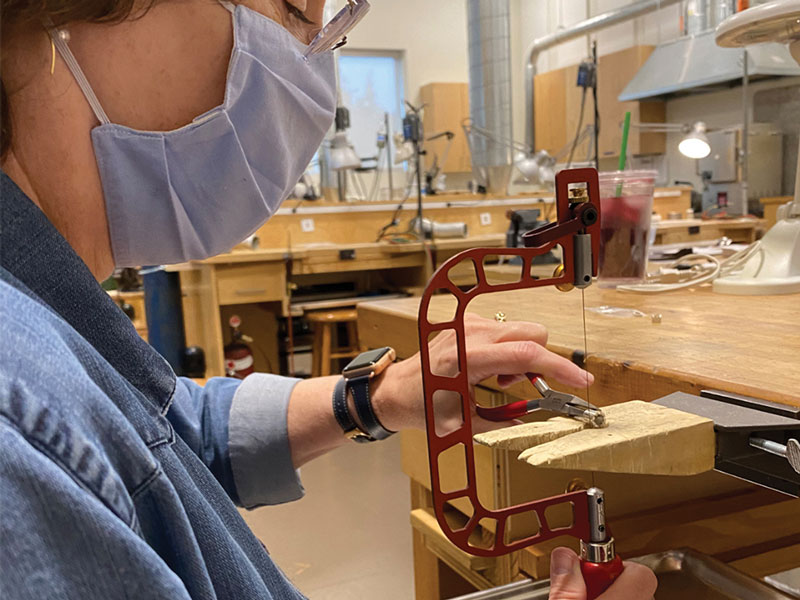
More expensive tools will not always deliver better results. If your sawing skills are poor with a student grade saw frame, they will not be any better with an expensive, professional one.
However, tools are not skills. No matter how specialized or high-priced a tool is, it will not solve your problem if you do not have the skills to use it, says Jason Chandler, founder of the Portland Jewelry Academy in Portland, Oregon. If your sawing skills are poor with a “student grade” saw frame, they will not be any better with an expensive, “professional” one. This is a trap many new graduates fall into, although experienced jewelers can sometimes be snared by it, too.
“I call them fishing-lure tools,” says Chandler. Sporting goods stores, he explains, stock hundreds of different fishing lures, but they all catch the same fish. The expensive fishing lures “are engineered to catch fishermen.” And fishing-lure jewelry tools are meant to catch jewelers. In reality, he says, there’s nothing that a $300 saw frame can do that a $20 saw frame can’t. “Using a saw frame is a discipline skill,” he says. If you have spent the time developing the skill, then a less expensive tool will work just as well.
“In general, the simpler the tool, the more discipline needed to use it,” says Chandler.
In fact, jewelers who do not have access to sophisticated equipment “can make the most incredibly professional-looking jewelry with nothing but a hammer, a nail, and a stake,” says Calgary, Alberta, Canada–based jewelry designer, writer, and educator Nanz Aalund. In fact, she adds, “the more skills you have, the fewer tools you really need to use.”
But there is still some difference of opinion about the quality of tools necessary when just starting your business.
“My point of view is that you buy the really cheap tool to make you the money to buy the next tool,” says Calgary, Alberta, Canada–based jeweler and educator Charles Lewton-Brain.
Chandler agrees, for the most part, and offers some guidelines. When comparing two tools of widely differing price, he says, the first question to ask yourself is, will both tools do the job you need them to do? If the answer is yes, then the next question to ask is, will the cheaper tool last for at least five years of regular professional use?
“The more expensive tool may be a better tool,” says Chandler. “Maybe it takes less finesse to use. Or it could be that it just simply lasts 20 years compared to the cheaper tool. But after five years of constant use or professional regular use, that cheaper tool has paid for itself, and it has paid for the purchase of the upgrade five years from now.” And for now, you can find another use for the money you save.
Aalund, however, believes in investing in the better tool from the start, provided it fits within your budget. “I was always taught to buy the best quality I could possibly afford because it will last longer and ultimately save money,” she says. “I still have my first flex-shaft, which was the cheapest one [Foredom] made in 1978. And it still runs like a dream.”
Chandler’s rule of thumb—to buy the cheapest tool that will do the job and will last for a minimum of five years—applies only to tools that can wear out, such as pliers or saw frames. There are other tools that never wear out, such as a rolling mill, and that are worth buying the higher quality. “Never buy a discount draw plate,” he cautions. “It’s a tool that either works, or it doesn’t.”
At the other end of the spectrum, he says, there are some tools you may use only very infrequently, maybe once a year or once every three years. So, you may buy a “a cheap, horrible version…grit your teeth and hate using it, but you only use it once a year.”
Sourcing Affordable Equipment
When thinking about buying tools on a limited budget, most jewelers probably think of used equipment. Luckily, there seem to be a number of places where you can find good quality used tools.
Joel McFadden, principal at JMD Jewelry in Chapel Hill, North Carolina, suggests seeking out retail jewelers who offered bench services but are now going out of business. “The downside to that is that a lot of times these companies are going to want to sell everything” to one buyer, including display cases and furniture.
Many jewelers have had luck sourcing used equipment online. There’s the jewelry forum Ganoksin (orchid.ganoksin.com) as well as a variety of Facebook jeweler groups. On Facebook, you can search the groups for the specific tool you are interested in.
These online groups are also great places to learn more about specific tools, though Chandler warns to use the sites with caution. “The bigger the group, the more information there is, but also the more misinformation,” he says. You’ll have to use “your best ability to sort through the information you get.”
It may pay to search a little outside the box as well. Aalund notes that in the 2010s there were a number of people who took up jewelry making as a hobby. Now, 10 and 12 years later, they have decided not to continue.
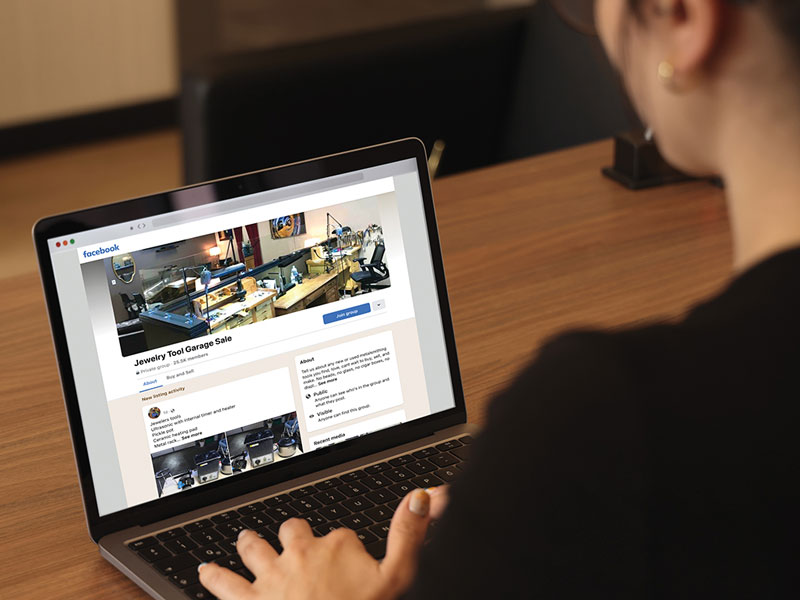
Online jeweler groups are a great resource for finding used tools. You can also use them to learn more about specific tools as well as which tool brands are better quality than others.
“They’re destashing the tools that they just bought—and barely used—10 years ago,” she says. “If you could find tools from a hobbyist who’s giving up the hobby, that would be a really good place to get excellent tools.” As a result, you might be able to buy an entire casting set up for a quarter of the price it would be new.
Lewton-Brain adds that the pandemic resulted in a surge of interest in jewelry making—and purchasing of jewelry tools. “Many people bought all these expensive tools without a clue what to do with them,” he says. These are coming available as well. “So right now, it’s not a bad time to be purchasing certain tools for those two reasons.”
Despite their hobbyist origins, very often, these are high-quality tools. “This is their hobby, they’re spending money like nobody’s business,” says Aalund. Some of the tools are even things that she, as a professional, has never considered buying. “A $15 ring clamp will hold my piece of jewelry while I set the bezel. I don’t need this $800 engraving ball.”
Some of these hobbyists have told Aalund that they’ve bought the expensive equipment because they want to be able to sell their jewelry. She tries to explain that “now you have to amortize the $10,000 you spent on equipment for your hobby, it has to be built into the price of each piece of jewelry. The less money you spend on tools, the more money you can spend on materials and gemstones. It is your skill that makes it professional, not big, expensive tools.”
What should you expect to pay for used equipment? That, of course, will vary. But Chandler suggests a rule of thumb. “As a general rule, 50 percent of the new value is good. The exception being specialty tools that don’t wear out, like rolling mills. They’re about 75 percent [of the original cost].”
Not all tools have to be used. If you’re not having any luck finding a second-hand tool, many industry suppliers offer a collection of affordable new tools. “Jewelry tool manufacturers are starting to make tools that are in that entry-level range,” says McFadden.
While many jewelers recommend buying jewelry-specific tools, most admit that there are exceptions so don’t be afraid to look outside the industry.
Lewton-Brain is a big fan of looking beyond the jeweler’s toolbox. “I can go to Harbor Freight and, for $35, I can buy a sealed 3,450 rpm grinder that I can take the wheels off of and make into a polishing machine instead of spending $650 or $800 on a new [jewelry-specific] one.”
That’s why he recommends that, when looking for tools, jewelers find another occupation or hobby that uses the same or similar tool to solve a particular problem. “Let’s say that you wanted a portable version of a flex-shaft that goes on your belt, that runs for three hours, and goes from zero to 50,000 rpm.” From a jewelry supply company, he says, that might run as much as $900. However, manicurists have used them in nail salons for many years, and they are priced for as much as 30 percent less.
“Anything for automotive is way cheaper than what a jeweler would pay for the same thing,” says Lewton-Brain. “A jeweler will pay up to $250 for a vibratory tumbler, and you can walk into any gun shop, or even Harbor Freight, and buy one for $64 because the gunners use it for tumbling brass for reloading.”
However, caution does need to be taken when looking outside the industry. McFadden uses torches as an example. “A lot of the torches that are not made for the jewelry industry really don’t work for the jewelry industry,” he explains. “The flame is too large or too hot or too cold or spits out the wrong kind of gases.”
Finally, be careful about getting carried away outfitting your new shop. “Do not take out loans for your tools,” says Lewton-Brain. “I have seen more talented people crash and burn because they took on debt to equip their workshops. Debt kills.”
The DIY Route
If you make jewelry, you’re good with your hands and you may be tempted to make some of your own equipment to save money. One area where some jewelers try this is with the making of their own jeweler’s bench.
Bought new, a jeweler’s bench can run from around $500 for a basic setup to well into the thousands for all the bells and whistles. But if you are handy with wood, you may consider saving money by building your own jewelry bench, customizing it to your specific needs. Several jewelers have posted their bench plans online that you can use as a reference.
You may be tempted to simply convert a desk or table that you already have. However, says Chandler, “the jeweler’s workbench is a highly specialized tool. It is both a heavy-duty work surface or worktable, and it is a toolbox. Most desks are not strong enough to be a jeweler’s bench.”
When it comes to some of the other larger equipment that you may need, if you understand the equipment and how it works, you may be able to rig up a workable solution until you have enough money to buy the correct piece of equipment.
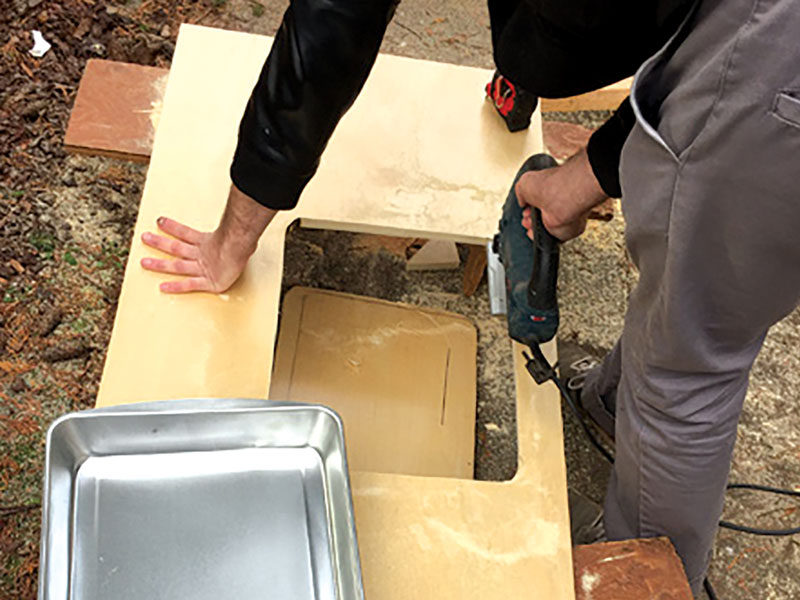
To save money, some jewelers have gone the DIY route and created their own jeweler’s benches. Several jewelers have posted their bench plans online that can be used as a reference.
For example, Chandler recounts that his first vacuum chamber for investing was a heavy-duty stock pot. He fitted it with a plastic lid that was thick enough to handle the vacuum pressure, and, using plumbing fittings, he hooked up a vacuum pump to it. “The pump was the big investment,” he says. “I would vacuum out my investment in that on the floor. I could use the handles of the pot to rock it to vibrate the bubbles out of the investment.”
But not everyone should be doing this kind of thing. Lewton-Brain has some horror stories about jury-rigged set ups he’s seen in shops. “Anything with electricity,” he says, “you need a licensed electrician to approve it.” Otherwise, you’re asking for trouble, not only with the risk of your shop—or home—burning down, but trouble with your insurance company should you make a claim.
Before You Buy
Before you buy any tool, says Lewton-Brain, be sure you know how to use it. “Do you know how to operate this tool? Have you been shown the safety concerns for this tool?”
This is especially critical if you’re self-taught. “That’s why I always recommend students go and work for a repair shop or a manufacturing shop for several years,” says Aalund. Not only do you really begin to learn your skills, but you also learn how to use the various equipment as well as which tool brands are better quality than others.
You also need to know how to maintain the particular type of equipment that you are buying. Does the equipment need to have the oil changed periodically? Does it need new seals? “So many times, no one has a clue about how to service it. People never read the manual,” says Lewton-Brain. For example, to maintain a flex-shaft, “you need to know how to take it apart, how to change the cable, which breaks every few years, and how to test the carbon [brushes], which is how the motor works, and how to replace them.” This can happen frequently when buying used tools, as they may not come with the original operating manuals. In those instances, reach out to the manufacturer, who may have the manuals available for download online.
Reading up on the operating and maintenance instructions before you buy a tool can also help you when inspecting used equipment, especially if you’re buying it from a hobbyist who may not have known how to take care of the tool.
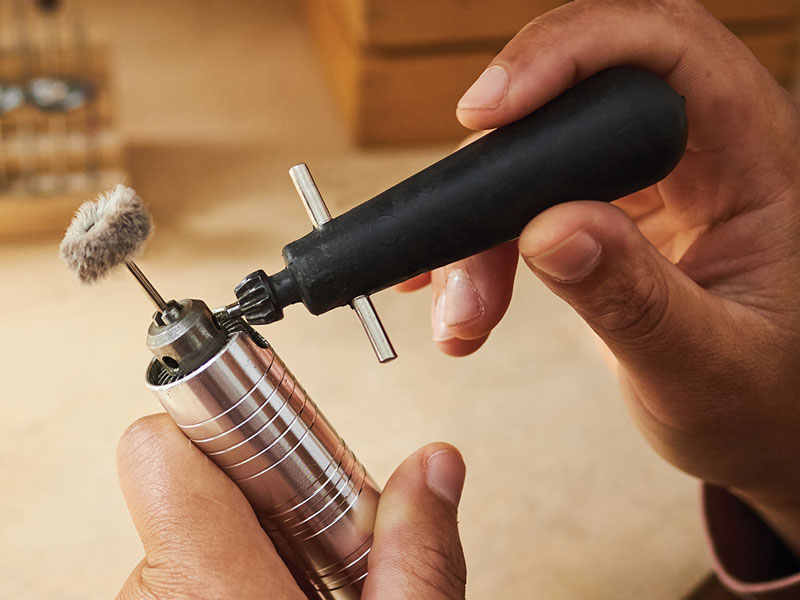
Before buying a tool, read up on the operating and maintenance instructions. This can help when you’re inspecting used equipment to verify how well it has been maintained.
It can also be helpful to buy used tools in person, whenever possible. “If [the seller’s] shop is well maintained, and their other tools are well maintained, the one you’re buying from them probably has been well maintained as well,” says Aalund.
Having background information on specific tools and brands can also help you avoid another pitfall of buying used tools: knockoffs. McFadden notes that there are some imitations of the Smith Little Torch available online that “can actually burst into flames and catch on fire in your hand” because connections between the torch handpiece and the gas hoses can loosen. He believes it’s important to “buy jeweler’s tools either from another jeweler or from a reliable jewelry source. I know it might cost a little bit more money, but you can really get hurt with the wrong tool.”
How Much Space?
In addition to budget constraints restricting the number of tools you can invest in, you may also be facing space constraints on where you store and work with them. Contrary to what some jewelers think, you don’t need much space to run a full jewelry shop. You don’t have to add on to your home, convert your garage, or rent a commercial space. One jeweler in Portland, Oregon, had her full shop in a small bedroom in a mobile home that was no larger than many walk-in closets.
You need only about 100 square feet of uncarpeted space, says McFadden, as long as you have good ventilation and good light. However, depending on where that space is, you may be limited as to what you can do in it. For example, if you are in an apartment, you probably can’t cast simply due to the size of the torch needed and having to run an oven for a long burnout cycle.
If you are still squeezed for space, you may be able to find some kind of shared workspace in your area. Schools that offer jewelry-making programs sometimes offer the use of their spaces and large equipment for former students. McFadden, who teaches at a nearby university in North Carolina, is able to use its facilities. “If I need to use a rolling mill or if I need to do something more heavy duty, I’ll go over to that space and use it because it’s right around the corner.”

Participating in a makerspace with shared equipment or partnering up with other jewelers with different skill sets can be a cost-effective way of building up your business.
Not all schools are well equipped however, he cautions. They may not have jewelry benches per se, and they may only have the minimum of equipment. And most will probably require that you be an active student.
In some areas of the country, you might be able to find a community makerspace. But there are caveats with that as well. It may not be supplied with the equipment that you need. Also, “there may be usage rules that the volunteers and members of that jewelry studio have put in place, which disallow outside individuals from coming into the studio to do production or commercial work,” says Aalund. She knows of a craft facility in Washington state that refused a jeweler permission to use its space, even though the jeweler was willing to pay the membership fee and work after hours so he would not interfere with other members. “The members didn’t want to share ‘their’ facility,” she says.
She also warns that, because hobbyists who populate makerspaces have been taught to make jewelry by copying the work of the instructor, they may see nothing wrong with copying your work as well.
If you do find a craft facility that will allow you to use its equipment, Aalund suggests first, that you keep your own counsel about why you are working there. Be organized and do only the pieces you need to do using their equipment. Take all the work with you to finish in your own space.
Second, pay the membership fee and take the safety classes even if you already know how to use the equipment. “It’s their liability insurance requirements,” she says.
Third, remember that you are sharing the space, and you may have to wait your turn to use the equipment.
Do You Need to Do It All?
Another way to keep down your equipment costs is to join forces with one or two or even three other jewelers whose skill sets may differ from yours and who may have one or two of the large pieces of equipment you need. For example, someone whose strength is casting might have the kiln and casting equipment needed.
“Most businesses will fail in the first five years,” says Aalund. “So, if you had someone else who was also sharing the rent, you might be able to share the cost of buying an expensive piece of equipment.”
This type of setup worked particularly well for Chandler, who joined forces with two other jewelers from the same trade shop when he went out on his own. Although they all could do pretty much all the necessary types of work required, each of them had honed their skills a bit more highly in certain areas. Chandler’s strength was casting, one of his partners was especially good with wax carving, and the other was more skilled at gemstone setting. They could do each of those types of jobs more quickly and efficiently, which allowed them to take on much more work collectively.
However, when doing this, says Lewton-Brain, it is important that right from the beginning you set up the ground rules and have a written agreement up front on who does what, who supplies what, what happens to equipment you buy jointly, and how the relationship will be dissolved or individuals can leave the partnership.
It’s also important that you have a rule about bringing in other jewelers. Aalund once shared space with another jeweler who wanted to bring in a third. But Aalund had had bad dealings with the proposed partner. In the end, she and her partner dissolved their partnership.
Rome wasn’t built in a day, and neither will your jeweler’s workshop be. But by taking the time to really understand which tools you need most, the quality level of those tools, and where you can find the best deal on them is a critical first step on your way to business success.