

Increase Efficiency and Profit by Streamlining Production
Slimming Down
How to identify and overcome production inefficiencies
By Sharon Elaine Thompson
The phrase, “If it ain’t broke, don’t fix it,” is as common in business as it is in other aspects of our lives. If something is working—whether it’s a routine or a manufacturing process—it’s easier to continue doing it than trying to improve it. Sure, we may make a tweak here, or slap on a fix there, and they may be clumsy, but as long as it continues to work, why meddle?
Because it may be more broken—or at least bent—than you think.
In 2012, Lashbrook Designs, a “mass-custom” manufacturer of men’s rings in Draper, Utah, was struggling with inefficiencies. Their business was growing as more jewelers embraced their product model, but, said Eric Laker, Lashbrook’s owner, in an interview with MJSA Journal in 2016, “We were working a lot of overtime and not hitting some of our due dates. A lot of mistakes were made and rework was rampant. This loss of time and material was very expensive. We were getting stuff out the door, but we knew it could be done better.”
Lashbrook’s struggles may sound familiar. Inefficiencies in production can happen as the result of sub-par training, old or inadequately maintained equipment and tools, outdated methods, or poorly planned workflow. Perhaps there is a lack of communication between staff, supervisors, and administration. Perhaps a company is not taking advantage of outsourcing opportunities that can reduce costs and speed workflow. Any or all of these can contribute to higher costs, a poorer quality product (and brand damage), and reduced profit margin. It can also create frustration and dissatisfaction among production staff, which can exacerbate the existing problems.
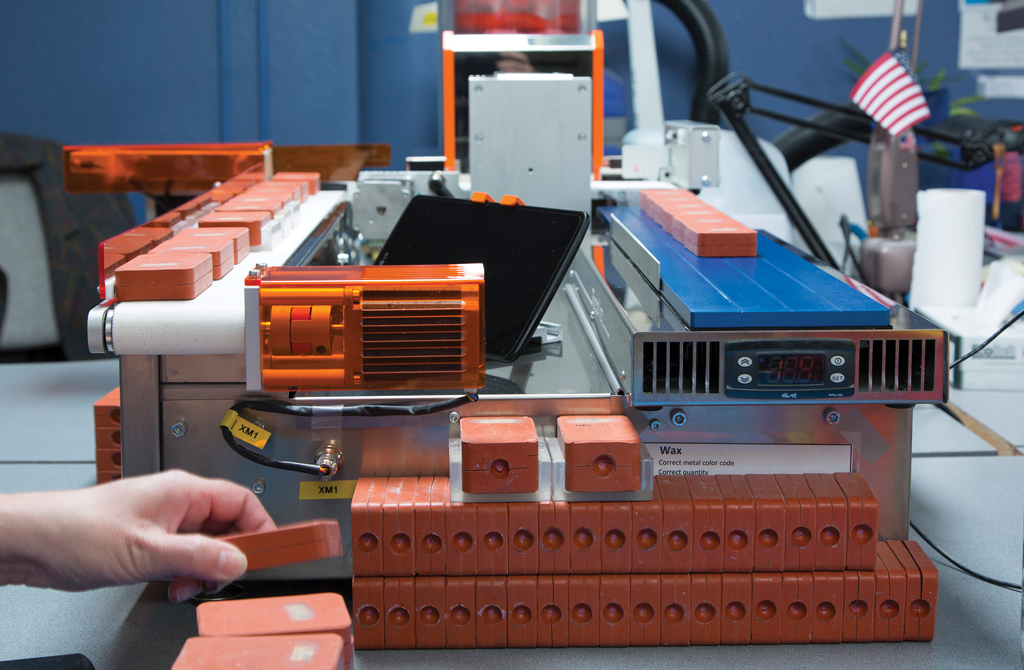
Investing in a wax injection machine allowed Rio Grande to ramp up wax temperatures automatically and precisely, resulting in increased output and better results.
However, addressing even just one of these problems can make huge differences in a company’s production capability. For example, Rio Grande in Albuquerque, New Mexico, had at one time more than a dozen people using old-style wax injectors to produce waxes for casting. The waxes produced were “inconsistent,” recalls Scott Patrick, a member of the Jewelry Tech Team, and “they needed a lot of clean up.” The company made the decision to invest in a costly electronic, state-of-the-art Riace wax injection machine. It allowed them to ramp up wax temperatures automatically and precisely. For each mold they could select the parameters for temperature and pressure that would produce the best wax model. The ability to gear temperature and pressure to suit each mold meant less wear and tear on the mold, and cleaner waxes that needed much less time to clean up. Rio was able to reduce the wax-injection department staff from more than a dozen to just six, “yet we had greater output and better results,” says Patrick. “Upgrading the equipment was huge.”
To Consult or Not to Consult?
Your first impulse may be to hire a consultant, one experienced in lean manufacturing, to help you discover inefficiencies in your processes. While there is a place for consultants, says Matthew Laker, vice president of operations at Lashbrook, “you can easily consume your early cost savings in consulting fees.” He advises that companies first learn all they can about lean manufacturing by watching videos, reading, and, if possible, visiting other jewelry industry companies who have incorporated lean practices into their planning. Once you understand the principles of lean, says Laker, “you can do quite a bit yourself. There is a lot of low-hanging fruit.”
Laker says they were fortunate to observe OC Tanner in Salt Lake City, a recognition company well-known for its lean practices and that offers periodic seminars on the topic. “A lot of what you get out of that is to see the result of lean,” he says. “The heads of departments made presentations about projects they were engaged in and what they were able to achieve with lean principles. You tour the facilities, see their team stand-up meetings, which is part and parcel with a lean operation. And you take a lot of notes about what could work in your business.
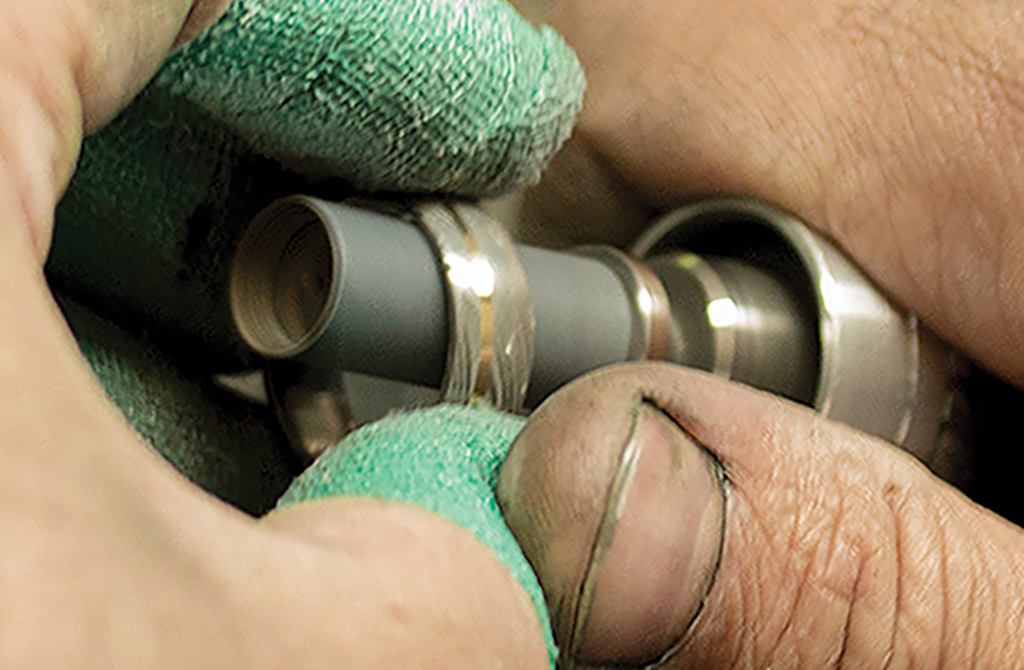
Streamlining production has paid off for Lashbrook Designs, which has seen a 40 percent increase in production and a 5 percent increase in profit.
“Benchmarking is everything,” Laker continues. “If you have to do everything yourself, you’ll struggle. But if you see someone in a similar type of environment, it gives you a good perspective on what you can do.”
Once you have addressed all that you can on your own, says Laker, that’s the time to bring in a consultant to go over what you’ve done, and perhaps recommend other steps you might take. “You need that outside set of eyes to see what you’re not seeing.” The help of a consultant at that time, can “drive things across the finish line sometimes,” he says. “It’s worth making that investment.”
Mapping Processes
Before you start changing things, says Andrea Hill, CEO of Hill Management Group, a Chicago-based consulting firm serving the international jewelry and luxury goods industries, it’s important to determine where you are right now. To do that, you can start from the top or the bottom.
From the top, says Hill, use your budget and monitor your profit and loss statement to analyze your performance relative to your plans to identify inefficiencies. “But your accounting has to be set up properly,” she cautions. “If your P&L isn’t organized, and you’re not entering things into the right categories, it won’t work.”
Most non-accountants don’t know how to set up a general ledger so it can deliver management insights, she says. “Have an accountant set it up for you at the beginning so you can get the most information out of your accounting data.” Then examine those reports every month. “Looking at your performance, as opposed to your plans, is a good way to see where you’re going off track.”
Also solicit feedback from customers on your performance, says Hill. “Look at the ways in which you fall short of customer expectations. Usually behind every error, misstep, or where you didn’t deliver what the customer was expecting, there is some kind of inefficiency.”

You can also start from the bottom, says Hill, by documenting and mapping the processes you currently use.
This involves drawing a diagram of exactly what is done in every process, at every step, and doing it in detail.
For example, says Hill, if documenting the picking, packing, and shipping process, you’ll want to know the answers to a number of questions. “What is the entry point? First, you receive an order. Then the next step is to go pick out the order. But is it? Do you get a cart? Where do you get the cart? What direction do you move through the warehouse? Do you put the item in the cart or directly in a box? Do you scan the product as it comes off the shelf or is that done when you pack? If the item is not on the shelf, what do you do? Where do you take the order when you’ve pulled it all? And so on and so on.”
The map you create is a series of little boxes and arrows that you fill in each step of the way: If this happens, then you do that. Is the item on the shelf? Yes or no? If yes, you do this. If no, you do that. “You do that with every single process,” says Hill.
Once you have the diagram, the next step is to have someone do the process while following the diagram exactly, without exception or interpretation. As they follow the process document, they’ll have questions, or others who do the same job will have a different way of doing it. “Create the process documents with the people who actually do the work to agree upon and document the most efficient way of doing each step so that from then on, everyone does it the same way.”
After you have determined the current best practice for doing a process, says Hill, it’s time to ask more questions, such as, “Could we eliminate a step? Is there a piece of equipment that we need to eliminate a step or is there a different way to think about it? Can we combine steps? Is there a piece of technology that would make the process smarter?”
“Map it, analyze it, make it all consistent, and look for opportunities for improvement,” says Hill.
Analyze with Time Studies
When you start analyzing your processes, time studies are invaluable, says Patrick and Scott Bradford (who also works on the Rio Grande Jewelry Tech Team). Keep a record of exactly how long each step in a process takes, whether it’s shooting waxes, spruing and investing, or pulling orders from the warehouse. Taking a close look at the studies can tell you where a process is less efficient.
The cause of the inefficiency may not be at the point it shows up, either. If cleanup after casting is taking more time than it should, it might be that the tools being used are worn and no one has reported them, the person doing the work may need more training, or perhaps she’s just in the wrong job.
However, the issue could be farther upstream. Maybe cleanup is taking more time because there are mold lines left on the wax. That could indicate that the mold is failing or being incorrectly used, that the pressure and/or temperature need to be adjusted, or again, that the person doing the work needs more training.
Time studies can be done at the same time as process mapping, but some experts recommend waiting to conduct them until the processes are finalized.
“We always map first, and then do time studies,” says Hill. “This is to ensure you are doing the right time studies based on one agreed-upon process. Too many times companies do time studies, only to discover the process flow itself was in error.”
However, she adds, “If you have an agreed-upon, generally efficient process, and you want to do time studies on certain segments of the process or the entire process, you can do time studies on their own with no mapping involved. You can also create a process map without including time studies at all.”
At Rio, says Patrick, they “create flow charts of processes and procedures, and the time studies are done during the execution of this flow.”
“The flow charts and time studies work in concert with each other,” he adds. “These studies are consistently analyzed and adjusted for improvements overall and within specific products, operations, and exceptions.”

Time studies are particularly important when a new product or process is introduced. At Rio that testing time is “baked in,” to the product introduction process, says Bradford.
“When we get in a new design that we’re unfamiliar with,” says Patrick, “we try to build in at least one extra week to work out the bugs before taking on the 500 pieces required by the order. Sometimes what we discover changes radically how the pieces are put together.”
During this initial test run, everyone who touches the piece notes their time, from the wax injector to the person who builds the sprue tree in the flask to the investor to the person clipping the sprues and so on. “Then when we have our time study, and we can evaluate the process,” says Patrick. If it’s determined that something should be changed, the test is run again, with everyone keeping track of the time.
“If you’re into the job, and inefficiencies arise, you’re making changes on the fly,” says Bradford. “If you plan for R&D and testing, when you do go into the production run you’ve already experienced what can happen, and things run more smoothly. That’s not to say you won’t have to re-evaluate in the middle of the process, but planning ahead of time, and having addressed those initial problems, you can make those re-evaluations faster when they arise.”
“That initial R&D and planning phase is like planning a Broadway show,” Bradford continues. “You know that everyone shows up, they know their lines, and the lighting is good—think of it like a dress rehearsal.”
One thing that is “always in my head, is efficiency of motion,” says Bradford. Someone working at a bench, for instance, may frequently go back and forth to the rolling mill. If the mill is on the other side of the room, the few seconds it takes to make the trip can, over days, weeks, and months, add up to time better used. “It may behoove me to move the mill closer to my bench so I can save the time spent just walking back and forth,” says Bradford.
But sometimes the few moments or minutes have a value that should be considered, says Patrick. At Rio, he uses a 3-D printer that is down the hall from his office. He could, of course, get a printer installed in his office, but he says, “a dozen times a day it allows me to stretch my legs and refocus my eyes” away from the screen. “It may seem inefficient, but at the same time, it keeps me invigorated when I return back to the computer or the bench.” And sometimes a casual meeting with a co-worker during those walks can trigger conversations and solutions to problems. Those are invaluable.
Setting Standards
It’s very important to set standards for certain processes, says Hill. As Rio discovered that regulation of temperature and pressure for any given mold could produce consistent wax models, there may be other areas of production that benefit from standardizing what might seem to be inconsequential differences.
“If you know that water temperature in casting can affect your outcome by using water that is colder or warmer,” says Hill, “by posting the correct temperature, and making sure that everyone is using the same temperature of water, you don’t have variable outcomes down the line.”
The environment, too, should be considered. In Dubai, where a manufacturing company was having trouble with unsatisfactory castings due to variability in the waxes, Hill took her place in the waxing room. As an outsider, unused to the temperatures in Dubai, she quickly discovered “the room temperature was so high that the waxes were too malleable.” This was causing the problems with casting quality.
“They had to post the temperature at which the room should be kept—right next to the thermostat—in order to keep the waxes consistent and improve the quality of the casting,” she says. “By standardizing the variables, you remove the opportunity for error and that leads to a better, more consistent product.”
Involve Everyone
When streamlining production, it’s important to include the views of everyone in the company.
“One thing I love about Rio,” says Bradford, “is that we’re all working toward the same goal, we’re on the same team together.” To encourage that vision, they have what is called the Development Process Improvement, or DPI, by which employees can submit their ideas for making work more efficient. “These are like a community suggestion box,” says Bradford. “Everyone is encouraged to submit them,” even when they have suggestions about a department they don’t work in.
The ideas are discussed in a meeting, and maybe others offer improvements on the idea. If it’s likely, then the department does a time study on it and it may be introduced into the production process.
This is where Rio’s practice of employee cross training can pay dividends. For example, someone trained in wax injection, might also be trained on clipping, grinding, and polishing. It’s beneficial, of course, to be able to move staff around when someone is out sick or on maternity leave, but it also gives employees a better perspective on what happens upstream from their usual job, and how making changes in one place might improve the efficiency in another. For example, a cleaner wax results in less cleanup, so how do you get that cleaner wax?
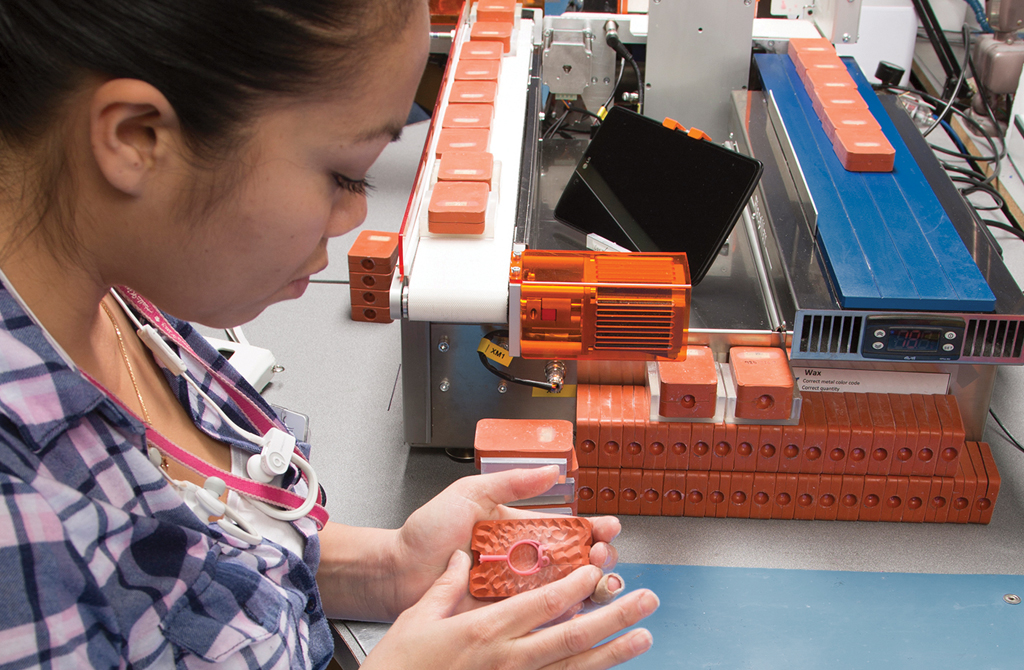
Cross training gives employees a better perspective on what happens upstream from their usual jobs, and how making changes in one place might improve the efficiency in another.
Cross training is invaluable in making improvement suggestions, says Bradford. “The more people you have on your team who have that global view, then you are not alone in offering suggestions on how to improve the process,” says Bradford.
“Everyone has an attitude of awareness,” adds Patrick. “Someone may notice something as they go through the warehouse that maybe the warehouse staff didn’t notice because they’re too close to it.”
While it’s important that staff gives feedback, sometimes it is valuable for the boss or supervisor to actually “do the work with them every once and a while,” says Hill. “In the packing and shipping example, every once in a while, grab a cart and do the work, because you’ll also see where people are struggling.” You may not notice—or be told—that the equipment is failing or has become inappropriate to the work demanded.
At a trade show once, Hill noticed that a staff member “had gear that was inadequate. ‘Why didn’t you tell me?’ I asked. She said she was ‘making do.’”
Involvement all hinges on “effective communication, in big bold letters,” says Bradford. “When things gets quiet, that’s when I get nervous. If people are talking and communicating, that’s when you can make the adjustments.”
Empowerment and Reward
Change is challenging for most of us. “Most people will resist change,” says Laker. “You’re moving people’s cheese all the time, and there are people who don’t do well with that. But you can go a long way to getting people to understand the need for change, and the opportunities in change.”
The first step is to encourage people to make suggestions, and then to acknowledge their ideas and comments, and to consider them.
“Ask, ‘What are you seeing that we can do better?’” says Hill. “Support them when they say they have another idea. If someone brings up a smarter way, the only way you’ll keep them bringing up ideas, is by entertaining the suggestion. Have them describe it, compare it to others, weigh the pros and cons, and make the best decision based on the information.”
She says that some people may question all the “hours we spend entertaining ideas.” But, she asks them in return, “How many hours could we save if just one of those ideas is a game-changer?”
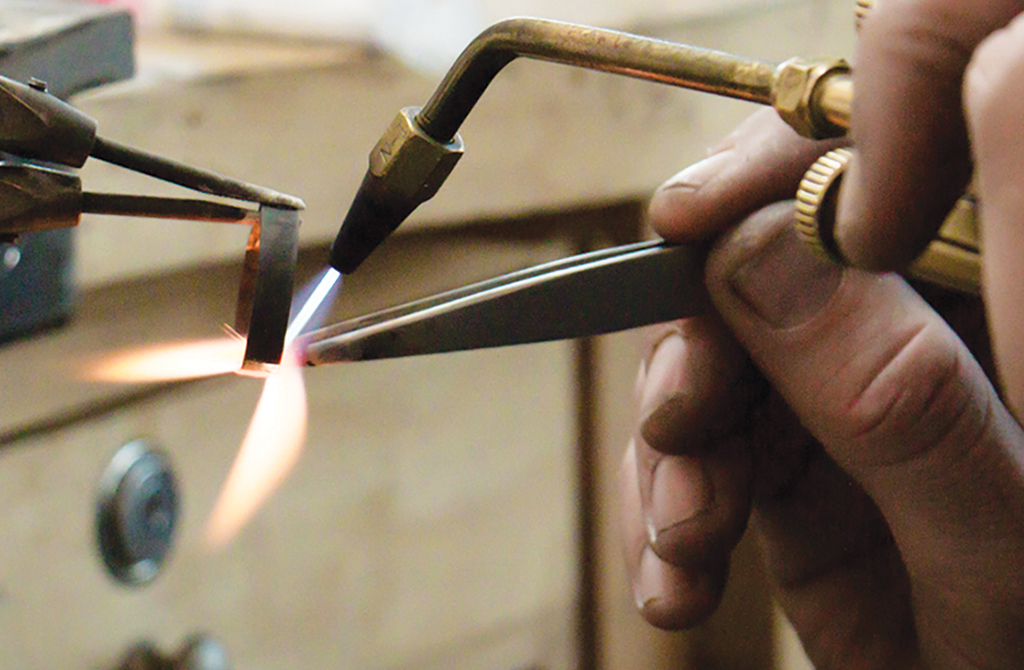
Lashbrook empowers its employees to bring up issues and make changes and then rewards them if their ideas help aid production and are actually put into practice.
Once you empower employees to bring up issues and make changes, says Laker, remunerate your employees appropriately if their ideas help aid production and are actually put into practice. It’s rewarding to be able to have a positive impact on one’s workplace, but financial and other rewards are more concrete ways of showing appreciation. The reward might be as simple as a gift card and parking spot closer to the building. However, says Laker, “If someone comes up with something that results in a $10,000 benefit, and you can give them a $500 bonus, that a great thing.”
At Lashbrook, efficiency is also rewarded with bonuses. “We pay enough in base to get the right people,” says Laker, “then when someone becomes efficient, they are paid a piece-rate bonus on top of that. When they become more efficient, they’re more valuable to us.”
“This isn’t a cheap place to live,” Laker says of the greater Salt Lake area. “We want people to make as much as they can, to be able to support their families, and we want them to be long-term employees. We want to pay them as well as we can.”
It’s a generous practice, but it’s not only the employees who benefit. “We saw a 40 percent increase in productivity based on this system,” says Laker.
Pay Attention to Equipment and Tools
People, of course, are key, but companies need to keep an eye on its tools and equipment, too. “I’ve worked in shops with casting machines that were older than I am,” says Bradford. For the most part, they worked, but they were “wild cards,” he says. “You know that one day it wouldn’t, and Murphy’s law says your equipment will stop working at the most inopportune time.” So, it’s vital to invest in equipment and tools and maintain them.
“I’ve heard horror stories of jewelers who were proud to make a bur last for a year,” says Patrick. “But by investing in a new three-dollar bur, he could have worked faster.”
“It feels inconvenient at the time to stop producing jewelry, and put down the jobs that have deadlines, to check the equipment,” says Bradford. “But you can keep a flex-shaft and casting machine running many years if you keep an eye on it and maintain it regularly.”

“[Streamlining production is] an ongoing process. You are never done.”
—Matthew Laker
Regular maintenance could be as simple as checking the oil in the vacuum pump and keeping the flex-shafts greased. If you’re unsure where to start, refer to the maintenance manuals that came with the equipment or reach out to the equipment manufacturers for cleaning and maintenance guidelines.
“If people don’t take the time to maintain their tools, it takes a toll over the long haul,” says Patrick. “Every week you should take a hard look at your equipment, make sure oil levels are right, that the seals are good.”
And as you do, replace the supplies you need to maintain your equipment, too. Order in new brushes, cables, oil, and seals.
Effect on the Bottom Line
This may seem like a lot of work to make small—or occasionally expensive—changes: changing the wax-injection pressure, moving benches closer together, holding meetings while standing, or investing in a new technology. Is it worth it?
Streamlining production “is the single greatest way, after sales, to keep your company profitable,” says Hill. “Think about the pressures on the bottom line. Sometimes it’s inflation, sometimes it’s competition, or the need to invest in infrastructure and technology. If you just focus on selling, it does bring in new revenue. But increasing efficiency is one of the main ways to increase margins and, therefore, profitability.”
It has certainly been worthwhile for Lashbrook. Their quality improved, their production increased 40 percent, and their profit increased by 5 percent.
And still the changes go on. “It’s an ongoing process,” says Laker. “You are never done.”