

Rina Young’s Ribbon Collar Necklace
Lyrical Moment
Creating flow and movement articulated ain metal
By Tina Snyder
New York City–based designer Rina Young has been designing jewelry for 34 years—and she’s been working with sterling silver wire for as long as she can remember. While she has hand fabricated many smaller jewelry pieces featuring the signature wrapped ribbon pattern shown in this one-of-a-kind brushed sterling silver collar necklace, she had never before created a piece of this scale.
“I wanted to make a lyrical statement piece that captures the moment of a leaf blowing in the wind,” says Young. “Using silver wire, I attempted to re-create that natural flowing pattern in a physical way.”
After sketching a conceptual drawing of the necklace, Young moved to paper to build a prototype. Wrapping strips of card stock and taping them together gave Young an idea of where the curves would go in the piece, but without the weight of the metal, it was a bit tricky to plan for how the necklace would sit on the body.

Rina Young
New York City
To ensure the proper articulation of the piece when worn, Young decided to assemble the necklace in eight parts, starting with the frontmost section and working back. Using a width of 3/8 inch sterling silver wire flattened into a strip, she brush finished the component, then began to curve it. Young elected to use a brushed steel wool finish, which disperses light, giving the necklace a luminous feel.
“You want to start wider at the front, then narrow it as you go back around the collarbone,” she explains. “I’ve done one-of-a-kind pieces with wider wire, and that was too wide for this piece because it has so many elements. I came upon this width of 3/8 inch since it has the durability to sit and not bend while being worn.”
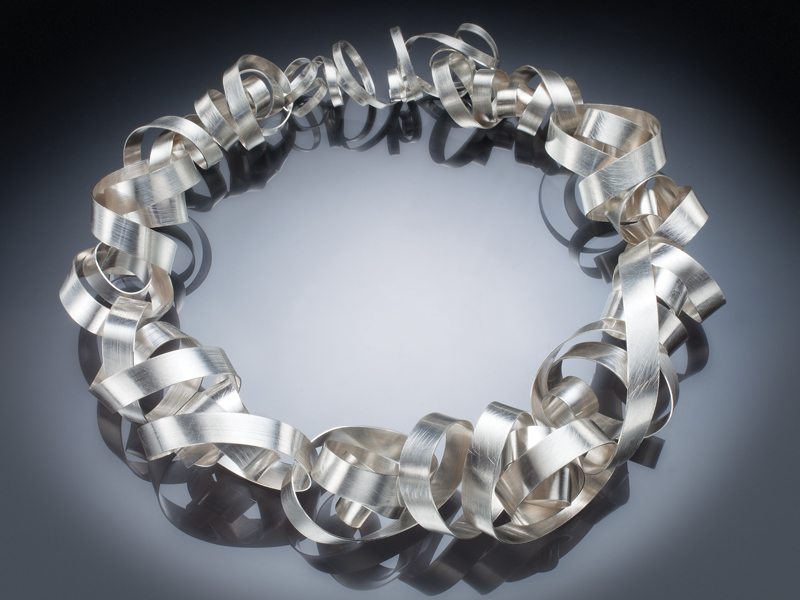
The seamless flow of the necklace is meant to capture the ebb and flow of a leaf blowing in the wind—mere seconds in time articulated in metal.
While shaping the components, Young did not anneal, but rather cold worked each section into shape, work hardening the metal in the process. “You get a few tries before the metal bends out of shape and kinks, and you can’t use that piece because there is a curve that doesn’t work,” she says. “It’s a lot of trial and error. Metal has a physical memory, and you have to work with that. If you bend it the wrong way, you can move it back but it still retains that image of where you bent it.”
For this necklace, the front five sections use 3/8 inch wide wire, the side two sections use 1/4 inch wide wire, and the back section uses 1/8 inch wide wire.
Weaving the sections together is a cumulative process, joining them one at a time while the necklace is built. This requires one very important tool: a mirror. “There is lots of looking in the mirror and trying on the piece as I work, building the sections so they lay comfortably around the neck, with nothing sticking out too much off the body,” Young says. “Each section has to work with the next one in order to create a fluid piece.”
Since there is no solder at all used in the piece and each component simply weaves into the next, Young says the necklace is a design experiment based on form. “You have to make sure there is enough metal weaving from section to section so it won’t come apart while also maintaining the aesthetic of the piece,” she adds.
The clasp in the back is virtually unnoticeable, as it’s simply a smaller curlicue that wraps around the opposite section of wire. The seamless flow of the ribbon is important to the cohesion of the necklace, which Young describes as a “dream piece” that captures the ebb and flow of a leaf blowing in the wind—mere seconds in time articulated in metal.